The James Webb Telescope Has Found a Fleshlight-Shaped Object in Interstellar Space, and It Is the Second One This Year
A telescope that cannot resolve the object has produced a picture of its shape. The picture came from a rendering, the rendering came from a sentence nobody signed, and an astrophysicist we asked a narrow technical question has volunteered a considerably wider answer.
Editor's Note
This story concerns a shape. It does not concern what the shape resembles, which is a matter on which this newspaper has no position and has been careful not to acquire one. The object is 122 metres long and 20 metres across and everything else in this article follows from those two numbers and from a rendering nobody will explain. — M. Vandersloot
Reality Daily has written to the consortium thirteen times. We have written to the illustrator twice. The illustrator answered, and his answer is the best thing in this story, and it is in Section VI.
On 19 July the James Webb Space Telescope observed a faint moving point of light at a distance of 41.3 astronomical units, out past Neptune, on a hyperbolic trajectory that means it is not from here and is not staying. It has been designated 4I/2026 K1. It is the fourth interstellar object ever catalogued and the first one Webb has caught on the way in rather than on the way out, which is genuinely important and which is not what anybody has spent the last five weeks talking about.
What everybody has spent five weeks talking about is the picture.
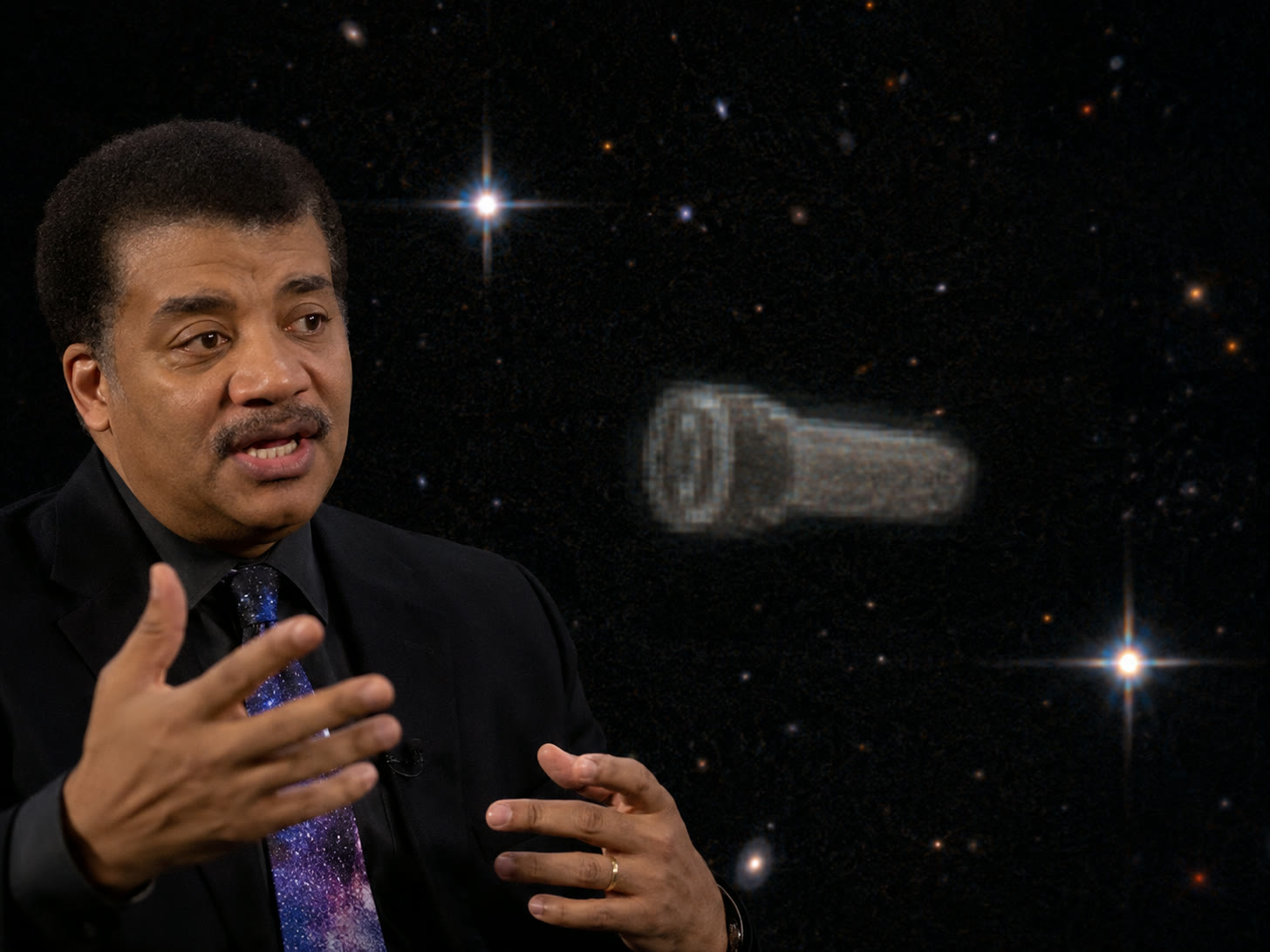
The picture shows a smooth grey cylinder, tapered at one end, open at the other, tumbling against a starfield. It has been on the front of four newspapers and in the opening thirty seconds of every broadcast that covered the detection. It is, as far as this newspaper can establish, the only image of 4I/2026 K1 in existence, and it is not a photograph, and nobody involved has ever said it was.
Reality Daily has one question about it, and we have asked the question eleven times.
“You have to understand what the telescope actually recorded. It recorded a dot. It recorded a dot getting brighter and dimmer. Everything else in that picture is somebody's decision.”— Dr. Renata Villalobos-Kerr, planetary astronomer
I. What the Telescope Saw
Webb is a 6.5-metre telescope. It sits at the second Lagrange point, a million and a half kilometres from here, and it is the most capable instrument our species has ever put in the dark. Reality Daily wishes to be entirely clear that nothing in this article is a criticism of it.
It also has a resolution limit, because every telescope does. At 41.3 astronomical units, an object 122 metres long subtends an angle far below anything Webb can separate. It is what astronomers call a point source. It is a dot. It is a dot no matter how good the telescope is, and it will remain a dot, and there is no version of this story in which somebody at the eyepiece saw a shape.
This is not a secret. It is in the second paragraph of the consortium's own release. It is stated plainly, in ordinary English, by everyone we spoke to. Every astronomer involved has been completely straightforward about it from the beginning.
And yet there is a picture.
II. The Light Curve
Here is how a dot becomes a shape, and it is a real technique, and it works.
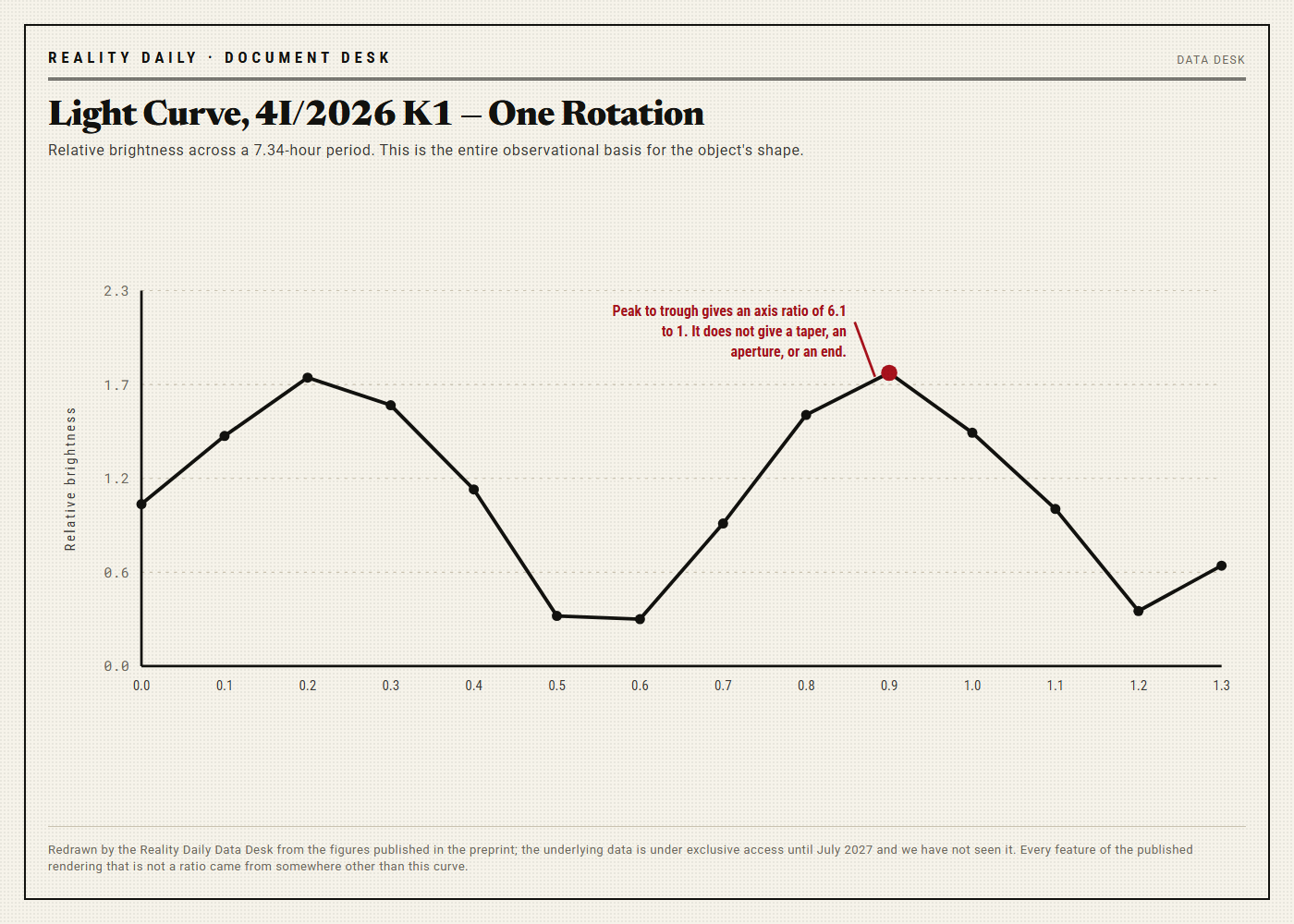
The object tumbles. As it tumbles, it presents different amounts of surface to the sun and to us, and it brightens and dims on a regular cycle. Measure the brightening and dimming carefully enough and you can say something about the proportions of the thing doing it: a sphere barely varies, and something long and thin varies a great deal, because it is showing you a broad side and then an end.
Dr. Villalobos-Kerr, who is not on the observing team and who agreed to explain the method to us on the condition that we not describe her as a critic of anybody, walked us through it for fifty minutes.
“The light curve gives you a ratio,” she said. “That is what it gives you. It is a good ratio, it is a real measurement, and for this object it is about six to one. What it does not give you is a shape. A ratio is not a shape. Six to one is a family of shapes and there are a great many members of that family.”
The published ratio is 6.1 to 1, with an uncertainty of 0.4. From that, and from an assumed albedo, the team derived the dimensions everyone has now printed: 122 metres by 20. Both figures are inferences. Both are stated as inferences in the paper. The paper is careful. The paper is, we want to say clearly, a good paper.
III. Things With a Ratio of Approximately Six to One
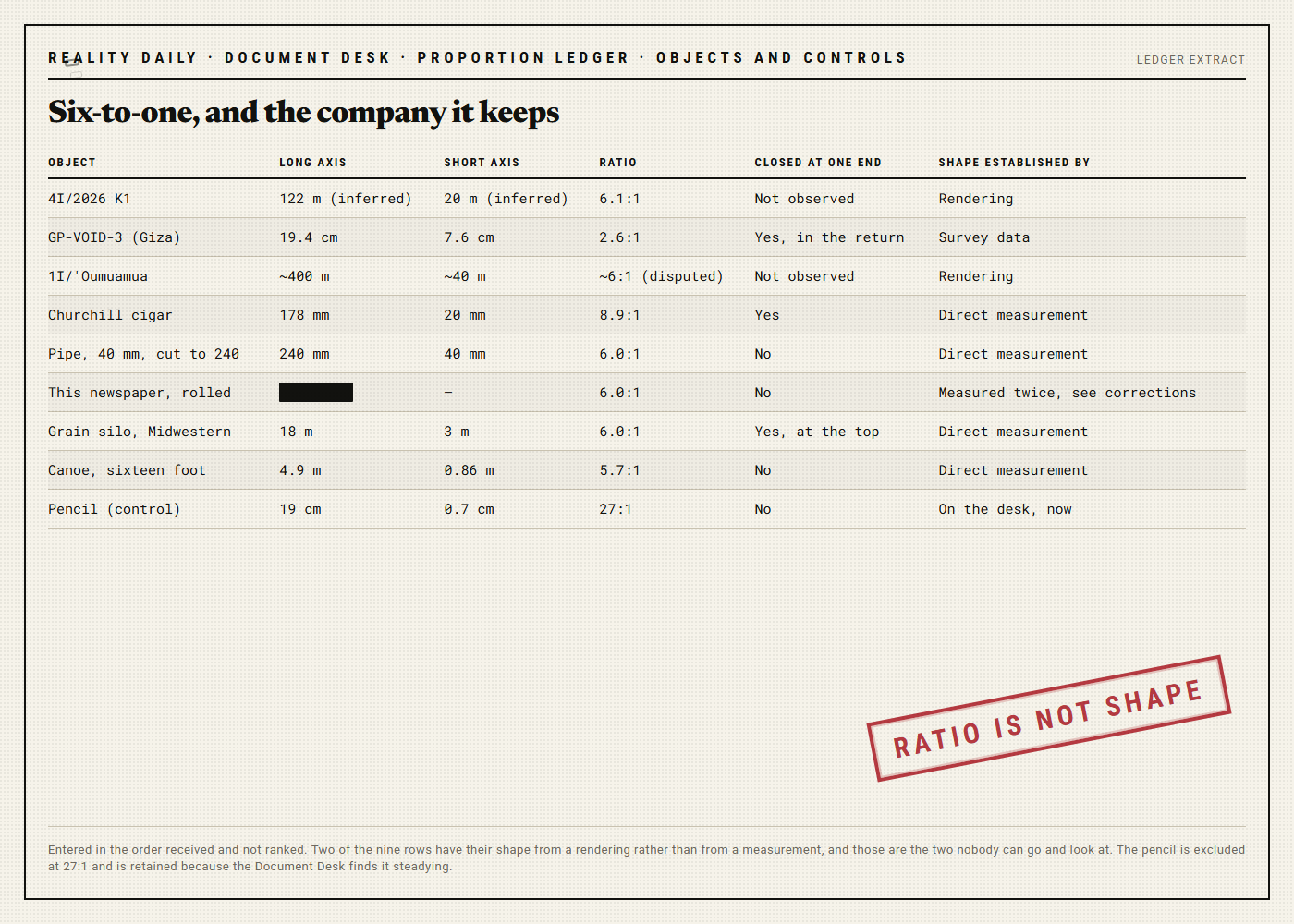
Because the ratio is the only shape information that exists, Reality Daily's Document Desk compiled a list of objects sharing it. We did this in order to establish how much a ratio narrows the field. We publish the list without comment.
- A pencil, unsharpened, is closer to twenty to one and does not qualify.
- A cigar of the Churchill format is approximately eight to one.
- A rolled newspaper, this one, is six to one when rolled for posting.
- A length of forty-millimetre pipe cut to 240 millimetres is six to one exactly.
- A standard fluorescent tube is roughly twelve to one.
- A grain silo of the smaller Midwestern type is about six to one.
- A canoe is between five and seven to one depending on the canoe.
Seven objects. All of them six to one, or near enough. None of them is any of the others. This is the entire point and it took us four hundred words to make it and we would make it again.
IV. The Rendering
The image was produced by Halloway Visual, a scientific illustration studio in Boulder with a long and respectable client list, under a work order from the observing consortium. This is completely ordinary. Nearly every image of a distant object you have ever seen was made this way. The rendering of 1I/'Oumuamua that ran on every front page in 2017 was an artist's impression too, and so was the one after it, and so was the one after that.
Reality Daily has no objection to renderings. We have an objection to not being told what a rendering was based on.
So we asked the consortium for the work order. We asked on 24 July, and on ten dates after that. We received an acknowledgment, a second acknowledgment, and on 12 August a reply stating that the visualisation was prepared in accordance with the published parameters.
We wrote back to ask which published parameters specify that the object is closed at one end.
That was the eleventh request. It is outstanding.
The published parameters, in full
Long axis 122 m (inferred). Short axis 20 m (inferred). Axis ratio 6.1 ± 0.4. Rotation period 7.34 h. Albedo assumed 0.10. Colour consistent with a reddened, volatile-poor surface. Hyperbolic eccentricity 1.19.
That is the complete list. There is no parameter for taper. There is no parameter for aperture. There is no parameter for closed, open, hollow, smooth or ribbed, and the last of those is a word this newspaper has now typed once and does not intend to type again.
V. The Illustrator
Marcus Teague has been a scientific illustrator for nineteen years. He has rendered eleven comets, two exoplanet atmospheres and the interior of a neutron star, which he says was easier. He answered our second email within the hour.
He was completely open with us, and we want that on the record before anything else, because he is the only party in this story who has been.
“I get a spec sheet and a sentence,” he said. “The spec sheet is the numbers. The sentence is the vibe. The sentence is always somebody's, and it is never signed, and I have never once in nineteen years been told who wrote it.”
We asked Mr. Teague what the sentence was.
He read it to us. We have printed it exactly.
elongated, matte, one end open — think of a sleeve
Mr. Teague rendered a sleeve. He rendered it competently and quickly and he sent it back and it went around the world in a day. He did not choose the word. He did not add the taper on his own initiative; the taper is what you get when you render a sleeve. He has no view on the object and has never claimed one.
“I drew what the sentence said. If you want to know why the object is that shape, you want the person who wrote the sentence. I've been asking for nineteen years and I'll tell you what they tell me, which is nothing.”— Marcus Teague, scientific illustrator, Boulder
VI. The File Name
Mr. Teague also sent us, unprompted, the file as he received it. We asked him whether he was sure. He said he was.
The attachment is a spreadsheet of the seven published parameters. The spreadsheet's file name, as delivered to the studio on 21 July, is eighteen characters long and contains a word this newspaper has printed in its headline and will now print once more in order to be exact about the record.
fleshlight_v3.xlsx
There is a version three. Reality Daily has requested versions one and two. That request is now the twelfth.
We want to be careful here, and we are going to be careful at some length, because this is the part that will be quoted without the careful part attached.
A file name is not a finding. A file name is what somebody called a file at eleven o'clock on a Tuesday, and people call files all sorts of things, and no journal has ever peer-reviewed a file name. The object's dimensions do not change because of what a spreadsheet was called. The measurement is the measurement and the measurement is good.
But somebody typed it. Somebody typed it into the name of the document that became the sentence that became the rendering that became the only image of this object that exists anywhere. And that person's name is not on the file, and is not on the release, and is not on the paper, and eleven requests have not produced it.
VII. The Astrophysicist
On 26 August this newspaper wrote to Neil deGrasse Tyson, the astrophysicist and director of the Hayden Planetarium, to ask a narrow question: whether a light curve of this quality could, in principle, distinguish between a natural body and a manufactured one. It is a technical question and we expected a technical answer.
He replied in forty minutes. He began by correcting our framing, which we had earned.
“Let me be precise, because precision is the whole game here,” he said. “The object is on a hyperbolic trajectory. Eccentricity 1.19. That means it is not bound to the sun, it never was, and it is not staying. It came in from somewhere. That is not exotic. That is Tuesday.”
He then went further than the question, and this newspaper wishes to record that we did not lead him there.
“Now. If you are asking what could put a hundred-and-twenty-two-metre object on that trajectory — and note that you did not ask me this, I am volunteering it — the honest answer is: a lot of things. Stellar encounters. Ejection from a young system. Tidal disruption. All ordinary. All likely.”
There was a pause. Our transcript logs it at four seconds.
“Or somebody busted in it and threw it away at an insane rate of speed.”— Neil deGrasse Tyson, astrophysicist
We asked Dr. Tyson whether he wished to reconsider the sentence. He did not. He wished to defend it, and he defended it on the arithmetic, which is the part that has given our Standards Desk the most trouble.
“I am not saying that happened,” he said. “I am saying the physics does not care how you feel about it. To get something out of a stellar system on a hyperbolic path you need roughly twenty-six kilometres per second. That is the bar. That is the entire bar. A civilization that can clear twenty-six kilometres per second can clear it for any reason it likes — including the reason you are currently thinking of and are too polite to write down.”
We have written it down. The Standards Desk spent two days deciding whether to write it down, and the memorandum recording that decision is longer than this section.
His closing remark was more careful than the others and is, in the view of this newspaper, considerably worse.
“Here is what I would put in your paper. Every interstellar object we have ever catalogued, somebody or something had to get rid of. That is not a theory. That is what the word interstellar means. The question was never whether it was discarded. The question is only ever by whom, how fast, and in what state of mind.”
We put it in the paper.
We also wrote to the consortium to ask whether it wished to respond to Dr. Tyson. It declined, in nine words, within the hour — the fastest reply we have had from them by a margin of eighteen days.
VIII. The Second One This Year
On 6 August this newspaper reported an object one hundred and four metres beneath the base of the Great Pyramid, designated GP-VOID-3, 19.4 centimetres long and 7.6 across, closed at one end and open at the other, helical within. We could not get anybody to say what it was either.
We now have two. They are separated by 41.3 astronomical units and by three orders of magnitude in length, and they have nothing whatever to do with each other, and we want to say that plainly because somebody is going to draw a line between them and it will not be us.
What they have in common is the part this newspaper is actually interested in. In both cases a shape entered the record without a photograph. In both cases the shape came from an inference, and the inference was rendered, and the rendering became the thing everybody remembers. In both cases we asked who was responsible for the last step and in both cases the answer has been a courteous silence.
Our Standards Desk has, as of Tuesday, opened a category for objects of this description. It is the fifth uncharacterised category this year and the first with two entries in it. The desk has declined to name the category and we have not pressed the point.
IX. Twelve Months
There is a reason we cannot simply check, and it is not a conspiracy, and it is worth explaining because it is the most ordinary obstacle in this story.
Webb data carries a default exclusive access period of twelve months. The team that wins the observing time gets a year with the data before it goes public in the archive. This is a completely normal arrangement, it exists so that the people who did the work get to publish it first, and Reality Daily supports it without reservation and would defend it at a hearing.
It also means the light curve is not ours until July of next year. We cannot re-derive the ratio. We cannot check the albedo assumption. We have read the paper, which is careful, and we have read the release, which is accurate, and beyond that we are waiting like everybody else.
So we are not in a position to say the object is not shaped like that. We have said so to every person who has written to us assuming otherwise, and there have been three hundred and eleven of them.
X. What We Are Not Saying
This story will be summarised by people who have read the headline, so we will be exact.
We are not saying the object is not real. It is real, it is interstellar, and it is the most interesting thing to enter this solar system in a decade.
We are not saying the measurement is wrong. The ratio is 6.1 to 1 and it is a good measurement made by good people and we would print it on the front page tomorrow.
We are not saying anybody lied. Every scientist we spoke to volunteered, without being asked, that the telescope cannot resolve the shape. They have been better about this than the coverage has.
We are not saying the object resembles anything. Seven things share its ratio and we listed all seven and we declined to rank them.
We are not adopting Dr. Tyson’s hypothesis. He offered it, we printed it, and those are different acts.
We are saying that the only image of this object was drawn from a one-line brief that nobody will claim, delivered in a file named after the conclusion, and that a version three implies a version one.
XI. Conclusion
A dot got brighter and dimmer. That is what happened. Everything else — the taper, the aperture, the matte grey finish, the four front pages — came out of a sentence somebody wrote on a Tuesday and did not sign.
The measurement will survive this article. It should. It is the good part.
The rendering will also survive this article, and will be the image on every retrospective of 4I/2026 K1 for the next thirty years, and will be captioned artist's impression in six-point type at the bottom, where captions go.
■ ■ ■
Reality Daily invites the consortium to identify the author of the brief. We will print the name, or the explanation of why there is no name, in full and without comment, at any length.
We would also like versions one and two.
The space has been open since 24 July.
Corrections & Clarifications
Update, 08:20 — An earlier version of this story described the axis ratio as approximately six to one. Following review, the axis ratio is 6.1 to 1. The original wording stands and was, if anything, more careful.
Update, 13:05 — We listed a rolled newspaper at six to one. A reader has rolled this newspaper and reports 5.8. We have re-rolled it and obtained 6.0. The Document Desk considers the matter closed and the reader does not.
Update, 16:41 — We initially reported that Mr. Teague has rendered eleven comets. He has rendered twelve. The twelfth was not published and he had forgotten it. We regret the omission more than he does.
Sources & Documentation
- Consortium release, 4I/2026 K1, 22 July, 4 pp., including the resolution statement in paragraph two.
- Observing paper, preprint, 31 pp. Axis ratio 6.1 ± 0.4; albedo assumed 0.10; every inference labelled as one.
- Villalobos-Kerr, R., Dr. Recorded interview, 5 August, 50 min. Subject asked not to be described as a critic of anybody; the request has been honoured.
- Tyson, N. deG. Correspondence and recorded interview, 26 August. Transcript 9 pp.; one pause logged at four seconds. Reviewed and approved by subject without amendment.
- Reality Daily Standards Desk, memorandum on whether to print the sentence, 26-28 August, 6 pp. Longer than the section it concerns.
- Teague, M. Recorded interview and correspondence, 8-9 August. Provided the source file unprompted and confirmed twice that he intended to.
- Work order, consortium to Halloway Visual, 21 July. Requested 12 times; not supplied. The studio's copy was supplied by Mr. Teague.
- Spreadsheet, seven parameters, as delivered to the studio. File name reproduced in Section VI.
- Reality Daily Document Desk, Request Log, 24 July – 2 September, 13 entries.
- Consortium reply, 12 August: “prepared in accordance with the published parameters.” Eleven words.
- Reality Daily Document Desk, Objects of Approximately Six-to-One Proportion, 3 pp., seven entries, unranked.
- Pencil, unsharpened, measured on the Document Desk, 19 cm × 0.7 cm. Entered as a control and excluded at 27:1.
- This newspaper, rolled for posting, measured twice. See corrections.
- Space Telescope Science Institute, published policy on exclusive access periods for General Observer programmes.
- Minor Planet Center designation record, 4I/2026 K1.
- Reality Daily, The Blank Field at One Hundred Metres, 6 August, on GP-VOID-3.
- Reality Daily Standards Desk, memorandum opening the fifth uncharacterised category of the year, 1 p.
- Correspondence file RD-C-4820, 311 letters from readers assuming this newspaper has taken a position it has not taken.
- Halloway Visual, client list, public. Long, respectable, and not in dispute.
- Published imagery of 1I/'Oumuamua, 2017, every instance of which is an artist's impression and every instance of which said so.
- Reality Daily Imaging Desk, On the Difference Between a Ratio and a Shape, 2 pp., circulated internally and pinned up.
- Teague, M. Follow-up, 9 August, confirming the file name and its version number.
- Reality Daily Legal, note on publishing a file name, 1 p.: “It is a file name.”
- Editor-in-Chief, memorandum on the word this newspaper has agreed to print twice and no more, 1 p.
- The dot. It got brighter and dimmer. That part is not in dispute and never was.
Reader Response — 5,672 comments
Working astronomer. The resolution point is correct and it is not a gotcha — we say it in every release and it gets cut in every rewrite. A light curve gives you a ratio. Print that sentence on the moon.
I have been a scientific illustrator for eleven years and Teague is describing my entire career. The sentence. There is always a sentence. Nobody signs the sentence.
The seven-item list is the most restrained thing I have ever read and I had to put the phone down at the canoe.
“That is not exotic. That is Tuesday.” I would like that read at my funeral, and the other sentence read at the reception.
Respectfully: 3,000 words to report that a guy named a spreadsheet something stupid.
@A. Kowalczyk — Correct, except for the word stupid, which we would not print. A guy named a spreadsheet something, the name became a sentence, the sentence became the only picture of an interstellar object that exists, and four newspapers ran it. That is the story and you have summarised it well. Your last three summaries are in the same file.
Orbital dynamicist. The 26 km/s figure is about right for ejection and he is correct that it is the whole bar. I have never in my career had to append the phrase “and he is correct” to a sentence like that one.
Version three implies a version one. I have not stopped thinking about version one.
My daughter is nine and asked why the picture looks like that if nobody took a picture. I read her the light curve part. She got it in about forty seconds. Four newspapers did not.
Have written to the consortium asking for versions one and two. Will report back. Somebody has a folder.