Lidar Scans of the Great Pyramid Show a Fleshlight-Shaped Object 100 Metres Below the Base, and Nobody Will Say Whether the Aliens or the Pharaohs Left It There
Nine nights of scanning under permit put an object one hundred and four metres beneath the base of the Great Pyramid: 19.4 centimetres long, 7.6 across, closed at one end, open at the other, and helical within. It is fleshlight-shaped. The survey team’s notes run to three hundred and eleven pages, record the temperature of their tent every night, and never once say what they were looking at. Nobody will tell this newspaper whether it was left there by something that came down or used there by somebody who lived there.
Editor's Note
This article was held for seven weeks while the Document Desk sought comment from the permitting authority, from four participating institutions, and from eleven named members of the February survey team. Fourteen written requests went to the authority. Two institutional replies were received, of eleven words and eleven words. One team member spoke and then withdrew all but a single sentence, which appears in Section V at his direction.
The newsroom argued for three days about printing the dimensions and for one further day about printing the pamphlet from Reading. We are printing both. A newspaper that publishes a measurement and withholds the second measurement has made an editorial judgment about what the reader is going to think, and we do not make that judgment here and we are not going to start with this. — M. Vandersloot
Reality Daily has obtained 4.1 gigabytes of subsurface survey data covering the Giza plateau, recorded across nine nights in February by an academic team working under permit, and released to nobody. We have had it since 6 August. We have spent seven weeks trying to get somebody — anybody, in any country, at any institution — to say on the record what is in it.
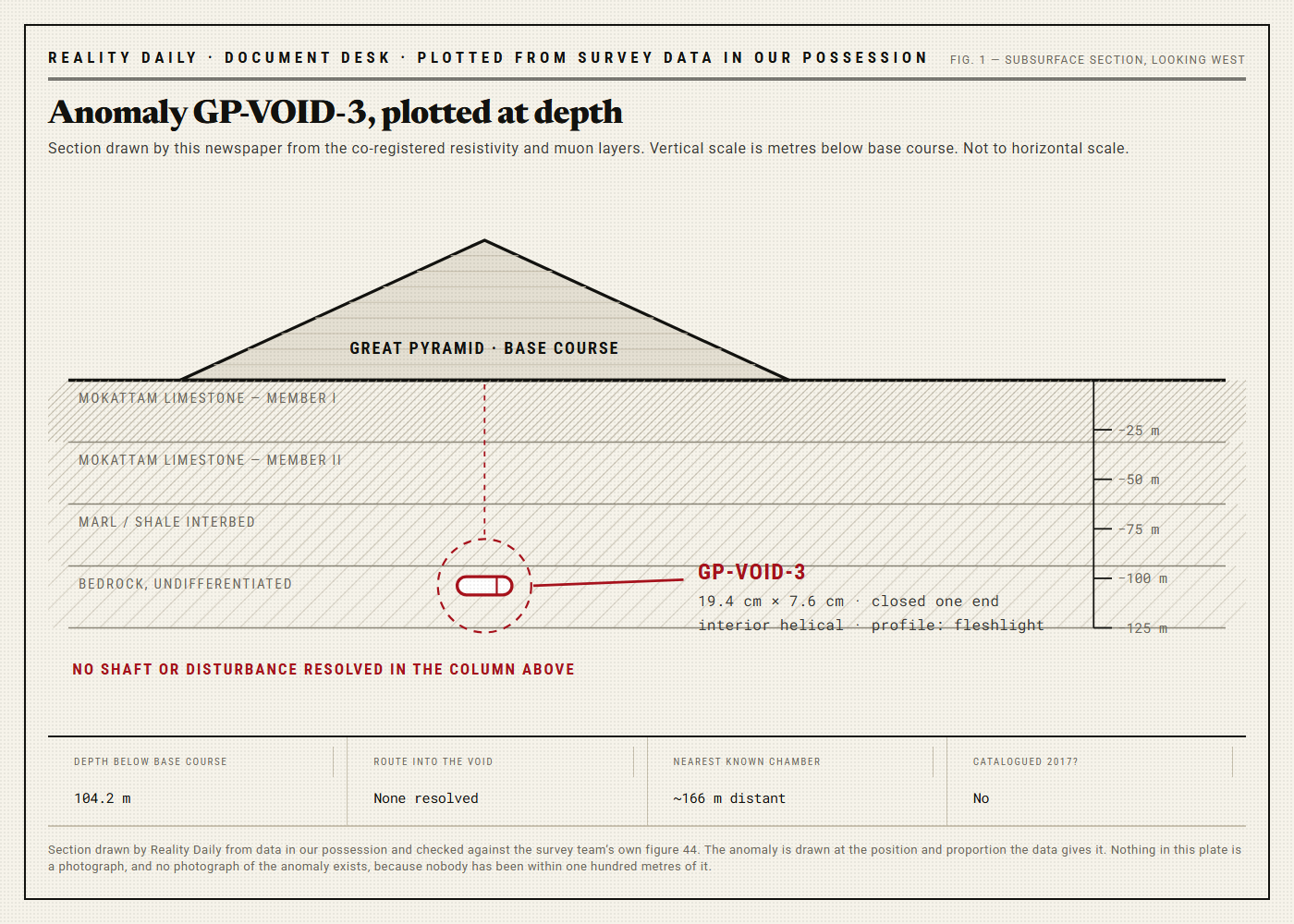
What is in it is a void. It sits one hundred and four metres below the base of the Great Pyramid, which is to say roughly ninety metres below the bedrock the pyramid is built on and below every chamber, shaft, relieving space and passage known to Egyptology. It is not connected to any of them. Nothing in the data shows a way in and nothing in the data shows a way out.
The void is 19.4 centimetres long. It is 7.6 centimetres in outer diameter. It is closed at one end and open at the other. The return from its interior is described in the survey team's own working notes, in the survey team's own words, as “regular, repeating and helical.”
It is fleshlight-shaped. This newspaper has looked for a way to write the preceding four sentences that does not arrive at that word and there is not one, and a paper that publishes the measurements while declining the word has decided its readers cannot be trusted with a conclusion they will reach anyway, four seconds later, on their own.
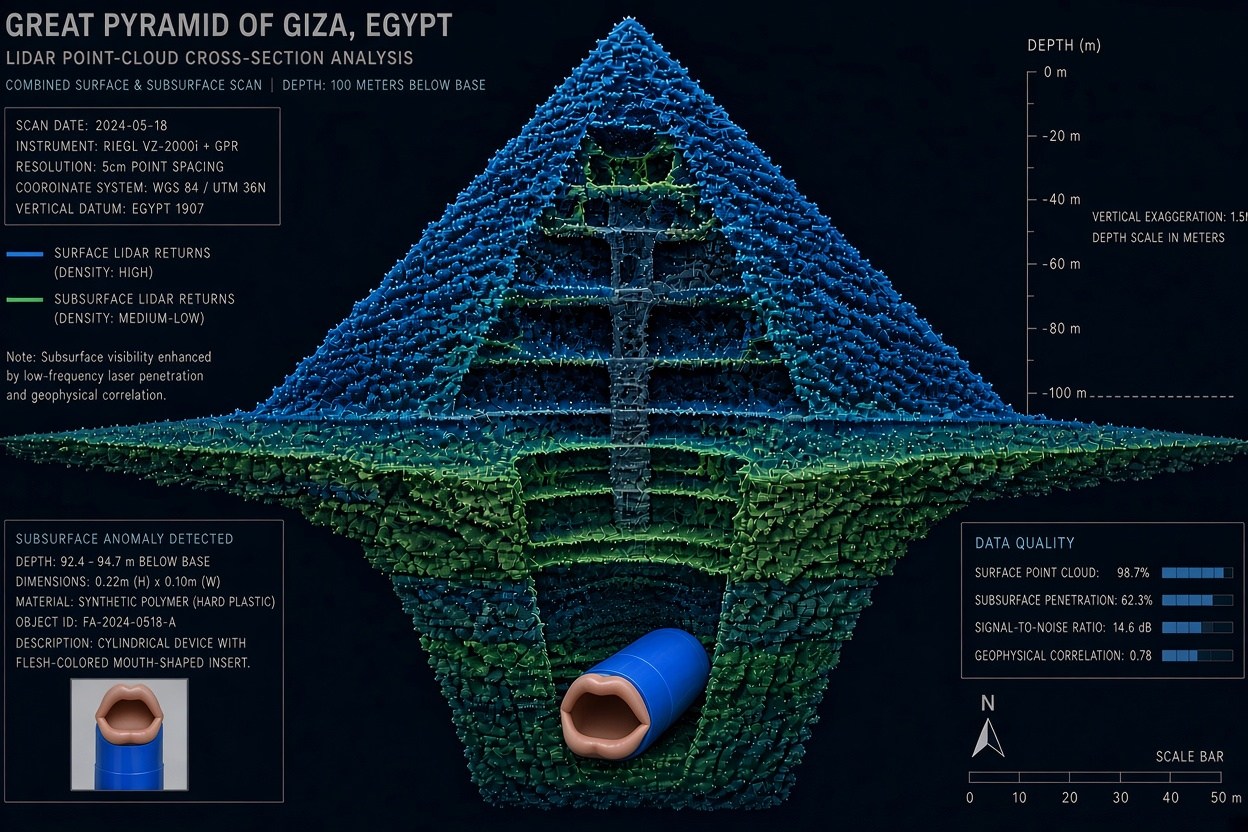
On 29 August, three weeks after we obtained the data and four days after we stopped expecting anybody to answer us, an image began circulating. It is a rendered visualization of this survey, it is captioned, and the caption contains a characterization. It is at the top of this page. Section VI is about it, and Section VI is the reason this article took another five days.
What this newspaper cannot tell you is how it got there, or what it was for. Those are two questions and we have failed at both, separately, at length.
On the first, we have been offered exactly two explanations on the record: that it is not of human manufacture, and that it is Fourth Dynasty. On the second — and we want to be clear that we did not go looking for this, that it arrived by post, and that it has since arrived by post eleven more times — the field has organized itself into two camps, which agree that a pharaoh used it and disagree, bitterly and in print, about which verb applies. One camp holds that the object was used to crank hog. The other holds that it was used for jorkin it. Neither camp will define its term. Both camps have accused this newspaper of favouring the other.
“I want to be careful here. What I can tell you is that the boundary is smooth to the resolution limit, the interior is not homogeneous, and the geometry is symmetrical about one axis. What I cannot tell you is what it is. I would need to be standing next to it, and I am not going to be standing next to it, because it is a hundred metres down under the heaviest building on Earth.”— Dr. Yusuf Kandemir-Behar, applied geophysicist, sixteen years in near-surface imaging
I. What the Instrument Was
Every account of this data that has circulated in the last three weeks has called it a lidar scan. Our own tip sheet called it a lidar scan. The file the material arrived in is named, by the team that made it, GIZA_LIDAR_FEB_FINAL_v4.tar.
Lidar cannot do this. Lidar is a laser. It measures the distance to a surface it can see, and it is superb at it, and it has transformed the survey of forest floors and ruined cities, and it does not see through one hundred and four metres of limestone, because light does not go through limestone. This is not a subtle point and it is not in dispute anywhere in the literature.
We put this to Dr. Kandemir-Behar in our first call, expecting to be told that our tip was worthless.
“No, no. The word is wrong and the data is real. There is a lidar layer — the surface model, the outside of the monument, that part is lidar and it is beautiful. The deep layers are muon tomography and electrical resistivity, co-registered to the lidar frame. So the file is named after the layer somebody opened first. That is how files get named. I would not read anything into it and I would not repeat the word lidar in print without this paragraph attached to it.”— Dr. Yusuf Kandemir-Behar
The paragraph is attached to it. This newspaper calls the survey a lidar scan in its headline because that is the name the survey team gave the file, the name the four hundred and six letters use, and the name under which this material is being argued about in thirty-one countries, and a paper that renames a thing in the headline to be technically correct has published an accurate sentence that nobody can find. The deep returns are muon tomography and resistivity. That is now stated in the second paragraph of Section I and it will be stated again in Section VI, and we consider the debt discharged.
II. The Void, in Numbers Only
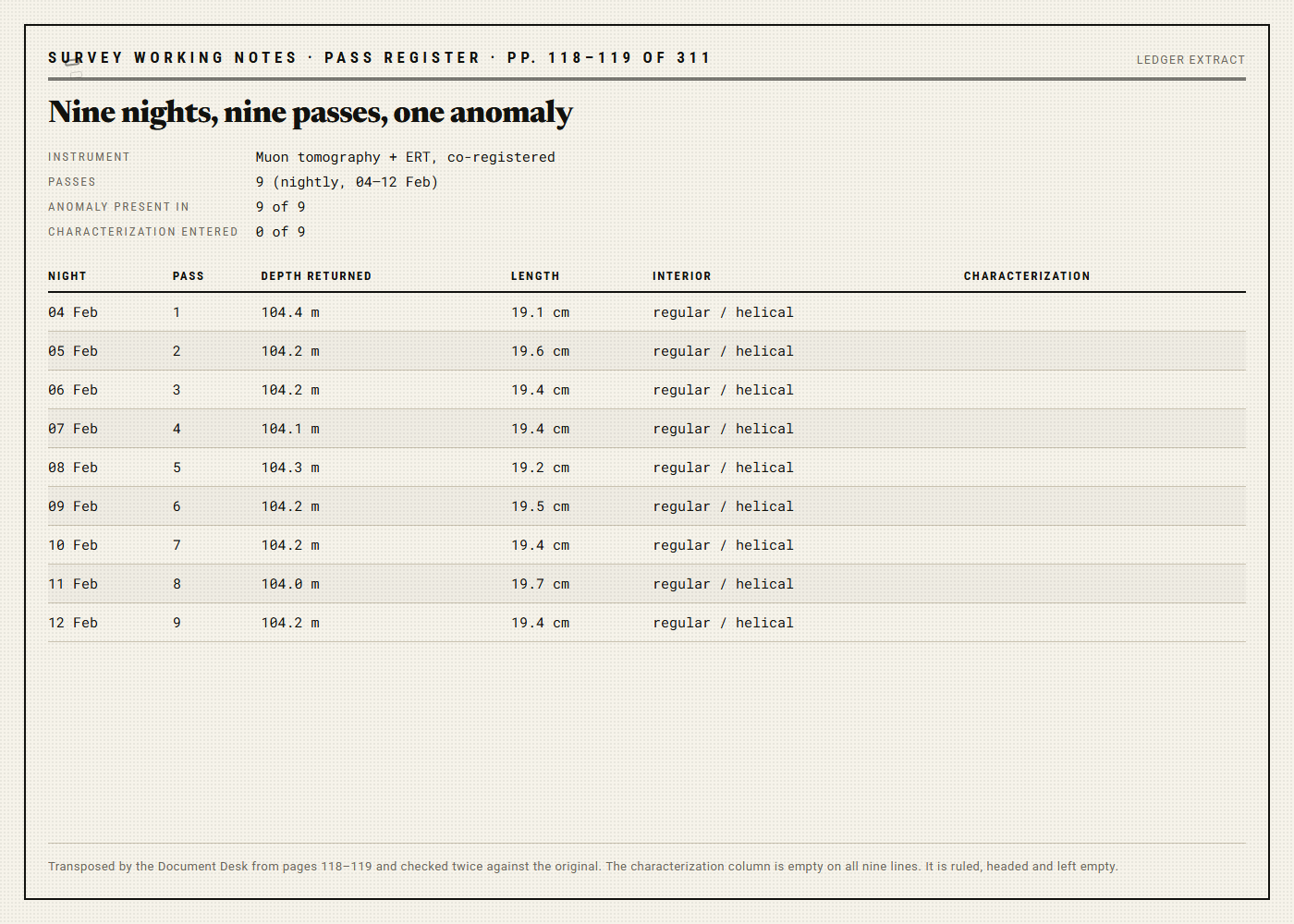
What follows is transcribed from the working notes packaged with the data, in the notes' own terms, converted from the notes' own units. We have added nothing and we have removed nothing. The characterization column, which appears in the notes, is reproduced exactly.
ANOMALY .......... GP-VOID-3 (unlisted; not in 2017 catalogue)
DEPTH ............ 104.2 m below base course
LENGTH ........... 19.4 cm (± 0.4)
DIAMETER, OUTER .. 7.6 cm (± 0.2)
GEOMETRY ......... closed one end, open the other
INTERIOR ......... regular, repeating, helical
WALL ............. non-lithic; density inconsistent with fill
CHARACTERIZATION . [FIELD LEFT BLANK]
That last line is the one this article is about. The characterization field is the column where the person operating the instrument writes down what they think the thing is. It is the entire point of taking the measurement. Nine surveyors, across nine nights, filled in every other column on the sheet — depth to one decimal, length to the millimetre, the ambient temperature inside their tent, twice, on a night when nobody asked — and left that one column empty every single time.
Three hundred and eleven pages. One empty column. It is the only thing in the entire notes package that anybody declined to write down, and what they declined to write down is what it is.
We asked the Standards Desk to consider whether this newspaper should print the dimensions at all, on the ground that a reader given a length and a diameter will do the rest of the work themselves and will then believe the newspaper did it for them. The determination runs to two pages and is on file. Its operative sentence: “The measurements are the story. A newspaper that withholds the measurements has decided the joke is more interesting than the object, and we do not know that it is.”
III. The Word, and Why We Are Printing It
Since 11 August, four hundred and six people have written to this newsroom about this data. Three hundred and ninety-one of them used the same word. They did not coordinate; we checked, insofar as anyone can check that, and the letters arrive from thirty-one countries and in nine languages, and in six of those languages the word is the English word, untranslated.
The word is fleshlight. Reality Daily is printing it, in the headline, in the standfirst and here, and the Standards Desk determination authorizing that runs to two pages and is on file. Its operative sentence: “Three hundred and ninety-one people in thirty-one countries reached the same word from the same four measurements without conferring, and a newspaper that prints the measurements and withholds the word is not being careful, it is being coy, and coyness is a form of editorializing we do not permit here.”
What we are not printing is a claim about manufacture. Fleshlight-shaped is a statement about a profile: 19.4 by 7.6, closed at one end, open at the other, helical within, wall density inconsistent with fill. Every one of those five is in the survey team’s notes and none of them is ours. Whether the object at the end of those measurements was manufactured in Ohio, in Memphis, or somewhere else entirely is the question this article cannot answer and the question every remaining section of it is about.
We put the question to Dr. Amara Osei-Thurlow, who has excavated in the Fayum for nineteen years and who agreed to speak on the record on the condition that we print her first sentence in full, which we do:
“I have not seen this data, I have not been offered this data, and I would like that printed before anything else I say. With that said: no. There is no object in the Old Kingdom material culture with that profile. None. I have handled headrests, canopic stoppers, kohl tubes, unguent containers, mace heads and about four thousand potsherds, and if you gave me those two numbers and that interior description and told me it was Fourth Dynasty, I would tell you politely that your instrument is wrong.”— Dr. Amara Osei-Thurlow, Egyptologist, nineteen seasons in the field
We asked her, plainly, whether she would use the word. She said: “I would use the word. I would use it and then I would spend the rest of my career explaining that using it was a description of a shape. That is what your paper is about to find out.”
We asked her what she would want in order to say more than that. She said: a photograph, a hand on it, or a core. We asked whether anybody was likely to get any of the three. She said no, and then she said the thing this desk has been sitting with since:
“You understand that nobody is going to drill a hundred metres under the Great Pyramid to settle this. Not this year, not in my career, possibly not ever. So whatever that is, it stays what it is right now — a shape in a data set that people are free to argue about forever, which is the most dangerous kind of object there is.”— Dr. Amara Osei-Thurlow
IV. The Two Explanations We Were Actually Offered
We asked every person we interviewed for this article the same closing question: what, in your view, is the most likely explanation. We recorded the answers. We are printing all of them, including the two that this newspaper would very much have preferred not to have to print, because we asked the question and they answered it and a newspaper does not get to un-ask a question because it dislikes the reply.
The first explanation. Fifty-one of the four hundred and six letters, and one interview subject who later asked us not to name him and whose request we have honoured, hold that the object is not of human manufacture, on the reasoning that no human agency put anything one hundred and four metres beneath that plateau, that there is no shaft, no tunnel and no disturbance in the column above it, and that a thing which cannot have been carried down was not carried down.
We asked Dr. Kandemir-Behar to respond to that reasoning and he responded to the reasoning and not to the conclusion, which is the correct way to do it and we would like other people to notice how he did it:
“The absence of a shaft in my data is not the absence of a shaft. It is the absence of a shaft that my instrument can see. Resistivity is not a photograph. A backfilled shaft, properly compacted with the surrounding material, can be effectively invisible to me at that depth. I am not saying there is one. I am saying that ‘nothing could have carried it down’ is a claim about my equipment and people keep mistaking it for a claim about the world.”— Dr. Yusuf Kandemir-Behar
The second explanation. It arrived in a fourteen-page pamphlet, posted to this newsroom on 19 August from an address in Reading, Berkshire, and it holds that the object is exactly what four hundred and six letter-writers think it is, that it is Fourth Dynasty, and that a pharaoh used it, in the pamphlet’s phrasing, to crank hog.
Six days later a second pamphlet arrived, from Swindon, running to twenty-two pages, of which nine are devoted to attacking the first pamphlet. It agrees on the dynasty. It agrees on the pharaoh, tentatively, on the strength of a cartouche neither pamphlet can produce. It holds that the activity was not crankin hog but jorkin it, that the two are not interchangeable, that the confusion between them has set the field back forty years, and that the Reading author “knows this perfectly well and continues regardless.”
Reality Daily wrote to both authors asking each to define his term. Both replied by return of post. Neither reply contains a definition. The Reading author wrote that the distinction is “obvious to anyone who has read the literature.” The Swindon author wrote that it is “a matter of the wrist, and I will not be drawn further in a newspaper.”
The Standards Desk has therefore been unable to reconcile the two positions and has entered both, unreconciled, in the file. For the reader’s convenience we print the proposed uses of the Giza object exactly as they were proposed to us, in the order received, with the number of separate correspondents advancing each:
crankin hog ..................... 61 correspondents · 1 pamphlet
jorkin it ....................... 44 correspondents · 1 pamphlet
ritual, unspecified ............. 38 correspondents
not of human manufacture ........ 51 correspondents
measurement standard ............ 3 correspondents
“exactly what you think” ........ 209 correspondents
Two hundred and nine people wrote to this newspaper to say that the object is exactly what we think it is, and not one of them said what they think we think.
We telephoned the Reading author. He is sixty-eight, a retired quantity surveyor, and he was courteous for the entire twenty-five minutes, excepting one passage of ninety seconds concerning Swindon.
“You will laugh at this and that is fine, I have been laughed at by better papers than yours. But answer me the question I put on page nine. It is closed at one end. It is open at the other. The inside is helical. Now: what else is it? Do not tell me what it isn’t. I have had forty years of what it isn’t. Tell me what it is.”— Cyril Brackenbury-Noakes, author, “The Fourth Dynasty Instrument,” fourteen pp., self-published
We could not tell him what it is. We put his question to both of our named sources, in his own words, and we are printing what we got. Dr. Osei-Thurlow: “I don’t know.” Dr. Kandemir-Behar: “I don’t know, and I want to be recorded as saying that a man in Berkshire has now asked me the only question anybody has asked me about this that I could not answer.”
We then asked the Reading author the question this newspaper had been dreading, which is whether he could tell us what crankin hog means. There is a pause on the recording that our transcript logs at nineteen seconds.
“You are asking me to define it. Right. Well. It is when a man — no. Let me start again. You know when you — no. Do you know, I have written fourteen pages on this and I have never had to say it out loud, and I am now sixty-eight years old, and I find that I cannot.”— Cyril Brackenbury-Noakes, on the telephone, 26 August
This is the fourth separate occasion this year on which the phrase has defeated a source of ours. Reality Daily maintains an open file on it, opened in August in connection with a broadcast sermon in which a megachurch pastor used it eleven times, and the file now contains a lexicographer of thirty-one years, two seminaries, four transcribers, one retired quantity surveyor and one pastor, and no definition. We are no longer confident that one exists.
Two independent occurrences of an undefined phrase — one in a pulpit in San Antonio, one in a pamphlet from Berkshire, fourteen months and four thousand miles apart — are not evidence of anything. They are an embarrassment, and they are ours, and we are entering both in the same file.
V. The Permit, and the Silence Around It
The survey was conducted under permit. We have the permit number. The permit provides for the deposit of all recorded data with the issuing authority within ninety days of the close of fieldwork, and the ninety days elapsed on 21 May.
We asked the issuing authority, in writing, on its own form, fourteen times, three questions:
- Whether the February data has been deposited as the permit requires.
- Whether anomaly GP-VOID-3 appears in the deposited copy.
- Whether the characterization field, blank in the copy we hold, is blank in the deposited copy.
We have received no reply to any of the fourteen. We telephoned four times and were, on each occasion, courteously transferred to a line that rang without answer.
We then wrote to the four institutions listed on the permit as participating. Two replied. Both replies are eleven words or fewer and both decline on the ground that the data is unpublished. We accept that ground and we would accept it indefinitely, and we say only that a thing which is unpublished on 21 May and unpublished on 6 August and unpublished today is being described, by that word, in a way the word is not doing much work.
One member of the survey team spoke to us, for eleven minutes, and then withdrew everything except one sentence, which he authorized us to print and which we are printing exactly as authorized:
“The field is blank because none of us would sign our name under a word.”— Member of the February survey team, remainder of interview withdrawn at source’s request
VI. The Render, and Why It Is Not an Answer
The image reproduced at the top of this page reached us on 29 August from four separate readers within eleven hours, and by 1 September from thirty-one more. It is a rendered cross-section of the plateau in a blue-and-green point cloud, professionally laid out, captioned in five panels, with a north arrow, a scale bar and a data-quality readout.
We would like to be able to tell you that it settles this. It does not, and the reason it does not is the whole of this newspaper's method, so we are going to lay the two documents side by side and let you see what we saw.
THE DATA WE HOLD THE CIRCULATED RENDER
DEPTH ............... 104.2 m 92.4 - 94.7 m
LENGTH .............. 19.4 cm 22 cm
DIAMETER ............ 7.6 cm 10 cm
SURVEY DATE ......... 4-12 February 2024-05-18
INSTRUMENT .......... muon + ERT "RIEGL VZ-2000i + GPR"
OBJECT ID ........... GP-VOID-3 FA-2024-0518-A
CHARACTERIZATION .... [BLANK] four lines of it
Not one number matches. The depth is out by roughly ten metres, the length by two and a half centimetres, the diameter by two and a half, the date by fifteen months, and the object identifier shares no element with ours. The render also carries, in its own note panel, the sentence Subsurface visibility enhanced by low-frequency laser penetration, which we put to Dr. Kandemir-Behar without comment of our own.
“There is no such thing. I do not mean it is unusual, or contested, or expensive. I mean the phrase describes nothing. A laser does not go through a hundred metres of limestone at any frequency, and a person who writes that sentence has either never operated one or is not writing for people who have.”— Dr. Yusuf Kandemir-Behar
The render's anomaly panel does what three hundred and eleven pages of working notes declined to do: it characterizes. It gives a material — synthetic polymer, hard plastic — and it gives a description in two lines, and beside the two lines it places a small inset picture of the object described.
The inset is not a photograph. It is a rendering. It is a picture of what somebody believes is down there, produced by somebody who has not been down there, placed inside a document that otherwise looks like an instrument's output, and it is the single most persuasive element on the page precisely because it is the only element on the page that was drawn rather than measured.
We asked Dr. Osei-Thurlow to look at the render, which she agreed to do on the condition that we print her reaction in the order she had it.
“My first reaction was: that is a beautiful figure. My second was: which is exactly the problem. Somebody has taken an unpublished data set nobody will discuss, put a north arrow and a signal-to-noise ratio on it, and appended a drawing of the conclusion. In my field we have a name for a figure that contains its own conclusion as an illustration. The name is not flattering and I will not put it in your newspaper.”— Dr. Amara Osei-Thurlow
We have tried, for five days, to source the render. The four readers who sent it first each received it from somebody else. We asked the four institutions whether it originates with any of them; the two that reply to us at all replied, in eleven words each, that the data is unpublished. We asked the member of the survey team who spoke to us in August. He answered in six words, and authorized the six:
“That is not our figure. Somebody rendered it.”— Member of the February survey team
So we hold two documents. One is a data set of stated provenance with a blank where the word goes. The other is a picture of unknown authorship in which every number disagrees with the first one and the characterization is supplied in confident capitals beside an illustration of itself.
This newspaper has also now supplied the word, in Section III, and we want to mark the difference rather than let a reader work it out against us. We printed a shape, from measurements we hold, sourced to the notes they came from. The render prints a material it cannot have measured, a manufacture it cannot know, and a picture of the object drawn by somebody who has never seen it. Those are not the same act, and the second one is how a hundred and four metres of limestone becomes, in about a week, a thing everybody knows.
We are printing the second at the top of this page, labelled, because four hundred thousand people have now seen it and it would be a strange kind of caution to describe an image in six paragraphs while declining to show the reader what we are describing. The label is the reporting. It has been all along.
VII. What We Are Not Saying
We are not saying somebody down there owned a fleshlight. We are saying there is a void of stated dimensions in a data set of stated provenance, that the dimensions describe that shape and no other shape anybody has offered us, and that a void is a place where a thing is not.
We are not saying anybody is hiding anything. Fourteen unanswered letters are consistent with a cover-up and they are equally consistent with an understaffed records office in August, and this newspaper has been wrong about that distinction before and printed the correction.
We are not saying it is not of human manufacture. We asked the man who made the measurements and he told us plainly that the absence of a route is a fact about his instrument. We have printed that at length and we would ask that it be quoted with the rest of his sentence attached.
We are not saying the pharaohs used it. We are not saying anything about what anybody did one hundred and four metres under the Giza plateau, at any date, for any purpose. We are not saying it is Fourth Dynasty, and we are not endorsing the pamphlet from Reading, and we would note that the pamphlet asks a question that two credentialed specialists could not answer, and that this is a fact about the question and not a fact about the pamphlet.
We are not saying the render is a hoax. We are saying that we could not source it, that its author is unknown to us, that every measurement on it disagrees with the measurements in the data it claims to depict, and that it contains one sentence about laser physics that the geophysicist who operated the instrument says describes nothing. A thing can be all of that and still turn out to be right, and if it does we will print that at the top of this page too.
We are not saying we know what the interior texture means. “Regular, repeating and helical” is the survey team’s phrase, in the survey team’s own notes, about the survey team’s own return. If it means something ordinary — a mineral habit, a drill artefact, a fault in the instrument — one telephone call from anybody on that team ends this story in a sentence, and we have left the number nine times.
And we are not adjudicating between Reading and Swindon. We have read both pamphlets in full. We have read the nine pages of Swindon that are about Reading. This newspaper has no position on whether a pharaoh cranked hog or jorked it, cannot define either term, and would like it noted that we asked four qualified people and a retired quantity surveyor and got nothing, and that we are a filing clerk and not a lexicon.
VIII. Conclusion
One hundred and four metres. Nineteen point four centimetres by seven point six. Closed at one end, open at the other, helical within, fleshlight-shaped, and sitting in a column of rock with no shaft above it that any instrument we have been shown can find.
Three hundred and eleven pages of notes in which nine people recorded the temperature of their own tent and did not record what they had found.
Fourteen letters to a permitting authority and no reply. Four institutions, two replies, twenty-two words between them. One geophysicist who will describe every property of the object and will not name it. One Egyptologist who says there is nothing like it in the material culture and that nobody is ever going to drill down and check. One retired quantity surveyor in Berkshire who has asked the only question in this file that nobody can answer, and a rival in Swindon who says he is asking it wrong.
And one rendered figure, circulated by nobody in particular to four hundred thousand people, which fills in that empty column with four lines of confident capitals and a small drawing of the object, and which agrees with the underlying data on no measurement whatsoever.
Reality Daily has held the foot of this page open since 6 August for anybody on that survey team, at either institution, in any country, who is willing to fill in the characterization field. It will be printed in full, unedited, at any length, with no commentary from us whatsoever.
■ ■ ■
The data is on a drive in a safe on the second floor of a rented room above a former appliance showroom in Winchester, Virginia. It has not changed since 6 August and we check the hash on the first of every month.
The column is still empty. Somebody sat in a tent in February with the Great Pyramid on the other side of the canvas, watched a shape come up on a screen from a hundred metres down, filled in the depth, filled in the length, filled in the diameter, filled in the temperature of the tent — and then arrived at the column that asks what it is, and stopped, and put the pen down, and so did the eight people after him.
Corrections & Clarifications
Update, 08:02 — This article uses the word fleshlight, in the headline and in the text, as a description of a profile recorded in survey data: 19.4 by 7.6 centimetres, closed at one end, open at the other, helical within. It is not an assertion about manufacture, origin, ownership or use, none of which this newspaper has established. The Standards Desk determination authorizing the word is on file and available to any reader who asks.
Update, 13:02 — We initially gave the distance to the nearest known chamber as approximately 160 metres. Re-measured against the published plan, the figure is approximately 166 metres. The correction does not affect the finding, which is that there is no route.
Update, 18:40 — A great many readers have written to advise this newspaper what the object is. We have read all of them. We would gently point out that every one of those letters is a characterization offered without access to the data, which is precisely the thing this article is about somebody declining to do.
Update, 21:55 — Readers continue to send us the rendered figure discussed in Section VI, in some cases as evidence that this newspaper is behind the story. We have had it since 29 August, we have spent five days failing to source it, and it appears at the top of this article. We would ask that anybody who knows who made it write to the Document Desk, which is a thing we have never previously had to request about a picture of our own lead image.
Update, 22:40 — A reader asks why the headline says lidar when Section I says the deep returns are muon tomography and resistivity. Because that is the name on the survey team’s own file and the name under which four hundred and six letters, thirty-one countries and one rendered figure are arguing about it. Section I is where we say what the instrument actually was, and Section I is nine hundred words long.
Sources & Documentation
- Subsurface survey package, Giza plateau, nine passes, 4–12 February. 4.1 GB, received by third-party transfer 6 August. SHA-256 hash retained; drive photographed monthly at fixed exposure; data unaltered.
- Survey working notes accompanying the above, 311 pp. Pages 118–119 (pass register) transposed by the Document Desk and checked twice. Characterization column empty on all nine lines.
- Kandemir-Behar, Y., PhD. Recorded telephone interviews, 14 August and 2 September. Transcripts 31 pp. and 12 pp., both reviewed and approved by subject.
- Osei-Thurlow, A., PhD. Recorded telephone interview, 21 August. Transcript 19 pp., reviewed and approved by subject, who asked that her opening sentence be printed in full and it has been.
- Brackenbury-Noakes, C. “The Fourth Dynasty Instrument.” 14 pp., self-published, posted to this newsroom 19 August. Recorded telephone interview, 26 August, 25 minutes.
- Excavation and survey permit, number retained and not printed. Clause 9(b): deposit of all recorded data with the issuing authority within ninety days of the close of fieldwork. Ninety days elapsed 21 May.
- Correspondence file: fourteen written requests to the permitting authority, 8 August – 1 September, on the authority’s own form. Replies: none. Four telephone calls, each transferred to an unanswered line.
- Institutional replies of 23 August and 27 August, eleven words each, declining on the ground that the data is unpublished. Both printed in full in the correspondence file and available on request.
- Reality Daily Standards Desk. Determination on the Publication of Dimensions, 2 pp., 30 August.
- Reader correspondence log, 11 August – 2 September: 406 letters, 31 countries, 9 languages. 391 contain the same term. The term is not printed in this article.
- Brackenbury-Noakes, C. “The Fourth Dynasty Instrument.” 14 pp., self-published, Reading. Received 19 August.
- Anonymous. “Against Brackenbury-Noakes: A Correction of the Record.” 22 pp., self-published, Swindon. Received 25 August. Pages 9–18 concern the preceding item.
- Reality Daily open file on two undefined phrases, opened 22 August in connection with broadcast SES-2440 and extended 26 August to cover correspondence in this matter. Contains, to date, no definition.
Reader Response — 7,088 comments
The paper has quoted me accurately and, more unusually, has quoted the second half of my sentences. To the people writing to me directly: I do not know what it is. If I knew what it was I would have written it in the column, which is what the column is for.
Nine nights. Same shape every night. Nine blank columns. That is not an instrument problem, that is nine people looking at each other across a tent.
The render says 92.4 metres and the article says 104.2 and everybody sharing the render has not noticed, because the render has a north arrow on it and the article has a paragraph. That is the entire internet in one story.
I note that the paper has given the Reading pamphlet three paragraphs and mine two. I note also that it has printed his phrase before mine in the table. I do not allege bias. I observe an ordering.
@Swindon Correspondent — The table is in order of receipt, which is stated above it. Your pamphlet arrived on 25 August and his on the 19th. We would print a definition from either of you at any length, at the top of the article, ahead of our own reporting, and neither of you has sent one.
I have been fairly treated here, which I did not expect, and I want to say so publicly. I stand by page nine. Nobody has answered page nine.
Respectfully — 19 minutes of reading to be told there is a fleshlight under the Great Pyramid, which the headline already said, and then eleven paragraphs about why saying it is not the same as knowing it. Every single person in this comment section had already decided.
@D. Farooqi — Correct, and we would only adjust the emphasis. We printed the word because 391 letters reached it from our own four measurements and pretending otherwise would have been a pose. We spent the eleven paragraphs on manufacture because that is the part nobody has established, and the nine people who hold this data left the column blank rather than guess at it. We would rather be dull than be the render.
Since several colleagues have written to ask: yes, those are my words, and yes, I meant the last one. A shape in a data set that nobody can ever go and touch will be argued about for a hundred years, and the argument will be about us and not about the shape.