BJJ Social Media Posts Linked With Accelerated Technical Development
Public BJJ documentation and accelerated technical development. From the International Journal of Combat Sports Behavioral Science, Vol. 14, Issue 3, July 2026.
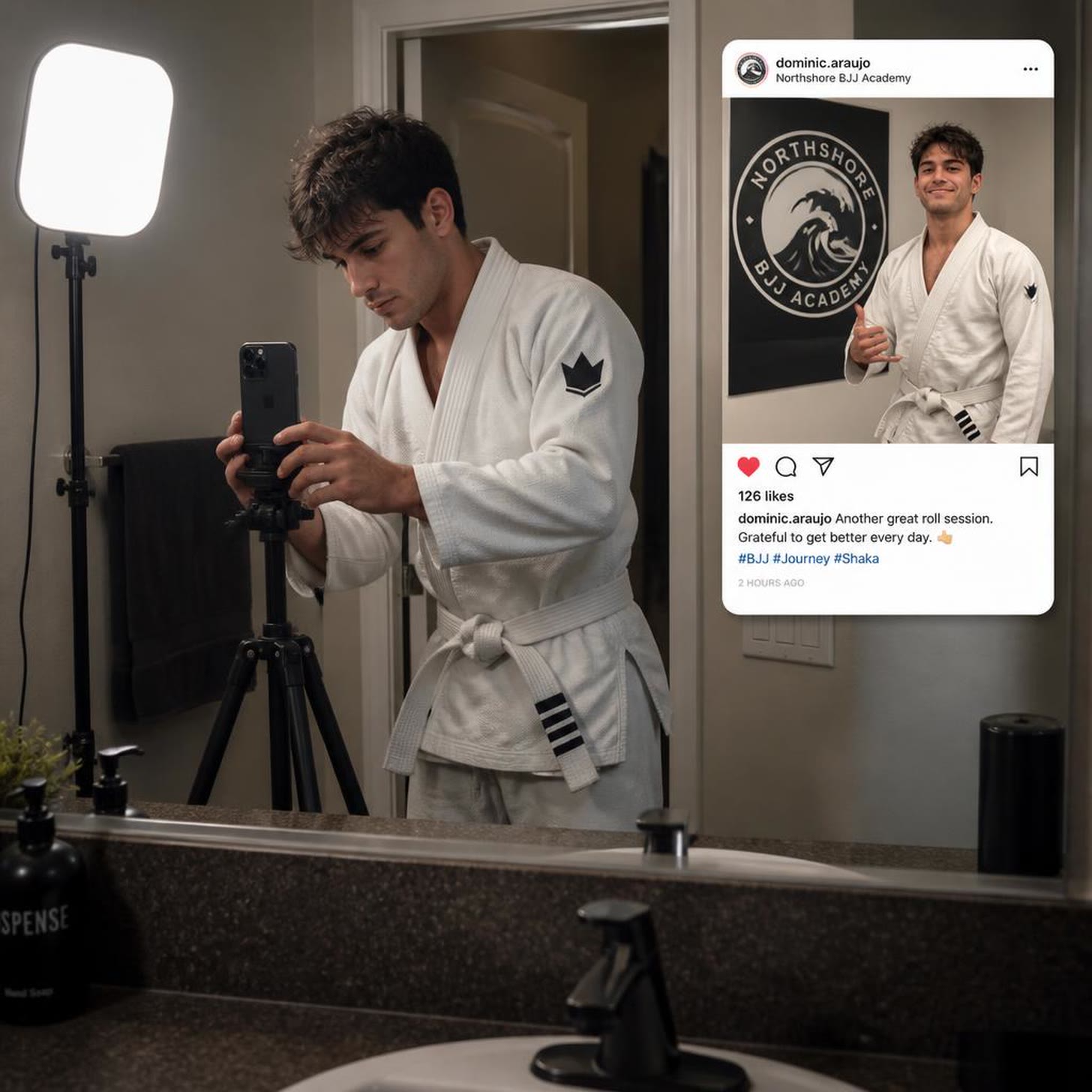
Abstract
Brazilian Jiu-Jitsu practitioners increasingly document their training on Facebook, Instagram and other social media platforms. This study examined whether publicly announcing one’s participation in BJJ is associated with accelerated technical development and faster belt progression. Researchers followed 412 practitioners for 24 months and found that highly active social media users progressed significantly faster than those who trained without publicly documenting their activities.
The findings suggest that telling people you train BJJ may, in fact, make you better at BJJ. Researchers have designated the phenomenon Public Commitment-Induced Grappling Adaptation, or PCIGA.
Introduction
BJJ progression has traditionally been attributed to training frequency, instruction, recovery and technical practice (Marchetti, 2019). Modern practitioners have introduced another potential variable: telling everyone about it.
A typical training session may now consist of training, taking a photograph, posting the photograph, receiving likes, training again, posting about the improvement, getting promoted and posting the promotion photograph. Prior work has established that likes function as a reliable reward signal (Kowalczyk & Amani, 2025). Researchers wanted to determine whether this cycle actually contributes to performance.
Methodology
Researchers followed 412 BJJ practitioners across 27 academies for two years, dividing them into four groups by how often they posted about their training and recording the average interval between promotions for each.
| Group | BJJ posts per month | Average promotion interval |
|---|---|---|
| Digitally Silent | 0–1 | 14.2 months |
| Casual | 2–5 | 12.8 months |
| Active | 6–15 | 11.3 months |
| Highly Documented | 16+ | 9.7 months |
The results were statistically significant. Practitioners who posted frequently about BJJ were promoted approximately 32 percent faster than those who maintained a digitally silent training profile.
Results
The strongest correlation was observed among practitioners who regularly posted:
- Training photographs
- Competition announcements
- Technique videos
- Belt promotions
- Inspirational captions
- Statements involving “the grind”
- Photographs of themselves looking exhausted after training
Highly documented practitioners also reported substantially greater confidence. Researchers noted, however, that increases in confidence occasionally preceded measurable increases in technical ability. This phenomenon has been designated Premature Black Belt Syndrome.
The Facebook Belt Clock
Researchers identified an additional psychological mechanism following belt promotions. Once a practitioner publicly announces a new stripe, an unofficial countdown begins, and each month without another stripe increases the pressure of maintaining the appearance of continued progress, a pattern first described among adult blue belts (Albuquerque & Hensley, 2023).
At approximately month 11, practitioners were significantly more likely to post statements such as “Enjoying the journey.” Researchers believe this may represent an adaptive coping mechanism.
Discussion
The study does not suggest that posting an Instagram Reel of an armbar directly improves the armbar. Rather, researchers believe public documentation creates social accountability, consistent with earlier findings on publicly declared fitness goals (Delacroix-Byrne et al., 2024). Once an individual has publicly established themselves as Someone Who Trains BJJ, failing to train becomes psychologically more difficult.
In this sense, social media may function as a low-grade performance-enhancing substance. It does not make you stronger. It simply makes more people aware that you’re supposed to be getting stronger.
Limitations
The study relied partially on self-reported data, which presented challenges. BJJ practitioners demonstrated a well-documented tendency to overestimate their technical understanding immediately after watching an instructional video (Ferreira, 2022).
Researchers also could not determine whether frequent posting caused increased training, or whether people who train more are simply more likely to post about it. Further research is required, preferably with more Instagram data.
Conclusion
Publicly documenting BJJ participation is strongly associated with faster progression, increased training adherence and elevated confidence. The mechanism remains unclear. It may involve accountability, positive reinforcement, or simply the uncomfortable realization that approximately 600 people now know you said you were “all in” this year.
Regardless, researchers recommend that practitioners seeking accelerated development maintain a consistent public record of their training. Three posts per week appear sufficient. More research is needed to determine whether additional posting produces additional technical benefits.
Researchers are currently investigating whether changing one’s profile picture to a gi photograph has any measurable effect on guard retention (Nakamura-Holt, in preparation).
Corrections & Clarifications
Sources & Documentation
- Albuquerque, T., & Hensley, M. (2023). Stripe anxiety and the eleven-month plateau: A longitudinal survey of adult blue belts. Journal of Applied Mat Psychology, 9(2), 114–131.
- Delacroix-Byrne, S., Okafor, J., & Lindqvist, P. (2024). Public goal declaration and exercise adherence: Evidence from 3,000 New Year’s resolutions. Behavioral Commitment Review, 17(4), 301–318.
- Ferreira, L. (2022). The instructional-video confidence gap: Self-rated technical understanding before and after 40 minutes of online content. International Journal of Combat Sports Behavioral Science, 10(1), 55–71.
- Kowalczyk, D., & Amani, F. (2025). Likes as reinforcement: Reward response to engagement on post-training photographs. Journal of Digital Athletics, 3(2), 88–97.
- Marchetti, G. (2019). Belt inflation in the franchise era. Martial Arts Economics, 12(3), 207–225.
- Nakamura-Holt, E. (in preparation). Gi imagery in profile photographs and perceived guard retention: A pilot study (n = 14).