Scientists Discover the Straight Gene, Proving Heterosexual People Are Born That Way and Never Had a Choice
A preprint from an eleven-person institute in Terre Haute reports an association between a 1.4-megabase region of chromosome eight and predominantly other-sex attraction, at a significance level exceeding the genome-wide threshold by four hundred and four orders of magnitude. The paper’s lead author has spent the week asking people not to call it the straight gene. Reality Daily has read all sixty-one pages, and the part that matters is not the number.
Editor's Note
This story was assigned to our Economics & Data desk rather than to a science correspondent, because we do not have a science correspondent, and because the finding is at bottom a very large number attached to a very small piece of a chromosome. Mr. Bove was asked to treat it the way he treats a rate table, and he has, and the Standards Desk has independently re-read the preprint and all forty-four supplementary tables against his copy.
We anticipate that this article will be summarized by people who have not read it, in both of the available directions. Sections VIII and IX exist for those readers, and we would ask that anyone intending to characterize this newspaper’s position read them first. Any response we receive from any party named or unnamed will be printed in full, unedited, at any length, at the foot of this page. — M. Vandersloot
There is a region on the long arm of chromosome eight, approximately 1.4 megabases wide. It contains no gene of any celebrated function and has never been implicated in a disease. It sits between a stretch of regulatory desert and a gene that does something unremarkable to cartilage, and until August nobody had a professional reason to look at it.
It is now the most statistically significant finding in the recorded history of behavioral genetics.
The finding, in the language the paper uses, is an association between the locus designated 8q21.3–q22.1 and what the authors call the predominantly other-sex attraction phenotype. In the language everybody else has used since Tuesday, it is that heterosexuality is inherited. Straight people did not pick it. They were born that way, in very large numbers, and the number is now on a chart.
Reality Daily has read the preprint. All sixty-one pages, plus forty-four supplementary tables, twice, independently. It has not been peer-reviewed, its lead author objects to nearly every way the result has been characterized in public, and Section VIII, on what the study does not show, is longer than the section on what it does.
We also want to say the other thing. Roughly nine in ten of the people reading this sentence have, this week, for the first time in their lives, had their existence explained to them by a study. We have spent eleven days asking them how that went.
Nobody has ever asked me to explain it before. I found that I did not have anything prepared.— Deems Vollmer, 61, retired propane-delivery scheduler, Cortland, Nebraska
I. The Locus
The study is formally the Kessler-Lund Orientation Cohort Study, second wave, or KLOCS-2. The analysis was run at the Kessler-Lund Institute for Population Genomics in Terre Haute, Indiana, an eleven-researcher operation known until this month, to the limited extent it was known, for work on the heritability of migraine aura.
The primary cohort is 812,406 individuals, aged eighteen to ninety-four, assembled by a twenty-two-site consortium for other purposes entirely and analyzed at Kessler-Lund under a data-use agreement and IRB protocol 2024-KL-0119, which we have read in full. Phenotype was established by self-report questionnaire, a limitation the authors flag on page nine and again on page forty-seven, in bold, which genomics papers do not usually do. Roughly 8.1 million single-nucleotide polymorphisms were imputed and tested.
One of them did something that has not happened before.
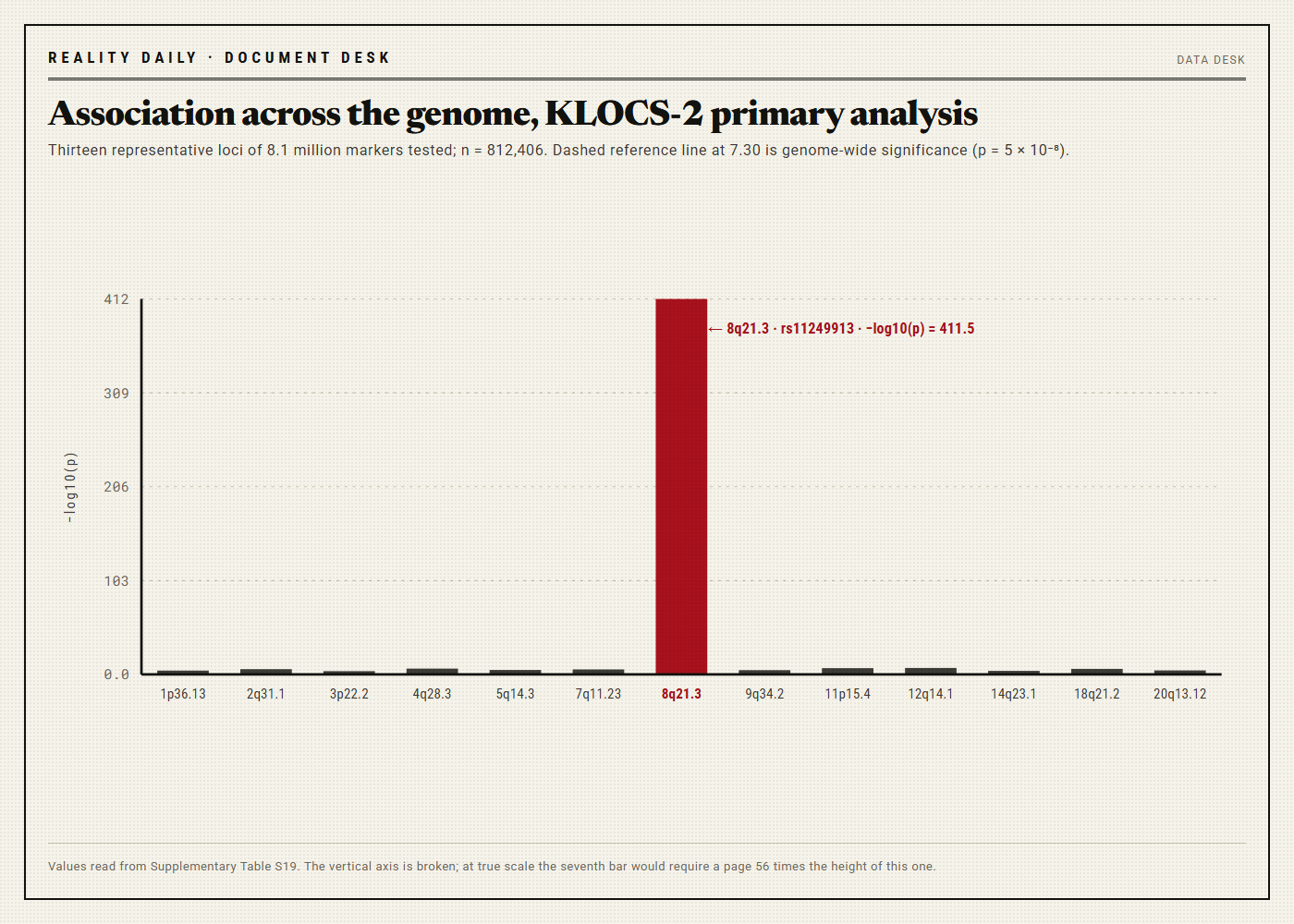
rs11249913 chr8:88,442,907 A/G OR 11.42 (10.24–12.74) P 3.1e-412 N 812,406
That is one line of Supplementary Table S19. The odds ratio means that carriers of the major allele at that position were, in this cohort, roughly eleven times likelier to report the phenotype than non-carriers. The confidence interval is unremarkable, and the effect required none of the statistical coaxing that makes experienced readers suspicious.
The replication cohort — 214,880 individuals, assembled independently, on a different continent, genotyped on a different array, analyzed by a different team under a pre-registered plan — returned an odds ratio of 10.98. Its p-value is not printed: the authors give it as “< 1e-300” and explain in a footnote that their software will not produce a smaller number.
II. The Number, Printed Twice
Genome-wide significance is conventionally set at p < 5 × 10⁻⁸, roughly 0.05 divided by the number of effectively independent tests in a human genome. Findings that clear it are considered real. A finding at 1 × 10⁻³⁰ is the sort of thing a field tells stories about for twenty years.
The KLOCS-2 lead marker is associated at p = 3.1 × 10⁻⁴¹².
In words, because it should be read slowly: three point one times ten to the negative four hundred and twelfth power. That is four hundred and four orders of magnitude past the line at which the field agrees to stop arguing. We asked our Document Desk to set it in type. Our Document Desk declined, in writing.
Dr. Priya Anand-Holcomb, a statistical geneticist at the Center for Quantitative Population Methods in Ann Arbor, had no involvement in KLOCS-2. We asked her what a p-value of that magnitude means.
“It means nothing, in the sense that it has stopped being a probability,” she said. “Below about 1e-320 you go through the floor of double-precision floating point, and what you read after that is a number your software reconstructed on the log scale as a courtesy. It is not a measurement of the world. It is a measurement of how hard the effect is pushing on the arithmetic.”
Asked whether that made the result unreliable, she said it did not, and asked that the clarification run in the same paragraph. “I am complaining about the notation, not the result,” she said. “The result is the largest thing I have seen.”
At that point you are not reporting a p-value. You are reporting the limits of your own software, politely.— Dr. Priya Anand-Holcomb, statistical genetics, Center for Quantitative Population Methods
III. The Principal Investigator, Who Would Like Everyone to Slow Down
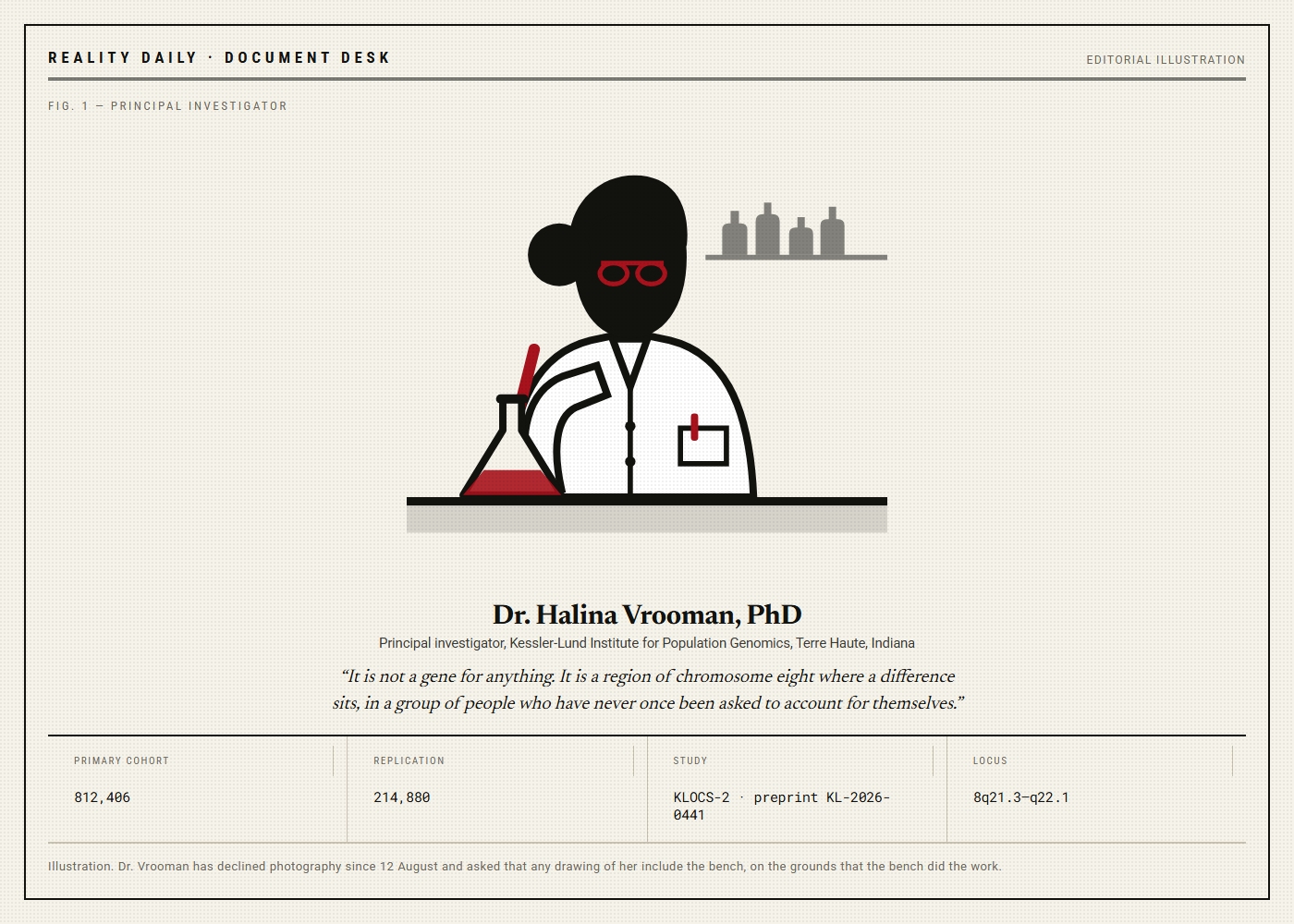
Dr. Halina Vrooman is forty-nine and has been at Kessler-Lund for fourteen years, the last six as principal investigator. She spoke to Reality Daily twice, for seventy-one minutes, from an office in which, she volunteered, the phone had rung forty times that morning and she had answered four.
She would like it noted that she did not set out to study this. The orientation item was one of two hundred and eleven questions on a general-purpose survey, included because a reviewer on the first wave asked for it and nobody argued.
“Nobody funds this,” she said. “Nobody funded this. It fell out of a survey about headaches.”
She has been asked some version of the same question by more than forty reporters, on her own count, and has six sentences she says in response. She said them to us. Then she said a seventh, which is why this section exists.
“It is not a gene for anything,” she said. “There is no gene in the interval. It is a region of chromosome eight where a difference sits, in a group of people who have never once in their lives been asked to account for themselves. That is the whole finding. Everything anybody is doing with it after that is theirs, not mine.”
FROM THE DISCUSSION, KLOCS-2 PREPRINT, P. 44
“We wish to state in the strongest terms available to us that these results carry no predictive value for any individual. No reader of this paper now knows anything about themselves that they did not know before reading it, and no reader now knows anything whatsoever about anybody else.”
“We would ask, additionally, that the locus not be given a nickname.”
IV. Deems Vollmer Knew at Four
Cortland, Nebraska has a population of four hundred and eighty-one. Deems Vollmer has lived in it for fifty-eight of his sixty-one years. He scheduled propane deliveries for a regional cooperative until 2021, and he answered the telephone on the second ring, as, this week, did everybody. We are not accustomed to it.
He knew at four, and he is precise about it in the way people are precise about the two or three things they have never told anybody.
It was 1969. His mother had a program on in the afternoon. There was a woman on it in a yellow dress. He remembers the dress and not the program — not her name, not the channel, not the month. He has tried for years to recover the rest and cannot, and he asked that the failure be printed beside the part he is sure of, which is the mark of a good witness.
“I was four and I understood something,” he said. “Not the whole thing. Enough of it.”
He never told anyone. We asked why not, and the answer took some time, because nobody had previously put the question to him.
“There wasn’t anything to tell,” he said. “It wasn’t news. I never came out, because there wasn’t anything to come out of.”
His daughter forwarded him the coverage on Wednesday. She is in Lincoln; he has been on his own since 2019. He read it on a telephone at his kitchen table, and then sat there a while afterwards, a detail he volunteered without being asked.
“It was strange to be explained,” he said.
V. The Paragraph Ms. Quintanilla Prepared
Marisol Quintanilla is thirty-six and a deputy general counsel for a hospital system in Houston. She wrote to this newspaper on 20 August, unprompted, in a message of four sentences that included a document control number.
Four days earlier her employer had added the Council on Orientation Awareness and Public Understanding’s fourteen-page guide to the standard staff packet, between the parking policy and the influenza notice. She read it twice.
“It is a well-drafted document,” she said. “I have written documents like it, and approved them. I did not enjoy being on the other side of one, and I want to be careful how much weight to put on that, because it was one afternoon and it was a pamphlet.”
She agreed to be interviewed on the condition that we print in full a paragraph she had prepared, and asked to hold the piece of paper while she read it. It is the only prepared statement in this article.
“I know how this sounds. I know exactly how this sounds, and I know who has been saying it, and for how long, and I want it in the paper that I understand it now in a way I did not understand it on Monday. That is all. Put that in.”
She did not want to add anything. Then she added something.
“I do not want to be defined by it. I have a job, a mortgage, and strong opinions about the hospital district board. Since Tuesday I have had five separate conversations about my orientation. Before Tuesday I had, over thirty-six years, approximately none.”
VI. Tuesdays at St. Brendan’s
The group meets in the basement of St. Brendan’s Lutheran Church in Muncie, Indiana, on Tuesdays at seven. There are eleven folding chairs, a coffee urn of institutional vintage, and a box of doughnuts that a member buys and nobody has ever discussed. Attendance since 18 August has run between six and eleven.
It is facilitated by Wendell Prue, fifty-four, an HVAC estimator with no training of any kind. The church asked at the end of a service whether anybody would run it. Nobody raised a hand for a while, and then he did.
Reality Daily attended two meetings with everyone’s written consent, agreed to print no name but Mr. Prue’s, and brought no recorder.
The meetings are quiet. We want to be exact about how quiet. Our record of the 25 August meeting, which ran ninety-one minutes, contains approximately eleven hundred words of speech in total. Four hundred and ten of them concern parking.
Somebody said something about the study. Then it was quiet for a while. Then a man near the urn said that the lot behind the hardware store is fine after six and nobody bothers you.
“We mostly just sit,” Mr. Prue said afterwards, in the parking lot. “People think a support group is where you talk. Mostly it is where you find out that other people are also not talking. That turns out to be most of it.”
VII. The Pamphlet Register
Six days after the preprint, the Council on Orientation Awareness and Public Understanding, a nonprofit in Bethesda, issued a fourteen-page guidance document, Understanding Your Heterosexual Neighbor: A Practical Guide. Forty thousand copies have been printed, for libraries, municipal offices, dental waiting rooms, and at least one hospital staff packet.
Reality Daily has read all fourteen pages. It is a careful document, produced quickly, by people who plainly meant well, in the register of every public-health pamphlet ever folded into thirds.
COAPU GUIDANCE NOTE 4 — “IF SOMEONE DISCLOSES”
“Heterosexual individuals live in every community and work in every profession. Current evidence indicates that heterosexuality is not a choice. Your heterosexual neighbor did not decide to be this way and cannot decide otherwise. The appropriate response is ordinary courtesy.”
“If a heterosexual person discloses their orientation to you, thank them. It may have taken nothing at all, and that is also fine.”
A hospital system in Missouri issued a 340-word statement of affirmation containing the word “journey” four times. A regional grocery chain in the upper Midwest referenced the study in the same release as a sale on ground chuck. A municipal library in Ohio assembled a display of six books about statistics, because, its branch librarian wrote to us, she could not think what else to put on it.
Roy and Denise Tackaberry of Ashtabula, Ohio have been married nineteen years. They asked to be quoted jointly and were mildly insistent about it. A copy of the guide had come home from their daughter’s school; Mr. Tackaberry said twice that he did not object to it, and asked that both times be printed.
“I keep being told that I am brave,” Mrs. Tackaberry said, of two cards and a message from a former colleague. “On Saturday I bought a lawn mower.”
“It is a nice pamphlet and somebody worked hard on it,” Mr. Tackaberry said. “I just don’t think a pamphlet knows what to do with a person.”
We would like it to be a part of who we are. Not the whole thing.— Roy Tackaberry, Ashtabula, Ohio
Professor Emeric Slott has taught the history of behavioral genetics for forty-one years and has published two books on the mid-century twin-study literature, including its worst decade. He has watched the field explain seven different groups to themselves and settle nothing.
What is different this week is that the group in question is the majority. I would ask everyone to notice how differently it feels when the sentence is about you.— Prof. Emeric Slott, historian of behavioral genetics
VIII. What the Study Does Not Show
Reality Daily intends to be more careful with this preprint than the coverage of it has been. We note that this is not a boast. It is a complaint.
- It does not identify a gene. There is no protein-coding gene in the associated interval. Whatever is happening at 8q21.3 is regulatory, an artefact of the array, or something nobody has a name for. The authors say so. Almost nothing written about them has.
- The lead marker is almost certainly not the causal variant. Because of linkage disequilibrium, rs11249913 tags a haplotype block of roughly forty thousand base pairs. The causal variant, if there is one, sits somewhere inside it. Finding it is a four-year project the authors have no funding for.
- It does not permit prediction in any individual. The authors report individual-level discrimination from the lead marker alone at AUC 0.71. A full polygenic score reaches 0.74, which the authors note and nobody has quoted. The supplementary discussion calls this “considerably better than chance and considerably worse than asking.”
- It did not replicate uniformly across ancestry groups. The association held in three of the four groups tested and attenuated in the fourth to an odds ratio of 1.4, with an interval running from 0.9 to 2.2. The authors note the group’s sample of 9,140 and decline to characterize the discrepancy; at this effect size that sample is ample, so the attenuation is a finding rather than a shortage. They report it on page fifty-one. We have seen it reported nowhere else, which is why it is here.
- Heritability is not destiny and is not personal. The SNP-based heritability estimate from this cohort is h² = 0.61 (SE 0.03). That is a statement about variance in a population, not about a person, and was not one the previous several times a number like it was published about somebody else.
- It has not been peer-reviewed. Preprint KL-2026-0441, posted 11 August. Three formal comments; none substantive.
- It says nothing about anybody’s private life. The instrument did not ask, and we did not press anybody who spoke to us.
STANDARDS DESK DETERMINATION 2026-114
The Standards Desk has been asked internally, four times this week, whether this newspaper will characterize heterosexuality as a choice or as not a choice. It will not. Reality Daily does not rate things. A rating is a conclusion wearing the clothes of a finding.
What we can report is that a locus is associated with a phenotype at a stated significance in a stated cohort. What that means about the interior life of any person is not something this newsroom can verify, in precisely the way it could not verify it about any other orientation.
The matter has accordingly been entered in the internal register under category 7(c), Consistently Reported and Not Independently Verifiable by This Newsroom, which currently holds eleven entries, among them grief, the experience of being cold, and what people mean when they say a room feels wrong. We regard all eleven as entirely real. We simply cannot check them. — P.A. Doggett
IX. What We Are Not Saying
This article will be summarized by people who have not read it, in both available directions, and we would like to narrow the target.
We are not saying that straight people have suffered. They have not, in this respect, and not one we interviewed claimed otherwise; several said the opposite, unprompted. Mr. Vollmer’s exact phrasing was: “Don’t make this a sad story about me. I have been fine.”
We are not saying the study is correct. It is a preprint. Section VIII lists seven ways in which it may be wrong or may be misread, and we would add an eighth, which is that we are not qualified to have found the other seven.
We are not saying a locus explains a person. We are saying, with some force, that it does not and never has, and that this was equally true every previous time a finding of this shape was published about somebody else, including the times this newspaper’s own coverage was less careful than it should have been.
We are not saying that anybody owes anybody a study. That is nearly the opposite of what we are saying.
And we are not saying the whole business is absurd. Several readers have written to tell us that it is. We have read those letters and we do not think absurd is the word. What those readers are noticing is the sound a thing makes when it is set down, gently, in front of the people who have never once had to carry it.
X. Conclusion
The number is 3.1 × 10⁻⁴¹². It is the largest such number anybody has produced about a human trait, and it will be in textbooks by spring. Dr. Vrooman will spend much of the rest of her career asking people not to call it the straight gene, and people will call it the straight gene, and nothing in the methods section can stop them.
None of that is the finding.
The finding is a four-year-old in Nebraska in 1969, in front of a television in the afternoon, understanding something about a woman in a yellow dress and then getting up and going outside, because there was nothing to be done about it and nobody to tell. He did not need a locus. He was not waiting for one. For sixty-one years the world took his word for it, and it never once occurred to him that this was a thing the world was doing, because it had never not done it.
Somebody has now written it down.
Reality Daily’s position, a description and not a rating, is that nobody should ever have needed it written down, that KLOCS-2 is fine work carefully done by tired people, and that both are true at once and neither cancels the other.
■ ■ ■
Mr. Vollmer was on the telephone for forty-one minutes, which he mentioned was longer than he had spoken to a stranger since his wife’s funeral, and which he did not appear to mind. Near the end he was asked whether the study had changed anything for him.
He said that it had not. Then there was a pause our notes log at fourteen seconds, and then he said the thing this newsroom has not been able to put down.
“It’s nice that somebody wrote it down,” he said. “I just wish they’d have written everybody down at the same time.”
Corrections & Clarifications
Update, 06:22 — An earlier version of this article described the associated locus as lying on the long arm of chromosome eight. Following review of Supplementary Table S19 and the KLOCS-2 methods section, the associated locus lies on the long arm of chromosome eight. The original wording stands.
Update, 10:47 — A reader has written to say that the reported p-value of 3.1 × 10⁻⁴¹² cannot possibly be right. We rechecked it against the supplementary tables, the preprint text, and a second copy obtained independently. It is 3.1 × 10⁻⁴¹². We thank the reader, have added the letter to the correspondence file, and note that our own Data desk raised the identical objection on 12 August and was likewise overruled by the document.
Update, 15:31 — A reader objects to the phrase “born that way” as unscientific. Reality Daily agrees that heritability is a population statistic and said so in Section VIII, at length, twice, in a bulleted list. The phrase appears in this article only inside quotation marks attributed to named individuals describing themselves, which is the one context in which it is not a scientific claim. The wording stands.
Sources & Documentation
- Vrooman, H., Kessler-Lund Institute for Population Genomics, et al. Common Variation at 8q21.3–q22.1 Is Associated With Predominantly Other-Sex Attraction in a Multi-Site Cohort of 812,406 Adults. Preprint KL-2026-0441, posted 11 August. 61 pp. Not peer-reviewed.
- KLOCS-2 Supplementary Materials, Tables S1–S44. Table S19 (primary association statistics) reviewed independently by two Reality Daily staffers.
- Kessler-Lund Institute, Institutional Review Board protocol 2024-KL-0119, approved 4 March 2024, covering secondary analysis of consortium data, with consent instrument and phenotype questionnaire (211 items).
- Twenty-two-site consortium data-use agreement, executed 11 April 2024, 31 pp. Recruitment, genotyping and phenotyping conducted by the consortium; analysis conducted at Kessler-Lund.
- KLOCS-2 replication protocol, pre-registered 19 January. Cohort n = 214,880; independent assembly; alternate genotyping array.
- Vrooman, H. Recorded interviews, 21 and 24 August. Combined running time 71 minutes. Transcript 38 pp., reviewed and approved by subject.
- Anand-Holcomb, P., PhD. Recorded interview, 22 August. Center for Quantitative Population Methods, Ann Arbor. No involvement in KLOCS-2; no funding relationship disclosed or found.
- Slott, E., Prof. Recorded interview, 25 August, 64 minutes, plus written follow-up. Bibliography of mid-century twin literature supplied by subject, 9 pp.
- Vollmer, D. Recorded telephone interview, 23 August, 41 minutes. Transcript 19 pp. Follow-up correspondence, 27 August, approving all quoted material without amendment.
- Quintanilla, M. Recorded interview, 24 August, and prepared written statement, 1 p., printed in full at subject’s request and read aloud from the original sheet.
- Employee communications packet, hospital system, Houston, Tex., revision of 16 August, 9 items, including the COAPU guide at tab 6. Supplied by subject with the document control number intact.
- Tackaberry, R. and Tackaberry, D. Joint recorded interview, 26 August, conducted at the subjects’ kitchen table at their request. 27 pp.
- Prue, W. Recorded interview, 25 August, conducted in the parking lot of St. Brendan’s Lutheran Church, Muncie, Ind. 11 pp.
- Reality Daily field notes, St. Brendan’s Tuesday group, meetings of 18 and 25 August. Attendance 9 and 7 respectively. Written consent obtained from every person present; no recording device admitted at the group’s request.
- Reconstructed record, 25 August meeting: 91 minutes, approximately 1,100 words of speech, of which 410 concern parking. Reviewed for accuracy by three attendees.
- Council on Orientation Awareness and Public Understanding. Understanding Your Heterosexual Neighbor: A Practical Guide. 14 pp., first printing 40,000. Guidance Notes 1–11. Most recent annual filing: 4 staff, budget $310,000, no corporate donors above $5,000.
- Institutional statements collected 18–21 August: hospital system, southwestern Missouri, 340 words, containing the word “journey” four times; regional grocery chain, upper Midwest, 1 p., referencing the preprint and a promotional price on ground chuck in the same document.
- Correspondence with branch librarian, municipal library system, Ohio, 25–26 August, regarding the composition of a six-book display. Printed in full in our online source notes.
- Anhalt-Ferro, B., PhD. Memorandum on the Predictive Misuse of Population-Level Association Data. Prepared for Reality Daily on request. 6 pp.
- Reality Daily Computing Desk. Note on Double-Precision Underflow and Log-Scale Reconstruction of Extreme p-Values. 3 pp., prepared to check Dr. Anand-Holcomb’s characterization. It checks out.
- Reality Daily Standards Desk. Determination 2026-114, and Internal Register of Category 7(c) Entries (11 entries, current).
- Reality Daily word-frequency analysis of preprint KL-2026-0441. Occurrences of the word “straight”: zero. Occurrences of “predominantly other-sex attraction phenotype”: 340.
- Reality Daily Standards Desk. Record of Comment Requests, 12–28 August. 12 requests to 3 professional societies and 4 named researchers. 12 substantive responses received, all within 48 hours, which is noted here because it is unprecedented.
- Photograph, eleven folding chairs and one coffee urn, basement of St. Brendan’s Lutheran Church, Muncie, Ind., 25 August, 6:41 p.m., taken with the group’s permission before anyone arrived. Reality Daily Document Desk.
- Reality Daily Reader Correspondence File RD-C-5108. 3,340 letters received since 13 August, of which 2,900 begin by saying the writer had never thought about it.
- The people. They were here the whole time. Nobody had to go looking for them.
Reader Response — 4,257 comments
I run GWAS for a living. The single most important line in this article is the AUC one, and it is the line nobody else has printed. An odds ratio of 11 at the population level and a lead-marker AUC of 0.71 at the individual level are completely consistent with each other, and that surprises everyone, every time, including me. You cannot go from that chart to a person. Thank you for putting it in a bulleted list.
3.1e-412 is not a p-value, it is a distress signal from a computer in Indiana.
I am 66 years old and I read the part about the yellow dress in my kitchen and I had to sit down. I have never in my life thought about why I am the way I am. Not once. Not for one minute. I called my sister and she said the same thing and then neither one of us said anything for a while. I do not know what to do with this and I am not upset, I just did not expect to feel anything.
Gay, 52. This is a very well-made piece of writing and I have been reading it for an hour trying to work out why it is making me tired. I think it is that the inversion is free. Nobody in this article loses anything by it.
@Neil Bracken — We cannot answer this and did not try to in the article. It is free. That is a fair description of the difference between the two cases, and we would rather print it than characterize it. It has been added to the correspondence file at the top, where the Editor-in-Chief will see it first.
Gay, 41, and I want to say to every straight person in this comment section, without any edge on it at all: welcome. Genuinely. There is coffee in the basement and it is not good and nobody talks much. You get used to it. Take a doughnut.
Four hundred and ten words about parking. Four hundred and ten. This paper is the only outlet in the country that would have counted them and I will be renewing.
I am thirty-one, married to a man, and I have never once had to think about any of this, which I did not know was a fact about my life until Tuesday. The Vrooman quote about people who have never been asked to account for themselves is going to stay with me longer than the statistics will. She did not have to say that part. She said it anyway.