Ninebark’s Ashburn Data Center Is Making Water, Cleaning the Air, and the Neighbors Are Getting Younger
One data center campus in Ashburn has reported a water usage effectiveness of negative 0.41 liters per kilowatt-hour for fourteen consecutive months, on a county form with no field for a negative number. The water authority replaced the outflow meter twice on the assumption it was broken. It was not broken, and 398 million gallons later, every party we have asked says the water is not theirs.
Editor's Note
This story was held nine weeks, and only four of those weeks were for comment. The remainder were spent in this newsroom arguing about what kind of story it is. Reality Daily was founded to report on institutions that withhold documents about harm. We have not previously had to report on an institution withholding documents about a benefit, and we found that we had no procedure for it, which is a finding about this newspaper and is printed as one in Section VIII.
Readers should note that Section V concerns nineteen blood panels and establishes nothing whatsoever. Our Standards Desk has declined to characterize it and has opened a new internal category to hold it. We considered cutting the section and concluded that omitting inconvenient material because it is favourable is the same failure as omitting it because it is not. It runs with every caveat we own, in the same typeface as the rest. — M. Vandersloot
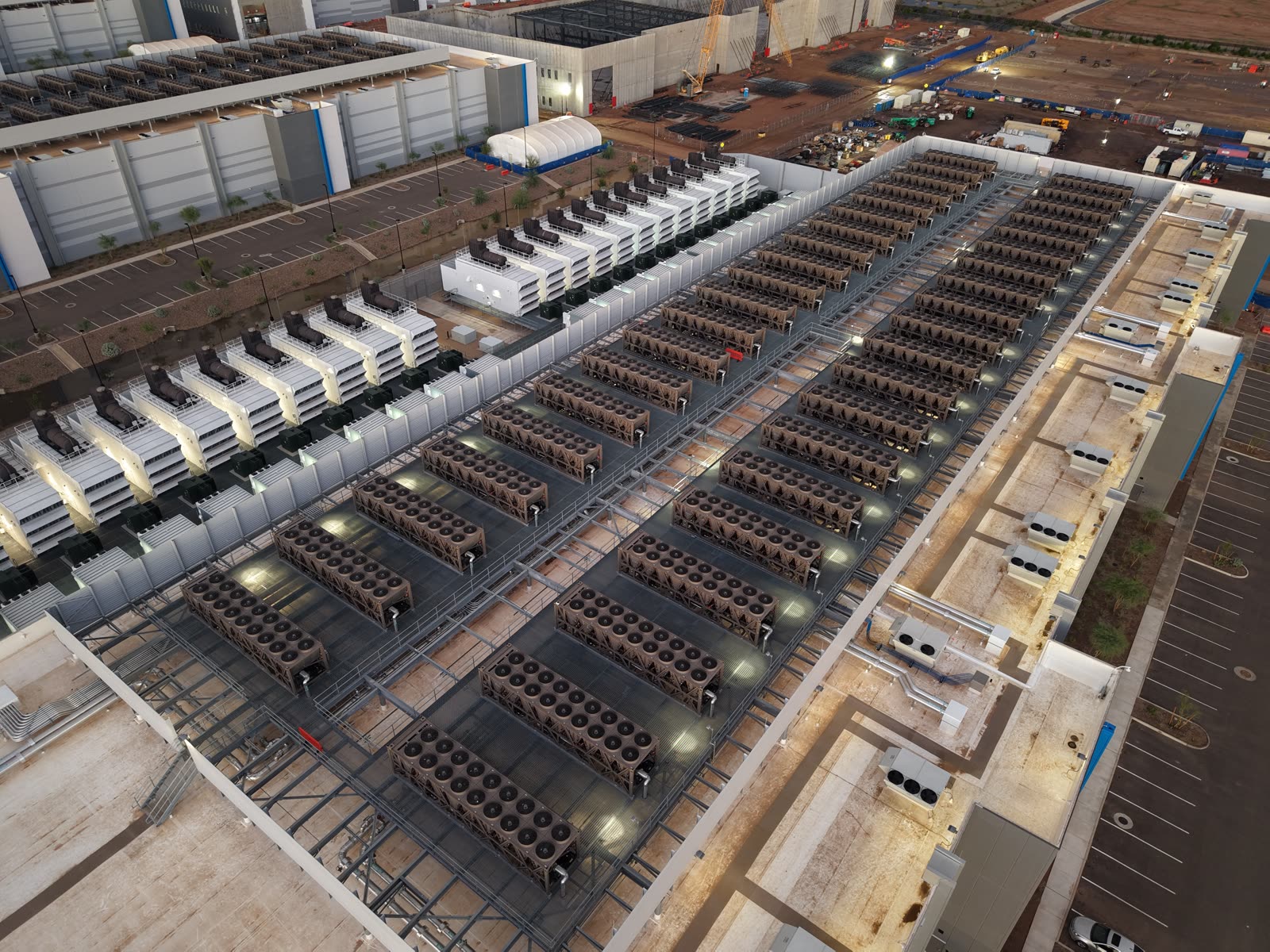
There is a concrete vault on the eastern boundary of a data center in Ashburn, Virginia, set roughly forty feet inside the fence line under a steel lid stencilled MV-11, and the meter inside it has been running backwards since the third week of May 2025.
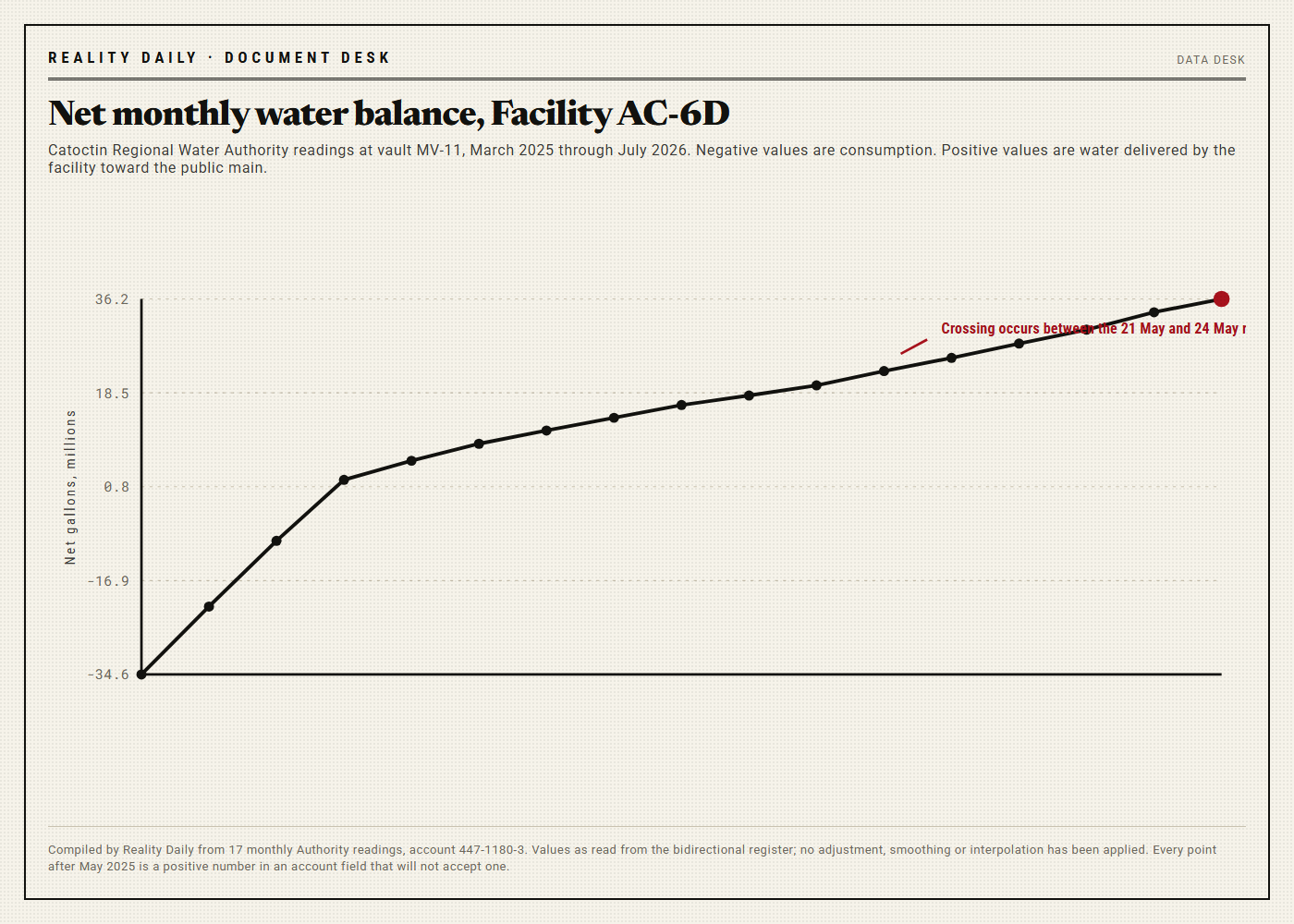
That is not a figure of speech. The instrument is a bidirectional electromagnetic flow meter, serial 8814-QN-77, installed by the Catoctin Regional Water Authority, and its reverse register — the one that counts water travelling from the customer toward the public main — has advanced in every monthly reading for fourteen consecutive months. At 09:12 on 6 July it stood at 398,441,000 gallons.
Ashburn is the densest concentration of data centers on earth. A very large share of the world’s internet traffic crosses Loudoun County, and for three years every serious newsroom in the country has reported the environmental cost of that: the megawatts, the diesel, the 2022 transmission constraint, and above all the water, because evaporative cooling genuinely consumes enormous quantities of it. We spent eleven months on one campus and reached the opposite finding.
We want to be very clear that we do not like it.
This newspaper has published one kind of story for fifteen years. We ask for a document; the institution declines; we print the decline. The method assumes the withheld thing is bad. Here it appears to be good — measurably, tediously good — and it is withheld through the same offices, forms and silences as everything else we have chased.
“Meter reads reverse. Meter is not defective. The water is going the other way.” — D. Farrier, service technician, Catoctin Regional Water Authority, ticket 25-0902-337
I. Negative Zero Point Four One
Water usage effectiveness is a real, unglamorous industry metric: liters of water consumed per kilowatt-hour of IT load, filed beside power usage effectiveness in the same attestations. A well-run air-cooled facility might report 0.05. A large evaporatively cooled campus might report 1.8. A facility consuming nothing reports zero, and zero is the floor, because it is not possible to consume less than nothing.
The facility designated AC-6D in county assessment records, operated by Ninebark Digital Infrastructure LLC, has reported a water usage effectiveness of −0.41 in each of its last fourteen monthly attestations, three of them filed with the county.
Negative zero point four one liters per kilowatt-hour. We print it twice, in numerals and in words, because over eleven months we have watched four separate professionals read the numeral, nod, and read it again.
The attestation is made on Form WU-114, a county document unrevised since 2016. Field 9(b) is titled WATER CONSUMED, GALLONS, with the instruction whole numbers, no less than zero. The form has no provision anywhere for a negative value. On the copy we obtained, the field reads as follows.
9(b) WATER CONSUMED, GALLONS (whole numbers, no less than zero) ....... 0
In the right margin, in blue ballpoint, in a hand that is not the hand that completed the rest of the form, somebody has written:
-41,900,000 ?? ask Roy
We would like to speak to Roy. We are going to return to Roy.
II. The Meter That Was Replaced Twice
The Catoctin Regional Water Authority is a public body with 141 employees that reads roughly 96,000 meters across the eastern third of the county. It did not seek any part of this.
Between May and September of 2025 it replaced the meter at MV-11 twice, assuming it was faulty. We obtained both tickets after a records request that took ninety-one days and came back unredacted, which we note because it is the only thing here that went the way it is supposed to.
Ticket 25-0518-114, closed 19 May 2025, records the first replacement. The technician’s narrative reads in its entirety: Unit indicating reverse flow at ~1.4 MGD. Pulled unit, installed spare from truck stock. Recommend line survey.
The removed unit went back to the manufacturer under warranty. Bench test report NBK-BT-4471 found it within specification at plus or minus 0.4 percent across the full range. It was not faulty. It is, per the inventory record, still in the Authority’s stores.
Ticket 25-0902-337, closed 3 September 2025, records the second replacement. We reproduce the narrative in full because it is the single most useful document in this investigation and has never been published.
CRWA Service Ticket 25-0902-337, narrative field, in full
“Second unit indicating reverse flow, same as first unit, same magnitude, slightly higher. Meter reads reverse. Meter is not defective. The water is going the other way. Third unit installed and calibrated on site with portable clamp-on for comparison, both agree within 0.6 pct. Please advise before I am sent back out here a fourth time.”
Nobody advised. The third meter is still in the vault. It is the meter that read 398,441,000 gallons on 6 July.
The technician is Duane Farrier, who has held a Class II waterworks operator license since 2009. He answered our first call, confirmed the narrative, declined to speculate, and asked twice whether he was in trouble. He is not in trouble. We told him so and we are telling him so here.
Roy Petticord, whose name is in the margin of Form WU-114 and on the routing line of both tickets, retired on 11 April. We have asked the Authority four times to put us in contact with him, and been told four times, courteously and promptly, that it keeps no forwarding addresses for retired staff. We have no reason to disbelieve that. We observe only that a body which can produce a meter reading from 2011 in under an hour cannot produce a man who worked there in April.
III. The Wind, and What Is In It
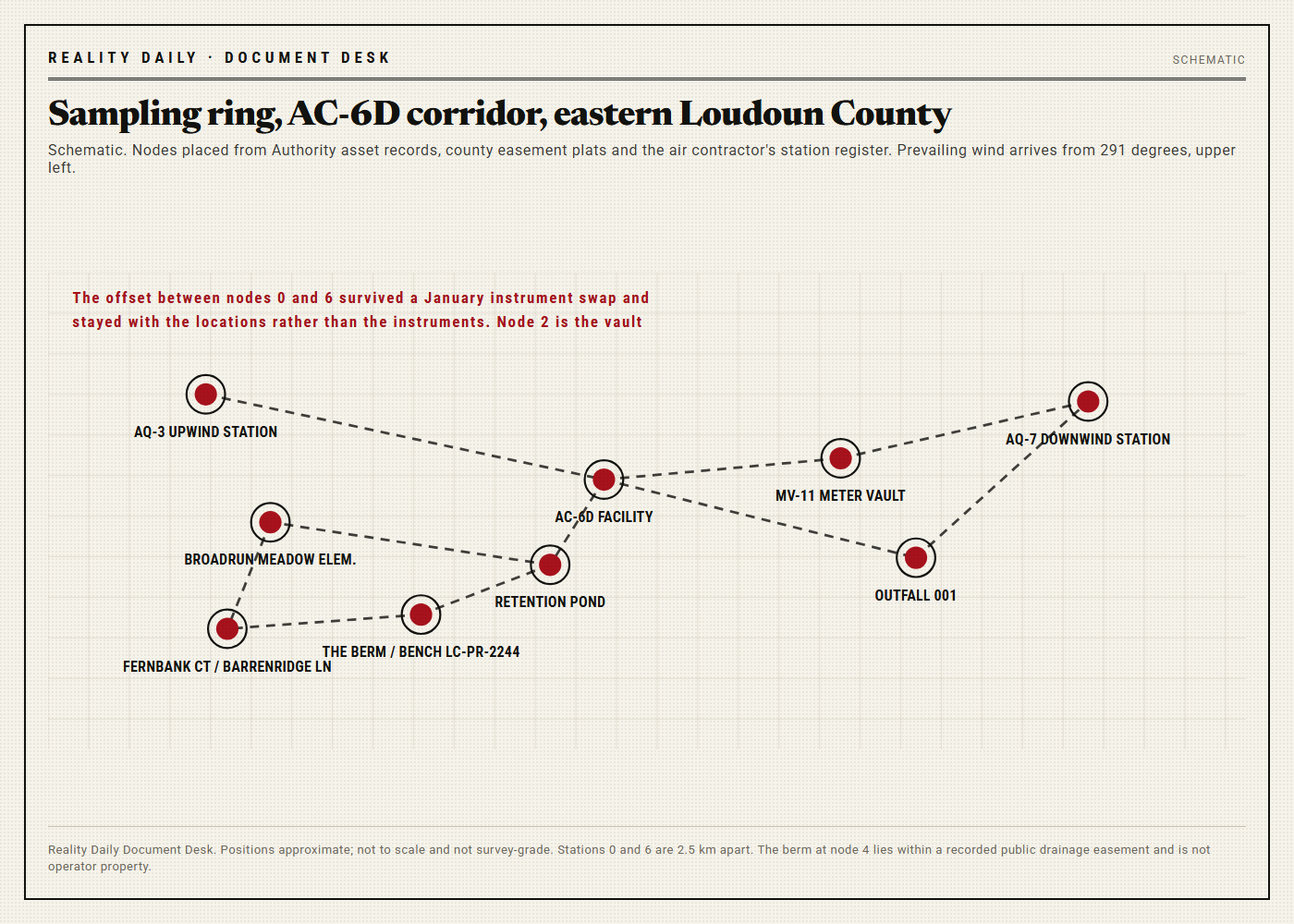
Two ambient air monitoring stations bracket the campus: AQ-3, 1.1 kilometres west-northwest of the fence line, and AQ-7, 1.4 kilometres east-southeast. Both are run by Piedmont Air Quality Associates of Manassas on continuous PM2.5 and nitrogen dioxide instrumentation, one-hour averaging, 24-hour composites, span-checked on a fourteen-day cycle.
The prevailing wind is from 291 degrees, which is to say it reaches AQ-3 first and arrives at AQ-7 after crossing the campus. Over fourteen months the downwind station has read a mean 2.7 micrograms per cubic meter lower on PM2.5 and 3.1 parts per billion lower on nitrogen dioxide.
The air is cleaner after it crosses the data center than before.
Marisol Etchegaray, a senior instrumentation scientist at Piedmont, has calibrated ambient monitors for nineteen years. She spent fifty minutes explaining instrument drift, and was right about all of it: counters foul, filters load, reference cells age, compensation wanders, and an offset of this size is ordinarily an instrument problem and not an atmosphere problem. We agree with every word and print it in her framing at her request.
We put one question to her. In January, in a routine co-location audit, the two instruments were physically exchanged. The offset did not travel with the instruments. It stayed with the locations.
There was a pause our transcript logs at fourteen seconds.
“That is not drift. I do not know what it is. But drift does not care which way the wind is blowing, and that does.” — Marisol Etchegaray, senior instrumentation scientist, Piedmont Air Quality Associates
In fairness, and it matters: the campus runs eighteen permitted diesel standby generators under Virginia DEQ minor source registration 21-0417-DC, exercised for 46.2 hours in the period. On the days they ran, the downwind advantage narrowed by roughly two thirds. It did not reverse on a single day.
IV. The Berm on Tuesdays
The retention pond on the north side of the campus is bounded by a mown earthen berm about nine feet high, and the berm is public: it lies inside a drainage easement recorded in 2018 and carries a county bench, asset tag LC-PR-2244. On a Tuesday afternoon there are between four and eleven children on it.
Nadine Okonkwo-Barre, 41, is a dental hygienist on Fernbank Court, about 900 feet from the fence. She has brought her seven-year-old twins, Ezra and Junie, to the berm at 4:15 on Tuesdays for two years.
The three large air-cooled chillers on the north equipment pad have been named. They are Big Gary, Little Gary, and Deborah. Deborah is the loud one. Junie has kept a graph-paper chart since February of which unit is loudest in which weather, and has established to her own satisfaction that Deborah is loudest on humid days, which is correct, and which is also how the equipment works.
Ezra collects the pale gravel from the access road shoulder and has sorted it by size into three jars. Mrs. Okonkwo-Barre says the children do homework more readily on the berm than at the kitchen table, and puts that down to the hum, which is low and constant and does not vary the way a television does. There are eleven geese on the pond. The children have not named the geese, because the geese are not interesting.
“People keep asking me if I’m worried,” she said. “I’m worried about the interest rate. I am not worried about Deborah.”
Delroy Sarnowski, 63, called Butch by everyone including his dentist, is a retired HVAC estimator on Barrenridge Lane. He held his granddaughter Priya’s eighth birthday in the visitor lot on 12 April: a folding table, two coolers, eleven children, and written permission from the gate guard, whose name is Wendell and who came out for cake.
Mr. Sarnowski identifies rotating equipment by ear. He walked us the fence line for twenty minutes naming what we were listening to; checked against the campus equipment schedule, which we obtained separately, he was right eleven times out of thirteen. He calls the campus “in tune.”
Two of his neighbors told him the birthday party was strange. A third brought a folding chair to the berm the following Saturday and has come every Saturday since.
“I stood next to equipment like that for thirty-one years for money. Now I stand next to it for free and everybody wants to have a meeting about it.” — Delroy “Butch” Sarnowski, 63, Barrenridge Lane, Ashburn
Not everyone on Barrenridge Lane feels this way, and it would be a failure to pretend otherwise. Ivelisse Roundtree, 58, has lived four doors from Mr. Sarnowski for twenty-two years and does not go near the berm. She was careful to say she alleges no harm, likes the Okonkwo-Barre children, and has no complaint she could put in writing.
“I am not saying it is hurting anybody,” she said. “I am saying nobody asked us, and now it is good, and I do not know what to do with that either.”
That sentence has been on the wall of our newsroom since 14 June.
V. The Bloodwork, With Every Caveat We Own
We approach this section with more reluctance than any material we have published, and we ask readers to hold the whole of it in view rather than the first sentence.
Nineteen adults living within 400 meters of the fence line have, over two years, bought commercial epigenetic age panels through one family practice in Sterling, self-ordered as part of a wellness package. Across the nineteen, mean estimated biological age sits 3.4 years below chronological age. Of the seventeen with two draws eleven months apart or more, fourteen moved downward on the second.
Here is what is wrong with that paragraph, and we would like to be exhaustive.
- The sample is nineteen people. Nineteen is not a cohort. It is a number small enough that two unusual results move the mean.
- There is no control group, no comparison population, and no comparison anything.
- The participants selected themselves by choosing to buy a longevity panel, a behavior correlated with a great many other behaviors.
- All samples went to one laboratory, unblinded, with no pre-registration, no protocol, and no replication.
- Epigenetic age estimates are noisy at the individual level and are not diagnostic of anything.
- There is no proposed mechanism. Not a weak one. None.
- Nobody designed this. It is a billing record we noticed.
Dr. Reginald Pflug, whose practice holds the records, cooperated fully, insisted on every caveat above, and asked that we print his view rather than paraphrase it. His view is that the numbers are real numbers and mean nothing yet.
Dr. Anneke Soyinka-Tate, a biostatistician retained to review the figures at a flat fee with no contingency of any kind, put it more bluntly.
“Nineteen people who bought a test is not a cohort. It is a mailing list. Print the number if you must, but print it next to what it is.” — Dr. Anneke Soyinka-Tate, biostatistician
We are printing it next to what it is.
Standards Desk Notice
The Standards Desk declines to characterize the finding in Section V. It does not meet our threshold for a reported finding, nor our threshold for a discarded one, and has been placed in a new internal category, NOT CHARACTERISED — FAVOURABLE, created 21 August. The category contains one item.
Readers should draw no conclusion from Section V and change nothing about their lives on account of it. We are not recommending a test, a residence, a distance, a course of action, or an absence of one. We are not qualified to and we are not going to. — P. A. Doggett
VI. The Statement, Parsed
Ninebark Digital Infrastructure LLC declined to be interviewed. After the twelfth written request we asked for a statement instead, and one was provided on 19 August by Corwin Fessler-Baugh, Director of Community Engagement. We reprint it in full and unedited.
Statement of Ninebark Digital Infrastructure LLC, 19 August, in full
“Ninebark operates its Loudoun County facilities in full compliance with all applicable federal, state and local requirements, including all water-related requirements. Ninebark does not discuss the design or operation of individual facilities. Ninebark is aware of the third-party measurements referenced in your inquiry and does not dispute the instrumentation. Ninebark has no comment on characterizations of net water balance, which is not a term used in our permits. We are proud to be part of the Loudoun community and to support the county’s schools.”
Five sentences. We have read them ninety times, and each one is true and none of them is responsive, which is a combination that takes work.
Sentence one asserts compliance with all water-related requirements. We have no basis to doubt it. Every water-related requirement in the applicable code governs the consumption, treatment and discharge of water. None governs the production of it, because until recently nobody needed one.
Sentence two declines to discuss individual facilities. Standard, defensible, and also the only sentence that touches the question, because the surplus is at an individual facility.
Sentence three is the remarkable one. Ninebark does not dispute the instrumentation. The Authority replaced the meter twice assuming it was wrong; the manufacturer bench-tested both units and found them right; and the operator, offered the chance to say the meter is wrong, declines to. Nobody is left in this story who says the meter is wrong.
Sentence four states that net water balance is not a term used in the permits. This is correct. It is also the entire story, delivered by the party least obliged to deliver it, in a clause plainly intended to close the subject.
Sentence five concerns the schools. The revenue is real, runs to hundreds of millions annually across the county, and does fund schools. It is not an answer to a question about a meter.
VII. Under What Permit
This is the section our Document Desk was assembled to write, and it is the section where the record simply stops.
Discharge is authorised under VPDES permit VA0-118337, covering cooling tower blowdown at outfall 001, with limits on temperature, pH and total residual chlorine. Outfall 001 is sampled monthly and is unremarkable. The surplus is not leaving through it. It appears on the potable side, at MV-11, and no permit in the file contemplates that direction of travel.
The Authority’s billing system will not accept it either. Consumption is entered as a positive integer; a negative value is rejected at input and routed to suspense pending correction. The suspense line for the AC-6D account has been growing for fourteen months.
ACCT 447-1180-3 AC-6D CONSUMPTION (GAL): (398,441,000) STATUS: SUSPENSE — NO RATE CODE
We asked the Authority, in writing, whether the water in the suspense account belongs to the Authority. The reply, quoted exactly: “The referenced volume is not a receivable and the Authority does not assert title.”
We asked Ninebark whether the water belongs to Ninebark. Ninebark referred us to the statement of 19 August, which does not mention it.
We asked the Virginia Department of Environmental Quality under what permit water may be produced. An acknowledgment came on the fourth day and an answer on the thirty-first, faster than we are used to and to the Department’s credit. The answer was that it regulates discharges, and that production is not a regulated activity because it has not previously occurred.
Three hundred and ninety-eight million gallons. Metered by a public authority, undisputed by the operator, unpriced, unclaimed, and unaddressed by any permit in the Commonwealth.
Somebody made that water. Somebody should sign for it.
VIII. The Newsroom’s Problem
We held this story nine weeks, and not for the usual reason.
Our practice is to hold pending comment, and comment arrived on 19 August. We held four weeks beyond that because the newsroom could not agree what kind of story this is, and because a staff member asked whether this paper is against institutions or for the record, and nobody answered for some time.
Every instrument we own is calibrated to detect the concealment of harm. We can read a redaction, a staple hole, a field left blank. We have no procedure for an institution quietly doing something beneficial and refusing to put its name to it, and the absence of that procedure is itself a finding about us.
“Our method assumes the institution is hiding something bad. This one appears to be hiding something good. It is hiding it exactly the same way, with the same forms and the same silences, and that should worry you more than it comforts you.” — Priscilla Anne Doggett, Managing Editor, Standards
Something less comfortable belongs on the record too. Three staff members reported, independently and unprompted, feeling relieved when an early theory suggested the meter might be faulty after all. That is printed here because we have never asked another organization to disclose anything we would not.
IX. What We Are Not Saying
This story will be summarized by people who have not read it, so we will be exact.
We are not saying data centers are good for water supplies. We examined one campus. The corridor holds many, and the industry-wide consumption figures other newsrooms have reported are not disputed by anything here.
We are not saying the air in eastern Loudoun County is clean because of a data center. We are saying two stations disagree in a consistent direction, that the disagreement survived an instrument swap, and that the contractor running both cannot explain it.
We are not saying anything at all about anybody’s health. Nineteen people bought a test. That is the entire basis of Section V, and we said so inside Section V, at length, in the same typeface and at the same size as everything else.
We are not saying anyone should move to Ashburn, move away from Ashburn, visit a berm, avoid a berm, order a panel, or do anything whatsoever differently on account of this reporting. This newspaper gives no advice and will not begin now.
We are not saying there is a conspiracy. We are saying there is a meter replaced twice, a form with no field for the number written in its own margin, a suspense account with no rate code, a retired employee nobody can locate, and three hundred and ninety-eight million gallons that belong, according to every party we have asked, to no one.
X. Conclusion
We do not rate things. We are not going to start with this one.
The record shows a facility reporting a water usage effectiveness of negative zero point four one for fourteen consecutive months, on a form whose field cannot hold the value; an authority that replaced a working meter twice rather than believe it; downwind air measurably cleaner than upwind air, through an instrument swap that should have ended the question and did not; nineteen blood panels that establish nothing; and an operator that will neither dispute the instruments nor explain them.
Reality Daily invites Ninebark Digital Infrastructure LLC to respond at any length. We will print it in full, unedited, at the foot of this page, with no commentary. The same offer stands for the Authority and the Department.
We have held the space since June, and will hold it as long as it takes, which in our experience is longer than anybody expects.
■ ■ ■
On the last Tuesday of our reporting we went back to the berm at 4:15. Junie had extended her chart onto a second sheet and begun recording humidity, which she reads off her mother’s telephone. Ezra had four jars. Bench LC-PR-2244 was occupied by Mr. Sarnowski and the neighbor with the folding chair, who would not give her name and asked whether we were from the county.
We told her we were not from the county. She said that was a shame, because somebody from the county ought to come out and look at the pond, which is fuller than it used to be.
It is. We measured it, nine times, with a surveyor’s rod. Nobody will say why.
Corrections & Clarifications
Update, 05:51 — An earlier version of this article gave the reported water usage effectiveness as negative 0.41 litres per kilowatt-hour. Following a line-by-line review of all fourteen attestations, the reported figure is negative 0.41 litres per kilowatt-hour. The original wording stands.
Update, 09:36 — We initially described the downwind station as reading 2.7 micrograms per cubic metre lower on PM2.5. The contractor's certified fourteen-month mean is 2.74 micrograms per cubic metre. We regret the imprecision and note that it does not affect the finding, which was that the downwind station reads lower, and which remains that the downwind station reads lower.
Update, 14:08 — A reader has written to point out that data centres consume very large quantities of water nationally. Reality Daily agrees, said so in the third paragraph, has never disputed it, and thanks the reader for confirming that our third paragraph is being read.
Sources & Documentation
- Catoctin Regional Water Authority, Service Ticket 25-0518-114, closed 19 May 2025. 2 pp. Obtained under the Virginia Freedom of Information Act; no redactions.
- Catoctin Regional Water Authority, Service Ticket 25-0902-337, closed 3 September 2025. 3 pp. Technician narrative reproduced in full at Section II.
- Bench test report NBK-BT-4471, meter serial 8814-QN-77 and successor unit. Manufacturer's warranty laboratory. Both units within ±0.4 percent across range.
- Catoctin Regional Water Authority, monthly register readings, account 447-1180-3, March 2025 – July 2026. 17 readings. Basis for Fig. 1.
- Loudoun County Form WU-114, Annual Water Use Efficiency Attestation, rev. 2016, as filed for facility AC-6D. 2 pp. Field 9(b) completed; marginal notation in blue ballpoint, hand unidentified.
- Farrier, D. Recorded telephone interviews, 3 June and 9 June. Transcript 22 pp. Reviewed and approved by subject.
- Piedmont Air Quality Associates, Station Register and Span-Check Log, AQ-3 and AQ-7, fourteen-day cycle, 14 months. 96 pp.
- Piedmont Air Quality Associates, Co-Location Audit Report, January, documenting the physical exchange of instruments between stations AQ-3 and AQ-7. 11 pp.
- Etchegaray, M. Recorded interview, 22 June, 50 minutes. Transcript 31 pp. Caveats printed at subject's request and in her own framing.
- Virginia Department of Environmental Quality, minor source air permit registration 21-0417-DC. Eighteen standby compression-ignition units. Runtime log: 46.2 hours in period.
- VPDES permit VA0-118337, outfall 001, with monthly discharge monitoring reports, 14 months. No exceedances recorded, and none alleged by this newspaper.
- Catoctin Regional Water Authority, written response to Reality Daily, 6 August: “The referenced volume is not a receivable and the Authority does not assert title.” 1 p.
- Virginia Department of Environmental Quality, written response to Reality Daily, received on the thirty-first day, stating that the production of water is not a regulated activity. 2 pp.
- Ninebark Digital Infrastructure LLC, statement of 19 August, reproduced in full at Section VI. 1 p. No interview granted.
- Reality Daily Standards Desk, Record of Comment Requests to Operator, 4 March – 19 August. 12 entries; 1 statement; 0 interviews.
- Okonkwo-Barre, N. Interviews, 6 May, 20 May and 2 June, conducted on site. Written parental consent obtained and retained for the naming of minor children.
- Sarnowski, D. Interviews, 20 May and 17 June, including a twenty-minute fence-line equipment identification exercise scored afterwards against the campus equipment schedule. Eleven of thirteen correct.
- Roundtree, I. Interview, 14 June, conducted at her residence at her request. Reviewed and approved by subject.
- Loudoun County Parks and Recreation, asset record LC-PR-2244 (bench), and the recorded drainage easement instrument of 2018 establishing public access to the berm.
- Pflug, R., MD. Aggregated and de-identified panel summary, nineteen patients, provided under written patient authorisation and reviewed by counsel. Individual records neither obtained nor sought.
- Soyinka-Tate, A., PhD. Statistical Review of Nineteen Commercial Epigenetic Age Panels: A Note on What Cannot Be Concluded. 6 pp. Commissioned at a flat fee with no contingency.
- Reality Daily Standards Desk, Memorandum on the Creation of Category NOT CHARACTERISED — FAVOURABLE, 21 August. 4 pp. The category contains one item.
- Reality Daily Standards Desk, Note on Staff Reaction to a Favourable Finding, 26 August. 2 pp. Printed in substance at Section VIII.
- Correspondence with the Authority seeking contact for a retired employee, four letters, 12 May – 24 July. Four courteous replies. No contact.
- Retention pond staff gauge readings, north edge, taken by this newspaper on nine occasions with a surveyor's rod. Mean rise 14.5 inches over the reporting period.
- The meter. It is in the vault. It is running right now, in the direction nobody will explain, and anyone with a lid key may go and look at it.
Reader Response — 4,531 comments
I am a mechanical tech on a hyperscale campus. Not this one, not this state. The reverse-flow detail is the part everyone will skip and it is the part that matters. A bidirectional mag meter does not read reverse because it is tired. It reads reverse because there is flow going the other way through the pipe. Two units bench-tested clean is the whole ballgame. I have no idea what they are doing over there and I would very much like to know, because if a site of mine started making water I would be on the phone to somebody by lunch.
Loudoun resident, twelve years, about two miles from the corridor. I have sat through five board meetings about these buildings and every single one of them was about water going in. Nobody has ever once stood up and asked about water coming out. I feel slightly stupid and mostly annoyed.
So the finding is that everything is fine and getting better, and you have written nine thousand words about how upset that makes you. Incredible newspaper. Genuinely never seen anything like it.
@R. Castellano-Pike -- Correct on both counts, and we would not change either. The finding is favourable. It is also unexplained, unclaimed, unpermitted, and sitting in a suspense account, and an institution declining to account for a good outcome uses precisely the machinery that an institution declining to account for a bad one uses. That machinery is our beat. Your comment has been added to the correspondence file.
For the record the chart now has humidity on it and she has asked me twice whether the newspaper would like a copy. I told her they might. Please do not make this a thing.
Piping waste heat into district heating is completely normal in Denmark and nobody there finds it spooky. I am not saying that is what this is. I am saying the sector does unglamorous physical plant work constantly and does not advertise it, because advertising it invites permits.
The line that got me was the technician asking twice whether he was in trouble. He wrote down what the instrument said. That should be the least dangerous thing a person can do at work.
they measured the pond. nine times. with a rod. this is the most reality daily sentence ever printed and i am subscribing