Lex Fridman Has Set Sail for Egypt to Reach the Fleshlight-Shaped Object Beneath the Great Pyramid, and Says He Holds No Anger Toward the Ministry That Denied Him Access
The podcaster and AI researcher cleared Piraeus on 26 August aboard a chartered Maltese-flagged motor yacht, bound for Alexandria and, he says, for anomaly GP-VOID-3 one hundred and four metres beneath the Great Pyramid. He applied for access and was courteously refused. This newspaper has asked him nine times, in writing, what the plan is for the ninety metres of limestone in between, and has received nine warm replies about something else.

Editor's Note
This article was held for six days while the Document Desk attempted, for a ninth and then a tenth time, to obtain from Mr. Fridman a statement addressing the ninety metres of limestone between the surface of the Giza plateau and the object he has said he intends to reach. Every request was answered, promptly and at length. None of the answers concerned the limestone. We are publishing with all nine replies printed in full in the ledger below, because the replies are the record and the reader is entitled to make of them what we could not.
The newsroom argued for two days about whether this story is unkind. I have read every word of the correspondence twice and I do not believe it is, and I have instructed the desk to print the refusal letter in full, to state plainly that Mr. Fridman has proposed nothing unlawful, and to stop short of characterizing a voyage this paper does not understand. Where we could not characterize, we have said so. — M. Vandersloot
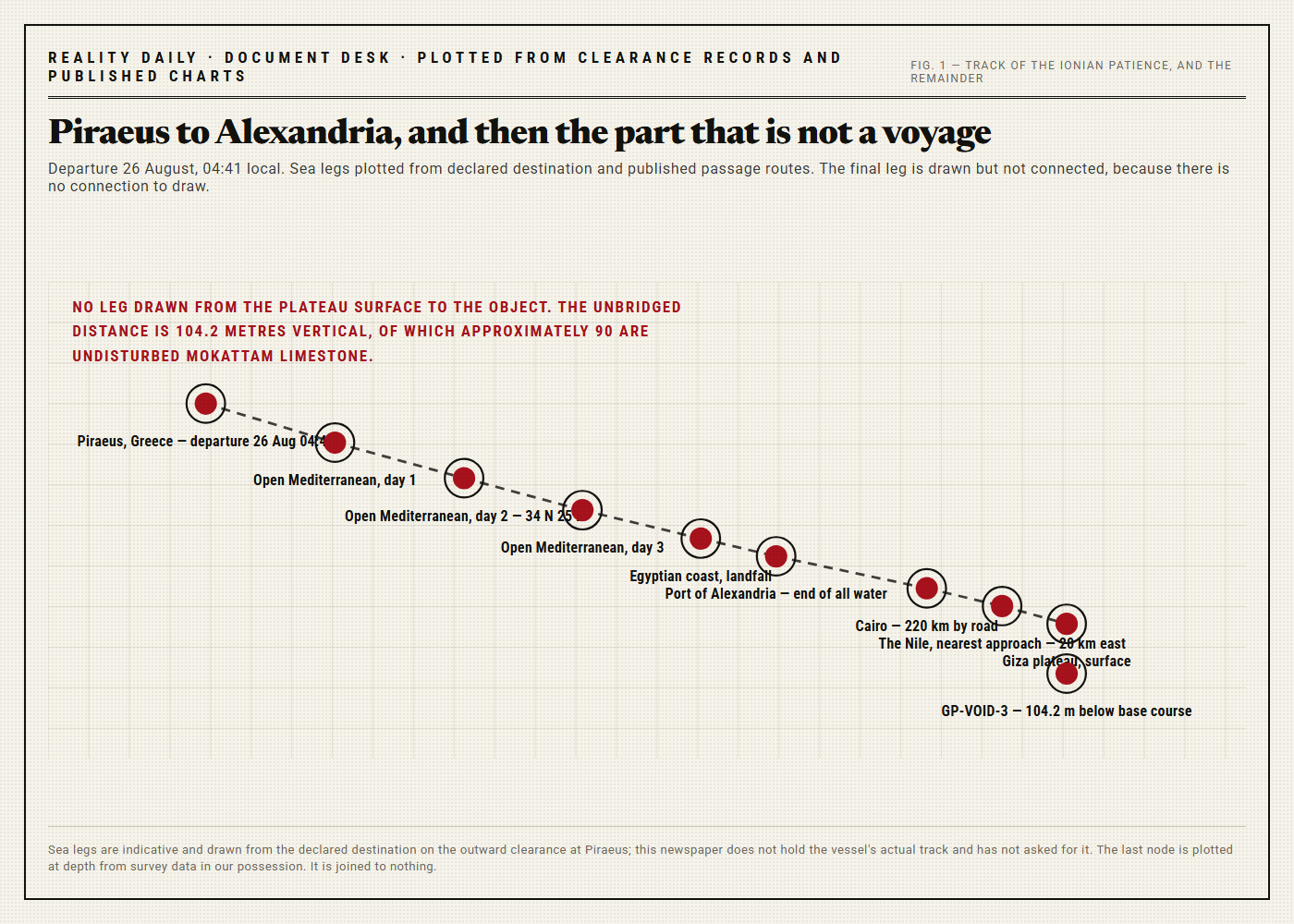
The motor vessel Ionian Patience cleared the outer mole at Piraeus at 04:41 local time on 26 August, under Maltese flag, official number 7441-MT, twenty-eight point six metres length overall, six crew and two passengers. Her declared destination was the Port of Alexandria. Her declared purpose, on the outward clearance form, was "private cruising."
One of the two passengers is Lex Fridman, the podcaster and artificial-intelligence researcher, and his purpose is not private cruising. He has said so himself, at length, warmly, and to anybody who asks. He is going to Egypt to reach the object this newspaper reported in February beneath the base of the Great Pyramid: anomaly GP-VOID-3, one hundred and four metres down, 19.4 centimetres long, 7.6 centimetres in outer diameter, closed at one end, open at the other, helical within. Fleshlight-shaped. We published the survey data in The Blank Field at One Hundred Metres, and we have held the foot of that page open ever since for anybody willing to say what the thing is.
Mr. Fridman applied for access. Access was declined. The declination was courteous, prompt, one paragraph long, and in our judgment entirely reasonable, and we print it in full in Section II below. He has not appealed it. He has not disputed it. He has not proposed excavating, and he has said in terms that he does not intend to excavate, and this newspaper wishes to state at the outset and without qualification that nothing he has described doing is unlawful in Egypt or anywhere else. He intends, in his own words, to be present.
Between the deck of the Ionian Patience and the object he intends to be present at, there are two hundred and twenty kilometres of Egyptian road, a river he cannot navigate to the site, and approximately ninety metres of solid Mokattam limestone. Reality Daily has asked him about the limestone nine times, in writing, over eleven days. We have received nine replies. Every one of them was kind. Not one of them was about the limestone.
This is not a story about a man doing something wrong. It is a story about a vessel whose papers are in order, a refusal whose reasoning is sound, and a gap of ninety metres that nobody in this file has addressed, including the only person sailing toward it.
"I reached out to the ministry. They said no. And I want to say — I understand. I really do. They have a responsibility to protect something ancient and beautiful, and I respect that deeply. I hold no anger. I just also happen to be on a boat."— Lex Fridman, by voice message to this newspaper, 28 August
I. The Vessel
The Ionian Patience is a 2009-built displacement motor yacht, twenty-eight point six metres overall, twin diesels, cruising at eleven knots. She is registered in Valletta, Malta, official number 7441-MT, under a corporate owner whose filings are current, and carries six crew, a valid ISM safety-management certificate, and insurance expiring in April.
We checked all of it. We would like to report that we found something. We did not. The registry entry is complete, the tonnage certificate matches the hull, the master holds an unlimited yacht master certificate issued in 2016 and renewed in 2021, and the outward clearance was granted in the ordinary course.
Ilias Pantazoglou has worked port clearance at Piraeus for nineteen years. He returned our call, listened to the whole question, and answered a narrower one.
"The vessel is properly documented. Crew list, ISM, insurance, tonnage, destination declared as Alexandria. It is correct. What the people on board intend to do after they get off the boat is not a thing I am given a form for."— Ilias Pantazoglou, port clearance officer, Piraeus
We record, with a faint disappointment we are obliged by our own standards to disclose, that the boat is fine. The boat is completely fine. The boat is the least interesting document in this file.
II. The Application, and the Refusal
On 4 August, an application for site access was submitted on Mr. Fridman's behalf to the office handling foreign requests to the Giza plateau. Nine pages. It requested, in its own words, "presence at the location, for a period of up to four hours, without instrumentation," and requested no excavation, no coring, no drilling, no survey and no removal. It is the most modest application of its kind we have read, and it was declined on 14 August in a single paragraph, which we print in full:
Reply of the permitting authority, 14 August, reference OPFM/2026/1188
"Thank you for your correspondence and for your evident interest in the site. The Giza plateau is a World Heritage property and access outside published visiting arrangements is granted only in connection with an approved scientific mission holding a current excavation or survey permit, of which your request forms no part. We are therefore unable to accede to it. We would note that the monuments are open to visitors daily and that no special arrangement is required to see them. We wish you a pleasant visit to Egypt."
We have parsed that paragraph the way we parse everything, and it survives parsing. It states a rule, states the rule's basis, and states why the request falls outside it. It then does something this newspaper has encountered perhaps four times in eleven years of institutional correspondence: it offers the applicant a way to get most of what he wants, which is to buy a ticket like everybody else, and wishes him well.
It was sent ten days after the application, signed, with a reference number, by a named official whose name we are not printing because she did not ask to be part of this and has done nothing but her job correctly.
Mr. Fridman's response, sent to us unprompted:
"I want to thank whoever wrote that letter. Genuinely. It's a kind letter. It took ten days and somebody actually read the thing I sent. Do you know how rare that is? I don't know her name. If she ever wants to sit down for three or four hours and talk about what it's like to be the person who says no to people all day, I would love that conversation. I think there's something profound there."— Lex Fridman
III. The Ninety Metres
Here is the arithmetic, and we are going to keep coming back to it, because it is the only thing in this story that nobody will engage with.
The object sits 104.2 metres below the base course of the Great Pyramid. Roughly fourteen of those metres are the monument's own footing and the plateau's shaped bedrock surface. The remaining ninety, give or take, are Mokattam limestone, undisturbed, with no shaft, tunnel, borehole or void resolved anywhere in the column above the anomaly in 4.1 gigabytes of survey data that this newspaper has held since 6 August and re-hashes on the first of every month.
Ninety metres of rock.
Mr. Fridman is a serious person who has spent his working life on hard technical problems and is not confused about what limestone is. That is why the desk kept writing. A man who does not understand a problem gives you a wrong answer. Mr. Fridman gives you a beautiful answer to a different question, immediately, and then thanks you for asking.
We asked, on 21 August: what is the plan for the intervening rock. He replied in forty minutes.
"Let me say something about rock. I think there's something profound about geology, about deep time, about the fact that this limestone was a seabed. Little creatures died and settled and got pressed into stone and now it's holding up the heaviest building humans ever made. I think about that a lot. I don't have the answer. I just think it's beautiful."— Lex Fridman, reply of 21 August
That is not a non-answer. A non-answer is a press officer saying the matter is under review. That is an answer to a question we did not ask, offered warmly by a man who appears to believe he has answered us, and the desk read it four times before concluding that it contains no plan.
IV. What Reaching 104 Metres Would Actually Take
Because we did not want to characterize a problem we had not costed, Reality Daily retained Dr. Ingrid Saylor-Achebe, a geotechnical engineer with twenty-two years in deep foundations and rock coring. She was given the depth, the rock type, the site constraints, and no names. Her memorandum runs to six pages. Its operative content is a list, in her own ordering:
- A track-mounted rotary core rig good to 110 metres in competent limestone, needing nine metres of mast clearance and a working pad of twelve metres by eighteen.
- Circulation and containment, because you cannot flush cuttings onto a World Heritage surface.
- A haul route taking twenty-odd tonnes of rig, casing, rods and a support vehicle onto a plateau that is not a haul route.
- A structural monitoring array, because you are coring beside a six-million-tonne masonry structure.
- Four to nine months, weather-dependent, before you reach 104 metres in a manner anybody would sign.
- Permits. All of them. Every single one.
We then put to her the actual facts: a chartered motor yacht, two passengers, no equipment declared, no permit, and a stated intention to be present and nothing more. She asked us to read the question back. We read it back. There is a pause on the recording our transcript logs at eleven seconds.
"I want to be careful, because I don't want to be unkind about a person I've never met, and there's nothing wrong with what he's doing. So let me put it as plainly as I can. Nothing he is doing is wrong. Nothing he is doing is drilling."— Dr. Ingrid Saylor-Achebe, geotechnical engineer, twenty-two years in rock coring
We asked whether the boat helps. She said the boat is a genuinely efficient way to move two people across a sea. She said that as an approach to a target at minus one hundred and four metres it is, and she wanted the word recorded exactly, "lateral."
V. The Boat Cannot Reach Giza
Our editors twice asked us to cut this section as too obvious to print. We twice restored it, on the ground that nobody has addressed it.
The Giza plateau is inland. The Port of Alexandria is on the Mediterranean coast, approximately 220 kilometres from Cairo by road. The Nile passes roughly twenty kilometres east of the plateau at its nearest approach and does not go to it, and there has been no navigable water to the base of the Great Pyramid since the Old Kingdom harbor installations silted up some four thousand years ago.
A boat cannot get there. We say this without any pleasure. From Alexandria a person may travel to Giza by road or rail in about three hours, the same as anybody, and Mr. Fridman is entitled to do that and has never said he would not. But the voyage has been described, by people who admire him and by people who do not, as a journey to the object, and it is a journey to a coastline two hundred and twenty kilometres and ninety vertical metres short of it.
We put the geography to Mr. Fridman on 24 August, with a map attached.
"You're right that the boat doesn't get me all the way. I know that. I've looked at the map, I've looked at it many times. But there's something about going by sea. You leave, and then for days there is nothing, and you're with yourself, and you can't check anything, and I think most of the suffering in modern life comes from never having to sit with yourself for four days. I don't have the answer. I just wanted to arrive slowly."— Lex Fridman, reply of 24 August
Reality Daily notes, for the record, that this is the only reply in the entire correspondence which acknowledges a physical constraint, that it acknowledges the wrong one, and that it is, on the merits, rather good.
VI. Nine Questions, Nine Answers
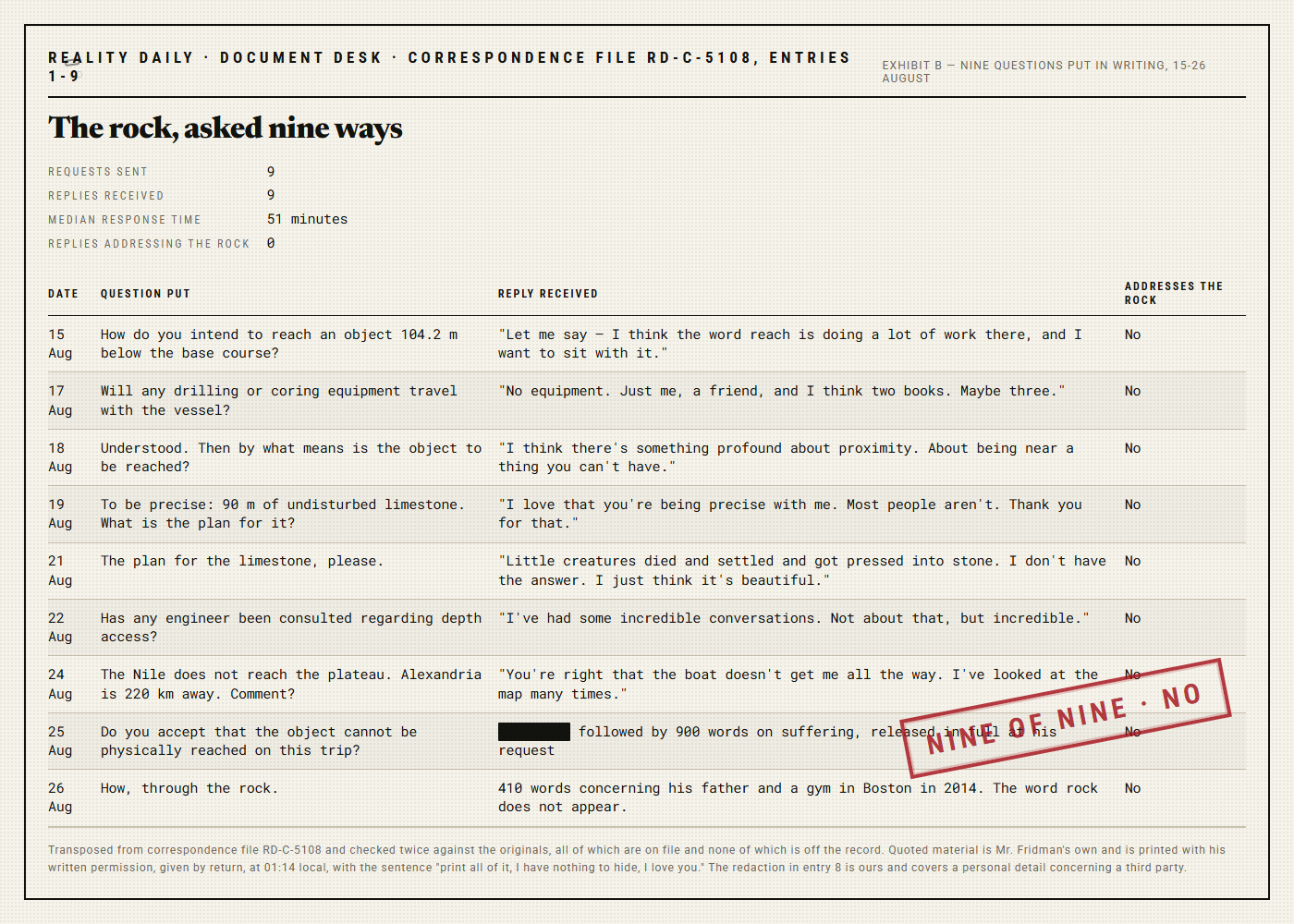
Between 15 and 26 August the Document Desk put the same question nine times, in nine formulations, escalating in specificity on the theory that the imprecision was ours. All nine were answered, at a median of fifty-one minutes, by Mr. Fridman personally, several at two and three in the morning local, one from what he described as a deck chair. The exchange follows in full, with the last column added by us.
The ninth question, sent on 26 August, was four words long: "How, through the rock." We had abandoned sentence structure by then. The reply ran to four hundred and ten words, is about his father and a conversation in a Boston gym in 2014, and is one of the more affecting things this desk has been sent by a source. It does not contain the word rock.
We are not alleging that he is dodging us. A dodge is a decision to withhold. The Standards Desk has read all nine independently, and the unanimous finding of this newsroom is that Mr. Fridman believes he is answering the question.
VII. The Plateau, and the People Who Arrive At It
Dr. Nabila Serrano-Fahmy has worked on the Giza necropolis and its cemeteries for twenty-six seasons. She agreed to speak on the condition that she not be asked to comment on any individual by name, which we honored, and she was told only the shape of the situation.
She was not surprised by any part of it. That was the first thing we noticed. We described a man crossing the Mediterranean by chartered yacht to be near an object one hundred and four metres beneath the pyramid, and she said, "Yes," and waited for the question.
"People have been coming to that plateau with certainties for two hundred years. Napoleon's people came with certainties. The pyramidologists came with a measuring rod and a certainty. Every decade somebody arrives who has worked it out. I have read most of them, because reading them is part of my job, and I want to tell you the thing that nobody finds satisfying. The plateau is still there. It was there before all of them and it did not change because they arrived."— Dr. Nabila Serrano-Fahmy, Egyptologist, twenty-six seasons at Giza
She said she objected to nothing anybody does lawfully, that the site receives some fourteen thousand visitors on an ordinary day, and that one more of them arriving by sea and thinking hard is the least of the plateau's problems. Then she asked us a question we could not answer, which was what he intends to do when he is standing on top of it. We wrote and asked. He replied in thirty-four minutes and the reply is in Section X.
VIII. What the Standards Desk Would Not Call It
On 29 August the Standards Desk was asked to rule on a single word in the second paragraph of this article. The word was "expedition."
The determination runs to two pages and declines the word, on the ground that an expedition has an object it can reach. It also declines "holiday," on the ground that no holiday in the file has ever been refused in writing and undertaken anyway.
Standards Desk determination SD-2026-31, operative paragraph
"The desk finds the voyage is not an expedition, because the destination is unreachable by the means employed and the traveler has proposed no means by which it would become reachable. The desk finds the voyage is not a holiday, because the traveler sought institutional permission for it and was refused, and holidays are not refused. The desk declines to characterize further and opens Category 9, uncharacterized, into which this matter is entered as the sole occupant."
It is the fifth uncharacterized category opened this year and the first to concern a person rather than a document, and the desk recorded its discomfort in a footnote: "The desk notes that it has been unable to characterize the man's plan, and further notes that the man has been unable to characterize it either, and that these two failures are not the same failure and should not be recorded as one."
IX. What We Are Not Saying
We are not saying Mr. Fridman has proposed anything unlawful. He has not. He applied through the proper office, in writing, in advance, was declined, and accepted the declination without appeal. He has said repeatedly that he does not intend to dig, disturb, instrument or remove anything. Nothing in this file suggests otherwise.
We are not saying the permitting authority did anything but its job. Its reply was prompt, signed, reasoned and generous. We have spent two years in this newsroom complaining about institutions that will not answer, and the one institution in this story answered inside ten days, and we are obliged to say so as loudly as we say the other thing.
We are not saying the boat is a stunt, or that he is wrong about the sea. The vessel has correct papers and is making a lawful passage between two ports, and four days of nothing with no way to check anything is very likely good for a person, and two members of this staff have said privately that they would like to go.
We are not saying he is unserious. He answered nine questions in eleven days at a median of fifty-one minutes, himself, several in the middle of his own night. Four institutions in our February story took three weeks to produce twenty-two words between them.
And we are not saying the rock is an argument against him. It is not an argument. It is ninety metres of Mokattam limestone, it has been there for approximately fifty million years, it does not know he is coming, and the only thing this newspaper has established in eleven days of asking is that it is the one subject he will not be drawn on.
X. Conclusion
A twenty-eight point six metre motor yacht, Maltese flag, six crew, two passengers, cleared outward from Piraeus at 04:41 on 26 August, papers in order, bound for a port two hundred and twenty kilometres from a plateau, above an object ninety metres below the reach of anybody standing on it.
One application, nine pages, requesting four hours and no instruments. One refusal, one paragraph, ten days, signed, correct.
Nine written questions about ninety metres of limestone. Nine replies, all warm, all prompt, all about something else. A geotechnical engineer who costed the real job at four to nine months and a twenty-tonne rig. An Egyptologist of twenty-six seasons who has watched two hundred years of arrivals and reports that the plateau is unchanged.
And a man on a boat, in the middle of the Mediterranean, who applied, was told no, said thank you, and kept going, and who answered our final question, about what he means to do when he is standing on the ground above it, in thirty-four minutes:
"People keep asking me how I'm going to get through the rock, and I think that's the wrong question, and I say that with love. I'm not going to get through the rock. The rock has been there for fifty million years and I've been here for forty-one and I am not going to solve it in an afternoon. I'm going to stand on top of it. I'm going to be quiet for a while. And then I'm going to fly home, and I'm going to think about it for the rest of my life. Let me say — I hold no anger toward anyone in this. Not the ministry, not the people laughing. I love you all."— Lex Fridman, reply of 30 August, at sea
■ ■ ■
The Ionian Patience is expected at Alexandria within the week. We have asked the Egyptian ports authority nothing, because there is nothing to ask.
We have held the foot of this page open, as we always do, for anybody who wishes to fill in a blank. In February the blank was a column headed characterization, left empty nine nights running by nine people in a tent. This time it is smaller and stranger. It is the ninety metres. We have asked nine times and we will ask a tenth, and we will print the answer in full, unedited, at any length, with no commentary from us whatsoever.
He will answer within the hour. He always does. It will be about his father, or about jiu-jitsu, or about the fact that the limestone was once a seabed, and it will be kind, and it will not mention the rock, and this newspaper — which has spent fourteen years being lied to by people with press offices — finds that it has run out of ways to be annoyed about it.
Corrections & Clarifications
Update, 07:20 — An earlier version described the intervening rock as approximately ninety metres. Following review against the survey data, the intervening rock is approximately ninety metres. The original wording stands.
Update, 12:46 — We gave the sea distance from Piraeus to Alexandria as roughly 590 nautical miles. Recalculated against published passage tables, the figure is roughly 600. The correction does not affect the finding, which concerns the last 104.2 metres and not the first 600 miles.
Update, 19:03 — Several readers have written to say that Mr. Fridman never claimed he would dig. Reality Daily agrees, said so in the third paragraph, in Section IX, and in the editor's note, and thanks those readers for confirming that our third paragraph is being read.
Sources & Documentation
- Outward clearance record, motor vessel Ionian Patience, Piraeus, 26 August, 04:41 local. Destination declared: Alexandria. Purpose declared: private cruising.
- Malta ship registry, entry for official number 7441-MT. Registration current; corporate owner filings current as of 1 September.
- Tonnage certificate and ISM safety-management certificate, Ionian Patience, both examined; hull particulars 28.6 m LOA, 7.1 m beam, twin diesel, six crew.
- Certificate of entry, protection and indemnity cover, Ionian Patience, expiring April. Copy on file.
- Master's certificate of competency, unlimited yacht master, issued 2016, revalidated 2021. Verified against the issuing administration's public register.
- Pantazoglou, I. Recorded telephone interview, 27 August. Port clearance officer, Piraeus, nineteen years. Transcript 9 pp., reviewed and approved by subject.
- Application for site access, submitted on Mr. Fridman's behalf, 4 August. 9 pp. Requests presence for up to four hours without instrumentation. No excavation, coring, drilling, survey or removal requested.
- Reply of the permitting authority, 14 August, reference OPFM/2026/1188. One paragraph, signed, printed in full at Section II. Official's name withheld by this newspaper on its own motion.
- Saylor-Achebe, I., PhD. Memorandum on Access Requirements to 104 m in Competent Limestone Adjacent to a Loaded Masonry Structure. 6 pp. Commissioned by Reality Daily.
- Saylor-Achebe, I., PhD. Recorded telephone interview, 29 August. Transcript 14 pp., reviewed and approved by subject, including the eleven-second pause, which she asked us to leave in.
- Serrano-Fahmy, N., PhD. Recorded interview, 30 August. Twenty-six seasons at the Giza necropolis. Spoke on condition that no individual be put to her by name; condition honored.
- Reality Daily correspondence file RD-C-5108: nine written requests to Mr. Fridman, 15-26 August; nine replies; median response time 51 minutes; zero addressing the intervening rock.
- Written permission of the subject to publish all nine replies in full, received by return at 01:14 local, 27 August.
- Reality Daily. The Blank Field at One Hundred Metres. Antiquities Desk, February. Subsurface survey package, 4.1 GB, nine passes; working notes 311 pp.; characterization column empty on all nine lines.
- Survey working notes accompanying the above, entry for anomaly GP-VOID-3: depth 104.2 m below base course; length 19.4 cm; outer diameter 7.6 cm; closed one end, open the other; interior regular, repeating, helical.
- Published road distance, Alexandria to Cairo, 220 km. Egyptian national road network tables.
- Published hydrographic charting, lower Nile, Giza governorate. Nearest navigable approach to the plateau approximately 20 km east. No navigable connection to the plateau exists.
- Standards Desk determination SD-2026-31, 29 August. 2 pp. Declines to characterize the voyage as an expedition or as a holiday. Opens Category 9, uncharacterized.
- Standards Desk, footnote to SD-2026-31, printed in Section VIII at the desk's request.
- Reality Daily Standards Desk register of uncharacterized categories, 2026. Five opened to date; four concern documents; one concerns a person.
- Reader correspondence log, 27 August - 2 September: 1,880 letters. 412 offer to fund a drill. Reality Daily has declined all 412 and holds no funds.
- Reality Daily Legal. Memorandum on Reporting a Lawful Voyage. 3 pp. Operative finding: nothing described in this article is unlawful and the article must say so.
- Note of a tenth written request to Mr. Fridman, sent 1 September, 08:00, subject line consisting of the word ROCK. Outstanding at press time.
- The rock is ninety metres thick. It has not been asked to comment.
Reader Response — 4,348 comments
Merchant mariner, twenty-two years. The registry number checks, 7441-MT is a real Maltese format and she is a 2009 displacement hull, which at eleven knots puts Piraeus to Alexandria at about two and a half days, not four. He is getting less time alone with himself than he thinks.
Geologist here. Mokattam limestone is competent, well-bedded, and about the most boring rock on earth to core, which is the point. It is not hard to get through. It is hard to get permission to get through. Nobody in this story has confused those two things except the headline writers elsewhere.
I have listened to him for six years, through a divorce and a bad year at work. He talks like this because he means it. I don't care that the boat doesn't get there. Somebody applied, was told no, said thank you, and went anyway to stand near a thing. That is the nicest thing I have read in months.
The part that got me is he answered nine times in eleven days at one in the morning and the paper still could not get an answer. He wasn't hiding. He just genuinely does not think the rock is the interesting part. I have thought about that all day.
Man charters a yacht to look at the ground. Respectfully, I could look at the ground from here, and my ground also has something under it, and I am asking for nothing.
@hallie_sinks — Correct, and that is the story. He is going a very long way to stand on top of ninety metres of limestone, and so, in a sense, could anybody. What distinguishes this from your ground is that he applied for permission to stand on it, was refused in writing, accepted the refusal without complaint, and went anyway to do the only lawful thing left, which is to be present. We could not find a word for that either. It is now Category 9.
You people asked me to count flags on a boat this time. I want it on the record that I said no, and that I said no politely.
Since several people have written to me directly: yes, I said it, and no, I was not being cruel. If he called me tomorrow and asked what a core to 104 metres would cost, I would tell him, for free, in an afternoon. He has not called. Nobody has called. In twenty-two years that has never once been the problem.
From Giza. He is welcome. Everybody is welcome, it is a ticket and a queue like anywhere. My uncle has sold tea at that gate for thirty years and has watched a great many people arrive to be changed by it and leave the same. He will be fine. The pyramid will be fine.