Scientists Link the Harley-Davidson Roar to an Involuntary Climactic Reflex, and a Father of Three Is Pleading It After a Deadly Crash at a Red Light
A study nobody will produce says a sound can cause a reflex. A man in a hospital bed says the reflex caused a crash. Eleven people are dead, a defense has been entered that no court has seen before, and Reality Daily has spent nine weeks asking for two documents: the study, and the sound.
Editor's Note
This story concerns a physiological response that the study describes in clinical terms and that this newspaper has declined to characterize further. Readers seeking the clinical description may consult the filing. We have not linked it. — P. A. Doggett
It also concerns a collision in which eleven people died. That figure appears in this story where the record requires it and nowhere else. The remainder of the story concerns a defense, a study, and a federal trademark file, which is where the reporting led.
There is a sound. You have heard it. It arrives before the motorcycle does and it leaves after, and it has a shape that people who do not ride can nonetheless draw in the air with one hand. Harley-Davidson tried, in 1994, to register that shape with the United States Patent and Trademark Office as a mark. Reality Daily will return to that application, because it turns out to be the only document in this story that anybody ever tried to write down.
This week a research institute announced that the sound causes, in a subset of the population, an involuntary reflex. The institute used a clinical term for the reflex. This newspaper is using the word reflex. We are aware of the gap between those two choices and we have made it on purpose.
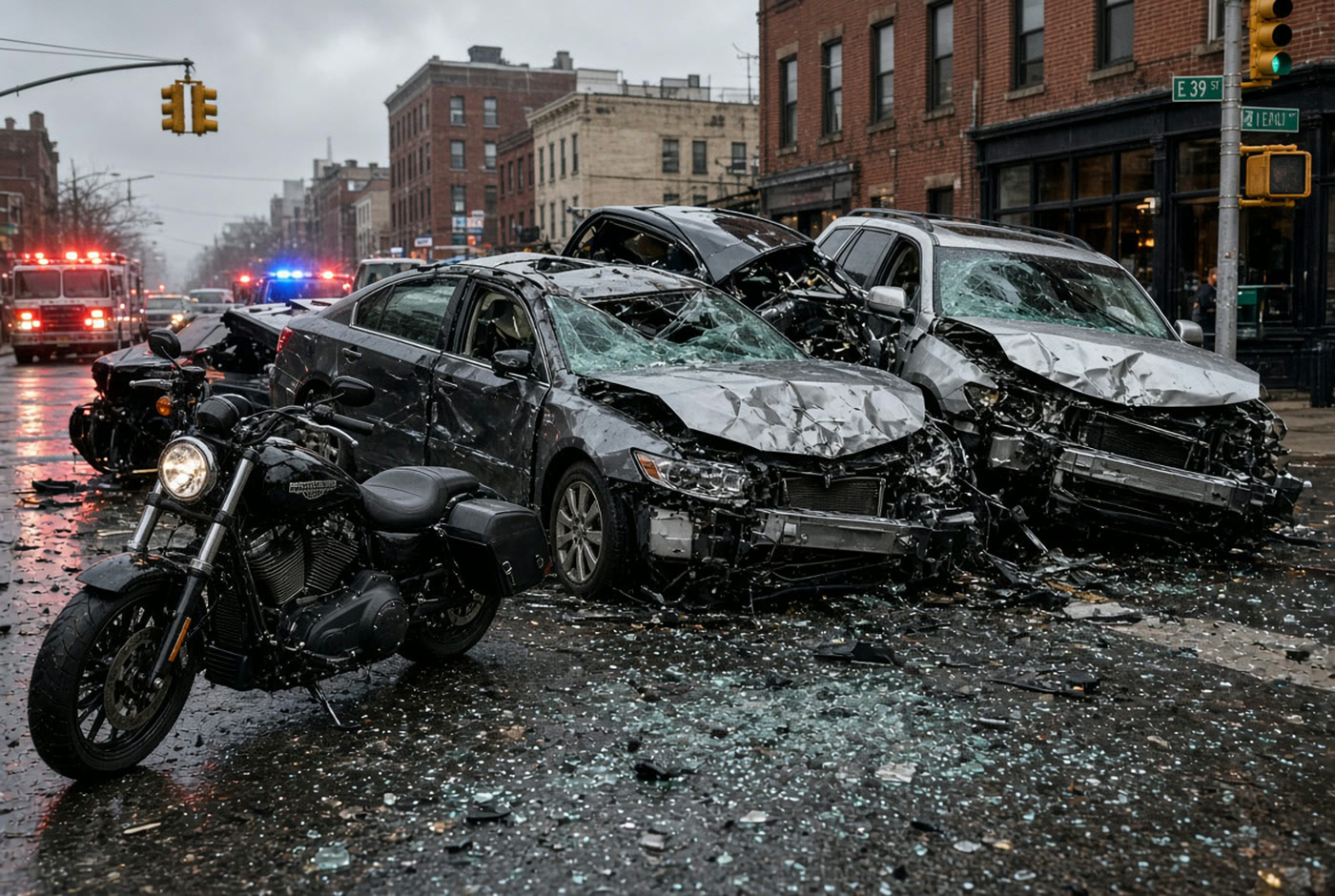
The announcement arrived in the same week that Randall P. Hargrove, forty-two, a warehouse supervisor and father of three from the east side of Columbus, entered a plea in Franklin County that no court in the state, and by our count no court in the country, has been asked to consider. Mr. Hargrove was stopped at a red light at the corner of Livingston and Lockbourne when a motorcycle drew alongside him and its rider revved the engine. Mr. Hargrove’s vehicle then left the intersection at speed. Eleven people died. His attorneys have entered a plea of not guilty by reason of spontaneous climactic reflex.
We have spent nine weeks on this story. We have asked for two documents. We have received neither.
“I love my family. I would never put anyone in danger on purpose. One second I was waiting for the light. The next, my body just took over.”— Randall P. Hargrove, from Grant Medical Center, 14 August
I. What the Institute Announced
The announcement ran to four paragraphs and was issued by the Harlan-Voss Institute for Applied Physiology, a private research body in Dayton whose previous public statements concern ergonomic seating. It said that a study of exposed subjects had established a rare physiological link between the low-frequency signature of a large-displacement V-twin engine and an involuntary climactic reflex in a susceptible minority. It said the link was robust. It said further research was warranted.
It did not say how many subjects. It did not say how they were exposed, at what distance, at what sound-pressure level, or for how long. It did not say who reviewed it, where it is published, or whether it is published. It did not give the reflex a number, a rate, a threshold, or a confidence interval. It gave it a name, and the name is the part this newspaper has declined to print.

Reality Daily wrote to the institute on 11 July asking for the study. We asked again on 14 July, and on nineteen dates thereafter. We received two automated acknowledgments and, on 2 August, a one-line reply from a communications office stating that the study was available to qualified parties on request. We requested it. We were asked to qualify. We have described our qualifications at length in Section VIII, and they were found wanting.
We want to be exact about what this means. It does not mean the study is false. It means we have not seen it, and neither, as far as we can establish, has anyone else outside the institute, including the court that has been asked to rule on it.
II. The Plea
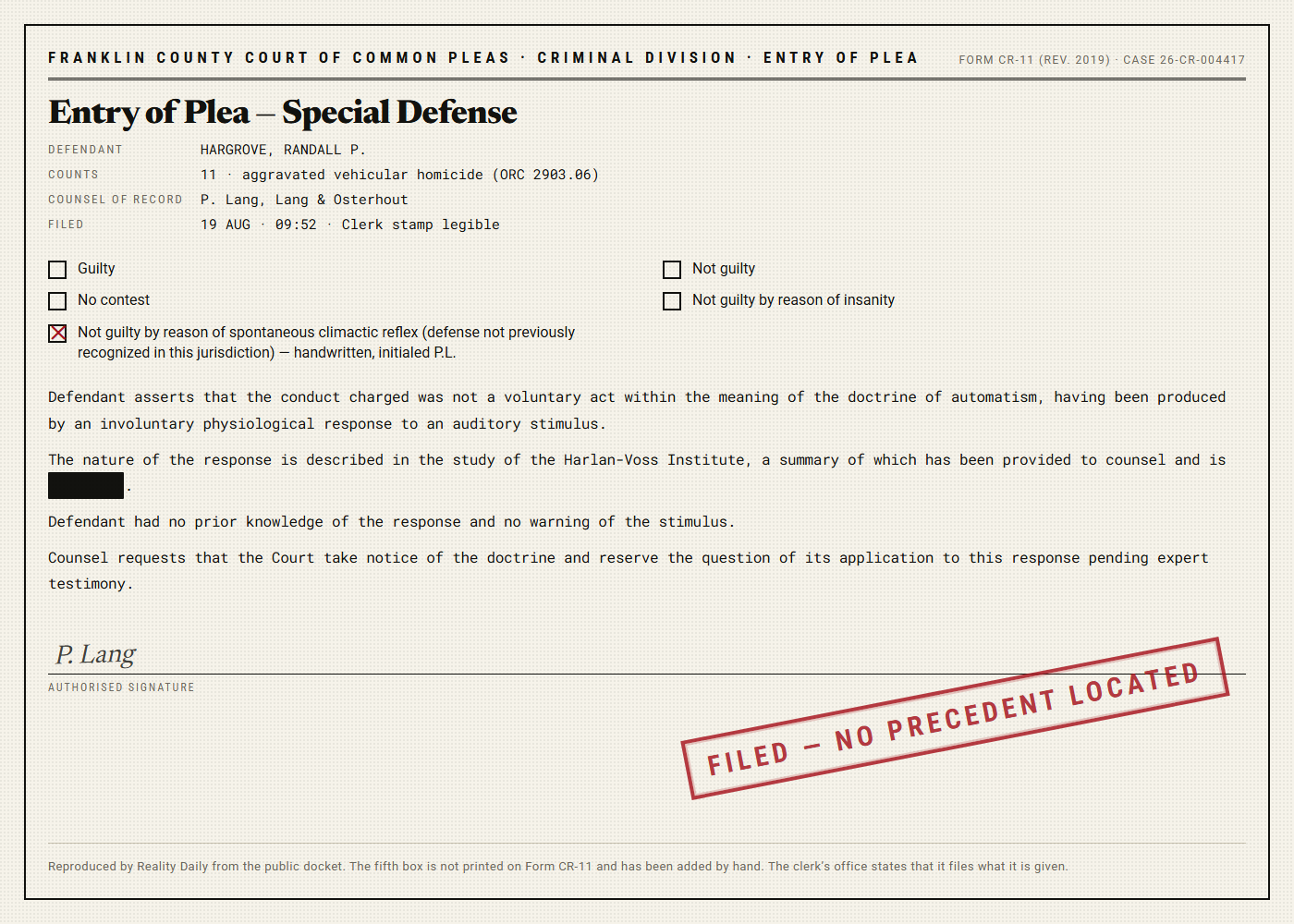
The plea was entered on 19 August by Patricia Lang of Lang & Osterhout, a Columbus firm. The standard form used in Franklin County offers four boxes: guilty, not guilty, no contest, and not guilty by reason of insanity. None of the four is checked. Beneath them, in handwriting, a fifth line has been added and initialed.
NOT GUILTY BY REASON OF SPONTANEOUS CLIMACTIC REFLEX (DEFENSE NOT PREVIOUSLY RECOGNIZED IN THIS JURISDICTION) — P.L.
The clerk accepted the form. The clerk’s office, asked by this newspaper what it does with a fifth box, said that it files what it is given and that characterizing the boxes is not the clerk’s function. We found this answer complete and have no follow-up.
Ms. Lang was direct with us. “These are not isolated weirdos,” she said. “These are regular people whose nervous systems were hijacked by the same auditory trigger that hit Randall. Science finally caught up. The law needs to catch up too.”
We asked Ms. Lang whether she had read the study. She said her office had been provided with a summary. We asked whether we could see the summary. She said it was privileged. We asked whether the court had the study. She said the court would have it when the court needed it. We have printed that sentence exactly as she said it, and we have read it eleven times, and it has not yet resolved into a yes.
III. The Sound, As Specified by Nobody
Here is the difficulty, stated as plainly as we can.
If a sound causes a reflex, the reflex has a trigger. If the trigger is a sound, the sound has a specification: a frequency, a pressure level, a duration, a pattern. Every other stimulus in every other study this newspaper has ever read has one. A light has a wavelength. A drug has a dose. A sound has a spectrum, and the spectrum can be written down.
Somebody once tried. On 1 February 1994, Harley-Davidson Inc. filed application 74/485,223 with the United States Patent and Trademark Office seeking to register, as a trademark, the sound of its engine. The application described the mark as the exhaust sound of the company’s V-twin motorcycle engines when the goods are in use. Nine competitors opposed it. In June 2000, after six years, the company withdrew the application, stating that it did not wish to spend further resources on it and that its customers already knew what a Harley sounds like.
Reality Daily has requested the file. The Patent Office has responded promptly and courteously, which unsettled the newsroom, and has supplied the prosecution history, which we have read. It is one hundred and fourteen pages. In one hundred and fourteen pages, the sound is described in words seven times and in numbers zero times. There is no frequency. There is no pressure level. There is a recording, referenced as an exhibit, which the file states was deposited on cassette, and which the Office has been unable to locate.
So the only federal attempt to specify the sound describes it in prose and refers to a tape that is gone. The institute that says the sound causes a reflex will not say what the sound is. And the man in the hospital bed says only that it was a motorcycle, and that it was loud, and that it was beside him.
“The engine is a forty-five-degree V-twin with both rods on one crankpin. The firing is uneven. That is the whole of what I can tell you about the sound, and I have been rebuilding these for thirty-one years.”— Dale Purcell, retired powertrain technician, Milwaukee
IV. The Doctrine
Automatism is a real defense. Reality Daily wishes to be clear about that, because the plea will be described elsewhere as an invention and it is not. It is the defense that an act was not voluntary — that the body moved without the mind’s instruction — and it has a long, sober history in the case law of most common-law jurisdictions. Courts have considered it in sleepwalking, in seizure, in concussion, and, more than once, in sneezing at the wheel.
Professor Ilse Marchetti teaches criminal law at a university that asked not to be named, and she explained the doctrine to us for forty minutes with a patience we did not deserve.
“The question is never whether the defense exists,” she said. “It does. The question is whether the act was involuntary. That is a factual question. It is answered with evidence. If a study establishes that a stimulus produces a reflex, and the reflex produces the act, then the study is the evidence, and the case turns on the study.”
We told her nobody would send us the study.
There was a pause. Our transcript logs it at six seconds.
“Then the case turns on a document nobody has seen,” she said. “I would like to say that is unusual.”
Marchetti, transcript, 22 August, 10:41 a.m.
“I want to add one thing, because your paper will be careful with it and most will not. The doctrine requires that the person had no warning. A driver who knows he sneezes in bright light and drives into the sun is not protected. So if this reflex exists, the next question is whether Mr. Hargrove knew he had it. And that is not a question for a physiologist. That is a question for Mr. Hargrove.”
V. The Accounts
Within hours of the institute’s announcement, people began to come forward. Reality Daily has logged forty-one accounts. We have spoken to nine of the people who gave them. We have printed three, because three is what our standards permit for accounts that cannot be independently verified, and because the three are representative.
Mark Ellison teaches high-school chemistry outside Dayton. He is fifty-one. He has never told anyone.
“I’ve lived with this for twelve years,” he said. “One short rev at a gas station and I was done. Completely helpless. I thought I was the only one.”
A rideshare driver in Portland, Oregon, who asked that her name be withheld because her employer monitors her vehicle, described “an overwhelming and completely involuntary wave” at a stoplight in 2023, after which she pulled to the curb, ended her shift, and drove home by side streets. She has not accepted a fare on a road with a motorcycle dealership on it since.
An accountant in Tampa told us that in 2019 he rolled into the rear of a landscaping truck after a group of motorcycles idled beside him at a light. The damage was minor. He paid for it himself and told the other driver he had been looking at his phone.
“I felt ridiculous and ashamed,” he said. “Now I see I wasn’t broken. I was just susceptible.”
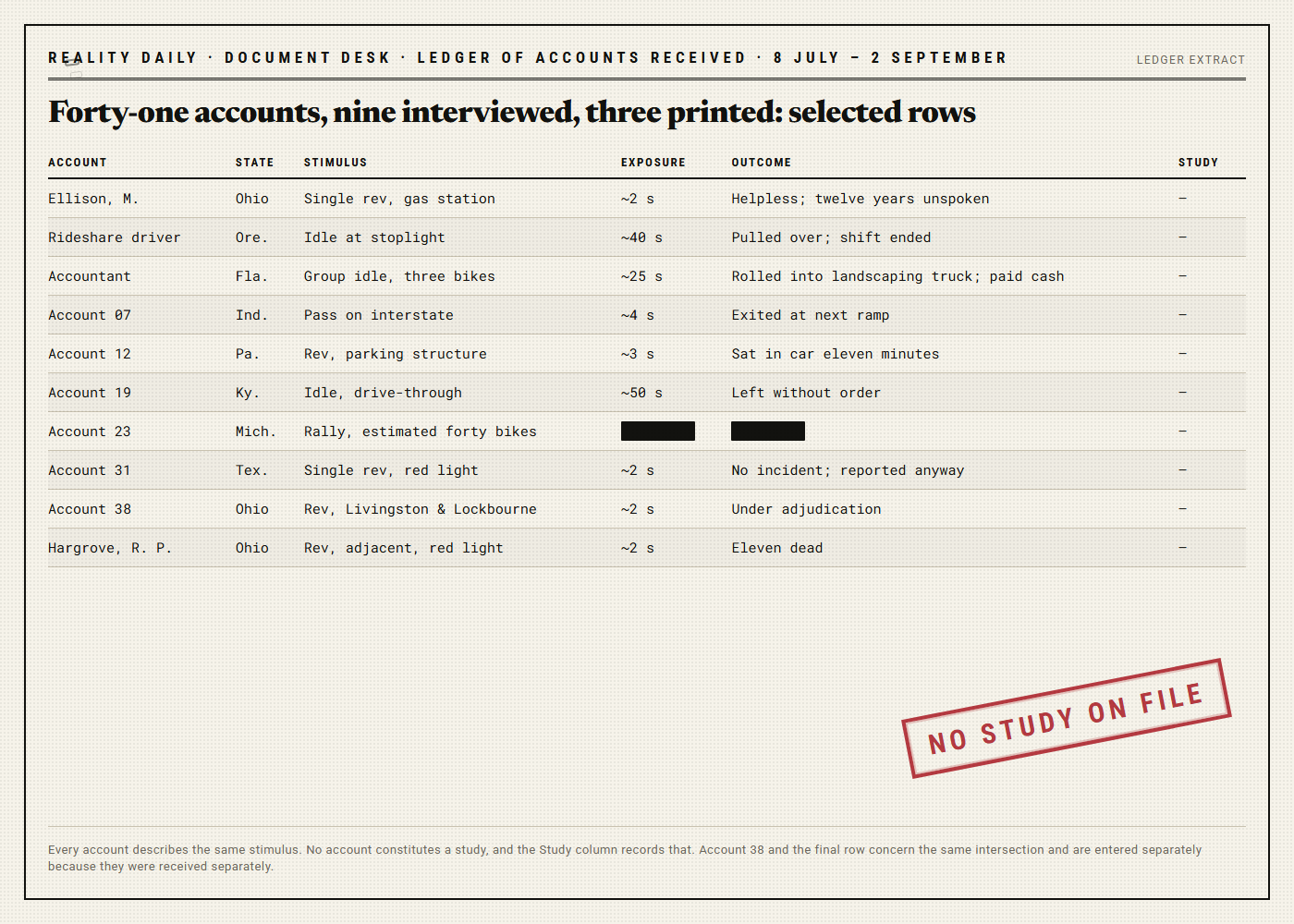
We have entered all forty-one accounts in a ledger. Every one of them describes the same stimulus. None of them is a study. We are aware of the difference and we have printed them anyway, because they are what we have, and because the institute has not sent us the thing that would replace them.
VI. The Dealer and the Rider
Buck Reynolds has sold Harley-Davidson motorcycles in Grove City for twenty-six years. He was not surprised.
“We’ve always known the sound moves people,” he said. “Apparently for some it moves them a little too far.”
We asked Mr. Reynolds whether he could tell us how loud the sound is. He said that at idle, standing beside it, a stock engine runs about eighty decibels, and that a rev takes it past a hundred. We asked how he knew. He said he had a meter in the shop for the county. We asked to see the meter. He showed us the meter. It is the only instrument anybody in this story has produced, and it is a sound meter in a motorcycle shop in Grove City, and we have entered its reading in the verification rail as the sole figure supplied.
Denise Morales has ridden for thirty-four years and is known on the road as Thunder. She was not surprised either.
“Respect the roar,” she said. “Some of us feel it more than others.”
We asked Ms. Morales whether she had ever experienced the reflex. She looked at us for a while. She said the road was long and she had seen a great deal on it and that she would not be characterizing any of it for a newspaper. We found this reasonable and thanked her. She said the crash was a terrible thing and that she would be thinking about the families. We have printed that too.
“Eighty at idle. Over a hundred on the throttle. That’s the number. I don’t know what it does to anybody. I sell the bikes.”— Buck Reynolds, dealer, Grove City
VII. The Sneeze
Mr. Hargrove’s supporters, of whom there are now several thousand on a petition, argue that punishing a man for an involuntary bodily response is no different from blaming him for a sneeze or a muscle spasm. Reality Daily has examined this argument with care, because it is the argument the case will turn on, and because it is, as far as it goes, correct.
A sneeze is involuntary. The law knows this. There are cases. A driver who sneezes and leaves the road has, in more than one jurisdiction, been found not to have driven at all in the legal sense during the sneeze, because he was not, for that half-second, in command of the vehicle.
But the sneeze cases have a feature this case does not. Everyone agrees that sneezes exist. Nobody has had to send anybody a study.
That is the whole of the difference, and it is the whole of this story. The defense is sound if the reflex is real. The reflex is real if the study says so. The study is in Dayton, in a building whose previous concern was chairs, and it is available to qualified parties, and we are not one.
VIII. Our Qualifications
On 4 August we submitted to the institute a statement of qualifications, as requested, in order to obtain the study. We list it here so that readers can judge.
- Reality Daily has read, in full, every study it has ever cited, which its Standards Desk confirms is unusual.
- Its Economics & Data desk holds a working command of confidence intervals and has previously computed the volume of Lake Superior to seven significant figures.
- Its Document Desk has filed 2,209 records requests since 2014 and can read a redaction.
- Its Editor-in-Chief has declined two regional press awards and would decline a third.
The institute replied on 9 August that these qualifications did not meet its criteria. We asked for the criteria. That request is pending, and is, by our count, the twentieth.
IX. What We Are Not Saying
This story will be summarized by people who have not read it, so we will be exact.
We are not saying the reflex does not exist. We have not seen the study, which is a different thing, and we have said so in every section.
We are not saying Mr. Hargrove is lying. He is a soft-spoken man in a hospital bed who has said one thing, consistently, to everyone, and we have no basis to doubt it and have not looked for one.
We are not saying the defense is frivolous. It is a real doctrine, correctly pleaded, that turns on a fact, and the fact is in a document, and the document is in Dayton.
We are not saying anything about the eleven people, because there is nothing this newspaper can add to that, and we have not tried.
We are saying that a sound nobody will specify is alleged to cause a reflex nobody will document, and that a man’s liberty now depends on both, and that the only person in this entire matter who has produced a number is a motorcycle dealer in Grove City with a meter he keeps for the county.
X. Conclusion
Harley-Davidson spent six years and one hundred and fourteen pages trying to write down its own sound, and gave up, and said its customers already knew it. The institute that says the sound causes a reflex will not say what the sound is. The court will decide whether a man was in command of his body on the strength of a document it has not been shown.
We have asked for the study twenty times. We have asked for the tape once, and been told it is gone.
Somebody has the study. Somebody once had the tape.
We would like either.
■ ■ ■
Reality Daily invites the Harlan-Voss Institute to supply the study, at any length, and will print its abstract, its methods and its results in full and without comment. We invite Ms. Lang to supply the summary. We invite the Patent Office, should the cassette be located, to let us listen to it, once, in a room of their choosing, with a meter.
The space has been open since 11 July. We have kept it open through nine weeks and twenty requests, and we will keep it open through the trial.
Mr. Hargrove remains at Grant Medical Center. He is expected to recover. He has said nothing further, and we have not asked him to.
Corrections & Clarifications
Update, 09:12 — An earlier version of this story gave the trademark application’s length as one hundred and fourteen pages. Following review, the prosecution history is one hundred and fourteen pages. The original wording stands.
Update, 14:40 — We initially reported that the institute’s previous public statements concerned ergonomic seating. A reader has noted that one 2019 statement concerned a standing desk. We regret the imprecision and note that a standing desk is a chair a person has declined.
Update, 17:05 — Mr. Reynolds has written to say his meter reads eighty-two at idle, not eighty. We have entered eighty-two. It remains the only figure anyone has supplied, and it has now been supplied twice.
Sources & Documentation
- Harlan-Voss Institute for Applied Physiology, public announcement, 4 pp., undated, issued the week of 7 July.
- Reality Daily Standards Desk, Record of Requests to the Harlan-Voss Institute, 11 July – 2 September, 20 entries; 2 automated acknowledgments; 1 substantive reply of one line.
- Harlan-Voss Institute, reply of 2 August: “available to qualified parties on request.” Screenshot on file.
- Reality Daily, Statement of Qualifications, submitted 4 August, 2 pp. Reproduced in Section VIII.
- Harlan-Voss Institute, reply of 9 August, declining. 3 sentences.
- Franklin County Clerk of Courts, entry of plea, State v. Hargrove, filed 19 August, 1 p., with handwritten fifth line initialed P.L.
- Lang, P. Recorded interview, 21 August, 31 pp. transcript, reviewed by subject.
- United States Patent and Trademark Office, prosecution history, Serial No. 74/485,223, Harley-Davidson Inc., filed 1 February 1994, abandoned June 2000. 114 pp.
- USPTO, correspondence regarding exhibit deposited on cassette, 2 pp.: “unable to locate.”
- Purcell, D. Recorded interview, 18 August, Milwaukee. 14 pp.
- Marchetti, I., Prof. Recorded interview, 22 August, 40 min. Institutional affiliation withheld at subject’s request. Transcript logs one pause of six seconds.
- Reality Daily Document Desk, Ledger of Accounts Received, 8 July – 2 September, 41 entries, 9 interviewed, 3 printed.
- Ellison, M. Recorded interview, 12 August, Dayton. Approved for publication by subject.
- Rideshare driver, Portland, Ore. Interview, 15 August. Name withheld at subject’s request; identity known to the Editor-in-Chief.
- Accountant, Tampa, Fla. Interview, 16 August. Name withheld. 2019 damage receipt provided to the Standards Desk.
- Reynolds, B. Interview, 20 August, Grove City. Sound meter, county-calibrated, reading witnessed.
- Reynolds, B. Written correction, 3 September: 82 dB, not 80.
- Morales, D. Interview, 20 August, roadside. Declined to characterize.
- Petition, Justice for Randall, 3,118 signatures as of 2 September.
- Ohio Revised Code, Title XXIX, and secondary authority on involuntary conduct, as supplied by Prof. Marchetti, 11 pp.
- Reality Daily Standards Desk, Independent Readings of Ms. Lang’s Sentence Regarding the Court, by Three Staffers, 3 documents; none resolves it to a yes.
- Grant Medical Center, patient condition statement, 14 August: stable.
- Reality Daily Editor-in-Chief, memorandum, On Declining to Characterize the Physiology, 1 p.
- Harley-Davidson Inc., public statement on withdrawal, June 2000, as reported at the time: customers already know the sound.
- The sound. It has a number. Somebody has it.
Reader Response — 4,257 comments
Acoustics tech here. 82 at idle beside a stock V-twin is about right, low hundreds on a hard rev at a meter. That part checks. The rest of the story is about a document I have never seen either.
I am not going to say anything about myself except that I read the Ellison paragraph four times and then closed the laptop and went for a walk.
My husband rides. I read him the Thunder Morales part. He said “she’s right” and went out to the garage and has not come back in.
Respectfully, this is 3,000 words to say a lab in Dayton won’t answer its email.
@A. Kowalczyk — Correct. A lab in Dayton will not answer its email, a man’s trial turns on what the email would contain, and the only number in the case came from a motorcycle dealer with a meter. That is the story. We have added your summary to the correspondence file, where it now sits beside your last one.
Thirty years riding. Respect the roar is the first true thing I’ve read about it in a newspaper. The rest of you can keep your study.
“a standing desk is a chair a person has declined” is going on the wall.
Wrote to the Patent Office about the cassette. Will report back. Somebody put that tape in a drawer in 1994 and I intend to find the drawer.