Columbus Man Says Only Lawbreakers Object to Constant Surveillance, Notes His Wife and Her Boyfriend Can Now Walk Safely to the Motel 6
A Columbus homeowner defended his neighborhood's automated license plate readers with a specific, checkable, first-hand claim about a nightly walk. Reality Daily filed a public records request to test it. The cameras confirmed it on twenty-three of twenty-eight nights, in eighty-three rows, without a single misclassification.
Editor's Note
This story was not held. It was filed on 29 August and published on 2 September, which is the shortest interval between filing and publication in this newspaper's history, because the Standards Desk found no assertion in it that required a twelfth comment request to settle. The single outstanding request — to the civic association, for its contract and retention policy — reached twelve on 29 August and produced a four-word reply, which is printed in full at the foot of the page.
Readers should understand what this story is and is not. It is a verification of one homeowner's factual claim about a public system, and that verification came back affirmative on every available measure. It is not an endorsement of the system, and the objections of counsel quoted in Section IV remain wholly unanswered. The desk has opened a new classification for the material, which is described in Section VIII. — P. A. Doggett
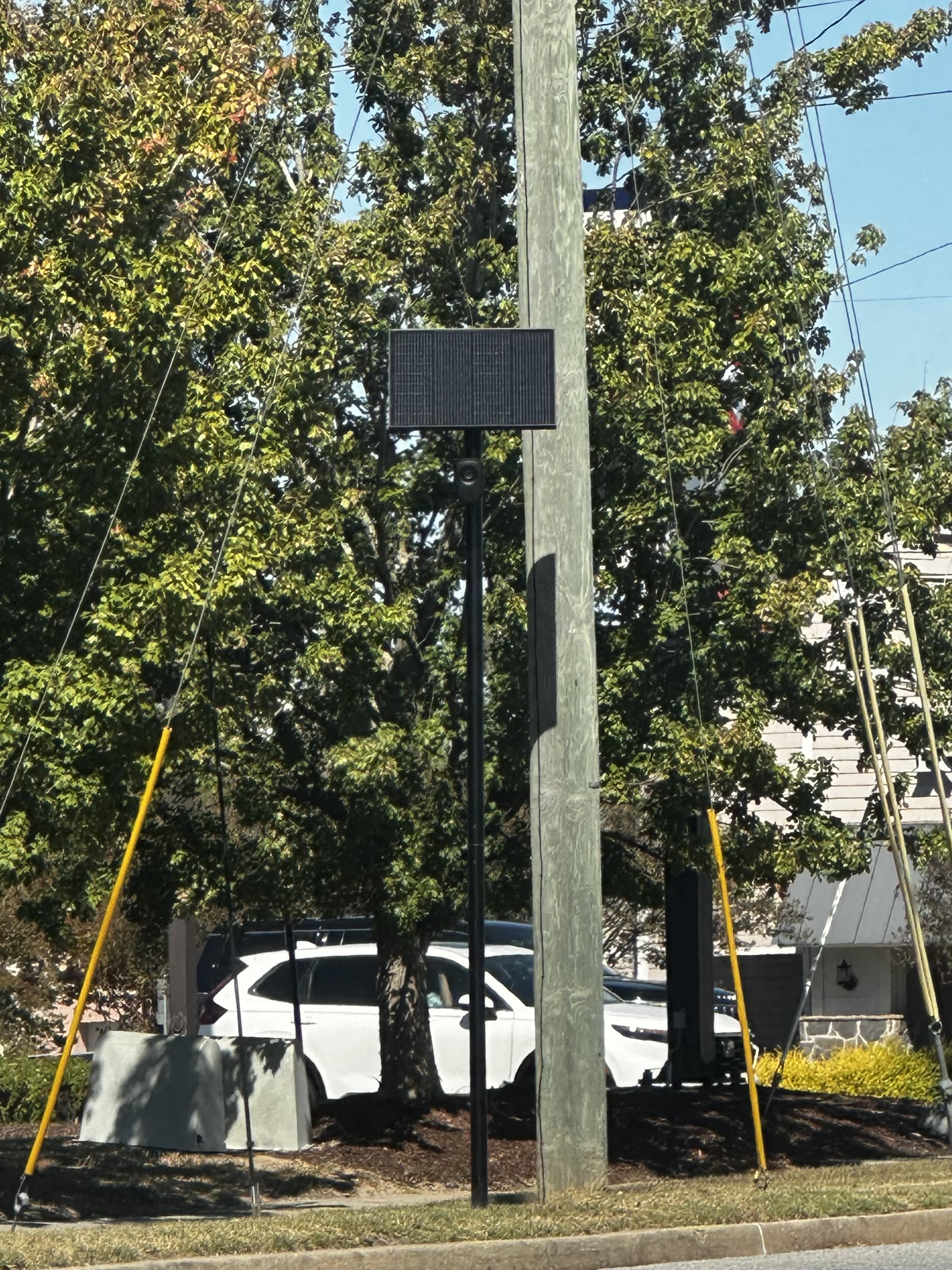
The pole is a treated wood utility pole on the east side of Fairholm Road in Columbus, Ohio, set twenty-six feet north of the driveway apron at number 1147, and Chris Chris Jr. would like you to look at what is bolted to it.
It is an automated license plate reader: gray, about the size of a shoebox, twelve feet up, a small solar panel canted south above it on its own arm. There are seven of them in Blenheim Woods. The civic association voted them in at a special meeting in February of last year, thirty-three to four. Mr. Chris voted for them, and Mr. Chris is the reason they are there.
He met this reporter at the curb on a Saturday morning in August, walked him to the pole, pointed at the bracket and said, "That's a four-bolt. They wanted a two-bolt. I said four." Then he went into the garage and came back with a can of pop, cold, and did not ask whether one was wanted.
Mr. Chris is fifty-eight. He schedules delivery routes for a food-service distributor on the west side. He has lived in the house twenty-two years, he edges the lawn in both directions, and he had the association's camera coverage map laminated at his own expense before anyone asked to see it.
He is in favor of the cameras. He is emphatically, articulately and unusually specifically in favor of them, and that specificity is why this newspaper spent four weeks and a public records request on the opinion of a single homeowner.
"Only people breaking the law have an issue with constant surveillance." — Chris Chris Jr., homeowner, Fairholm Road, Columbus
I. The Porch on Fairholm Road
The interview ran seventy-one minutes, mostly on the concrete stoop, because Mr. Chris wanted the pole in view while he talked about it. He is a good host and a poor sitter. Twice he got up mid-sentence to move a hose.
His case for the cameras began where most of these cases begin, with a two-year stretch anybody on the street can recite from memory. Between January 2023 and December 2024 the Columbus Division of Police recorded fourteen theft-from-vehicle reports on the 1000 and 1100 blocks of Fairholm Road alone, one of them from Mr. Chris's own driveway on a Tuesday night in October while he slept eleven feet away behind a bedroom wall.
In calendar year 2026 to date, on the same two blocks, the figure is three.
Reality Daily is obliged to say what a careful reader is already saying: two numbers eighteen months apart are not a causal finding. Crime moves. Reporting rates move. Mr. Chris said a version of this before we could.
"I'm not a statistician," he said. "I'm telling you what I see out my window."
II. The Argument, Set Out at Its Strongest
The position Mr. Chris holds is the oldest in the surveillance debate: nothing to hide, nothing to fear. It has been rebutted at length, in law reviews and by two of the organizations cited later in this story, and those rebuttals are serious.
But Mr. Chris did not offer the slogan and stop. He offered the slogan and then, unprompted, offered evidence, which is more than the slogan's professional opponents usually get.
What he said, at 10:58 a.m., was this: "My wife and her boyfriend can walk safely from the bar to the Motel 6 without fear of being robbed."
He said it again at 11:24 a.m., while explaining the solar panel. He said it a third time at 11:47 a.m., standing at the driver's-side door of this reporter's car, as a closing argument.
We want to be exact about why that mattered. Nearly every defense of neighborhood surveillance offered to a reporter is a hypothetical: a child who might be taken, a car that might be found. Mr. Chris did not offer a hypothetical. He offered a route, two people, a direction of travel and a time of night — a falsifiable claim about the performance of a public system, made on the record, by the man who campaigned for it.
Reality Daily checks things. That is the entire function of the building.
So we checked it.
III. What the Cameras Are and What They Record
An automated license plate reader is a fixed camera, usually pole-mounted and solar-powered, that photographs passing vehicles and writes a record: plate, timestamp, camera, direction of travel. Current units add what the industry calls a vehicle fingerprint — body type, color bucket, roof rack, decal — so a vehicle can be found without a plate at all. The best-known vendor in the category is Flock Safety. The association will not tell us which one it bought from.
Retention is typically thirty days. Retention is typically thirty days because the vendor sets it there by default, not because any statute requires it, and that distinction is the subject of Section IV.
Here is the limitation, stated plainly and early because it is real: these are vehicle systems. They are designed, marketed, priced, aimed and calibrated for vehicles. Anyone who tells you an automated license plate reader is built to track people on foot is overstating what the product is for.
They do, however, log a secondary channel. Every unit in the current generation writes a non-vehicle motion record for anything that crosses the frame and fails plate classification, sorted into flat categories: PED, PED-PAIR, PED-GROUP, CYCLE, ANIMAL. It appears in none of the four brochures we obtained. It is in the export schema, six pages of field definitions long, and in Ohio it is a public record.
IV. The Objection, Given Its Full Space
Bernadine Ottey has been a staff attorney with a state civil-liberties organization in Cleveland for nineteen years. She has litigated four records cases involving automated plate readers and lost three of them. She gave us fifty-one minutes.
"The objection is not that a camera saw you," she said. "A person on a sidewalk can see you. The objection is that the camera wrote it down, and put it in a database hundreds of other agencies can query without asking anybody's permission, and kept it for a period a vendor chose and a city council never voted on."
"People say thirty days like it is a law. It is a checkbox in an administrator panel, and I have never once had a municipality produce me a document showing who is authorized to change it."
"And aggregation is the whole problem. One detection is nothing. It is a fact about a Tuesday. Forty detections is not forty facts about forty Tuesdays. Forty detections is a pattern, and a pattern is a description of a person's life, and nobody in this process ever agreed to be described."
"The objection was never to being seen once. It is to being seen every time, by default, forever, by somebody who did not have to ask." — Bernadine Ottey, staff attorney, Cleveland
As is our practice, we read Ms. Ottey the strongest opposing material we had, unsoftened: Mr. Chris's example exactly as he gave it, and then, at her request, again.
Our transcript logs eleven seconds of silence.
"Can I ask you something about the example he gave you," she said. "About his wife and the —"
We had moved on to the retention schedule, which was the reason for the call, and we did not come back to it, and the fault for that is entirely this reporter's. Ms. Ottey sent a follow-up message forty minutes later, reproduced here in its entirety.
Did you check?
We had not yet. We took it as instruction.
V. The Request, and What Came Back
Ms. Ottey's message arrived on a Friday afternoon. The Document Desk filed on the following Monday, 17 August, with the Columbus Division of Police under Ohio Revised Code section 149.43. It was docketed R-2026-14882 at 9:14 a.m.
The period we could ask for was chosen for us, and not by us. Under a thirty-day retention default a request filed on 17 August reaches back to 18 July and no further. Everything older is already overwritten, and no records officer can produce what a system has discarded. So we asked for twenty-eight nights, 20 July through 16 August, and we asked for them narrowly.
Request R-2026-14882, as filed
"All non-vehicle detection channel records generated by automated license plate reader units 02, 04, 07 and 11 (Blenheim Woods deployment) for the period 20 July through 16 August, limited to events timestamped between 23:00 and 00:30. Requested fields: date, camera, timestamp, event classification, subject count, machine-derived heading, operator note. No image files are requested. No plate data is requested."
It was fulfilled in four days, in nine pages, at no charge, with three redactions and a cover letter that answered the question we actually asked. The Division also released two fields we had not requested: pair-persistence and per-row classification confidence. We did not ask why.
Reality Daily notes the speed because we note it every time and it is almost never true. The Document Desk has filed 2,209 requests since 2014, of which thirty-one percent were fulfilled. A public agency in Ohio did its job in four days, and the record should show it.
The extract itself was pulled on 18 August, the morning after the docket number was assigned. That date matters, and Section VII is where it matters.
VI. Twenty-Three Nights
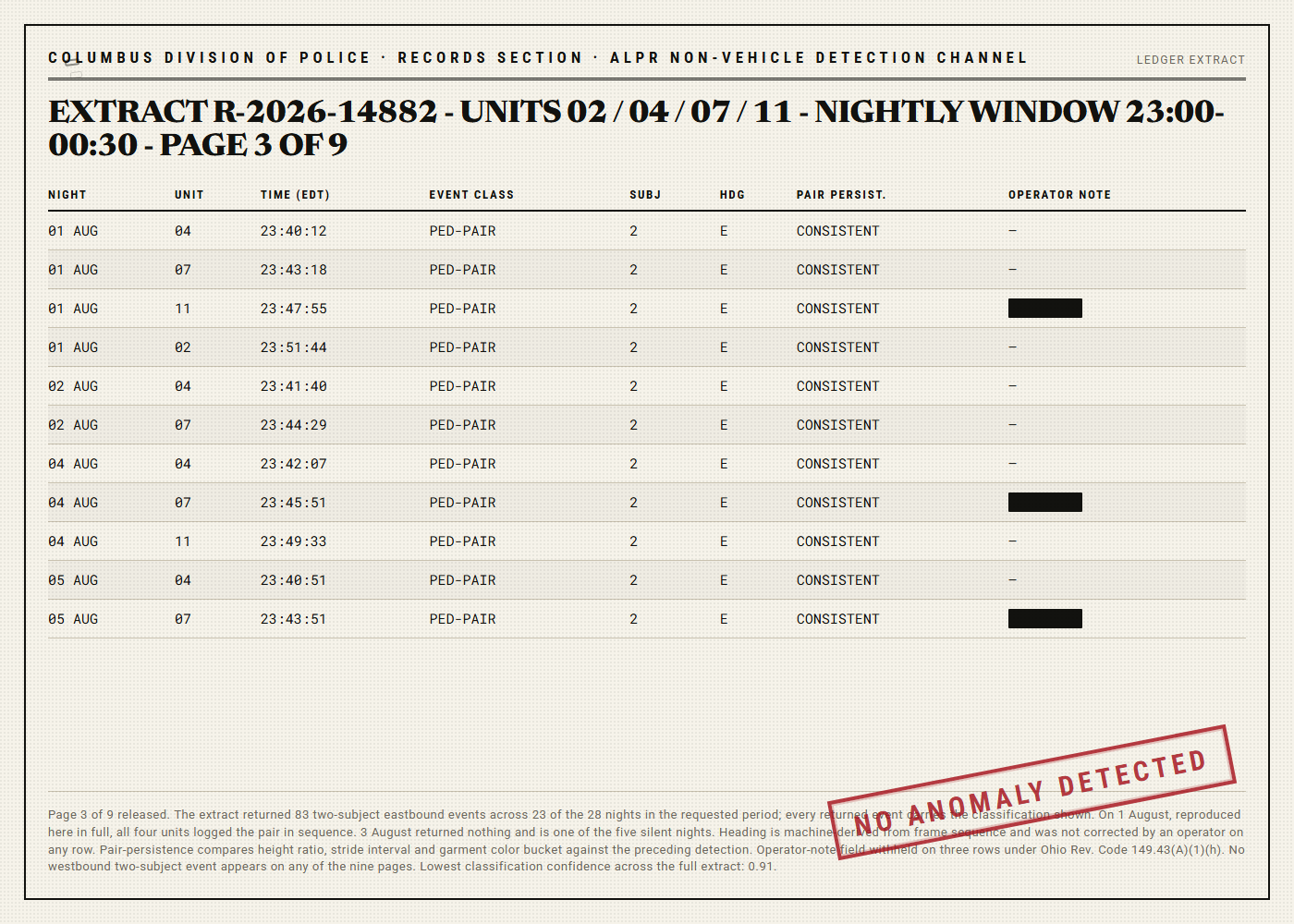
The extract covers twenty-eight calendar nights. On twenty-three of them the four cameras produced at least one detection inside the requested window. On every one of those nights, the classification is identical.
PED-PAIR. Subject count, two. Heading, east. Earliest event 11:40:12 p.m.; latest 11:52:44 p.m. Lowest classification confidence on any row across all nine pages, 0.91.
Eighty-three rows. No night with a detection produced a partial or a misclassified one. No single-subject event, no three-subject event, no cycle, no animal, and no operator correction anywhere on the nine pages.
The system's own pair-persistence field — which compares height ratio, stride interval and garment color bucket against the preceding detection — returns CONSISTENT on all eighty-three rows. The record describes the same two people, walking the same direction, at the same time, for four weeks.
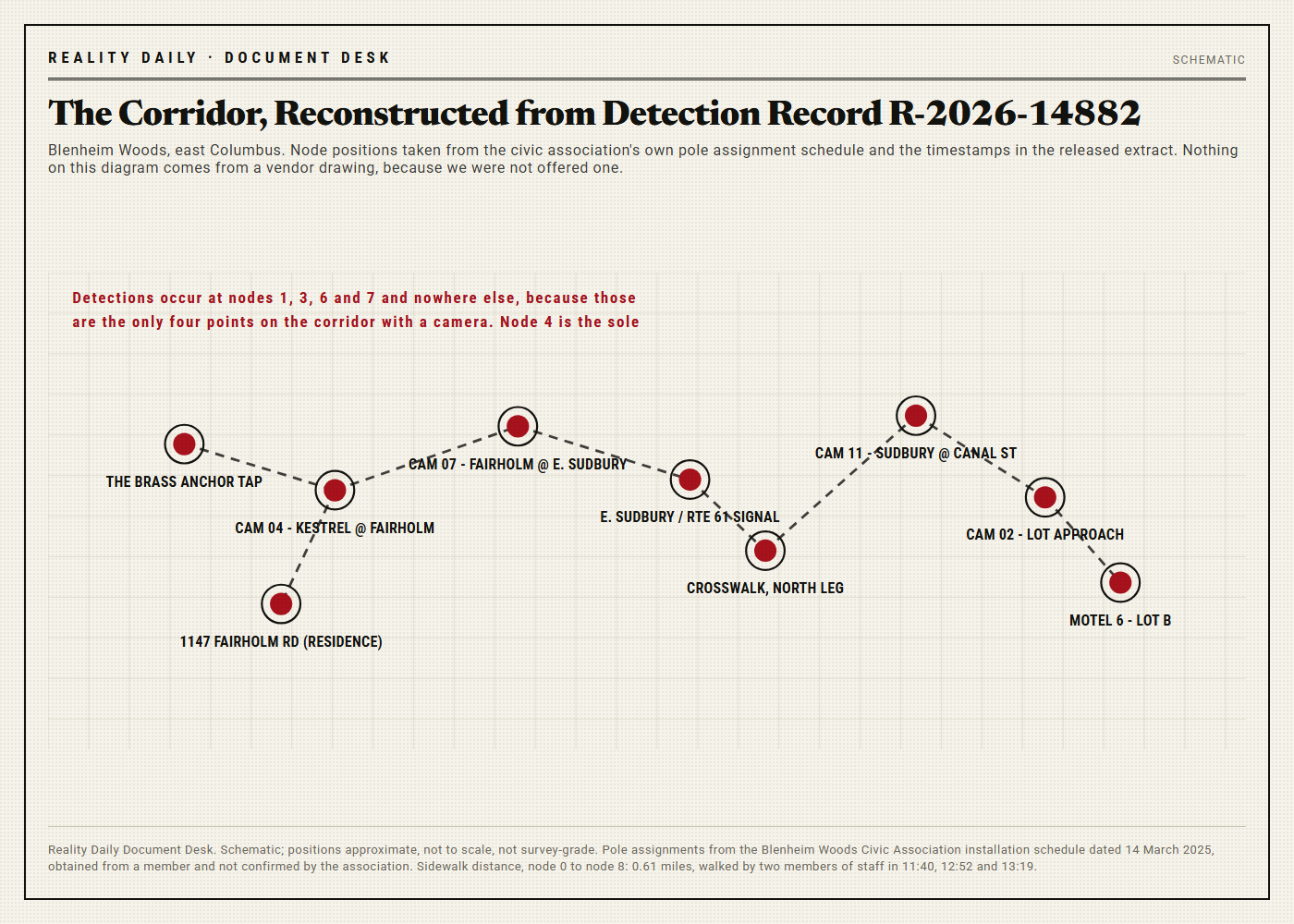
The route runs 0.61 miles from the tavern at the west end of Kestrel Avenue to the motel lot on the state route. Our own timing test, walked three times by two staff, produced 11:40, 12:52 and 13:19. The recorded window is twelve minutes and thirty-two seconds wide. The record and the sidewalk agree.
The tavern is the Brass Anchor Tap, and Ruthann Vandenbrink has held the license there since 2011. She was asked one question and gave one answer: last call is 11:15 p.m. and the room is empty by half past, seven nights a week, because she has never wanted to be in that building at midnight. The earliest detection in the extract is 11:40:12 p.m.
And there is no gap. Camera 04 logged the pair on all twenty-three nights, camera 07 on twenty-two, camera 11 on twenty and camera 02 on eighteen. On sixteen nights all four logged it in sequence, west to east, in the order the sidewalk runs. There is no stretch of that walk, at that hour, that this system does not cover.
Mr. Chris said the walk is safe. Calls for service on the corridor across the same twenty-eight nights: two, neither inside the window, neither involving a pedestrian. Reported offenses against a person: zero.
The claim was checkable. We checked it. It checks.
VII. The Records Officer
Loretta J. Sanquist has been a public records officer with the Columbus Division of Police for twenty-nine years. She authenticated the extract line by line at our request, on a recorded line, 21 August.
She confirmed that the nine pages are a direct production-system export rather than a reconstruction; that the three withheld operator notes are the only material removed; and that the extract was pulled on 18 August, when the oldest night on it, 20 July, stood on day twenty-nine of a thirty-day retention clock.
Those rows cleared the system the following night. By 15 September not one of the eighty-three will have a surviving original, and for the earliest nights the nine pages in this newsroom are already the only copy there is.
Then she said the thing our newsroom has been quoting at each other since.
Sanquist, transcript, 21 August, 2:14 p.m.
"I'll tell you what's unusual about this, and it isn't what you think. That is a clean run. Twenty-three nights, four cameras, eighty-three rows, nothing dropped, nothing misclassified, no operator correction anywhere on it. I release these all day long and I do not see clean runs. Half of what I send out has a camera that was down for a week or a channel that logged a shopping cart as a person."
"Whatever those four units are doing out there, they are doing it correctly."
We asked her about westbound movement. She answered, then answered again in a more precise form. We are printing both, because the second form is the accurate one.
"There's no westbound two-subject event on any page. If they walked back, they didn't walk back through my cameras in that window." A pause. "Or they didn't walk back in that window."
"Eighty-three rows and not one operator correction. I have never released a run like that." — Loretta J. Sanquist, public records officer, Columbus Division of Police
VIII. What the Record Does Not Establish
Reality Daily wishes to be exact, because this story will be summarized by people who have not read it, and because a detection record is a narrow instrument often asked to carry a wide claim.
- It does not establish identity. The non-vehicle channel captures no facial detail, and the Division of Police maintains no pedestrian identity index. The record says two people. It does not say which two.
- It does not establish that either subject entered the motel. Camera 02 covers the lot approach from the public right-of-way. It does not cover the lot, the building, the office, or any door.
- It does not establish a relationship between the two subjects. PED-PAIR is a proximity-and-heading classification. Two strangers walking three feet apart at the same speed are classified identically to two people who have known each other for years.
- It does not establish that either subject is Mr. Chris's wife. Mr. Chris told us his wife makes this walk. We have not spoken to her. A message left at the residence on 26 August was not returned, and we made no second attempt. We do not characterize a person we have not interviewed on the strength of a proximity flag.
- It does not establish the purpose of the walk, and we did not ask Mr. Chris about the purpose of the walk, because the purpose of the walk is not a fact about camera coverage.
- It does not establish anything about the five nights on which no detection was returned. Those nights are silent. Silence is not evidence, and we have said so in every story we have ever filed.
What it does establish, and here we intend to be equally exact, is that on twenty-three of twenty-eight nights a stretch of Columbus sidewalk 0.61 miles long produced a correctly classified, confidence-weighted record of two people walking east between 11:40 and 11:52 p.m., logged by four devices across eighty-three rows with no gap and no misclassification — which is exactly what the Blenheim Woods Civic Association pays twenty-one thousand dollars a year to obtain.
Our Standards Desk has had to open a category for it.
Standards Desk — Classification Memorandum 2026-11
Opened 27 August. Category: PEDESTRIAN — RECURRING PAIR, UNCHARACTERIZED. This is the first entry. No existing category fit the material, and the desk declines to place a verified detection sequence in a category implying a characterization the record does not support.
The finding is that the equipment works. The desk has nothing further to add and does not anticipate adding anything further. — P. A. Doggett
IX. We Read the Record Back to Mr. Chris
Standards Desk practice requires that any person whose factual claim we verify be shown the verification before publication. We returned to Fairholm Road on 24 August with all nine pages.
He read them at the kitchen table, twice, following the rows with his finger, in a house that smelled of fresh vacuuming. He was delighted. He talked for twenty-six minutes.
Every one of those twenty-six minutes was about camera coverage.
He wanted to know why camera 07 logged the pair twenty-two times and camera 11 only twenty. We told him what Ms. Sanquist told us: pole height, and a silver maple in the tree lawn at the northeast corner that fills out over the approach by midsummer. He wrote "MAPLE — SEPT MTG" on the back of the ninth page. He said the association would trim it, and from the way he said it, the association will trim it.
He asked whether we could get the same extract for the alley behind Kestrel Avenue. We told him he could file for it himself. He wrote the statute cite down too, under the maple.
Then he pushed the nine pages back across the table and said it a fourth time.
"I'll say it again. My wife and her boyfriend can walk from that bar to that motel and nothing happens to them. Not one thing. That's the cameras. That's what that is, right there on the paper." — Chris Chris Jr., 24 August, reading the extract at his kitchen table
He asked if we wanted another pop. It was August. We said yes.
X. What We Are Not Saying
We are not saying automated license plate readers should be installed, or should be removed. We held no position on that when we started and have not acquired one. Ms. Ottey's objections are serious, are on the record at length above, and are not answered by anything in these nine pages.
We are not saying we identified anyone. There are no names in the record and we have not put any there.
We are not saying Mr. Chris's claim was doubted. It was checked. Those are different operations, and the difference between them is the entire trade, and the profession has spent twenty years forgetting it.
We are saying one narrow thing, and it is the only thing this story establishes: a homeowner made a specific, falsifiable, first-hand claim about a public surveillance system in his own neighborhood, and that system's own records confirmed it on twenty-three separate nights, in eighty-three separate rows, without a single misclassification, and those figures have not appeared in print anywhere before this page.
XI. Conclusion
Seven cameras. Twenty-one thousand dollars a year, divided among 244 households, which is eighty-six dollars each. A vote of thirty-three to four at a February meeting whose minutes have been requested twelve times and not produced.
Against that: nine pages. Twenty-eight nights requested. Twenty-three nights returned. Eighty-three rows. Four cameras. Zero gaps. Zero misclassifications. One direction. One window twelve minutes and thirty-two seconds wide. A lowest confidence figure of 0.91.
Mr. Chris asked us twice to make sure we printed the part about the walk. He was right, and we will print it once more.
His wife and her boyfriend can walk from the bar to the Motel 6 without fear of being robbed. The cameras cover every foot of it. The record proves it. The record proves it eighty-three times.
■ ■ ■
The Blenheim Woods Civic Association was asked twelve times, between 11 and 29 August, for its vendor contract, its written retention policy, the name of the person authorized to change the retention setting, and the minutes of the February vote. Eleven produced nothing. The twelfth produced a message from the association president, Doyle Ambrister, timed 6:02 a.m. on 29 August, reproduced unedited, as our standards require.
This has been discussed.
It has been discussed. We would like very much to see where. The space beneath this paragraph is held open indefinitely for the association's response, at whatever length it chooses, without commentary from us.
One further note. Mr. Chris has offered to walk the route himself with a reporter, at 11:40 p.m., to demonstrate the lighting at the Route 61 signal, which he considers inadequate and intends to raise in September alongside the maple. We have accepted. We will file what we see.
Corrections & Clarifications
Update, 06:48 — An earlier version of this article reported that Mr. Chris offered the walking-safety argument twice during the 8 August interview. Review of the full recording confirms he offered it three times, at 10:58, 11:24 and 11:47 a.m., and a fourth time on 24 August. Our original characterization of the argument as repeated stands, and is strengthened.
Update, 10:21 — We initially gave the detection window as 11:41 to 11:52 p.m. The earliest event in the extract, on 1 August at unit 04, is timestamped 23:40:12. The correct window is 11:40 to 11:52 p.m. The window is one minute wider than first reported. The finding, which was that every detection falls inside a single narrow window, is unaffected and remains that every detection falls inside a single narrow window.
Update, 15:33 — A reader writes to point out that automated license plate readers are designed to read license plates and are not built to follow people on foot. Reality Daily agrees, said so at length in Section III, and notes that the released record nonetheless contains eighty-three correctly classified two-subject pedestrian detections across twenty-three nights, which is the finding of this story. We thank the reader for confirming that our Section III is being read.
Sources & Documentation
- Reality Daily Document Desk. Ohio Public Records Request R-2026-14882, filed 17 August with the Columbus Division of Police under Ohio Rev. Code § 149.43. 1 p. Docketed 9:14 a.m. Reproduced in full at Section V.
- Columbus Division of Police, Records Section. ALPR Non-Vehicle Detection Channel Extract, Units 02/04/07/11, 20 July – 16 August. 9 pp., 83 rows, released 21 August. Three operator-note fields withheld under § 149.43(A)(1)(h). Two fields released beyond those requested.
- Sanquist, L. J. Recorded telephone interview, 21 August, 2:14 p.m. EDT. Transcript 18 pp., reviewed and approved by subject.
- Chris, C., Jr. Recorded interview at residence, 8 August, 10:41 a.m. – 11:52 a.m. EDT. Transcript 34 pp. Subject declined to review and said we should print whatever he said.
- Chris, C., Jr. Second recorded interview at residence, 24 August, 26 min. Transcript 11 pp. Conducted solely to read the verified record back to the subject, per Standards Desk practice.
- Ottey, B. Recorded telephone interview, 14 August, 51 min. Transcript 22 pp. Quoted material approved in full and without amendment.
- Ottey, B. Follow-up electronic message, 14 August, 4:51 p.m. Three words. Reproduced in full at Section IV.
- Vandenbrink, R. In-person interview, the Brass Anchor Tap, Kestrel Avenue, 16 August. Reporter's notes, 4 pp. Licensee since 2011. Stated closing time confirmed against posted hours and against the Ohio liquor permit on the wall behind the register.
- Blenheim Woods Civic Association. Installation Schedule and Pole Assignment, 14 March 2025. 2 pp. Obtained from a member. The association has neither confirmed nor disputed it.
- Blenheim Woods Civic Association. Minutes of the Special Meeting of 2 February 2025 (vote 33–4). Requested twelve times. Not produced.
- Camera coverage map, laminated, produced by the subject at interview. Photographed both sides, 3,024 × 4,032 px, EXIF intact.
- Columbus Division of Police, published incident statistics, reporting area covering the 1000–1200 blocks of Fairholm Road, calendar years 2023–2026.
- Calls for service, corridor nodes 0 through 8, 20 July – 16 August: 2. Neither within the 23:00–00:30 window. Released with the extract, unrequested.
- American Civil Liberties Union. Published materials on automated license plate reader retention, network search and interagency sharing, 2013–2025. Reviewed in full.
- Electronic Frontier Foundation. Street-Level Surveillance: Automated License Plate Readers. Reviewed in full.
- Vendor product literature, ALPR category, four manufacturers, 58 pp. total. Default retention stated: 30 days (three); 30 days, configurable (one).
- Export schema documentation, non-vehicle motion channel. 6 pp. Field definitions PED / PED-PAIR / PED-GROUP / CYCLE / ANIMAL. Not referenced in any of the four brochures above.
- Reality Daily Document Desk. Corridor Walk Timing Test, node 0 to node 8, three trials, two staff. 11:40 / 12:52 / 13:19.
- Reality Daily Standards Desk. Classification Memorandum 2026-11, opening the category PEDESTRIAN — RECURRING PAIR, UNCHARACTERIZED. 1 p. First entry.
- Reality Daily Standards Desk. Record of Comment Requests to the Blenheim Woods Civic Association, 11 August – 29 August. 12 entries; 1 reply, of four words.
- Ambrister, D. Electronic message, 29 August, 6:02 a.m. Reproduced in full and unedited at the foot of this story.
- Message left at the residence for the second subject described in Mr. Chris's account, 26 August. No response as of publication. No second attempt made, by decision of the Managing Editor, Standards.
- Reality Daily Legal. Memorandum on the Publication of Non-Identifying Pedestrian Detection Records. 3 pp.
- Franklin County auditor, parcel record, 1147 Fairholm Road. Owner-occupied since 2004. Lot 0.19 acres.
- Reality Daily Reader Correspondence File RD-C-5108, opened at publication, currently empty.
- The extract. Twenty-three nights. Eighty-three rows. Nobody has disputed a line of it.
Reader Response — 4,074 comments
I installed and serviced these for four years. Different vendor, different state, not this deployment. The non-vehicle channel is exactly as described here. It is not in the sales deck and it is in the export, and PED-PAIR really is just proximity plus matched heading over a couple of frames. Nobody buys these units for that. It is a byproduct of the motion classifier. The article gets it right, including the part about it being a byproduct.
Two streets over from Fairholm. I voted against the cameras at that meeting and I will say the rest out loud too: the break-ins stopped. I still think Ms. Ottey is right about the retention checkbox and I still want to see that contract.
Respectfully: three thousand words, nine pages of public records and a laminated map to establish that two people walked east.
@Nate Brindisi — Correct. That is the story. A specific and falsifiable claim was made about the performance of a publicly sited surveillance system, and the system's own logs confirmed it on twenty-three nights out of twenty-eight, across eighty-three rows, with no coverage gap, no misclassification and no operator correction. We have not obtained a comparable verified run from any agency in twelve years of requests. Your summary has been added to the correspondence file.
the man specified a four-bolt bracket. they offered two and he said four. i would follow this man into any zoning hearing in america.
Ms. Ottey's three paragraphs are the clearest short statement of the aggregation problem I have read anywhere, including in the case law. Please print the retention half of that interview. The reporter admits he dropped it.
Trim the maple. He is right about the maple. A silver maple in a tree lawn will take out an approach angle in one season and the association has known about that tree since 2019.
Filing the same request for my own street tomorrow morning. Thank you for printing the docket format and the statute cite instead of just saying you filed something.
Twenty years as a claims adjuster. "No anomaly detected" is the most expensive three words in any file I have ever opened.