Trump and Obama Call Each Other Every Night to Say Goodnight and Always End With “I Love You”
For fourteen months a telephone call has been placed on 423 of 426 consecutive nights between a residence in Palm Beach County and one in Kalorama, inside a nine-minute window, lasting on average four minutes and eleven seconds. Reality Daily has obtained the metadata. The field containing what was actually said arrived from the government already blacked out, under the exemption the government reserves for private life.
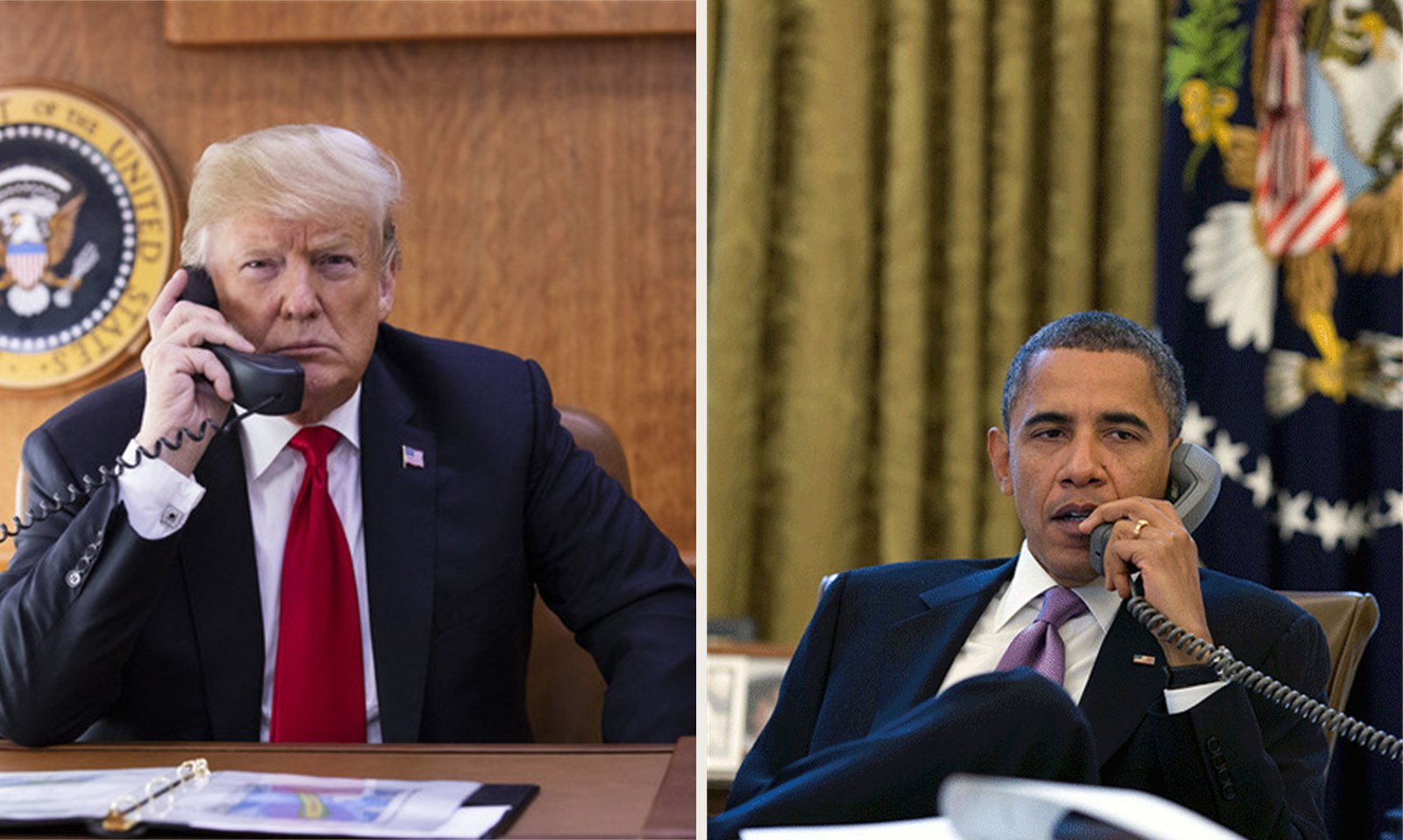
Editor's Note
This story was held for eleven weeks, which ties the longest we have ever held anything, and not for the usual reason. The usual reason is that a party has not answered us. In this instance the party did answer, in a fashion, by releasing four hundred and twenty-six nights of telephone metadata with a single field removed, and it is this newsroom that has been unable to answer itself. The Standards Desk convened four times on whether the story could be published at all. Accuracy was never the question. Every figure below has been verified twice, by two readers who did not know what the other had found.
Readers should also know that we have broken our own rule in order to print it. Our standard is twelve requests for comment before we publish without one. We have sent nine to each office and we are not sending the remaining three. That rule exists to make institutions answer for their conduct; applying it here would have meant writing to two private men three more times each to demand an explanation of something that is not the public's business and that this paper has already decided it does not want explained. I am recording the departure rather than quietly reaching the number, because a paper that conceals a breach of its own standard has no standard. I am publishing at nine because our standards contain no exception for stories that make us uncomfortable, and because Ms. Doggett, who runs the Standards Desk and who voted against running this twice, wrote in her final note that a paper which spends its life demanding documents does not get to look away from the one it received. Both offices have been offered unlimited space, at any length, unedited, with no commentary from us. That space is open and will stay open. — M. Vandersloot
Every night, at a time that has varied across fourteen months by no more than nine minutes, a telephone call is placed between a residence in Palm Beach County, Florida, and a residence in the Kalorama neighborhood of Washington, D.C. It is answered, nearly always, before the second ring. It lasts, on average, four minutes and eleven seconds. Reality Daily has obtained partial call detail records covering 426 consecutive nights. The call appears on 423 of them.
We can establish that call to the second. Connect times, durations, direction of origination, the trunk group the path rides, the supervision signals that open the circuit and release it. Two Standards Desk readers went through all 424 released rows independently and found no discrepancy.
We cannot establish one word that was said.
The two parties appear on this page as the release names them: trunk attributions with initials appended. We will state at the top what the release does not, because nothing below is intelligible without it. These are two men whose public conduct toward one another is among the most exhaustively documented hostilities in American life — more than a decade of it, in speeches, interviews, books and broadcast segments, on the record and at volume, continuing without a week's interruption through every one of the 426 nights in this file. We are not going to reconcile that. Section VIII is the account of our failure to.
Three former White House switchboard operators, interviewed separately over five months, none of whom will allow us to print a name, have each described the final exchange of these calls in the same words. Those words are in no file we hold. The field in which they would appear is a black rectangle with a statutory citation printed beside it.
What follows is a great deal of evidence. In the one respect any reader will care about, it is none.
"You don't need eleven seconds to hang up a telephone. One second is a hang-up. Eleven seconds is two people not wanting to be the one who does it."— Delmar J. Whitcomb, retired staff sergeant, White House Communications Agency switching branch, 1979–2004
I. The Request, and the Thing We Did Not Ask For
On 12 June, Tobias Wrenn of our Document Desk filed a records request, logged as RD-FOIA-2211, for telecommunications metadata associated with support furnished to former presidents under the Former Presidents Act of 1958. The White House Communications Agency is a real military unit, and certain federally furnished support does continue after a president leaves office. We state both facts only so that no reader mistakes the scaffolding for the finding.
The request was deliberately narrow: trunk attribution, connect and disconnect timestamps, duration, supervision events. We want to be exact here, because this will be mischaracterized — we did not ask what was said.
The response arrived 131 days later: nineteen pages of tabular extract, a cover letter, an index. It was fulfilled competently by a records access officer whose name is on that cover letter and which we are not printing, on the ground that this newsroom does not name a working civil servant who has done nothing except their job. The grade is on the form and we will print that much: Government Information Specialist II. We mention the officer first because the officer appears to be the only person in this story who did anything on time.
The extract format contains fourteen fields. Thirteen are the ordinary furniture of a call detail record. The fourteenth is labeled, in the schema legend, CONT/DISP.
We did not ask for field fourteen. We did not know it existed. It arrived redacted, which is how we learned of it. There is a discovery available only to people who file narrow requests: you find out what a system keeps by seeing which part of it comes back covered.
II. The Window
Herschel Bove, who runs our economics and data desk and believes a number without a denominator is a rumor, spent nine days making the file interrogable. The arithmetic is the only part of this story that will survive contact with our critics, so we are going to go slowly.
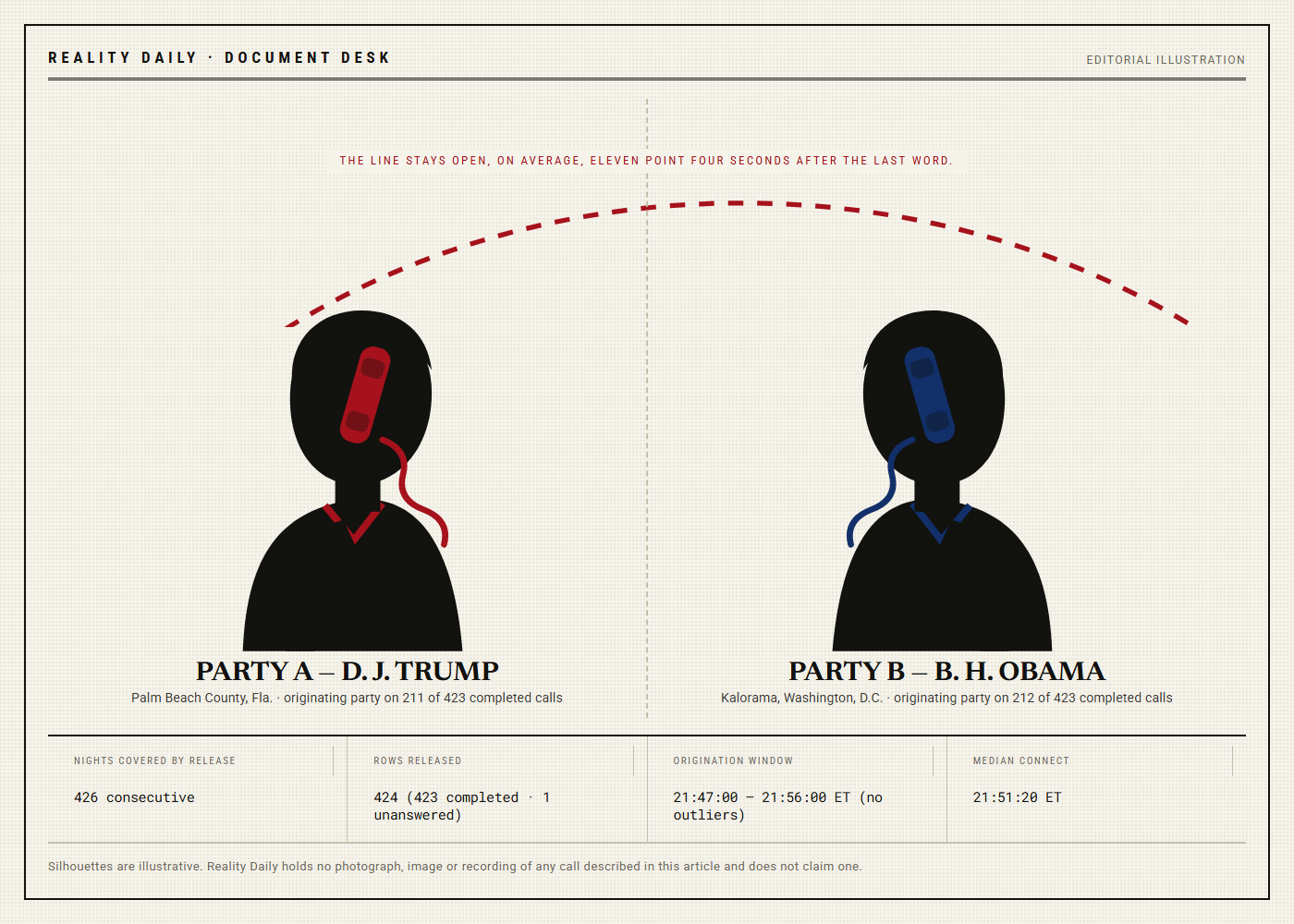
Across the 423 completed calls, origination occurs between 9:47:00 p.m. and 9:56:00 p.m. Eastern. Not approximately. In every instance. The median connect is 9:51:20 p.m. The window has no outliers, for the reason that there is nothing outside it to be an outlier of.
Duration requires care and we will take it in public. Set aside one night — Night 332, which we come to in Section VII — and the remaining 422 calls have a mean of 249 seconds, four minutes and nine, with a standard deviation of 18.6 seconds. Put Night 332 back in and the mean is 251.1 seconds, four minutes and eleven, and the standard deviation is 47.2.
We print both, and we tell you which number we removed, because 18.6 seconds is the honest description of an ordinary night and 47.2 seconds is the honest description of the file, and a standard deviation that quietly swallowed Night 332 would be a lie of arithmetic. Mr. Bove asked that this paragraph not be cut for space. It has not been.
Excluding Night 332, the shortest call in fourteen months is three minutes eleven and the longest five minutes four. Night 332 is nineteen minutes and three seconds.
Origination alternates strictly, one night to the next, with a single exception we are not going to preview. Party A originates on 211 of the 423 completed calls and Party B on 212; across all 424 released rows, including one origination never answered, it is 211 to 213. Mr. Bove ran the sequence against nine randomization models. It failed all nine, which is what a strictly alternating sequence does, and he asks us to record that running them was not a waste of his time because the alternative was assuming.
It looks like turn-taking. It looks like two people who worked out, without writing it down, whose turn it is.
We are not qualified to say what that means. Mr. Bove, who has modelled commuter departures and medication adherence in chronic-care cohorts, notes that this is tighter than medication adherence, and that nobody is reminding them. And we are obliged to say here, rather than six sections down where it would sit more comfortably, that across all 426 of these nights the same two parties were conducting one of the loudest feuds in the country, in public, with their names on it. We have no framework in which to hold both files at once.
III. What a Call Detail Record Establishes, and What It Cannot
A call detail record is a real and unglamorous telecom artifact. Switches generate them by the billion, and they capture originating number, terminating number, when the path opened, when it closed, duration and route. They do not capture content. They never have. This is not a policy. It is an architecture.
Nadine Prilosky, twenty-two years a switch engineer for a regional carrier in Council Bluffs, Iowa, reviewed Mr. Bove's methodology and found two places where we were overreaching. We corrected both. "The switch is not listening," she said. "The switch is counting. If somebody tells you a CDR proves what was said in a call, that person is either confused or selling something."
We asked what a fourteen-month unbroken run of a four-minute call would tell her with no names attached. She said it would tell her the call was a fixture, and fixtures are usually machines — a nightly file transfer, a monitoring poll, an automated test. The giveaway for a machine is that its durations are either identical or wildly variable. This file is neither. Then she said the sentence that appears in the minutes of all four Standards Desk convenings, cited twice as a reason to run this story and twice as a reason not to.
"A call detail record can prove that two people were on a line together every night for a year. It cannot tell you whether they were kind to each other. And I want you to notice that the second part is the part you actually want."— Nadine Prilosky, switch engineer (ret.), Council Bluffs, Iowa
IV. Field Fourteen, and the Exemption Nobody Should Have Chosen
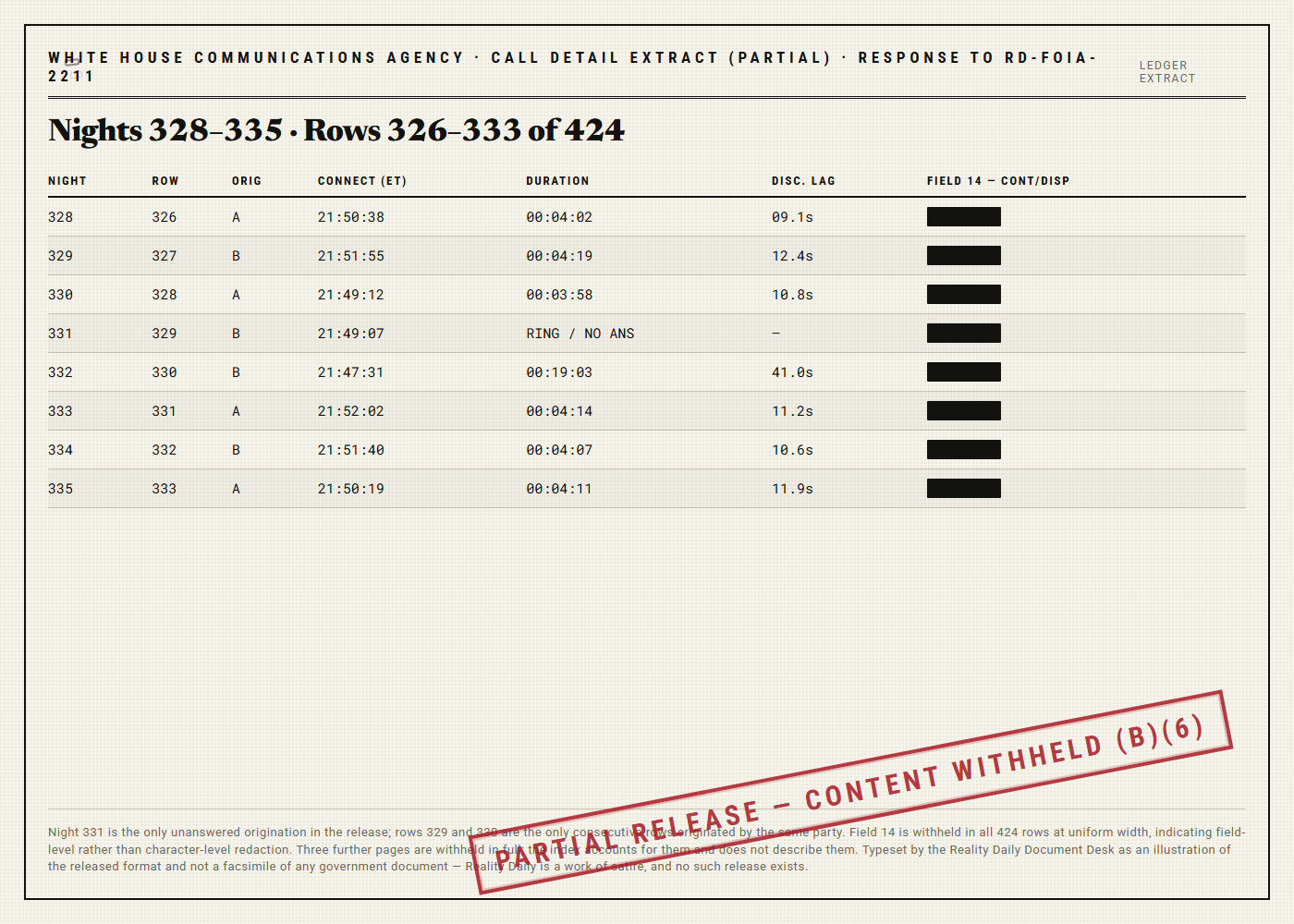
Field fourteen, CONT/DISP, is redacted in all 424 rows, including the unanswered origination of Night 331, uniformly and at identical width, which indicates a field-level rather than a character-level withholding. Three further pages are withheld in full. The index accounts for them and does not describe them.
The citation printed beside the redaction is 5 U.S.C. § 552(b)(6).
We are going to be pedantic here, because this is the load-bearing fact of the article and everyone summarizing this story will skim past it. Exemption (b)(5) is the deliberative-process exemption. It covers inter-agency memoranda — the machinery of government doing government things — and it is what an agency reaches for when a document concerns official business it would rather not discuss.
Exemption (b)(6) is a different animal. It covers personnel files, medical files, and "similar files" whose disclosure would constitute a clearly unwarranted invasion of personal privacy. It is the exemption for a person's private life.
The agency did not withhold field fourteen as government business. The agency withheld it as somebody's private life. That is a characterization, made by the United States government, in writing, on a form, and it was not intended as one. It is the closest thing to a comment on the content of these calls that any official body has provided.
We wrote on 4 November to ask whether the designation was deliberate or an administrative default. The reply was two lines, reproduced in full because it is two lines:
THE (b)(6) DESIGNATION IS CORRECT AS APPLIED. NO FURTHER EXPLANATION IS AVAILABLE. — GOVERNMENT INFORMATION SPECIALIST II, OFFICE OF RECORDS ACCESS
What the File Does Not Contain
No transcript. No recording. No summary. No operator annotation in any released row. No routing memorandum establishing when the arrangement began. No termination date. No authorization document. No reference to any of it in any other record we have obtained in seven months of looking.
V. Three Operators, Independently, None of Whom Will Be Named
Between March and July, three former White House switchboard operators spoke to Reality Daily. The circumstances of each contact are the only part of this section that can be examined at all, so we set them out precisely. The first spoke by telephone for forty-one minutes, would not be recorded, and permitted contemporaneous notes. The second met a reporter at a diner off Route 301 in Waldorf, Maryland, for twenty-two minutes and permitted no notes. The third answered four questions in writing through an intermediary who would not carry a fifth sent the same afternoon, and declined all follow-up.
Our procedure for authenticating a reconstruction written in a car is not elaborate, and we set it out so that readers can weigh it themselves. The reporter wrote the account longhand in the vehicle, photographed each page before leaving the lot, and sent the photographs to the Standards Desk, which logged receipt at 3:14 p.m. and sealed the originals unread until morning. That timestamp is the only element of the second account that any party other than our own reporter has verified. We are therefore able to state with certainty when the account was written down, and nothing whatsoever about whether it is true. This is the general condition of this section.
None of the three, so far as we can determine, knows that the others spoke to us. We say "so far as we can determine" because it is the honest formulation and a stronger one would be a lie.
Each was asked one opening question, identical in all three instances: Is there anything about the end of the call? The Standards Desk has flagged that as a leading question. The Standards Desk is correct. We print the flag alongside the answers, which is our policy and which here costs us something.
The Three Accounts, as Recorded by the Standards Desk
Operator One: "It ends the same way every time. Both of them. 'I love you.' Then whoever it is says goodnight and that's it."
Operator Two: "You'd catch the tail of it bridging off. 'I love you.' Both ends. I stopped noticing after about a month, and then I noticed that I'd stopped noticing."
Operator Three (written): "They say I love you. They both say it. I would not swear to anything else in this business but I will swear to that, and I still won't put my name on it."
Now we must be careful, and being careful here is not a formality. Three unattributed accounts, independently obtained, converging on an identical phrase, establish one thing: three people in a position to know say the same thing. That is not nothing. It is more than most published claims rest on. It is also not a document, and the difference between those categories is this newspaper's entire reason for existing.
It would be easy to write that the phrase is "confirmed by three independent sources." That sentence would pass at nearly every publication in the country and would still be doing work the evidence has not done. Convergent unattributed testimony is at once the weakest evidence we publish and the strongest anybody has assembled about these calls. We would rather be uncomfortable than tidy.
VI. Mr. Whitcomb, Who Would Go on the Record
Delmar J. Whitcomb is seventy-one. He served in the switching branch of the White House Communications Agency from 1979 to 2004 and retired a staff sergeant. He lives in Sykesville, Maryland, and voices church pipe organs for congregations that cannot afford the firms that do it properly. He returned our call on the first attempt, which almost nobody in this story did.
He would confirm nothing about content, and wanted the reason recorded. "I never listened to a call in twenty-five years," he said, "and I am not going to spend my retirement being the fella who says he did." We asked twice. He declined twice. We would ask readers not to write to him.
He confirmed one thing about routing. A call of this description does not ride a commercial path end to end; it hands off to an agency-managed trunk group whose supervision holds the path open until both ends release it, and which logs the interval between the last speech energy on the line and the release.
We asked what that interval ordinarily is, on an ordinary call, between ordinary people.
He said one second. Maybe two. Somebody says goodbye and somebody hangs up the phone.
In our file, across 423 completed calls, the mean interval between final speech energy and release is eleven point four seconds. The maximum is forty-one. Nine calls exceed thirty. Not one is under four.
One sentence belongs here that an orderly plan of this article would put two sections down. In the month those intervals were recorded, one of these parties described the other, in a broadcast interview we hold on file, as among the worst things ever to happen to the country, and the other, at a public event eleven days later, declined to say his counterpart's name aloud when invited three times to do it. We put it here because Section VIII is a long way down, and because a reader is entitled to know who is on the other end of eleven point four seconds.
We read Mr. Whitcomb the number. Our transcript logs a pause of eight seconds. Then: "You don't need eleven seconds to hang up a telephone. One second is a hang-up. Eleven seconds is two people not wanting to be the one who does it." And then, immediately: "Now don't you make that sound like more than it is." And then he asked us to read the number again. And we read it again. And he said, "Okay." And that was the end of the interview.
VII. The Three Nights
There are three nights in 426 on which no call is completed. We examined all three. We will print what we found and then stop, and readers who find the stopping unsatisfying are invited to consider why they wanted more.
Night 88. The release documents a scheduled maintenance window on the relevant trunk group from 9:00 p.m. to 11:30 p.m. Eastern. There is no call because there is no path. An explanation. Boring. Almost certainly correct.
Night 265. Publicly filed aircraft movement data places one party over the North Atlantic for the entirety of the window. There is no call. Also an explanation. Also boring.
Night 331. The record shows an origination at 9:49:07 p.m. It rings. It is not answered. The path releases at 9:49:51 p.m., forty-four seconds later. It is the only unanswered origination in the file, and it is not retried that night.
On Night 332 the call runs nineteen minutes and three seconds. It is the longest in the file by thirteen minutes and fifty-nine seconds and carries the longest disconnect interval we recorded, forty-one seconds. It was placed between two men who, across the fourteen months this release covers, said nothing warm about one another in public on any occasion we have identified, and we have identified 1,140 occasions.
The same party originated on Night 331 and again on Night 332. It is the only place in 424 rows where the same party originates on two consecutive nights.
The following night runs four minutes and fourteen seconds. The file resumes its ordinary shape and does not vary again.
Reality Daily has spent six weeks on Night 331. We checked weather, commercial power, published schedules, court dockets, hospital admissions in two jurisdictions, and every public appearance either party made in the surrounding seventy-two hours. We found nothing. We are printing the date and the forty-four seconds and declining to say what they mean, because we do not know, and because there is a version of this paragraph that would be very moving and would also be invented.
VIII. The Public Record, Which Does Not Match the Metadata
The antagonism has now been stated three times above and has to be accounted for, because it is what makes this file difficult rather than merely charming. Donald Trump and Barack Obama have been publicly hostile toward one another for more than a decade — speeches, interviews, rally remarks, books, broadcast segments, in front of everyone, none of it retracted. Their brief exchange at the funeral of George H. W. Bush in December 2018 lasted seconds, was photographed from four angles, and produced by our count more than nine hundred separate items of commentary.
Mr. Bove compiled every public statement either man made about the other during the fourteen months our records cover. There are 1,140. Three coders, working without conferring, rated each on a five-point warmth scale. Inter-coder agreement is 0.91. The corpus mean is 1.6.
On the night of the most hostile statement in that corpus — coded 1.0 by all three coders, independently — the call was placed at 9:50:44 p.m. and ran four minutes and six seconds. That is five seconds under the file mean, inside one standard deviation on either computation. The disconnect interval that night was twelve seconds, which is above the mean.
We are not going to reconcile that. Every reconciliation we drafted required us to assert something about the interior life of two men we have never met. Nobody else has reconciled it either, because until this morning nobody knew there was anything to reconcile.
"Public conduct and private conduct are two records. We are trained, professionally and culturally, to treat the loud one as the real one. There is no methodological basis for that preference. There is only volume."— Prof. Adele Marchetti-Hoyt, Presidential Records Act scholar
IX. The Newsroom's Own Discomfort, and a New Category
This is a newspaper that does missing invoices. We are good at missing invoices. Our methodology is built for institutions that will not produce a document, and our temperament — dogged, literal, faintly aggrieved — is calibrated for adversaries.
We spent eleven weeks trying to make this a story about records continuity. There is one in it: a federal system generating a category of record no institution has acknowledged, withheld under an exemption whose selection is itself a disclosure. That is Section IV, and Section IV is real reporting.
It is not what this is. We have tried very hard for it to be what this is.
The Standards Desk convened on 14 August for three hours and forty minutes on a single question: whether the phrase in Section V could be printed, and under what characterization. Our standards say we do not rate things, because ratings are conclusions dressed as findings. The desk found — correctly, in my judgment, and I ran the meeting — that here both available characterizations function as ratings and both mislead. "Verified" claims a document we do not have. "Unverified" implies a doubt nobody on this staff holds.
Standards Desk Determination SD-441, filed 14 August, 6:52 p.m.
The phrase attested in Section V is hereby assigned Category IV: Reported Identically by Independent Parties; Not Documented; Not Disputed; Not To Be Characterized.
Category IV is created by this determination and did not previously exist. It has one member. Staff are directed not to describe Category IV material as verified, unverified, alleged, reported, claimed, or believed. Staff are directed to state what was said, by whom, under what conditions, and to stop.
Ms. Vandersloot has asked me to record, over my objection, that I voted against publication twice and in favor once, that the third vote is the one that counted, and that I remain unsure it was correct.
I will add one thing in my own voice, which this desk does not do. The phrase "two men saying goodnight" appears below. In the first three drafts it read "two former presidents saying goodnight." I struck it each time and could not say why until the fourth pass, when I wrote in the margin — I am quoting my own marginalia because the Editor-in-Chief insisted — they are not being presidents when they do this.
X. What We Are Not Saying
Reality Daily wishes to be exact, because this story will be summarized by people who have not read it, and this one will be summarized affectionately, which is worse.
We are not saying we know what is said on these calls. We have 423 durations and zero words.
We are not saying these two men are friends. We have evidence of a schedule, kept without exception for fourteen months by two people with every conceivable public reason not to keep it.
We are not saying the antagonism is performed or insincere. We have no basis for that and would resent anyone who wrote it under our masthead. Both records exist. Both are real. We are publishing the one nobody had.
We are not saying anything at all about Night 331. We have printed a date, forty-four seconds, and the fact that the same party originated again the next night. That is the whole of what we know.
And we are not saying this is a small story because it is a tender one. We looked, for weeks and in earnest, for a defensible reason to treat it as minor. There is not one.
XI. Conclusion
426 nights. 423 calls. 424 rows. A nine-minute window with no outliers. A mean of four minutes and eleven seconds; a standard deviation of forty-seven point two, or eighteen point six with Night 332 removed, and we have told you which number we removed. Two hundred and eleven originations to two hundred and twelve, strictly alternating, once out of order. Eleven point four seconds of open circuit before either man will release the line.
Everything about this call that can be counted has been counted. All of it points at the one thing that cannot be, which is two men saying goodnight.
Field fourteen is black in 424 consecutive rows, under the exemption reserved for private life, applied deliberately and confirmed in two lines by a specialist who declined to elaborate and was, we think, right not to.
We would also like to record, and we recognize that a serious paper should not print this, that we are no longer certain we want it opened.
■ ■ ■
Reality Daily has written to both offices nine times each, on paper, at the addresses kept for post-presidential correspondence. Each letter offered unlimited space, at any length, printed in full and unedited, with no commentary from us. Our standard is twelve requests and we have stopped at nine, for the reason the Editor-in-Chief sets out at the head of this article. The offer stands indefinitely. The space has been open since 12 June. Neither office has responded, and we want to say something about that which is not the thing we usually say. Usually a silence is a refusal, and we print it as one, and we are good at printing it as one. This silence does not read that way.
The call was placed again last night, at 9:52:11 p.m. Eastern. It ran four minutes and nine seconds. The line stayed open for thirteen seconds after the talking stopped. We do not know what was said. The Standards Desk has asked me to note, for the record, that it no longer wants to.
Corrections & Clarifications
Update, 05:41 — An earlier version of this article gave the mean call duration as "approximately four minutes." Following a full recount by the Standards Desk, the mean call duration is four minutes and eleven seconds. The original approximation was correct and is now also precise.
Update, 10:16 — Three readers have written to say that Section IV should read "all 423 rows" rather than "all 424 rows," on the ground that the release documents 423 completed calls. Field fourteen is withheld in all 424 rows. The 424th is Night 331, on which the government has redacted the content of a telephone call that never connected. The original wording stands, and we thank the three readers for making us look at it a second time, which we ought to have done ourselves.
Update, 16:03 — We described the mean disconnect interval as "eleven point four seconds." Following a manual recount of all 423 supervision records by two Standards Desk readers working independently, the mean disconnect interval is eleven point four seconds. The original wording stands. The recount took nine hours and neither reader has asked for the time back.
Sources & Documentation
- White House Communications Agency, Call Detail Extract (Partial), Response to RD-FOIA-2211. 19 pp. tabular extract, 1 p. cover letter, 1 p. index. 424 rows. Field 14 (CONT/DISP) withheld in all 424 rows under 5 U.S.C. § 552(b)(6); three pages withheld in full.
- Reality Daily Document Desk. Records Request RD-FOIA-2211, as filed 12 June. 2 pp. Reproduced in full on this site. Contains no request for call content.
- Correspondence from the responding records access officer, Government Information Specialist II, 4 November. 2 lines, reproduced in full in Section IV. Name withheld by Reality Daily: this newsroom does not name a working civil servant who has done nothing except their job.
- Bove, H. Distributional Analysis of 423 Completed Originations, with Nine Randomization Models. Reality Daily Economics & Data. 4 pp. plus appendices. States both standard deviations and identifies the excluded observation by name.
- Bove, H. Memorandum on the Exclusion of Night 332 from the Ordinary-Night Distribution. 1 p. Filed before the Standards Desk asked for it.
- Prilosky, N. Recorded telephone interview, 61 minutes. Methodology review memorandum, 3 pp., identifying two instances of overreach in an earlier draft. Both corrected prior to publication.
- Whitcomb, D. J. Recorded telephone interview, 2 October, 4:12 p.m. EDT. Transcript 29 pp., reviewed and approved by subject. Subject declined twice to discuss call content; both declinations recorded and printed.
- Marchetti-Hoyt, A., Prof. Recorded interview, 22 September. Presidential Records Act of 1978; recognized categories of federal record including logs and metadata.
- Anonymous Source One (former White House switchboard operator). Telephone interview, 41 minutes, March. Contemporaneous notes, 6 pp. Identity known to the Editor-in-Chief and the Standards Desk only.
- Anonymous Source Two (former White House switchboard operator). In-person interview, 22 minutes, Waldorf, Md., June. No notes permitted; reporter's reconstruction written the same afternoon, photographed in the lot, received and logged by the Standards Desk at 3:14 p.m., originals sealed unread until the following morning.
- Anonymous Source Three (former White House switchboard operator). Written responses to four questions, transmitted through an intermediary, July. A fifth question, sent the same afternoon, was not carried. All follow-up declined.
- Reality Daily Standards Desk. Conditions of Participation Imposed by an Intermediary, Recorded Verbatim. 1 p. Includes the intermediary's objection to the word "intermediary."
- Reality Daily Standards Desk. Determination SD-441: Creation of Category IV. Filed 14 August, 6:52 p.m. 3 pp. Vote 2–1.
- Reality Daily Standards Desk. Minutes of the Four Convenings. Total 9 hours 12 minutes. 31 pp.
- Bove, H. Public Statement Corpus: 1,140 Items, Three Coders, Five-Point Warmth Scale. Inter-coder agreement 0.91. Corpus mean 1.6.
- Photographic and broadcast record of the exchange at the state funeral of George H. W. Bush, December 2018. Four camera angles; 900+ subsequent commentary items catalogued by this newsroom.
- Former Presidents Act of 1958, as amended. Provisions governing federally furnished support to former presidents.
- Presidential Records Act of 1978, 44 U.S.C. §§ 2201–2209.
- 5 U.S.C. § 552(b)(5) and § 552(b)(6), compared side by side in a 1 p. Standards Desk memorandum prepared for the 14 August convening.
- Publicly filed aircraft movement data, Night 265, covering 21:00–23:00 ET. Retained.
- Trunk maintenance advisory, Night 88, 21:00–23:30 ET, as disclosed within the release itself at p. 14.
- Reality Daily Document Desk. Night 331 File. Six weeks of inquiry across weather, commercial power, published schedules, court dockets and public appearances in two jurisdictions. Findings: none.
- Reality Daily Standards Desk. Record of Comment Requests to Two Post-Presidential Offices, 12 June – present. 18 letters, nine to each office. 0 acknowledgments. 0 responses. Sequence discontinued at nine by written direction of the Editor-in-Chief; direction attached.
- Reality Daily Legal. Memorandum on Publication of Category IV Material. 4 pp.
- Reality Daily Reader Correspondence File RD-C-5108, opened for this story in advance of publication, presently empty.
- Doggett, P. A. On the Difference Between "No" and Silence. Internal memorandum, rev. 6. Not available to the public. Cited here by its author, who wrote it, and who has revised it once since filing this story.
- Marginal note, fourth draft, p. 31, in the hand of the Managing Editor, Standards. Quoted in Section IX at the insistence of the Editor-in-Chief.
- Reality Daily Imaging Desk. Redaction Width Measurement, Field 14, All 424 Rows. Uniform to within 0.4 mm. 2 pp.
- The call was placed again last night.
Reader Response — 4,485 comments
I do switch and transport work for a rural telephone co-op. The disconnect supervision detail is real and it is not a small thing. On a normal call the interval between the last speech energy and the release is one to two seconds, sometimes under one, because people hang up while the other person is still finishing the word. Eleven seconds is an enormous outlier. Forty-one seconds is somebody sitting there holding a handset.
Respectfully: this is three thousand words to say you obtained a phone bill.
@T. Aguirre-Whitlock — Correct, and we would not phrase it differently ourselves. We obtained a phone bill. The phone bill covers 426 consecutive nights, the government redacted one column of it under the exemption it reserves for a person’s private life rather than the one it reserves for government business, and no institution in the United States has acknowledged that the calls occur. The phone bill is the story. We have added your summary to the correspondence file.
I read this at my kitchen table at six in the morning and I have been sitting here since. My father and my uncle did not speak for nineteen years over a piece of land. They are both gone now. I do not know why this made me cry but it did and I am not sorry about it.
Night 331. Forty-four seconds of ringing and no answer. And then the next night he calls again, out of turn, when by the paper’s own count it was not his turn, and it runs nineteen minutes. You people printed that and then refused to say a single word about it and I think that is the most restraint I have ever seen a newspaper show.
The exemption point is the whole ballgame and everyone is going to skip it. (b)(5) would have meant it was official. They picked (b)(6). Somebody at that agency looked at that field and decided it belonged to the two of them and not to the United States. That is a person making a judgment call at a desk and I would like to shake their hand.
"Category IV: Not To Be Characterized." This paper invented a new epistemological category rather than write the words "we think it is true."
Thirty-one years driving a school bus in Rockingham County. Every night my wife and I say it before the light goes off and we have not missed one since 1994, and I never once thought of it as a fact anybody could count. Now somebody has counted somebody else’s and I find I am glad they did.
Filed a request of my own this morning for the three pages withheld in full. Will report back. I want to know what is on pages 14 through 16 and I have nothing but time.