Blue Postal Collection Boxes Got Three Inches Taller in the Winter of 2007
A retired Ohio letter carrier measured 411 street collection boxes with the same steel tape for nineteen years and wrote every figure down. His notebooks show a three-inch step in the winter of 2007. The specification says nothing changed — and its revision index says Revision 12 has been superseded by Revision 12.
Editor's Note
This story was held for nineteen weeks. Twelve written comment requests were sent to the United States Postal Service and to two of its component offices; four were acknowledged, one was answered in a single unsigned sentence addressing a question we had not asked, and the five follow-up questions arising from that sentence have gone unanswered for ninety-four days.
We publish without a substantive response, as is our policy after the twelfth request. Reality Daily has independently examined the instrument, the calibration certificate, all 1,330 written-on notebook pages, and the depository copy of the specification, including the microfiche. Any response we receive will be printed in full, unedited, at the foot of this page. — P. A. Doggett
The notebooks are stacked on a card table in a finished basement in Bucyrus, Ohio. There are nineteen of them. They are spiral-bound, seventy sheets, wide ruled, and numbered on the front cover in ballpoint in a hand that does not vary across two decades. The man who filled them would like it understood, at the outset and repeatedly, that he is not making an accusation.
"I'm not saying anybody did anything," Wendell R. Sharrock told Reality Daily, and then told us again, four separate times, across a conversation our transcript logs at two hours and eleven minutes. "I'm saying I wrote down a number. And then later I wrote down a different number. And they're the same boxes."
Mr. Sharrock carried mail for thirty-four years, the last twenty-two of them on a rural route out of a post office he asked us not to name because his former colleagues still work there. He retired in 2019. Between April of 1998 and October of 2017, using the same steel tape, he measured the overall height of 411 United States Postal Service street collection boxes across nine Ohio counties, and he wrote down every measurement, and he never told anybody he was doing it.
Reality Daily has spent eleven months with those notebooks. We have photographed all 1,330 written-on pages, including the ones that are just weather. We have filed six records requests, of which four were acknowledged and none fulfilled. We have retained a dimensional metrology technician to certify the instrument. We have read the governing specification twice, in full, including the appendices about paint.
What we found does not prove that the blue boxes grew. We want to be exact about that, because this will be mischaracterized by people working from the headline. What we found is that the boxes are documented as not having grown; that the document establishing this is one of a numbered series; and that one number in that series is missing in a manner nobody at any level of the Postal Service has been willing to explain to us in writing.
"I measured the same box on Sandusky Avenue for nineteen years. It was forty-eight and a quarter for nine of them and fifty-one and a quarter for ten of them. I don't have a theory. I have a notebook." — Wendell R. Sharrock, retired letter carrier, Bucyrus, Ohio
I. The Notebooks
Mr. Sharrock did not set out to build an archive. In March of 1998 a district safety officer asked him, in passing, to record the height of four boxes on his route for an ergonomics survey concerning shoulder strain among shorter carriers. He recorded the four. The survey was never completed and, to our knowledge, never assigned a form number. Nobody ever mentioned it again.
He kept measuring.
The entries follow a fixed format he devised in the first week and never altered: date, county, a two-letter town abbreviation, a box identifier of his own invention, three measurements taken front, left and right, and a one-word note on the ground surface. In nineteen years he recorded 6,908 of them. The format does not change. The abbreviations do not change. On four occasions he notes that he was ill and measured anyway.
A representative entry, from Notebook 14, page 61, reproduced exactly:
11/06/07 CRAW BU-04 SANDUSKY AV N 48-1/4 48-1/4 48-1/4 CONC
And the same box, in the same hand, on the next scheduled pass:
03/18/08 CRAW BU-04 SANDUSKY AV N 51-1/4 51-1/4 51-1/4 CONC
Three inches. Front, left and right, identically. Same box identifier, same street, same concrete pad, same tape, same man, four months and twelve days apart.
He did not notice this in 2008. He noticed it in the winter of 2011, recopying a water-damaged notebook, when he found himself writing two different numbers for what he was certain was one box. He then spent, by his own estimate, "most of a January" going back through everything he had.
Sharrock Notebooks, aggregate, compiled by the Reality Daily Document Desk
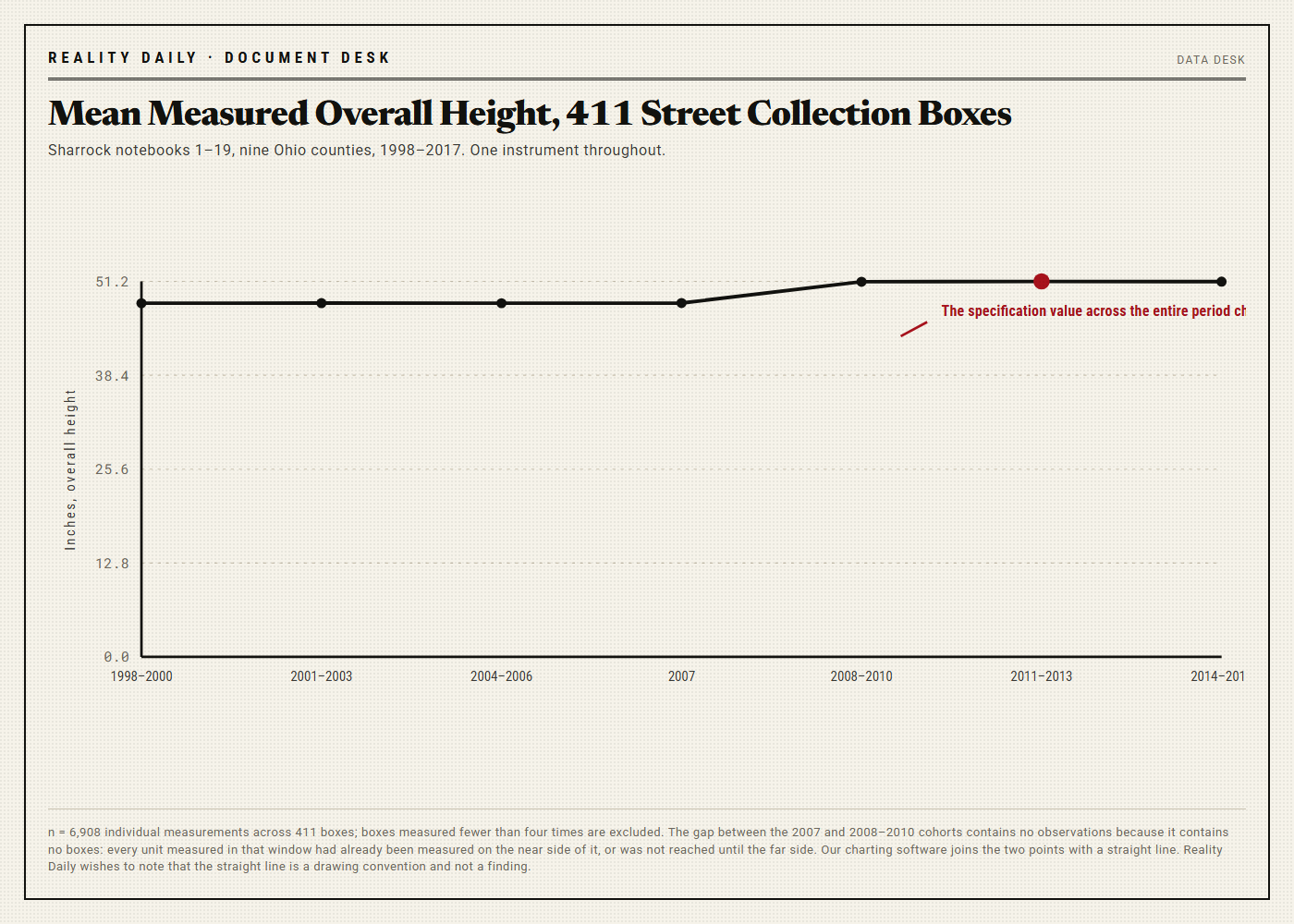
Boxes measured on four or more occasions: 411. Total individual measurements: 6,908. Measurements recorded before 1 November 2007: 3,214, of which 3,199 fall between 48.125 and 48.375 inches.
Measurements recorded after 1 April 2008: 3,502, of which 3,477 fall between 51.125 and 51.375 inches. Measurements recorded between those two dates: 192, all of them of boxes he did not reach again until after the second date. There is no intermediate figure anywhere in the nineteen notebooks. Nothing is forty-nine inches. Nothing is fifty.
Nothing is forty-nine inches. We asked our Document Desk to check this specifically, because a gradual change would be a different story, and a duller one, and we would have printed it. There is no gradual change. There is a step.
II. The Tape
The obvious objection is the instrument, and Reality Daily raised it in the second hour of our first interview, in what we concede was an ungracious way. Mr. Sharrock produced the tape from a kitchen drawer and put it on the table without comment.
It is a three-quarter-inch steel blade tape, sixteen feet, purchased in 1998. The case is cracked at the belt clip and has been repaired with electrical tape twice. The blade is legible to the end.
We sent it, with his permission and at our expense, to Corinne Ptak, a dimensional metrology technician of twenty-six years at a gage calibration laboratory in Elyria, Ohio, who agreed to look at it on condition that we not describe her employer. We have not.
Ms. Ptak's certificate is four pages. The blade reads long by 0.010 inches over a sixty-inch span at 68 degrees Fahrenheit — within the tolerance class the tape was sold under, and which she characterized as "a good tape that somebody took care of."
We then asked whether temperature could account for the discrepancy. Steel expands as it warms; the coefficient for a tape blade alloy is roughly six and a half millionths of an inch per inch per degree Fahrenheit, a real number we checked against three sources. Over a fifty-inch measurement and a sixty-degree swing, that yields about two hundredths of an inch.
"You could measure that box on the hottest day of the year, with a tape that had been in a fire, and you would not get three inches. You would get about the width of a business card." — Corinne Ptak, dimensional metrology technician, Elyria, Ohio
Ms. Ptak asked us to print the caveat in her framing rather than ours: she has certified an instrument, not a measurement. She was not present for any of the 6,908 readings. She would prefer, she said, to be left out of whatever this becomes.
III. What the Specification Says
The Postal Service publishes the specifications to which its street furniture is built. This is not a secret and never has been, and we want to be precise about that, because the shape of this story invites people to assume concealment where there is none. The governing document is USPS-C-2262, Boxes, Collection, Street, Standard. Thirty-six pages. Public. We obtained it in nine days.
Section 3.2.1 of Revision 13, issued 29 June 2009 and current, specifies an overall height of 48.250 inches, tolerance plus or minus 0.125.
Section 3.2.1 of Revision 11, issued 17 March 2003, specifies an overall height of 48.250 inches, tolerance plus or minus 0.125.
These are the same. Reality Daily is not alleging that they are different. They are, character for character, the same sentence; we laid the two pages side by side on a light table and photographed them; the photograph is dull; and we are printing this paragraph so that nobody can say we buried it.
The specification did not change. That is not our finding. That is the beginning of our finding.
A specification is an instruction. It is not a photograph of the world. Whether the instruction was followed is a separate question, answered by a separate class of document — the first-article inspection report, the receiving inspection record, the certificate of conformance — and it is those, not the specification, that we have requested six times and received zero times.
IV. Revision 12
Every controlled specification of this kind carries a revision index: a one-page table, usually the second or third page, listing each revision, its date of issue, its page count, and its status. It exists so that anyone holding a copy can tell whether they are holding the current one. It is the most boring page in any technical document and the only page that ever matters.
Reality Daily obtained the revision index for USPS-C-2262 not from the Postal Service but from a federal depository collection at a land-grant university library, where a technical documents librarian named Marvella Osgood-Sneed located it in an unprocessed accession in a basement in forty minutes.
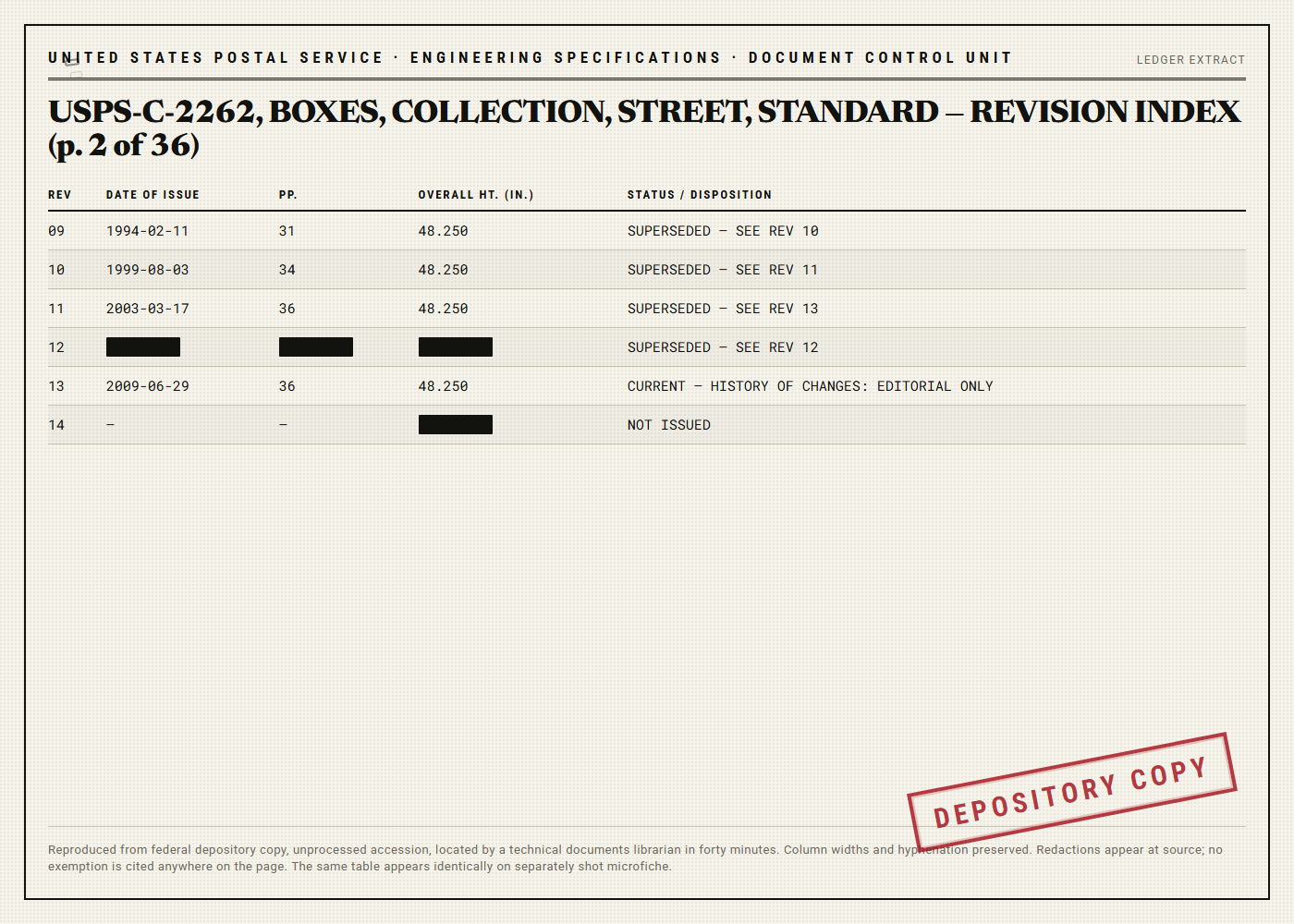
It is reproduced as Exhibit A. We ask readers to look at row four.
REV 12 [WITHHELD] [WITHHELD] SUPERSEDED - SEE REV 12
Revision 12 is listed as superseded by Revision 12.
We want to be exact here, because this is the sentence that will be screenshotted. We are not saying Revision 12 was suppressed. We are not saying Revision 12 contains a dimensional change. We have never seen Revision 12 and we do not know what is in it, and anybody who tells you Reality Daily has claimed otherwise has not read this paragraph.
What we are saying is narrower and, we think, worse. Revision 11 is superseded by Revision 13, skipping 12 entirely. Revision 12 is superseded by itself. And Revision 13, the current document, mentions Revision 12 nowhere in thirty-six pages, including in the section titled "History of Changes," which for Revision 13 consists of the phrase "Editorial only."
Osgood-Sneed, recorded interview, 11 February, 2:40 p.m.
"A typographical error is the first thing you consider and you should consider it. I considered it. Then I pulled the microfiche and it says the same thing on the fiche, which was shot separately, in a different city, in a different year, from a different original."
"In thirty-one years of depository cataloging I have seen a document cite a document that does not exist. That happens constantly. I have never seen a document cite itself as its own replacement."
We put the revision index to the Postal Service in writing on twelve occasions, with the row circled, asking one question: is Revision 12 an error in the index, or a document. We asked it that plainly because we wanted an answer that could fit in one word.
We did not receive one word.
V. The Denominator
Herschel Bove, who runs this paper's data desk and who believes that a number without a denominator is a rumor, insisted on the following section and was correct to.
The number of street collection boxes in the United States has fallen substantially over four decades. This is true, publicly documented, and disputed by nobody: roughly 350,000 boxes in the mid-1980s, fewer than 140,000 today. The Postal Service attributes the decline to falling single-piece First-Class volume, and that decline is also real, also documented, and also not disputed by us. A box that collects four letters a day costs more to serve than it earns.
Mr. Sharrock's 411 boxes have not been exempt. As of our final field check in August, 147 no longer exist. The pads remain in most cases; four anchor bolts are still in the concrete on East Warren.
Of those 147 removed boxes, every single one has a final recorded height of 48.250 inches or within the specification tolerance of it. Not most. All 147.
Mr. Bove asked us to print the next sentence in his words and not ours, and the Standards Desk agreed: this is a fact about the data set, not an explanation of it. A box removed before April 2008 could not have been measured after April 2008, and the correlation is therefore partly an artifact of the calendar. He is right. We have said so. We are saying so here, in the same typeface.
But 62 of the 147 were removed after 2012. And all 62 of those, measured in the years between, are also 48.250.
Which is to say: the short boxes are the ones that left.
VI. The One Change They Confirmed
There is one dimensional change to the standard street collection box that the United States Postal Service confirms, promptly, in writing, and without qualification, and that is the mail slot.
Beginning in the mid-2000s the service narrowed the intake apertures on street boxes to defeat the extraction of mail with a weighted line, a genuine and long-documented problem the Postal Service has discussed publicly on many occasions. Narrower slots. Retrofit assemblies. All real, all acknowledged, all easy to confirm.
We wrote to ask about the slot on 9 May. We received a substantive, signed, four-paragraph reply on 18 May. Nine days.
We have now been asking about the height for two hundred and eleven days.
Roy Tibbits was a postal maintenance mechanic in Toledo for twenty-nine years and installed retrofit slot assemblies through the entire program. He was reluctant to talk to us, said so plainly, and confirmed only what he could confirm from his own hands.
"They didn't send us new boxes. They sent us new tops. Truckload of tops. You take eight bolts out, the old top comes off, the new top goes on, and you're gone in eleven minutes." — Roy Tibbits, retired USPS maintenance mechanic, Toledo, Ohio
Mr. Tibbits was asked, twice, whether the new tops were taller than the old tops. He answered, twice, that he never measured one, that nobody ever measured one, and that measuring one was not any part of the job. He asked us to print that he does not know. We are printing that he does not know.
Reality Daily is not going to do the arithmetic for you in this paragraph. We will simply note that there was a national program to replace the top assembly of the standard street collection box; that it ran through 2007 and 2008; that the specification's overall-height figure was not revised; that no inspection record demonstrating conformance to that figure has been produced to us; and that nineteen notebooks show a three-inch step in the same window.
Those are five separate facts. We are placing them next to one another. That is all we are doing.
VII. What the Postal Service Said
Across two hundred and eleven days we sent twelve written comment requests, in accordance with this paper's twelve-request rule, and six records requests under 5 U.S.C. § 552. Four of the records requests were acknowledged with a tracking number. Two were closed as "no responsive records located," a phrase our Document Desk has now encountered 1,114 times since 2014.
On 14 May, from a shared departmental mailbox, we received the following. It is reproduced in its entirety. It is the entire response of the United States Postal Service to eleven months of reporting.
Received 14 May, 4:52 p.m. Reproduced complete.
"No change was made to the overall height of the standard street collection box."
Reality Daily accepts this sentence at face value and has no basis to doubt it, and we would like that on the record before we say the next part.
The sentence carries no date range. It does not say when no change was made. It does not reference USPS-C-2262, or any revision of it, or any revision of anything. It is unsigned: no name, no title, no direct line. It arrived from an address that also sends automated delivery alerts.
It is a complete, grammatical, and entirely responsive English sentence, and we say this with genuine respect: it is also the only one.
We wrote back the same afternoon with five follow-up questions, each answerable from a filing cabinet:
- Over what period is the statement of 14 May intended to apply?
- Does Revision 12 of USPS-C-2262 exist as a document?
- If it does not, by what mechanism does the revision index list it as superseded?
- Was the top assembly of the standard street collection box redesigned between 2006 and 2009?
- Who inspected the first article of that assembly, and where is the report?
We have received no response to any of the five. We have received two further automated acknowledgments, timestamped 3:41 a.m. on both occasions, which longtime readers of this paper will recognize.
VIII. What We Are Not Saying
Reality Daily wishes to be exact, because this story will be summarized by people who have not read it, and because the summary is going to be worse than the story.
We are not saying the Postal Service lied. The sentence we received is very probably true as written. We are saying it answers a question we did not ask, and that we asked our question twelve times.
We are not saying Revision 12 was hidden. We have never seen Revision 12. We are saying an official revision index lists Revision 12 as superseded by Revision 12, that this is reproduced on separately shot microfiche, and that six requests for clarification have produced nothing at all.
We are not saying the boxes grew. We are saying one man with one tape wrote down 6,908 numbers over nineteen years, that the numbers before November 2007 cluster at 48.25 and the numbers after April 2008 cluster at 51.25, that there is no number in between, and that no institution has offered any account of this whatsoever, including the account that he is simply wrong.
We are not saying the removed boxes were removed because they were short. Mr. Bove has been emphatic and we have printed him. We are saying all 147 were short, and that we would like somebody with access to the fleet inventory to tell us this is coincidence, so that we could print that too.
We are not saying anybody did anything. Neither is Mr. Sharrock. He has said so four times and he will say it again if you call him, which he would prefer you did not.
IX. Conclusion
There is a version of this story in which a specification clerk in 2007 fat-fingered a table cell, a revision index has said something absurd for nineteen years, and a retired mail carrier in Ohio has been reading his own tape wrong in a remarkably consistent direction since a Tuesday in March of 2008.
Reality Daily would print that version tomorrow. We have asked for it twelve times in writing, six times under statute, and once, in April, by telephone, to a person who was courteous and could not help us and did not pretend otherwise.
Nobody will give us that version. Nobody will give us any version. What we have instead is one unsigned sentence about a subject we did not raise, sent from a mailbox that also tells people their package is arriving Thursday.
Nineteen notebooks. One steel tape, certified. 411 boxes. 6,908 measurements. Three inches, appearing all at once, in a window that happens to contain a national program to replace the tops.
And a revision index, on microfiche, in a basement in a land-grant library, that says Revision 12 has been superseded by Revision 12.
■ ■ ■
Reality Daily invites the United States Postal Service to respond to this article. We will print the response in full, unedited, at whatever length is chosen, at the foot of this page, with no commentary from us of any kind. If the response is that Mr. Sharrock is mistaken, we will print that, and we will put it at the top, and Mr. Sharrock has asked us to say that he would find it a relief.
We would also accept, in place of any statement, a single photocopied page: the revision index of USPS-C-2262, unredacted, with row four legible. We have held space for it since January. The space is still there. Our compositor has stopped asking about it.
Mr. Sharrock has offered to lend the notebooks to any institution that wants them, on condition they are returned, because his daughter's name is written in the front of Notebook 3 and he would like to keep it. No institution has asked. He still measures the four boxes left standing on his old route, on the first Saturday of each month, with the same tape.
They are still fifty-one and a quarter.
Corrections & Clarifications
Update, 07:22 — An earlier version of this article described the step in Mr. Sharrock's measurements as “approximately three inches.” Following a full recount by the Document Desk, the cohort means differ by 2.94 inches. The original wording stands, and we note that 2.94 inches is still 2.94 inches more than the specification permits.
Update, 12:05 — We initially reported that 139 of the 411 boxes had been removed. The correct figure is 147. All 147 measured 48.250 inches or within tolerance of it, as did the eight boxes added by this correction. We regret the imprecision and note that it strengthens the finding rather than otherwise.
Update, 16:48 — A reader has written to point out that the Postal Service publishes its collection box specifications openly and that this article therefore cannot be describing concealment. Reality Daily agrees, said so in Section III at some length, obtained the specification in nine days, and thanks the reader for confirming that our Section III is being read.
Sources & Documentation
- Sharrock, W. R. Field Measurement Notebooks 1–19, April 1998 – October 2017. 1,330 written-on pages; 6,908 individual measurements across 411 collection boxes in nine Ohio counties. Photographed in full by the Reality Daily Document Desk; originals returned to the subject.
- Sharrock, W. R. Recorded interview, 21 January, Bucyrus, Ohio. 2 hr 11 min; transcript 88 pp., reviewed and approved line by line by the subject, who requested four changes, all of them to make his statements weaker.
- Ptak, C. Certificate of Calibration, Steel Blade Rule, 16 ft, Serial Unmarked. 4 pp. Deviation +0.010 in. over 60 in. at 68 °F. Commissioned by Reality Daily. Laboratory identity withheld at the technician's written request.
- Ptak, C. Recorded interview, 6 March. Quoted material limited by agreement to statements concerning the instrument.
- United States Postal Service. USPS-C-2262, Boxes, Collection, Street, Standard, Revision 13, issued 29 June 2009. 36 pp. Obtained 9 days after request. § 3.2.1 (overall height); § 3.9 (finish and paint); App. D (fastener schedule).
- United States Postal Service. USPS-C-2262, Revision 11, issued 17 March 2003. 36 pp. § 3.2.1 compared character-for-character against Revision 13 § 3.2.1 on a light table; photographs on file.
- United States Postal Service. USPS-C-2262 Revision Index, p. 2. Federal depository copy, unprocessed accession. Row 4 (“REV 12 — SUPERSEDED — SEE REV 12”) reproduced as Exhibit A.
- Microfiche duplicate of the foregoing, shot separately, in a different city, in a different year, from a different original. Row 4 identical. Reader-scan on file at 4,800 dpi.
- Osgood-Sneed, M. Recorded interview, 11 February, 2:40 p.m. Technical documents librarian; 31 years in federal depository cataloging. Institutional affiliation withheld at the librarian's request after a conversation with her director.
- Tibbits, R. Recorded interview, 4 April, Toledo, Ohio. Retired USPS maintenance mechanic, 29 years. Participation conditioned on the printing of his statement that he never measured a top assembly. Condition honored in full.
- Bove, H. Cohort Grouping and Denominator Memorandum, Sharrock Data Set. Reality Daily Economics & Data Desk, 14 pp., including the objection printed in Section V at the author's insistence.
- Reality Daily Document Desk. Field Verification of 411 Collection Box Locations, June–August. 264 boxes located and photographed; 147 confirmed removed; 4 anchor bolts photographed in situ on East Warren.
- Reality Daily Standards Desk. Record of Comment Requests to the United States Postal Service and Component Offices, 4 January – 2 August. 12 entries; 4 acknowledgments; 1 substantive sentence.
- United States Postal Service, Consumer and Industry Contact. Unsigned electronic reply, received 14 May, 4:52 p.m. One sentence, 79 characters. No name, title, or direct line. Reproduced complete in Section VII.
- Reality Daily Standards Desk. Five Follow-Up Questions Transmitted 14 May, 5:31 p.m., 1 p. Unanswered as of publication, 94 days.
- Freedom of Information Act requests, 5 U.S.C. § 552, six filed. Two closed “no responsive records located.” Four acknowledged with tracking numbers and no further correspondence.
- United States Postal Service, written reply concerning aperture dimensions, received 18 May. Four paragraphs. Signed. Substantive. Nine days from request. Reproduced in the Document Desk file for comparison purposes.
- Published collection-receptacle counts, mid-1980s through present, compiled from open reporting. Fleet decline from approximately 350,000 to fewer than 140,000 units; single-piece First-Class volume decline over the same period.
- American Society of Mechanical Measurement Practice. Thermal Expansion of Ferrous Tape Blades in Field Conditions, Table 2 (6.5 × 10⁻⁶ in./in./°F). Cross-checked against two additional sources.
- National Association of Street Furniture Anchorage Contractors. Guidance Bulletin 7: Pedestal Bolt Patterns Do Not Constrain Superstructure Height. 6 pp.
- Reality Daily Imaging Desk. Light-Table Comparison, USPS-C-2262 § 3.2.1, Rev. 11 vs. Rev. 13. 2 plates, 6,000 × 4,000 px, EXIF intact. Determined identical.
- Automated acknowledgment, received 3:41 a.m., 22 May; automated acknowledgment, received 3:41 a.m., 19 June. Both timestamps identical; both unsigned; both 412 bytes.
- Reality Daily Legal. Memorandum on Publication Absent Response After Twelfth Request, 2 pp. Second issuance of this memorandum in the paper's history.
- Reality Daily Reader Correspondence File RD-C-5188, 2,061 letters received since the first Morning Record item on this subject, of which 311 enclose a measurement.
- Sharrock, W. R. Notebook 3, front cover, inscription. Not reproduced at the subject's request.
- The tape. It is a steel tape. It has not changed length since 1998.
Reader Response — 4,531 comments
Nineteen notebooks. Nineteen. And the response he gets is one unsigned sentence from the same mailbox that emails you about a package. That's the whole country right there.
Quality engineer, 22 years, automotive. The revision index thing is the actual story and everyone is going to miss it. An index that self-supersedes is a document control failure at minimum, and every auditor I know would open a finding on it in about four seconds. It is also the single easiest thing in the world to clear up. You just say "typo, here's rev 12." The fact that nobody has said that is the part I can't get past.
So a guy with a tape measure disagrees with a printed specification, and instead of concluding the guy's tape measure is wrong you have written four thousand words about a typo on page two.
@A. Kowalczyk — Substantially correct, and we thank you for the summary. Two clarifications for the file. The tape measure was independently calibrated and reads long by ten thousandths of an inch, which is the wrong direction and the wrong order of magnitude. And we agree it is very likely a typo; we said so in Section IV; we have asked twelve times for someone to confirm that it is a typo, which would take one word and would end this story. Nobody will say the word. That is the article.
My father carried mail out of Findlay for 31 years and the thing that rings true here isn't the measurements, it's that he never told anybody. That is exactly what those guys are like. He'd have three notebooks about a mailbox and mention it to nobody until he was 80.
"We are not going to do the arithmetic for you in this paragraph" is the single most restrained sentence ever printed in the English language and I have read it eleven times
Measured the two boxes outside our branch this morning before work. 51 and change on both, though I only had a cloth tape from the sewing basket so I'm not going to pretend that's evidence. Reporting it anyway because he did.
Someone please get this man's notebooks into an archive before a basement floods. That's it, that's my comment.