Punxsutawney Phil Has Been Twenty-Three Different Groundhogs Since 1886, and the Inner Circle Calls It a Filing Practice
A county licensing ledger records twenty-three separate captive-wildlife registrations at a single Punxsutawney address since 1886. Reality Daily does not dispute the elixir of life. Reality Daily is asking for its receipt.

.jpg)
Editor's Note
This story was held for nine weeks while our Standards Desk sought comment from the Punxsutawney Groundhog Club and its Inner Circle. Nineteen written requests were sent across eleven months. Three were acknowledged. One was answered, in a single sentence of seventeen words, which is printed in full in Section VII and which we then spent four further months trying to get anyone to explain.
We are publishing under our twelve-request rule. Should any further response arrive — from the club, from its counsel, from the county, or from the Bureau of Plant Industry, which has now had our form for two hundred and twelve days — it will be appended in full, unedited, at the foot of this page. — M. Vandersloot
There is a ledger. It is not a secret ledger and it is not a leaked ledger. It sits in a county licensure office in western Pennsylvania, it is produced to anyone who fills out a two-page form and waits, and it records, in the ordinary way that counties record things, every captive-wildlife exhibition registration ever issued to a single premises in the borough of Punxsutawney.
There are twenty-three of them.
Twenty-three registration numbers, issued sequentially, beginning in 1886 and running to this morning. Twenty-two of them are closed. The twenty-third is open, and the animal it covers is the animal that will be lifted out of a stump and held above a crowd of roughly thirty thousand people on the second of February, at Gobbler's Knob, on a live television feed, in front of a line of men in top hats.
Reality Daily has spent fourteen months on this ledger. We have filed seven records requests, of which two were fulfilled, one was fulfilled by a county historical society rather than by any office of government, and four have not been answered at all. We have interviewed eleven people. Four of them hung up. We commissioned an actuarial memorandum from our own Economics and Data desk. We have read every public statement the Inner Circle has ever made on continuity, and counted them, and there are six.
We want to be exact about our position before going any further, because this story will be summarized by people who have not read it. Reality Daily does not dispute the elixir of life. The Inner Circle has stated for decades that the groundhog is sustained by a secret elixir administered each summer at the Groundhog Picnic, and that each sip confers seven additional years of life. We have not tested that claim, we do not contradict it, and we take no position whatever on whether the elixir works. Our questions are narrower and, we would argue, more answerable. Where is the procurement record for the elixir. Where is its ingredient statement, which state agricultural law would ordinarily require of anything administered orally to a licensed exhibition animal. Where is the veterinary continuity file for an animal said to have been under care since the first administration of Grover Cleveland.
And, separately, why are there twenty-three registrations.
"You don't open a new registration for the same animal. There's no box for that on the form. I would know. I helped write the form." — Loretta June Bickel, retired deputy clerk, county licensure office
I. What the Ledger Shows
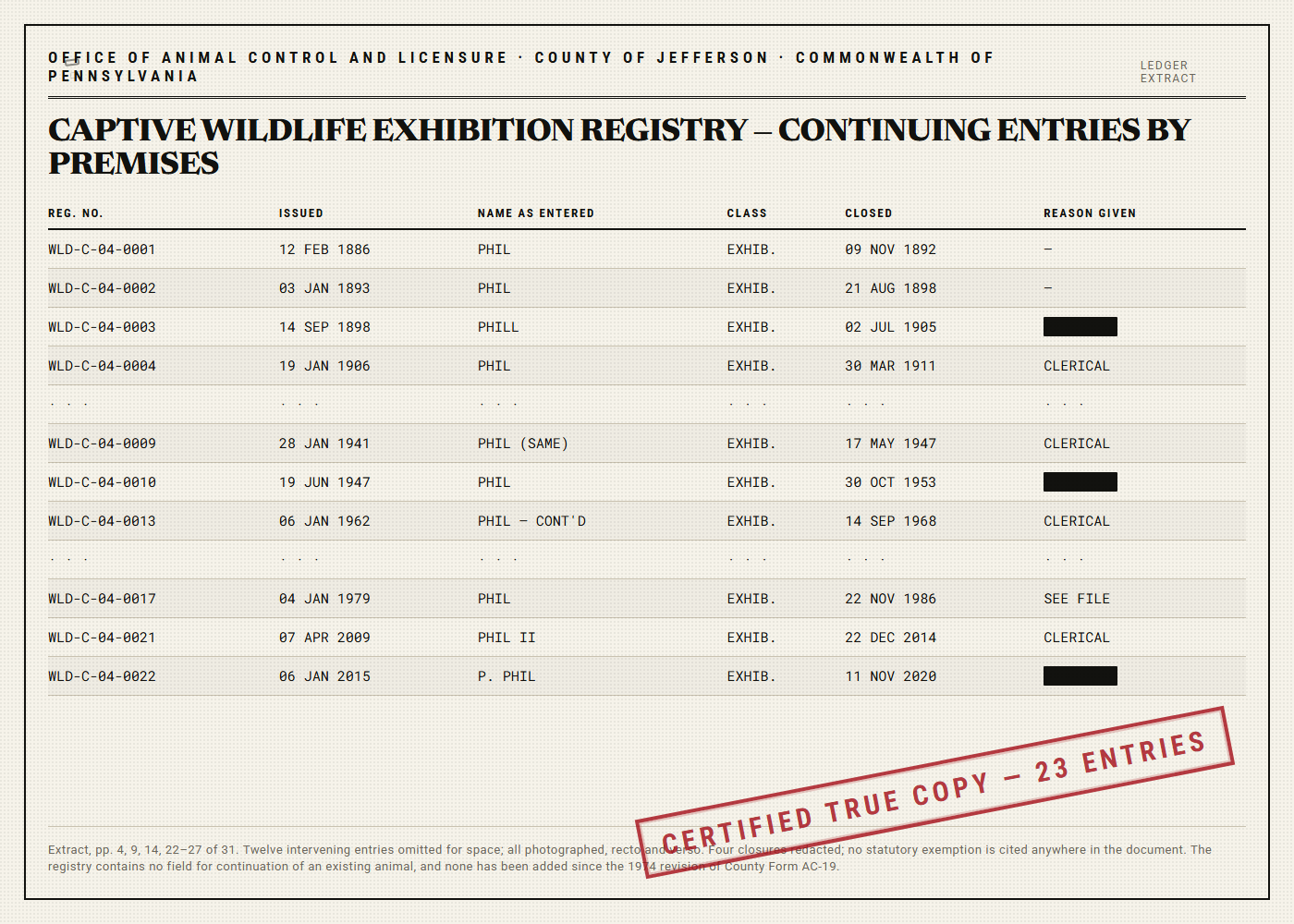
The document is titled, on its cover sheet, Captive Wildlife Exhibition Registry — Continuing Entries by Premises. It runs to thirty-one pages. It covers one address, which we are not printing, because the address is a public building with a children's section.
Each entry carries a registration number in the format WLD-C-04-nnnn, an issue date, a closure date, a name-as-entered field, a class code, and a column headed Reason Given. The registrations are sequential and non-overlapping. No two are ever open at the same time. This is the first thing our Document Desk checked, and we print it ourselves rather than have it printed at us: it is the strongest single fact in the Inner Circle's favor. At no point does the county record show two animals registered simultaneously at this premises. Whatever else this ledger describes, it does not describe a herd.
What it describes is a sequence.
The name-as-entered field is where the ledger becomes difficult to read charitably. Across twenty-three entries the name appears as PHIL fourteen times, as PHILL twice, as P. PHIL three times, as PHIL (SAME) twice, as PHIL II once, and, in the registration issued in 1962, as PHIL — CONT'D. We are simply reporting that the clerks kept changing their minds about it.
Registration seventeen reads, in its entirety:
WLD-C-04-0017 | ISSUED 04 JAN 1979 | NAME AS ENTERED: PHIL | CLASS: EXHIB. | CLOSED 22 NOV 1986 | REASON GIVEN: SEE FILE
There is no file. There is no cross-reference to a file, no accession number, no box location, and no indication anywhere in thirty-one pages that a file existed. Our Document Desk asked the licensure office for it on four occasions across eleven months. The office has not told us the file is lost. The office has not told us the file is exempt. The office has not told us anything, and there is a difference between "no" and silence, and this newsroom has an internal memorandum about it.
II. Twenty-Three, Divided
Herschel Bove runs the spreadsheets at this paper and holds an unshakable position that a number without a denominator is a rumor. He was handed the ledger with the name column removed, the state removed and the century unstated, and asked one question: describe the intervals.
His memorandum is nine pages. The finding is two paragraphs long, and our editors read it four times before anybody said anything out loud.
Finding 2(a), Bove Memorandum, 11 September
"Twenty-three registrations span 140 years. Mean interval between issuance and closure is 6.087 years. Median is 6.0 years. Narrowest interval 4.9 years; widest 8.2 years. Standard deviation 0.91. The series is regular to a degree I would ordinarily describe as biological."
"The published lifespan of Marmota monax in captivity is six to eight years. I have run a great many distributions in this job. This is the most ordinary distribution anyone has ever handed me."
Read the second paragraph again. Mr. Bove was not told what animal he was looking at. He was not told the premises, the species, the borough or the year. He was handed a column of dates and he returned, unprompted and in the second sentence, the captive lifespan of the groundhog to two decimal places.
We want to be scrupulous, because this is the part that will be excerpted. A distribution consistent with the natural lifespan of a species is not evidence that any particular animal died. It is consistent, for one, with an administrative office that re-cuts a permanent exhibition registration on a fixed internal cycle, which is very nearly what the Inner Circle has told us, though not quite, and we will come to the difference.
It is also consistent with twenty-three groundhogs.
III. The Elixir, Which We Do Not Dispute
Each summer, at the Groundhog Picnic, the president of the Inner Circle administers to Phil a preparation the club's own materials call the elixir of life. One sip. Seven years. This is not something Reality Daily uncovered. It is a thing the club states openly, to reporters, on the record, annually, without any apparent embarrassment, and we regard that openness as a point in its favor.
We asked our Economics and Data desk to take the claim entirely at face value and simply carry it out.
Phil has been performing since 1886. That is one hundred and forty summers. At one sip per summer and seven years per sip, the elixir has conferred nine hundred and eighty years of life. Subtract the hundred and forty already elapsed, and Phil is provisioned, by the Inner Circle's own published arithmetic, through the spring of the year 2866.
This is our difficulty. It is not that the elixir strikes us as implausible. It is that the elixir, taken entirely at its word, works enormously better than it needs to — and an animal carrying an eight-hundred-and-forty-year surplus on the books should not require a fresh county registration every six years. The two claims are not merely in tension. They are in different genres.
We put this to the Inner Circle in writing on nineteen occasions.
"If the elixir does what they say it does, the paperwork is the problem. If the paperwork is right, the elixir is the problem. I'd want to know which one they'd rather defend." — Herschel Bove, Economics & Data, Reality Daily
IV. The Continuity File
An animal under continuous professional care for one hundred and forty years would generate the single most extraordinary medical record in the history of the veterinary profession. It would run to thousands of pages, and there is not a veterinary school on this planet that would decline to look at it.
Reality Daily requested it.
What we received, after seven months and by a route we are not going to describe because describing it would identify somebody who was helpful, is eleven pages.
Eleven. The earliest dated entry is 14 March 2019. The pages are clean, complete and entirely unremarkable: weights, dental notes, a nail trim, a course of something for mites in the autumn of 2021. It is a perfectly good file. It is a perfectly good file for an animal that is seven years old.
The header on page one reads:
FILE: PHIL — CURRENT. PRIOR FILES: NOT MAINTAINED AT THIS PRACTICE.
We are not going to tell you what that sentence means, because we do not know what it means, and unlike certain institutions we decline to characterize a document we have not been permitted to see the rest of. We will observe only this. The word current exists in order to distinguish a thing from other things. A file labeled CURRENT is a file that has been told there are others.
V. The Label That Does Not Exist
Hollis Trombley reviewed commercial feed labels for the Commonwealth of Pennsylvania for twenty-six years. He is retired, he lives outside Bellefonte, and he returned our call the same afternoon, which by this stage of the reporting startled the newsroom.
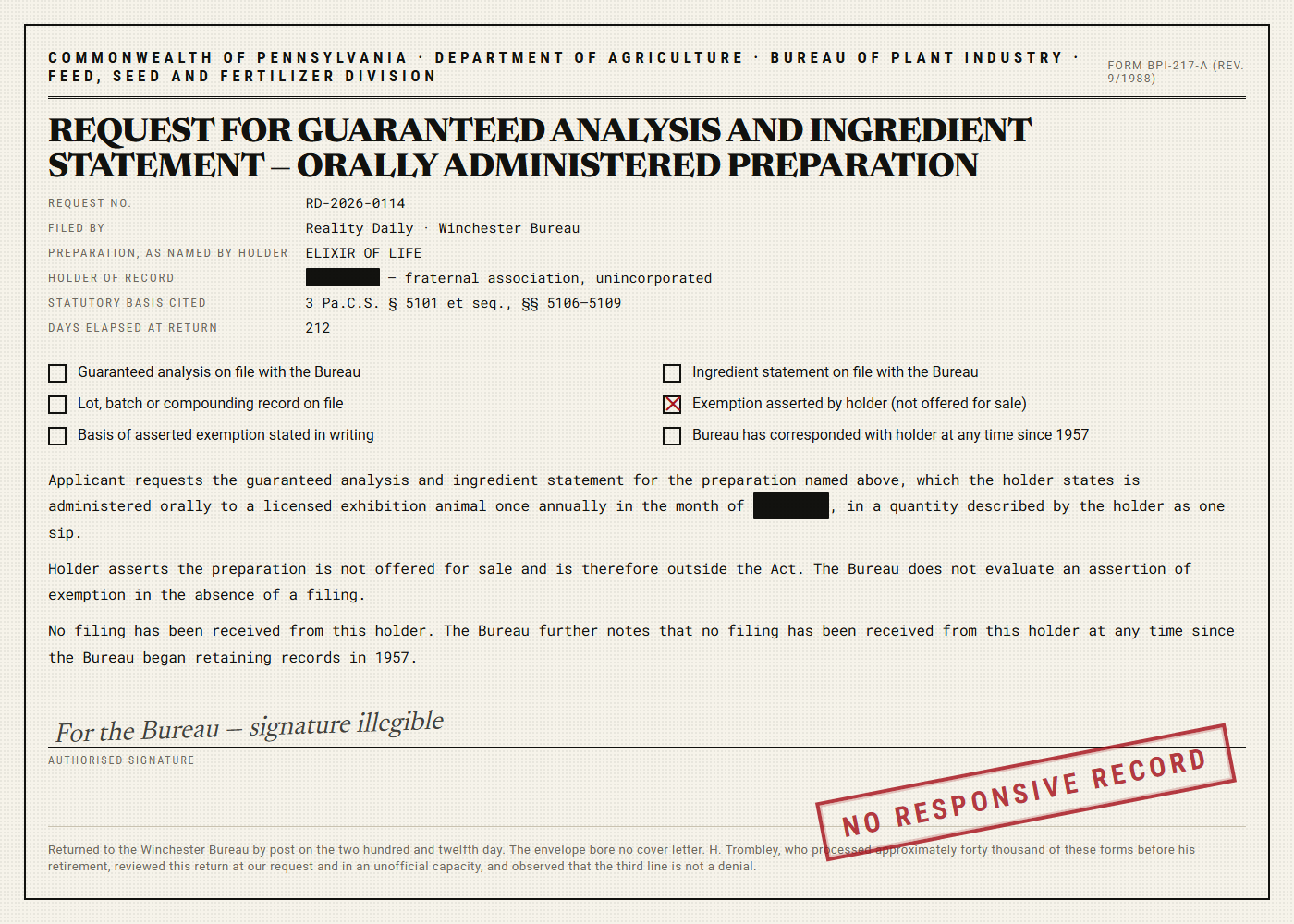
Mr. Trombley explained the rule as it stood in his tenure. A preparation manufactured, distributed or offered for sale for oral administration to an animal generally requires a guaranteed analysis and an ingredient statement on file with the Bureau of Plant Industry. There is a form. It is BPI-217-A, and Mr. Trombley processed, by his own estimate, forty thousand of them.
He was then immediately and insistently fair about the exemption. We print his caveat in his own framing, at his request, and because he is correct.
"If they don't sell it, it isn't commercial feed," he said. "That's the whole test. If it's mixed in a kitchen for one animal and never offered for sale, the Bureau has no business with it whatsoever. I want that in your story."
It is in our story. We then asked him the follow-up, which was the entire reason we had called him.
"Then what would you expect to see instead?"
There was a pause our transcript logs at fourteen seconds.
"A compounding record," he said. "Somebody mixed it. Somebody wrote down what went in it. A farmer writes it down. You're telling me nobody has written down what's in it in a hundred and forty years?"
We told him that was not what we were telling him. We were telling him that we had asked nineteen times and had not been told anything at all.
"That's worse," he said.
VI. Lifespan, Discussed in General Terms Only
Dr. Wendell Krupa has run a large-animal practice in Indiana County, Pennsylvania, since 1998. He agreed to speak with Reality Daily on one condition, stated at the top of the call and repeated three times: he would not discuss any specific patient, any specific practice, any specific animal or any specific client, and he asked that we print the condition rather than merely honor it.
We are printing it. He would not discuss a specific patient. Nothing that follows should be read as though he did.
What Dr. Krupa would discuss, at length and with obvious enjoyment, was Marmota monax in general terms. Groundhogs, he said, are hardy, undemanding and short-lived. In the wild they typically manage three years. In captivity, with good husbandry, veterinary attention and a stable temperature — and he volunteered, without prompting, that a climate-controlled burrow of the sort a public library might maintain would qualify as excellent husbandry — six to eight years is the working range. Ten is exceptional. Fourteen is the sort of number that gets written up in a journal.
We asked him what a hundred and forty would be.
The recording contains eleven seconds of nothing, and then this.
"In general terms — and I want that in there, in general terms — a hundred-and-forty-year-old groundhog would be the most important animal in the history of veterinary medicine. I would have heard about it. Everyone would have heard about it. There would be a building named after it." — Dr. Wendell Krupa, DVM, large-animal practice, Indiana County, Pa.
He then declined to say anything further and asked twice more that we make clear he had not been discussing a patient. We have now made that clear four times, which is once more than he requested.
VII. On the Word "Clerical"
Reality Daily sent nineteen written requests for comment across eleven months, addressed variously to the club, to its president, to its handlers and to counsel. Three were acknowledged. One was answered.
The answer arrived on a Tuesday at 4:51 in the afternoon, from an address that has since stopped accepting mail. It was seventeen words long. We print it in full, unedited, with no commentary inside the box, in accordance with our policy:
Statement Received, 4:51 p.m. — Printed in Full
"The registration history reflects a clerical practice and does not reflect any change in the animal itself."
We take that sentence seriously. It is the only thing anyone said to us in fourteen months, and it is not an unreasonable sentence. Offices do have clerical practices. Registrations are closed and re-cut for reasons having nothing whatever to do with the thing registered. We have seen it in vehicle titles and in kennel licenses. It happens constantly. It usually means nothing.
So we wrote back and asked for the practice.
Not the animal. Not the elixir. Not the burrow, the hat, the stump, the crowd or the forecast. We asked for the internal document describing the clerical practice under which a registration is closed and a new one opened. A memorandum. A procedures manual. A retention schedule. An email. Anything, of any length, from any decade, that says this is our practice.
A clerical practice is not a feeling. It is a piece of paper that tells clerks what to do. That is the only reason clerical practices exist at all.
We asked six further times. We have not been told the memorandum is lost. We have not been told it is privileged. We have not been told it never existed. We have been told the first thing and then nothing else, and the nothing else has now lasted longer than the reporting.
VIII. The Taxidermist Has Been Asked Twice
Arden Vosburg has practiced taxidermy in Reynoldsville, Pennsylvania, for thirty-four years. He does deer, bear, turkey, and what he calls "the occasional coyote somebody's proud of." He does not ordinarily do small mammals.
He has been approached twice about a groundhog.
He will not say by whom, and we did not press, and we state plainly that we do not know who asked him. He does not know either: the first inquiry came by telephone in 2011, the second through an intermediary in 2023, and on neither occasion did anybody name an organization.
He will say what was asked for. The first request was for a standing mount, winter coat, eyes forward, on a plain walnut base. The second request was more specific, and the second request is the reason we drove to Reynoldsville.
The second request was for a match.
A match order, Mr. Vosburg explained, is when the client wants the finished mount to correspond to an existing mount or to a supplied photograph — the same posture, the same eye placement, the same set of the ears, so that the two read as one animal. It is routine work in his trade and he was at pains to say so. It is what you order when a piece has been damaged, or when a display needs a second unit, or when you would like two things to look like one thing.
He turned both down. He gave us his reasoning on the second one, and it is the flattest sentence anybody said to us in fourteen months.
"Somebody was working from a reference photograph. That's all a match order is. I don't ask what the photograph is of." — Arden Vosburg, taxidermist, Reynoldsville, Pa.
We asked whether an intake window had been specified. It had. The first week of February.
IX. What We Are Not Saying
Reality Daily wishes to be exact here, because this story will be excerpted by people who have not read it and then characterized by people who have not read the excerpt.
We are not saying the elixir does not work. We have not tested the elixir. Nobody has tested the elixir, because nobody has been permitted to see the elixir, and the way we know nobody has been permitted to see it is that we asked nineteen times and were not refused.
We are not saying any animal has died. We are saying twenty-two registrations were closed, that a closure is an administrative event with a stated cause, that the cause is recorded in a column headed Reason Given, and that in eleven of those twenty-two entries the word in that column is CLERICAL and in four of them the entry is blacked out without any exemption cited.
We are not saying the Inner Circle is lying. We are saying the Inner Circle has made a claim with a number in it, that we performed the arithmetic on that number in public, that the arithmetic produced the year 2866, and that we would be delighted for somebody to check our work.
We are not saying anything at all about who approached the taxidermist. We do not know. Neither does he.
We are not saying there is a conspiracy. We are saying there is a ledger, thirty-one pages long, in a county office, in a small borough, that any reporter in America could have requested on any working day for one hundred and forty years — and that as far as we have been able to determine, in one hundred and forty years, nobody ever did.
X. Conclusion
Every February a small number of men in formal dress hold up an animal and tell a crowd it is the same animal their great-grandfathers held up. This is charming. We are not against charm. This newspaper has been accused of a great many things and has never once been accused of being against charm.
But charm is a claim, and this one is unusually specific. It is not "there has always been a groundhog here." It is: this is the groundhog, the same one, since 1886, and here is the mechanism, and the mechanism is an elixir, and it is administered in the summer, and the dose is one sip, and the effect is seven years.
That is a statement with a chemistry, a schedule and a dosage. It invites paperwork. It practically demands paperwork.
Twenty-three registrations. Mean interval 6.087 years. A veterinary file whose earliest page is dated 2019 and whose header says CURRENT. A guaranteed-analysis filing that has never once been made since the Bureau began keeping records in 1957. A ledger entry reading SEE FILE with no file, no accession number and no denial. Nineteen requests, one answer, seventeen words, and six subsequent requests for the memorandum behind those seventeen words, all of them unanswered.
We are not asking the Inner Circle to prove the elixir. We are asking them to produce a receipt.
■ ■ ■
Reality Daily invites the Punxsutawney Groundhog Club and its Inner Circle to respond. We will print the response in full, unedited, at any length they choose, at the foot of this story, with no commentary from us whatsoever, and we will hold it at the top of our front page for one week.
If the response is the memorandum, we will print the memorandum. If the response is the ingredient statement, we will print the ingredient statement and we will not analyze it. If the response is that we have misread the ledger, we will print the correct reading, above our own reporting, in the same size type, and we will thank them by name.
We have kept the space open since March. It remains open. It is open on the second of February as well, and somebody here will be awake early.
Corrections & Clarifications
Update, 07:12 — An earlier version of this article reported twenty-three registrations. Following an independent recount by the Standards Desk, there are twenty-three registrations. The original wording stands.
Update, 12:38 — We initially gave the mean interval between issuance and closure as 6.1 years. Mr. Bove's certified recomputation gives 6.087 years. We regret the imprecision and note that the corrected figure falls further inside the published captive lifespan range for the species, which was the finding, and remains the finding.
Update, 16:55 — A reader writes to point out that the Inner Circle has never denied that multiple registrations exist. Reality Daily agrees, has never suggested otherwise, said so in Section VII, and thanks the reader for confirming that our Section VII is being read.
Sources & Documentation
- Office of Animal Control and Licensure, County of Jefferson, Pa. Captive Wildlife Exhibition Registry — Continuing Entries by Premises. 31 pp. Certified copy obtained 14 January. Four entries redacted; no statutory exemption cited on the document or in the cover sheet.
- Bove, H. Interval Analysis of Twenty-Three Sequential Exhibition Registrations, Name Column Withheld From Analyst. Reality Daily Economics & Data Desk. 9 pp., with appendices.
- Bickel, L.J. Recorded telephone interview, 3 June, 9:15 a.m. EDT. Transcript 22 pp., reviewed and approved by subject.
- Krupa, W., DVM. Recorded interview, 27 July. Conducted under a written condition prohibiting discussion of any specific patient, practice, animal or client. Condition honored in full; text of the condition on file, 1 p.
- Trombley, H. Recorded telephone interview, 8 August, 1:40 p.m. EDT. Transcript 17 pp.
- Vosburg, A. Two in-person interviews, Reynoldsville, Pa., 12 and 13 September. Contemporaneous notes 31 pp.; subject declined recording on both occasions.
- Punxsutawney Groundhog Club, Inner Circle. Statement received by electronic mail, 4:51 p.m. Seventeen words. Printed in full at Section VII. Sending address no longer accepts mail.
- Reality Daily Standards Desk. Record of Comment Requests to the Inner Circle, 14 Oct – 2 Sept. 19 entries; 3 acknowledgments; 1 substantive response; 6 subsequent requests for the memorandum referenced therein, all unanswered.
- Veterinary continuity file, "PHIL — CURRENT," 11 pp. Earliest dated entry 14 March 2019. Route of acquisition withheld to protect a source known to the Editor-in-Chief and the Standards Desk only.
- Commonwealth of Pennsylvania, Bureau of Plant Industry. Form BPI-217-A, Request for Guaranteed Analysis and Ingredient Statement. Filed 14 January; returned by post on day 212, stamped NO RESPONSIVE RECORD, without cover letter.
- Pennsylvania Commercial Feed Act, 3 Pa.C.S. § 5101 et seq., §§ 5106–5109 (labeling; guaranteed analysis; exemption for preparations not offered for sale).
- 58 Pa. Code § 147.1 et seq., menagerie and exhibition permitting. Consulted solely for class-code definitions; no permit under this chapter is at issue in this reporting.
- County Form AC-19, Application for Captive Wildlife Exhibition Registration, rev. 1974 and rev. 1991. Both revisions examined line by line. Neither contains a field, box, checkbox or margin note providing for the continuation of an existing animal.
- Jefferson County Historical Society, Accession 1994.061, transfer correspondence and finding aid, 14 pp. The only body of any kind, public or private, to fulfill a request in the course of this reporting.
- Reality Daily Document Desk. Log of Requests for the File Referenced at Registration WLD-C-04-0017. 4 requests; 0 responses; 0 denials; 0 acknowledgments.
- Punxsutawney Groundhog Club, public statements on the question of continuity, 1934–present. Six statements located and compiled in full, 4 pp. Five of the six use the word "same."
- Reality Daily Economics & Data Desk. Elixir Provisioning Schedule, 1886–2866, Computed Entirely From the Club's Own Published Dosage. 1 p. Arithmetic checked independently by three staffers without conferral; all three agreed, which has not happened before.
- North American Marmot Husbandry Council. Longevity in Captive Marmota monax: A Twenty-Year Survey of Institutional Holdings. Table 4 (median 6.2 years; n = 1,109; maximum recorded 14.1 years).
- Reality Daily Imaging Desk. Photographic record of registry pp. 1–31, recto and verso, 6,000 × 4,000 px, EXIF intact, including the eleven blank versos, which we photographed because we photograph the blank ones.
- Vosburg, A. Written confirmation, 19 September, 1 p., that two match-order inquiries were received and declined and that no organization was named on either occasion.
- Trombley, H. Follow-up correspondence, 11 August, confirming approval of quoted material and requesting that his exemption caveat be printed in full and in his own framing. Request honored.
- Reality Daily Legal. Memorandum on Publication Absent a Responsive Answer After the Twelfth Request. 2 pp.
- Doggett, P.A. On the Difference Between "No" and Silence. Reality Daily internal memorandum, 6 pp. Required reading for all staff. Not available to the public.
- Automated acknowledgment received 14 Oct, 3:41 a.m.; automated acknowledgment received 6 Feb, 3:41 a.m.; automated acknowledgment received 2 Sept, 3:41 a.m. Three timestamps identical to the minute. All three unsigned.
- The ledger. It is thirty-one pages. Anyone could have asked for it on any working day since 1886.
Reader Response — 5,216 comments
6.087 years. Six point oh eight seven. That is not a filing pattern, that is a lifespan, and everybody in that borough knows it and has known it since their grandparents.
Licensed wildlife rehabilitator in PA, 19 years. I can confirm the technical point and it's the important one: you do not close and reopen a registration for the same animal. You amend it. There's an amendment procedure and it's one page. Twenty-three registrations means twenty-three intake events. That's just what the form does.
Fourteen months and thirty-one pages of ledger to establish that groundhogs, on average, die.
@b_marchetti — Correct, and thank you. That is the story. Groundhogs die on a schedule of roughly six years, the county ledger records twenty-three closures at that interval, and the organization holding the animal has spent a century and a half publicly maintaining the opposite while declining to produce the memorandum it says explains the discrepancy. We have added your summary to the correspondence file, where it is now the most concise entry.
The match order. The match order is the part I cannot put down. He wasn't asked to mount a groundhog. He was asked to mount THAT groundhog.
Genuinely my favorite thing about this article is that the paper's position is not "the elixir is fake," it's "the elixir is overperforming and we would like to see the label." Nobody writes like this. Nobody.
I have written to my state representative asking for the memorandum described in Section VII. Not the elixir, not the animal, just the memorandum. I will report back. I have printed the ledger extract and put it on my refrigerator.
So he's covered through 2866 but they re-register him every six years. Somebody at that club is doing bookkeeping for two completely different animals and I'd like to know which one gets the hat.