Trump Says He Stopped Hanging Out With Epstein So Much and Would Like the Record to Show That Bill Clinton, Bill Gates and Several Hundred Others Are in There Too
Everybody named in the Epstein documents would like it known that they knew him less well than the next person did. Reality Daily's data desk took that seriously, built a table, and sent a four-question form to nineteen offices asking for a whole number. Nineteen replied. None supplied one, and fourteen supplied somebody else's name instead.
Editor's Note
This article was held for six weeks while the Economics and Data desk pursued a single quantity. The four-question comment request reproduced in Section I was sent to nineteen offices and, subsequently, to 212 more. All nineteen of the original offices replied, promptly and courteously, and the desk wishes that noted. Not one reply contained a number.
Because this subject is grave and because the coverage of it is not always careful, the Editor-in-Chief directed that the following be stated in the note as well as in the body: appearance in a document is not evidence of wrongdoing, and this newspaper alleges no wrongdoing whatever by any person named in this article. What we report is an arithmetic problem and nothing else. Any response received hereafter will be printed at the foot of this page, unedited, at any length, with no commentary from us. — M. Vandersloot
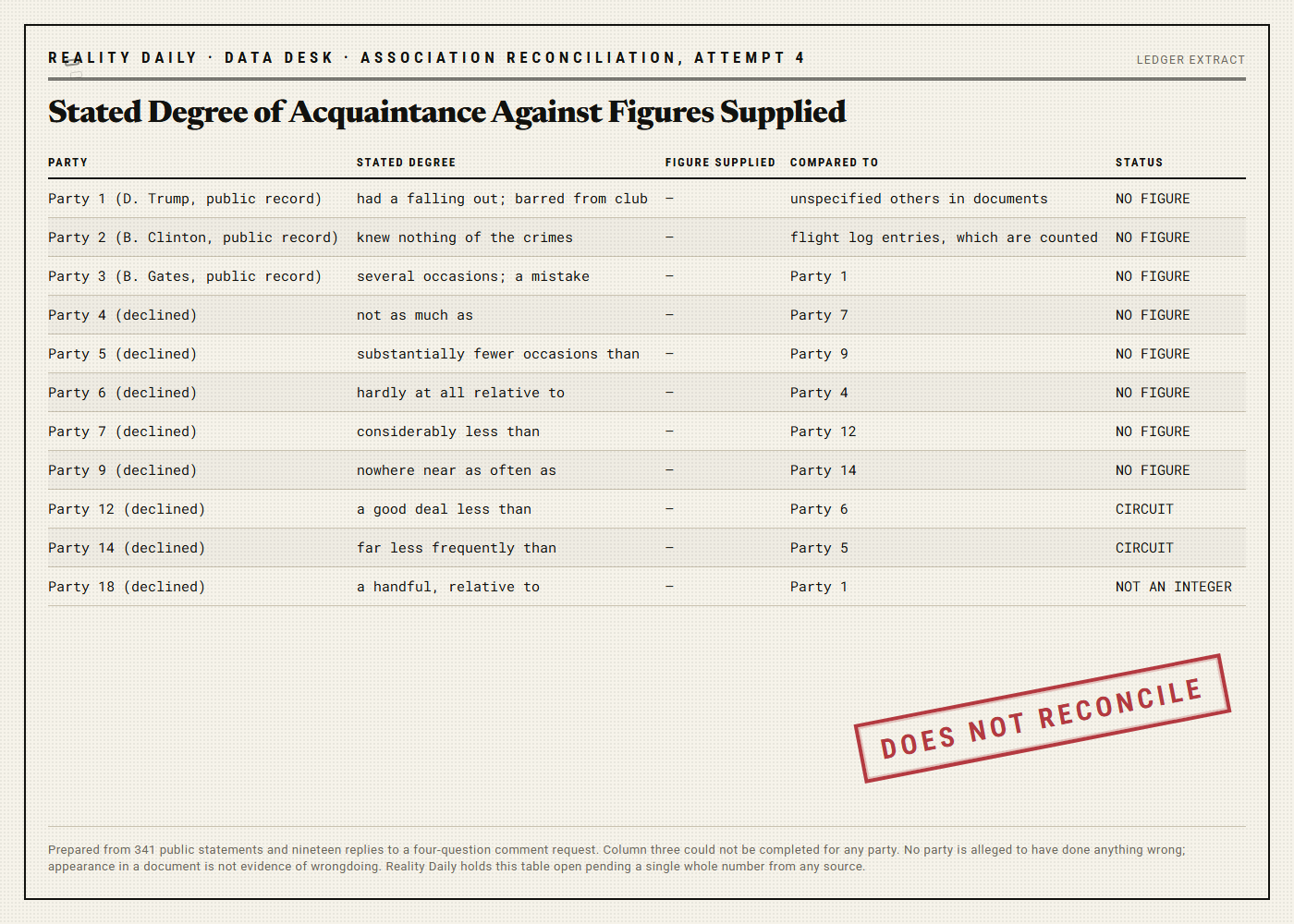
Reality Daily's Economics and Data desk has spent nine weeks attempting to construct a single table. It has five columns. Four are complete. The fifth, which is the one the table exists for, is empty on every row, and this article is an account of nineteen attempts to put a number in it.
The subject is the documentary record surrounding Jeffrey Epstein, the financier who died in federal custody in August 2019 while awaiting trial. Over several years an enormous quantity of associated material has entered the public domain: court filings, estate documents, flight logs, address books, contact lists. The release of further federal files has been a loud and continuing political argument, which we do not intend to referee.
We state the following at the top rather than buried in a note at the bottom, because it is the most important sentence in this newspaper today. Appearing in a document is not evidence of wrongdoing. It is not evidence of anything except that a document mentions a name. Courts have said this. News organizations have said this. We say it here, we will say it three more times before the end, and we would say it more often if the copy desk permitted.
What interests this desk is narrower. Since these materials became public, a very large number of people named in them have issued statements. We have read 341. They differ in length, in tone, and in the number of lawyers evidently involved. They are identical in structure. Every one says, in some arrangement of words, that the speaker knew the man less well than somebody else did.
That is a comparative claim. A comparative claim implies a quantity. We would like the quantity.
"A comparison is not a figure. I cannot enter 'less than Bill' in a column. There is no column for that. I have looked."— Herschel Bove, Economics and Data, Reality Daily, internal memorandum, week three
I. The Form
On the first Monday of the reporting period, this desk prepared a comment request of four questions. It was reviewed by the Standards Desk, revised twice for neutrality, and reviewed again. It fits on one page with room at the bottom. We reproduce it in full so that readers may judge whether it was unreasonable.
- Approximately how many times did the individual named above meet, speak with, or otherwise have contact with Jeffrey Epstein? A whole number is sufficient. A range is acceptable.
- Over what period did those contacts occur? Two years, expressed as a start year and an end year, is sufficient.
- If any dates are known with precision, please supply them. If none are, please write "none known."
- If you decline to supply a figure, please indicate whether that is because the figure is unknown to you or because you do not wish to state it. Either answer is acceptable to us and neither will be characterized.
Question four was added in week two, after the first six replies arrived and none of them answered questions one through three. Question four has never been answered either.
The form went to nineteen offices. Nineteen replied, which is genuinely unusual and to their credit; in the ordinary run of this newspaper's work a nineteen-for-nineteen response rate would be cause for a small celebration. Every reply was courteous. Every one was prompt. Not one contained a number.
II. Nineteen Offices, Nineteen Comparisons
We are printing a representative selection of the replies. Where a reply came from a spokesperson rather than a principal, we name the spokesperson. Where a reply restated a position the principal has already stated publicly, we have not improved upon it, because it is not our place to improve upon anyone's statement.
The first arrived at 4:11 p.m. on the day the forms went out.
"My client's acquaintance with the individual was considerably less extensive than that of a number of other people whose names are also in those documents."— Ardith Whorley-Pace, spokeswoman, Party 2
We wrote back the same afternoon, thanking her, and asked whether "considerably less extensive" could be expressed as a whole number. She replied within the hour that it could not, and that she thought the point had been made. We agreed the point had been made. It was not the thing we had asked for.
The second reply, from a different office entirely, arrived the following morning.
"Substantially fewer occasions than several individuals who have been far more prominently associated with this matter, and I would direct you to them."— Delbert Ocansey-Fring, communications director, Party 5
We draw attention to the second half of that sentence, because it recurs in fourteen of the nineteen replies. The respondent, having declined to supply a figure, supplies a name.
Two of the nineteen replies were, by the standards of this exercise, almost quantitative. One said "a handful." One said "on a small number of occasions, all of them professional, over what I would characterize as a limited window." Our desk spent an afternoon on whether "a handful" could be defended as an integer. Mr. Bove's ruling, entered in the working papers, was that it could not, on the grounds that a handful is a description of a hand.
The three most widely reported positions in this matter are already on the public record and were not obtained by us. We restate them without addition, because we are not going to paraphrase a man into something he did not say.
Donald Trump has said publicly that he and Epstein had a falling out and that he barred him from his club. He was quoted in a 2002 magazine profile saying he had known Epstein for fifteen years. Bill Clinton has said publicly that he knew nothing of Epstein's crimes; flight logs record travel on multiple occasions. Bill Gates has said publicly that he met Epstein on several occasions after Epstein's 2008 conviction and that doing so was a mistake.
Our desk read all three and had the same reaction to all three, which we record in the interest of transparency about our own conduct. We went looking for the numbers. There is one. It is fifteen, it is a duration rather than a count, it is from 2002, and it is the only integer any principal in this matter has placed on the record about his own acquaintance with the man. Mr. Bove has it on an index card above his desk.
Working note, Economics and Data, week four
"Fifteen years is a denominator. It is not a numerator. You cannot compute a rate from a denominator alone, and you certainly cannot compute eighteen other people's rates from one man's denominator. But it is the only real figure in the file and I am not going to pretend I am not pleased to have it."
III. What a Contact Book Is
A great deal of the public argument concerns address books and contact lists, and almost nobody arguing about them appears to have a settled idea of what one is. So we asked somebody whose working life has been spent with them.
Loreen Skidmore-Batts spent twenty-six years as a records archivist for a county clerk's office in central Pennsylvania and has processed, by her own estimate, over four thousand personal and business paper collections, of which she says a bit more than half contained at least one address book. She is retired. She agreed to a forty-minute call and gave us seventy.
We asked what a contact book is, expecting a technical answer about accession and provenance. She gave one, at length, and it was useful. Then we asked the simpler version, and she answered it in a way that stopped the interview.
"It is a list of people. Lists of people contain people. That is what a list is. If you are surprised to find people in it, you have misunderstood the object."— Loreen Skidmore-Batts, records archivist (ret.), central Pennsylvania
She went on, unprompted, to say the thing this desk had been trying to say for three weeks and had not managed. An address book records that somebody had somebody's telephone number. It does not record why, or whether the number was ever dialed, and it does not distinguish between a friend, a dentist, a plumber, a person met once at a party, and a person whose secretary sent a card. She said she had processed a collection containing the private numbers of two sitting governors and a man who resurfaced driveways.
We asked whether an archivist ever draws a conclusion from an entry.
"About the entry, yes," she said. "About the person, no. The entry is evidence that somebody wrote something down."
IV. Appearance in a Document Is Not Evidence of Anything
This section is not a hedge and not a formality inserted by counsel. It is the finding. We ask that it not be skipped, and we have placed it in the middle of the article rather than at the end for that reason.
A document is a record that something was written. That is the whole of what it establishes on its face. A name in a court filing may belong to a plaintiff, a defendant, a witness, a person mentioned in passing by a witness, an attorney, a court reporter, a landlord, an employee, a bank, or a person whose name was invoked by somebody else for reasons of their own. A name in a flight log establishes that a name was written in a flight log. A name in a contact book establishes, as Ms. Skidmore-Batts put it with more economy than we have managed, that somebody wrote something down.
Courts have said this explicitly when unsealing material, in language generally clearer than the coverage of the unsealing. News organizations have said it in the second paragraph of stories whose headlines did not. This newspaper says it here, in its own section, with its own heading, in the same typeface and at the same size as everything else we have printed today. The overwhelming majority of people named in these materials are, so far as anyone has alleged, witnesses, employees, former employees, professional contacts, acquaintances, people who attended a dinner, or people who appear in a phone book because phone books contain people.
We say all of this sincerely, and now the part that sits uncomfortably beside it. It remains true that nineteen offices were sent a four-question form about a matter in which no wrongdoing is alleged against any of them, that all nineteen replied, and that none would state a number. Both things are true at once. We cannot make them stop being true at once, and we have tried.
V. The Referral Graph
Fourteen of the nineteen replies named at least one other person. This newspaper's policy on fairness is not discretionary: if a statement invokes a third party, we contact the third party and offer them the same space. So we did.
The third parties replied. Their replies also named people. We contacted those people. This is where our desk stopped treating the correspondence as correspondence and started treating it as a graph.
The graph is directed. Each node is an office; each edge runs from an office to whichever office it named. As of Tuesday it contains 231 nodes and 388 edges, has generated 206 new inquiries beyond the original nineteen, and has not terminated. Four edges loop back to offices already contacted, producing what our desk calls closed comparative circuits: A knew him less well than B, B less well than C, C less well than D, and D less well than A.
Mr. Bove asked that the following be printed without softening.
"It is not a chain. A chain has an end. This is a graph with cycles in it, and a cycle means the ordering is inconsistent, and an inconsistent ordering means at least one party in each cycle is mistaken about their own position in it. I am not going to say which one. I am going to say that this is the most interesting thing that has ever crossed my desk."— Herschel Bove, Economics and Data
We want to be careful here, and the care is not decorative. A closed comparative circuit is not evidence that anybody is being untruthful. Four people can each sincerely believe they knew a man less well than the next, because human beings are not calibrated instruments and each can only see his own side of it. The circuit indicts nobody. It establishes only that the four statements cannot all be simultaneously correct as an ordering, which is a statement about arithmetic and not about character.
The graph is available to any of the 231 offices on request. Three have asked. All three asked whether their own node could be removed. It cannot, because the node exists because they wrote to us.
VI. The Denominator, and the Collapse of the Model
In week six this desk attempted the obvious methodological correction, which is that raw contact counts are not comparable across parties with different lengths of acquaintance. Forty contacts over twenty years and forty contacts over eight months describe two entirely different relationships, and any honest table has to normalize.
The metric proposed was contacts per year of acquaintance. It is not clever; it is the first thing anybody with a spreadsheet would do. Mr. Bove built it in an afternoon. It has three inputs: the number of contacts, the start of the acquaintance, and the end of it.
It was run on Thursday. It produced no output, for a reason Mr. Bove reported to the Editor-in-Chief in a memorandum of one paragraph, which we print in full because it is the shortest thing he has ever written.
MODEL FAILS. NUMERATOR NOT SUPPLIED. DENOMINATOR NOT SUPPLIED. NORMALIZING BY A QUANTITY NOBODY WILL STATE, USING A QUANTITY NOBODY WILL STATE. RECOMMEND WE STOP.
The denominator is length of acquaintance, which is precisely the quantity every one of the nineteen replies is at pains not to specify, because length of acquaintance is the thing being minimized. The correction requires the very figure whose absence created the need for the correction. Mr. Bove called this a model that eats itself and asked us not to print the phrase. He then reconsidered and asked us to print it, on the grounds that it is accurate.
He wishes it recorded that he does not regard the exercise as wasted. A model that collapses tells you the shape of what is missing, he says, and the shape here is a rectangle nineteen rows deep and one column wide.
VII. The Story That Has Been Over Eleven Times
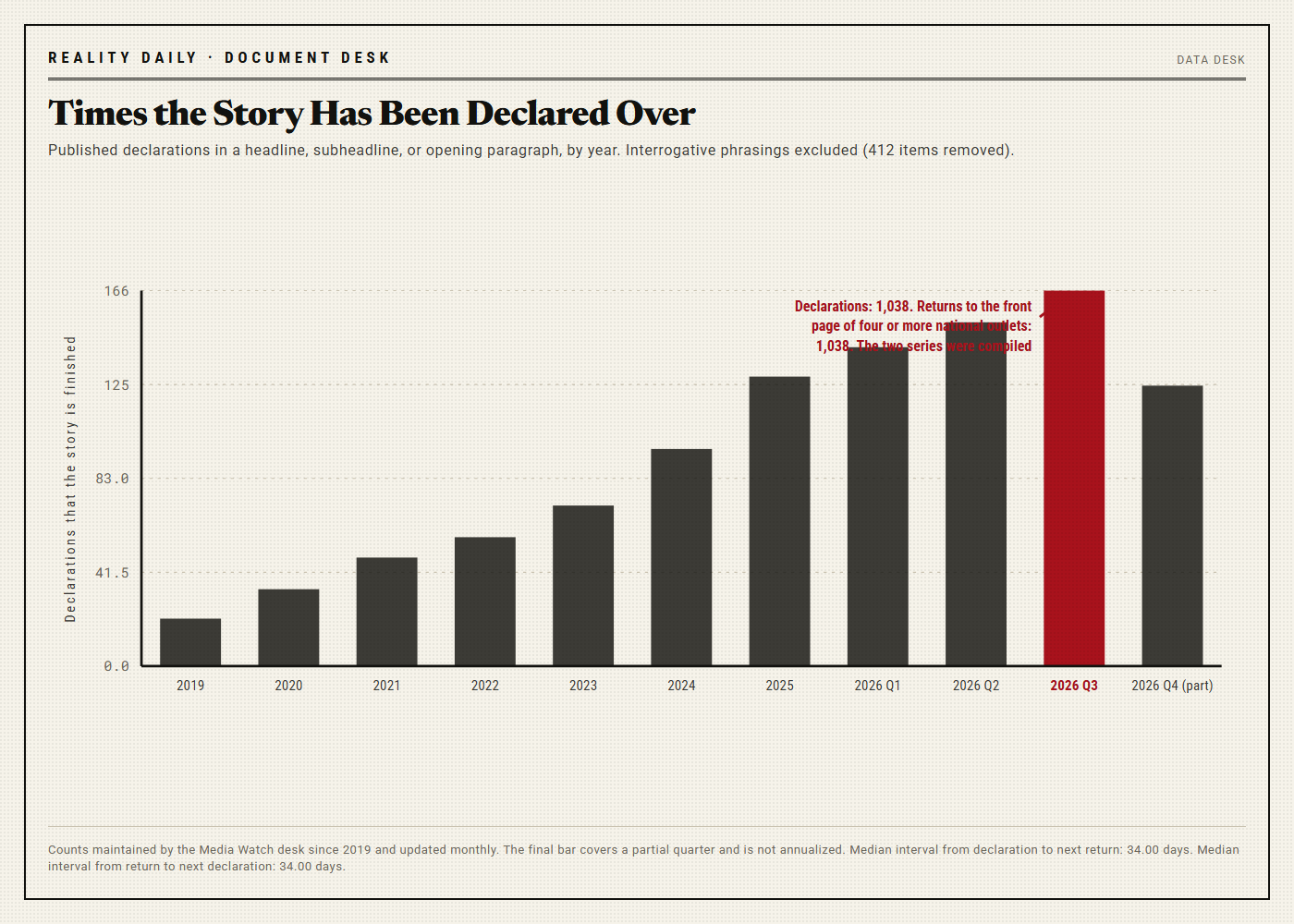
Our Media Watch desk maintains a count, begun in 2019 and updated monthly, of published assertions that this story is finished. The criteria were fixed in advance: the assertion must appear in a headline, subheadline, or opening paragraph, and it must be declarative rather than interrogative. Phrasings in the form of a question were excluded, which removed 412 items and which several staffers regarded as unnecessarily generous.
The count stands at 1,038. The declarations rise, rather than fall, across every year since 2019. The most recent was published eleven days ago.
The same desk maintains a second count: occasions on which the story has subsequently returned to the front page of at least four national outlets simultaneously, which is our operating definition of a return.
The two counts, plotted, are the same line. Not a similar line. The same line, to within the width of the plotted stroke, because every declaration has been followed by a return and every return has been followed by a declaration. Our Media Watch desk checked three times, assuming one series had been drawn twice. It had not. The series were compiled by different staffers in different files, and they overlap.
We do not draw a conclusion from this. We plot it.
Media Watch, methodological note
Declarations counted: 1,038. Returns counted: 1,038. Interval between a declaration and the next return, median: 34.00 days. Interval between a return and the next declaration, median: 34.00 days. Both medians were computed independently and neither staffer was told the other's result until after both were filed.
VIII. The Standards Desk Declines
On Monday this desk submitted the draft table to the Standards Desk with a request that it characterize, for each of the nineteen parties, the degree of acquaintance described by that party's own statement. We did not ask it to assess anybody's honesty. We asked it to sort nineteen self-descriptions into buckets.
It declined, in a memorandum of two pages, and its reasoning is better than our request was.
To sort a comparison into a bucket, the memorandum says, is to supply the figure the speaker declined to supply, on the speaker's behalf, from no evidence except the speaker's refusal. This newspaper does not rate things. Characterizing "considerably less than" as, say, moderate would be a rating with an extra step, and the extra step would be ours.
Accordingly all nineteen parties have been entered into a new category, bringing the number of uncharacterized categories opened by this newspaper this year to five. It is called STATED COMPARATIVELY, NO FIGURE SUPPLIED. Its definition runs to four lines. It has 231 members and is the fastest-growing category in the paper's history.
IX. What We Are Not Saying
Reality Daily wishes to be exact, because this article will be summarized by people who have not read it, and because the subject matter makes an inaccurate summary considerably more damaging than usual.
We are not saying that any person named in this article, or in any of these documents, committed any crime. We are not saying it, we are not implying it, we have not arranged a single fact to suggest it, and any reader who has taken that from what we printed is asked to reread Section IV.
We are not saying that appearing in a document is suspicious. It is not. It is the ordinary condition of anyone who has ever been in a phone book, testified about anything, worked for anybody, or been mentioned by a third party in a filing they never saw. We have said this four times now and we do not consider the repetition excessive.
We are not saying anyone owes this newspaper an answer. Nobody does. The form is a request and not a subpoena; we have no power to compel anything and would not want it. A person is entirely within his rights to decline to state how many times he met somebody, and several of the nineteen did decline, courteously, which we accepted without complaint.
We are not saying anybody lied. A comparative statement cannot be false in the way a figure can be false, because a comparative statement does not commit to anything checkable, and that is the entire property that makes it attractive.
We are saying that nineteen offices were asked for a whole number, that all nineteen answered, that all nineteen answered with a comparison, that fourteen of the nineteen answered by naming somebody else, that the resulting graph has 231 nodes and does not terminate, and that after nine weeks the column headed "Figure supplied" is empty on every row of a table that exists for no other purpose.
X. Conclusion
The ledger does not reconcile. A ledger requires figures and no figure has been entered, and it cannot be made to reconcile by the addition of further comparisons, of which we have 231 and could obtain more by writing another letter this afternoon.
Every party would like it known that they stood nearer the edge of the room than the next fellow. This is not a wicked impulse. It is the most human impulse available, it is what any of us would do, and this newspaper thinks less of nobody for having it. We observe only that a population each insisting they were furthest from the center produces, when tabulated, a room with no center in it, and that a room has a center whether or not anybody will say where.
Nine weeks. One form. Four questions. Nineteen offices, 231 nodes, 388 edges, 206 new inquiries, four closed circuits, and one integer, from 2002, which is a duration.
■ ■ ■
Reality Daily extends to all nineteen offices, and to the 212 subsequently added to the referral graph, unlimited space at the foot of this page. We will print any response in full, unedited, at any length whatever, with no commentary from us of any kind. This includes a response consisting of a single number and no other words, which we will print in the largest type our stylesheet permits.
We will also accept a range. We will accept an order of magnitude. We will accept "more than ten and fewer than a hundred." We have lowered this threshold four times in nine weeks, and the Standards Desk has asked that we stop, on the grounds that we are now negotiating against ourselves.
The space has been held open since the first Monday of the reporting period. It remains open. It is one column wide.
Corrections & Clarifications
Update, 06:12 — An earlier version of this article described the referral graph as containing "approximately 230 nodes." Following review by the Standards Desk, the figure is 231. The desk notes that this is the only occasion in nine weeks on which anybody connected with this story has replaced an approximation with a number, and that it was us.
Update, 10:48 — We initially wrote that fifteen of nineteen replies named a third party. A recount, performed twice and by two staffers, confirms fourteen. The fifteenth reply named a category of persons rather than a person, which our Standards Desk has ruled is not a name. The finding is unaffected, which was that nobody supplied a number.
Update, 14:31 — A reader writes that our headline restates a position rather than reporting a new one. That is correct. The position was stated publicly and we have restated it accurately, which is what the headline is for, and we have not added a figure to it because there is not one to add. The original wording stands.
Sources & Documentation
- Reality Daily Economics and Data Desk. Comment Request Form RD-ASSOC-01, Four Questions. 1 p. Reviewed twice by the Standards Desk for neutrality prior to first issue.
- Reality Daily Economics and Data Desk. Register of Public Statements Concerning Degree of Acquaintance. 341 entries, compiled from published reporting. Comparative constructions: 341. Numeric constructions: 0.
- Reality Daily Standards Desk. Record of Comment Requests, Original Nineteen Offices. 19 entries. Replies: 19. Figures supplied: 0. Median reply time: 2.00 days.
- Reality Daily Standards Desk. Record of Comment Requests, Referral Tier. 212 entries. Replies pending: 187.
- Whorley-Pace, A., spokeswoman. Written reply, 4:11 p.m., day one, and follow-up correspondence the same afternoon.
- Ocansey-Fring, D., communications director. Written reply, day two, with attached restatement of a prior public position.
- Skidmore-Batts, L., records archivist (ret.), central Pennsylvania. Recorded interview, 70 minutes. Transcript 24 pp., reviewed and approved by subject.
- Skidmore-Batts, L. Follow-up correspondence on the accession of personal address books, 3 pp., with two illustrative accession sheets, names redacted by her and not by us.
- New York magazine, 2002 profile of Jeffrey Epstein. Consulted for the single quoted duration figure discussed in Section II and for nothing else.
- Published statements of the three most widely reported parties, as reported contemporaneously by multiple national outlets. Restated in Section II without addition or paraphrase.
- Flight logs entered into the public record in connection with civil litigation. Reviewed for the limited purpose of establishing that they contain counts, which they do.
- Court orders accompanying the unsealing of associated materials, containing express statements that appearance in the documents is not evidence of wrongdoing. Reviewed in full by the Document Desk, 61 pp.
- Reality Daily Document Desk. Term Search of Nineteen Replies. Occurrences of "less," "fewer," "nowhere near," "hardly," "considerably": 63. Occurrences of any Arabic numeral describing a count of contacts: 0.
- Bove, H. Model: Contacts Per Year of Acquaintance, v1 through v4. Working papers 38 pp. All four versions fail at the same input.
- Bove, H. Memorandum to the Editor-in-Chief, week six, one paragraph, printed in full in Section VI.
- Reality Daily Economics and Data Desk. Referral Graph, v9. 231 nodes, 388 edges, 4 cycles. Spreadsheet available to any listed office on request; three have asked.
- Reality Daily Media Watch Desk. Register of Declarations That the Matter Is Concluded, 2019 to present. 1,038 entries, monthly updates. Interrogative phrasings excluded; 412 items removed on that ground.
- Reality Daily Media Watch Desk. Register of Returns to Simultaneous Front-Page Placement in Four or More National Outlets. 1,038 entries. Compiled separately, by a different staffer, in a different file.
- Reality Daily Media Watch Desk. Plot Verification Note. 1 p. Three checks performed on the assumption of a duplicated series. No duplication found.
- Reality Daily Standards Desk. Memorandum Declining to Characterize Degree of Acquaintance. 2 pp. Establishes category STATED COMPARATIVELY, NO FIGURE SUPPLIED.
- Reality Daily Standards Desk. Register of Uncharacterized Categories Opened This Year. 5 entries. The category described above is the fifth and the largest.
- Reality Daily Standards Desk. Ruling on whether "a handful" constitutes an integer. 1 p. It does not.
- Reality Daily Legal. Memorandum on Publication of Tabulated Non-Answers Where No Wrongdoing Is Alleged. 4 pp. Concludes that the tabulation is permissible and that the disclaimer is mandatory. We agreed with both halves.
- Reality Daily Reader Correspondence File RD-C-6104. 1,744 letters received since this inquiry was announced. Eleven enclose the writer's own estimate of somebody else's number. None enclose their own.
- Reality Daily Standards Desk. Internal Memorandum, "On the Difference Between 'No' and Silence," rev. 6. Required reading for all staff. Consulted for the distinction between a refusal and a comparison, which it does not cover, and which has been added in rev. 7.
- The column. It is one column wide. It is nineteen rows deep. It is empty.
Reader Response — 5,033 comments
Records archivist, nineteen years, mostly probate collections. The archivist in Section III is correct and I want to add one thing she was too polite to say. I have processed address books containing a state senator, two clergy, a bail bondsman and the man who did the gutters. The book does not rank them. The book does not know them. It is cardboard.
The closed circuit is the funniest thing I have read all year and I feel bad about that because of what this whole subject is. But four grown men in a ring each pointing at the next one saying that guy knew him better, forever, is a diagram of something very old.
Data analyst here. "Normalizing by a quantity nobody will state, using a quantity nobody will state" is going on the wall in our team room. That is every stakeholder request I have received since 2021.
I appreciate that you put Section IV in the middle instead of at the bottom in six point type like everybody else does. Being in a phone book is not a crime. I am in three phone books.
Respectfully, this is nine weeks of a newspaper mailing a form to people who are under no obligation to fill it in, and then printing a table about how they did not fill it in.
@T. Halvorsen-Bream — Correct in every particular, and stated more efficiently than we managed across ten sections. Nobody is obliged to answer us. We said so in Section IX and we say it again here. What we would put to you is only this: all nineteen chose to reply, at length, promptly, and with care, and each reply took more words to avoid the number than the number would have taken. That is not a refusal to engage. That is engagement, conducted entirely in the comparative. Your comment has been entered in the correspondence file, where it is the fourth item to contain an actual quantity.
Back again from the hour story. Same paper, same problem. Somebody is holding the hour and nobody knows anyone. I am beginning to think the Winchester Bureau has found one story and keeps walking into it.
A handful is a description of a hand. I have read that sentence eleven times and it has not stopped being correct.
Fifteen. One number in the entire record and it is a duration from 2002 and a man has it on an index card above his desk. That is the saddest spreadsheet in America.