Seven-Year-Old Classified as an Enemy Combatant Says the Situation Is Not, in His Assessment, Super Chill
A one-page determination form assigns a designation to a child and states, in a field the size of a postcard, the criteria on which it was assigned. That field has been withheld in full. Reality Daily has asked for it nineteen times.
Editor's Note
This article was held for nine weeks while the Standards Desk sought comment from the office identified in the record as the reviewing authority. Nineteen written requests were sent, seven of them beyond our standing policy of twelve. Two automated acknowledgments were received. Nothing else was.
The newsroom debated for six days whether to print the subject's assessment of his own situation. We are printing it. This newspaper does not decline to print a source on the ground that the source is inconvenient to the record, and it has never once declined to print a source for being seven. — M. Vandersloot
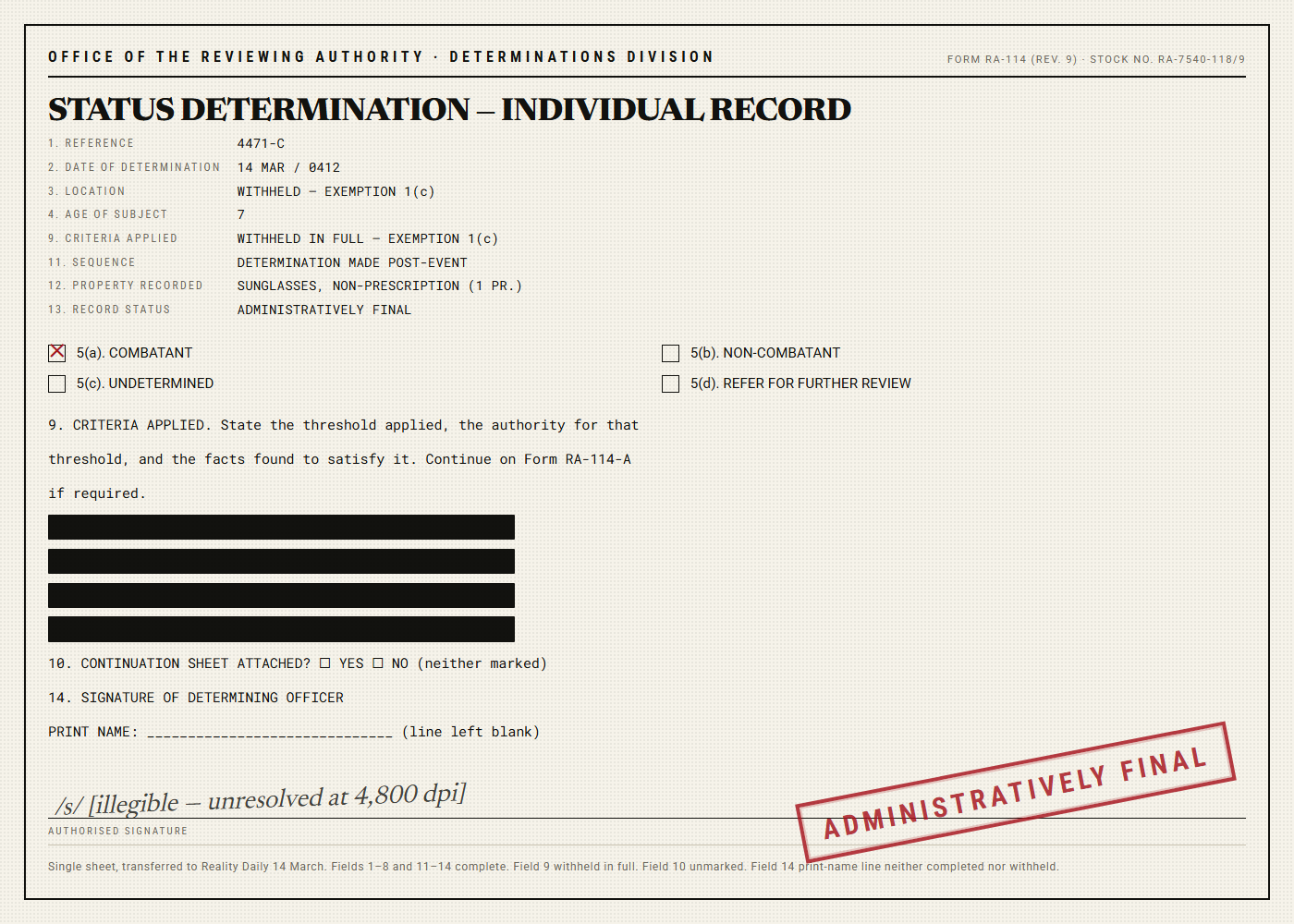
Reality Daily has obtained a single sheet of paper. It is a status determination form, revision nine, printed on one side, and it carries fourteen numbered fields. Twelve of them are complete. They are complete in the way forms are complete when the person filling them out has done it many times before: no crossings-out, no marginal notes, the date entered in the six-digit convention, the reference number written twice because the form asks for it twice.
One field is not complete. Field nine is the largest box on the page. It is the box in which the reviewing authority states the criteria it applied. In the copy we hold, field nine has been withheld in full under the authority's own disclosure schedule, exemption 1(c). We are going to be precise about this for the next three thousand words, so we will be precise about it now: the box is not empty. The box has been covered.
Field four gives the subject's age. Field four is one of the twelve complete ones. It reads: 7.
Asked for his assessment of the situation, the subject said that it was not, in his assessment, super chill. He was wearing Ray-Bans. He is seven. He is dead.
We are not going to tell you whether the determination is correct. We would like to. We cannot, for the reason that has organized every hour of this investigation and all nineteen written requests behind it. We have not been shown the criteria.
"Ask them what the standard is. Not the file, not the case, not the incident. The standard. An office that has one can say it in a sentence."— Deborah Kunz-Rasmussen, records-access attorney, Modesto, California
I. The Form
The document reached us on 14 March by third-party transfer, in a manila envelope with no return address and a postmark we have declined to print. Our Document Desk photographed it at 4,800 dots per inch before anyone read it. Our Legal Desk reviewed it for six days before anyone quoted it.
It is Form RA-114, revision nine. The revision number is set in eight-point type in the lower left corner, alongside a stock number and a printing date. We mention it because it establishes something no source in this story would state out loud: the form is not improvised. It was designed, laid out, proofed, revised eight times, and printed in a quantity large enough to justify assigning it a stock number.
Field one is a reference. Field two is a date. Field three is a location, withheld, about which we will say nothing at all. Field four is the age. Field five is the designation, offered as four checkboxes: COMBATANT, NON-COMBATANT, UNDETERMINED, REFER FOR FURTHER REVIEW. The first box is marked. The mark is a single ballpoint stroke and it does not extend outside the box.
Field ten asks whether a continuation sheet is attached. Neither box is marked.
Field eleven records that the determination was made after the event rather than before it. We report it because it is on the form, and draw no inference from it.
Field twelve is headed PROPERTY RECORDED. It reads, in full:
SUNGLASSES, NON-PRESCRIPTION (1 PR.)
We are not going to remark on field twelve. We printed it because it is on the form, and because our standards require that we print what we obtained rather than the portions of it we found manageable.
Field fourteen is the signature block. There is a signature. It is illegible — not stylized, not hurried, illegible — and our Document Desk cannot resolve a single letter of it at 4,800 dots per inch. Beneath it the form provides a second ruled line, labeled PRINT NAME. That line is blank. No exemption was claimed over it, because nobody has to claim an exemption over a thing they did not do.
The stamp across the foot of the page reads ADMINISTRATIVELY FINAL.
II. The Subject
Reality Daily knows this child's name. His family, through an intermediary, asked us not to print it. We are not printing it.
We want to draw a distinction that will otherwise be lost. We are withholding a name because a family asked us to and we agreed. The form is withholding the criteria because an office decided we could not have them and did not say why. Both are silences. They are not the same silence, and the difference is the subject of this article.
The form calls him SUBJECT 4471-C. We will use that designation where citation requires it and nowhere else, under protest, for consistency of reference only.
Asked, on the record, for his assessment of the situation, he gave it in eight words.
"It is not, in my assessment, super chill."— Subject 4471-C, age seven
We are not going to gloss that or set it against anything. We note only, as a matter of sourcing, that it is the sole assessment in this article offered by a person with direct knowledge of the events described, and the only one we obtained without filing a request.
III. Field Nine
Field nine is headed CRITERIA APPLIED. Beneath the heading, in the same eight-point type as the stock number, the form instructs the completing officer as follows: State the threshold applied, the authority for that threshold, and the facts found to satisfy it. Continue on Form RA-114-A if required.
Read that instruction twice. The form anticipates that the criteria may not fit in the box, and provides a continuation sheet for that contingency. Somebody wrote that sentence, somebody approved it, and somebody had a second form printed to receive the overflow.
We have requested Form RA-114-A five times. We have been told neither that it exists nor that it does not.
We obtained, in an unrelated transfer, chapter four of the Determinations Division drafting guide, which instructs officers on the completion of basis blocks. Its second paragraph reads:
A BASIS BLOCK SHALL BE COMPLETED IN SPECIFIC TERMS. REFERENCE TO ANOTHER BLOCK IS NOT A BASIS.
That is the authority's own rule, in the authority's own manual, about the authority's own form. We are not citing it against anybody. It is the clearest statement anyone has produced in this investigation of what field nine is for, and it was produced by the office that will not show us field nine.
FIELD 9, AS RECEIVED
The complete content of field nine of Form RA-114 (rev. 9), reference 4471-C, as transferred to Reality Daily on 14 March, reproduced without abridgment:
████████████████████████████████████████
The bar measures 4.1 inches by 2.7 inches. We measured it. It is the largest single element on the page, larger than the stamp, larger than the signature, and larger than field four.
IV. Nineteen Requests, Two Acknowledgments
Reality Daily's standing policy is twelve requests for comment before we publish without one. It is not a courtesy. It is a discipline, and our Editor-in-Chief has enforced it three times at the cost of a story.
Here we went to nineteen. The additional seven were authorized in an internal memorandum from the Editor-in-Chief which reads, in its entirety:
FIELD FOUR SAYS SEVEN. KEEP ASKING.
We did not ask the reviewing authority to reverse the determination. We have no standing to ask that and no view on whether it should be reversed. We asked five questions, in writing, on the authority's own request form, nineteen times:
- The text recorded in field nine of the referenced determination.
- The authority cited for the threshold stated in that field.
- Whether Form RA-114-A was completed in this matter.
- The identity, by title alone and not by name, of the officer who signed field fourteen.
- The memorandum recording the decision to withhold field nine, which is itself a record.
Four of those five are answerable from a filing cabinet. The fifth is answerable by whoever applied the exemption, who by definition was at a desk when they did.
We received two responses. Both were automated. Both arrived at 03:41. Neither was signed. The second was, character for character, the first.
The authority's own records instrument, rule six, provides for a response within twenty working days. As of publication the count stands at one hundred and twenty-two working days, and one hundred and seventy-two calendar days.
V. What a Redaction Asserts
Deborah Kunz-Rasmussen has practiced records-access law for twenty-two years, most of it for requesters and some of it, she volunteers before we can ask, for agencies. She works out of two rooms above a tax preparer in Modesto, California. She returned our call in forty minutes, the second-fastest call-back in the history of this newspaper.
She asked to see the form. We sent the form. She called back and said, before hello:
"Okay. So that's an exemption, not a nullity."
We asked her to explain the difference.
"An exemption gets applied to material. You withhold something. If field nine had never been completed, the correct entry is N/A, or a diagonal strikethrough, or initials in the margin. There's a convention for it and they teach it in the first week. What you do not do is put a bar over nothing. There's no procedure for withholding a blank."
"Somebody read what's under that bar, and decided you don't get it. That decision is itself a document, with a date on it and a person's initials at the bottom. Ask for that one."— Deborah Kunz-Rasmussen, records-access attorney
She stopped us twice to say she had not seen the underlying material. She stopped us a third time to say she did not know what regime governs this authority and was not going to guess about it on a recorded line. Then she volunteered, unasked, the most innocent explanation available to the office that will not answer us: that basis blocks are sometimes withheld wholesale because the block carries standing language appearing on every determination the office issues, classified as a body.
We print that possibility because she insisted on it, and because it is the one we would most like to be true. If it is true, the criteria are written down in one paragraph, in one place, and somebody could read them to us over the telephone.
"Either way," she said, "somebody can tell you what the threshold is. That's not a leak. That's a policy."
VI. How These Forms Work, In General
Walter E. Sibley spent twenty-six years as a classification management officer. He will not identify the service. He gave a reason for that, we found it sufficient, and we are not printing the reason either.
Mr. Sibley agreed to explain, in general terms, how a determination form of this family is built and what each part of it is for. He declined, on eleven separate occasions across a two-hour interview, to discuss any specific determination, including the one on the table in front of him, which he did not pick up. Our transcript indexes all eleven refusals.
He described a three-part architecture: the finding, the basis, and the review.
"The finding is the easy part," he said. "The finding is a box you check. Anybody can check a box. That's why it's a box."
"The basis is the whole apparatus. And here's what people outside get wrong about it — the basis block is not written for the public. It's written for the next officer. Somebody opens that file in four years. A reviewer, an inspector, a lawyer, your own successor. They have to be able to read the basis and say: yes, that was the standard, and it was applied. Or: no, it wasn't."
We asked what it means when the basis is withheld from that person as well.
"Then it isn't a basis. It's a decoration."
We asked him once, plainly, having told him in advance that we were going to ask it, whether a seven-year-old could satisfy the criteria on a form of this type. There is a pause on the recording which our transcript logs at fourteen seconds.
"I don't know what the criteria are. That is the whole of my answer and you can print the whole of it. And I'll give you one more for free: if you can't say the criterion out loud, in a room, to somebody who is going to write it down, you don't have a criterion. You have a preference."— Walter E. Sibley, retired classification management officer, twenty-six years, service not identified
VII. The Register
In June a second transfer brought us three pages of a classification register, a tabular ledger in which determinations are recorded in sequence for administrative tracking. We do not know how many pages the register runs to. We asked. That was request fourteen.
The register has five columns: AGE, DESIGNATION, BASIS CITED, REVIEWING AUTHORITY, STATUS. On every line of the extract the designation reads COMBATANT, the reviewing authority is withheld, and the status reads ADMINISTRATIVELY FINAL.
The basis column is also identical on every line. Tobias Wrenn of our Document Desk measured it with a steel rule at the direction of the Standards Desk. The bar in the basis column is 2.3 inches wide, and it is 2.3 inches wide on all twelve lines, to the limit of what a steel rule can establish.
The age column is not identical. We are printing the age column, because it is a column of numbers on a page we lawfully hold, and because the whole of our argument here is that a record ought to be readable by the people it is kept about.
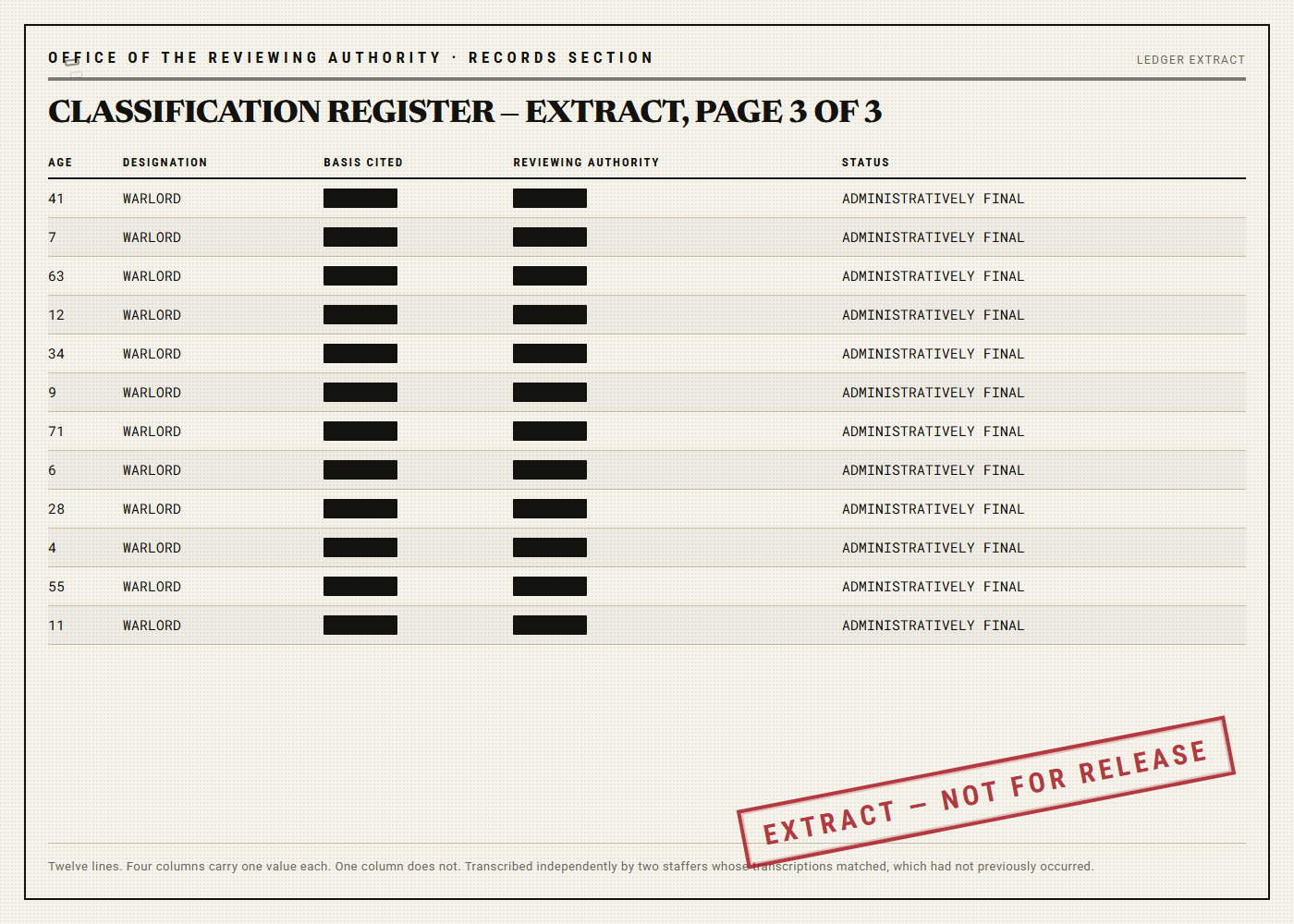
Two staffers transcribed page three independently, which is Standards Desk protocol and which in fourteen years has never once produced two matching transcriptions. These matched. There was nothing on the page to disagree about.
We want to state plainly what the extract does and does not show. It does not show that these determinations were made without individual consideration. It shows that the column recording the basis contains the same withheld entry in every case. Those are two different statements. We are making the second one, and we would like very much to be shown the material that would let us stop.
DOCUMENT DESK NOTE — WHAT WE MEASURED
Page 3. Basis column: bar 2.3 in., all twelve lines, ±0.02 in. Designation: one distinct value. Reviewing authority: one distinct value, withheld. Status: one distinct value. Age: twelve distinct values, range 4 to 71.
Steel rule, available for inspection by any party who asks in writing. To date, none has. — T. Wrenn
VIII. On the Word "Chill," and the Other Words
The Standards Desk spent two days on a question some readers will think trivial: whether this newspaper may render a subject's assessment in the subject's own register.
Our house style is plain. We would ordinarily write that a subject "expressed dissatisfaction," or "characterized the situation as unacceptable." In doing so we would be translating him into the vocabulary of the record — the same vocabulary that produced field nine — and we would be doing it without telling you.
We consulted Nadine Ostrowski, a lexicographer who works on usage for a general dictionary and has spent eleven years on adjectives.
"'Chill' is an assessment term," she said. "In this construction it isn't slang for calm. It means acceptable — tolerable, within normal limits. He used the negative form and hedged it with 'in my assessment,' which is the hedge you reach for when you expect to be contradicted. Grammatically that is a finding. It has a subject, a standard, and a qualifier. It is better formed than most of what I read in policy documents."
We are printing his words. The Standards Desk determination is on file and runs to one page.
The other vocabulary in this file is the record's own, and nobody has audited it. From the documents in our possession, in the documents' own words:
- The matter is described in one place as "a scheduling matter."
- It is described on another page as "below the threshold for a finding."
- A third page records: "No further action indicated."
- A fourth, addressing the register: "Records will be conformed."
We looked up "conformed." In records practice it means brought into agreement with a controlling document. It is a word for making the file match. It is not, in itself, an allegation, and we are not making one.
STATUS: RESOLVED. BELOW THRESHOLD FOR A FINDING. NO FURTHER ACTION INDICATED.
Two assessments of this situation are now in the record. One of them is eight words long, was given without a form, cites no authority, and claims no exemption. The other runs to three pages, cites as its basis a field we have not been permitted to read, and is administratively final.
IX. What We Are Not Saying
This article will be summarized by people who have not read it, so we will write the summary ourselves and they can use ours.
We are not saying the determination is wrong. We have not been shown the criteria. This newspaper does not rate things, and would not rate this one on the record it has.
We are not saying the determination is right, for precisely the same reason, and we would observe that the reason being identical in both directions is the finding.
We are not saying the criteria do not exist. The reviewing authority has asserted, by covering them, that they do. We are taking the authority at its word on that point. It is the only thing the authority has given us, and we are entering it as evidence in the authority's favor.
We are not saying anyone acted unlawfully. We do not know what law applies. We asked, in request eleven, what law applies. That request is among the seventeen that received nothing at all.
We are not taking a position on the events to which this determination relates, or on the circumstances from which they arose, or on any party to them. We have no position. We did not acquire one in fourteen months and we are not going to acquire one in the last four hundred words of an article about a form.
We are saying that field four says seven, and field nine says something we are not allowed to read, and that between those two facts there is a threshold, and that somebody, in an office, on some Tuesday, wrote it down.
X. Conclusion
Fourteen fields. Twelve complete. One covered. One on which nobody would say either way. A single ballpoint stroke inside a box. An illegible signature above a blank ruled line where a name is supposed to go.
We have been asking one question since 14 March. We have asked it nineteen times. It has not changed and it is not going to change: what is the threshold? Not who applied it. Not whether it was applied correctly. Not whether anybody should be investigated, disciplined, defended, or thanked. What is the threshold at which a person becomes a combatant — in specific terms, in the authority's own words, written down the way the authority's own drafting guide requires it to be written down.
We are a filing clerk. That is not modesty and it is not a pose. It is the only credential we claim, and we would like the document.
Reality Daily has held the foot of this page open since 14 March. Any response will be printed in full, unedited, at whatever length they choose, with no commentary from us. If the response consists solely of field nine, we will print field nine and nothing else, and we will consider the page well spent.
■ ■ ■
The form is in a drawer on the second floor of a rented room above a former appliance showroom in Winchester, Virginia. Tobias Wrenn photographs it on the first of every month at a fixed exposure, so that we can demonstrate, if it is ever necessary, that nothing about it has changed.
Nothing about it has changed.
Field four says seven. Field twelve says one pair of sunglasses, non-prescription. Field nine is covered. And a boy, asked for his assessment of the situation, gave one — in eight words, without a form, without an exemption, and without asking anybody's permission first — and his remains the only assessment in this file that anyone has been willing to state in specific terms.
Corrections & Clarifications
06:12 — An earlier version of this article described field nine as "blank." Field nine is not blank; it is withheld. The distinction is the whole of the story and we regret having introduced an error into it. The remainder of the wording stands.
11:07 — We described the criteria block as occupying roughly a third of the form's completable area. Following remeasurement by the Document Desk — of the completable area only, being the area inside the fourteen numbered fields and excluding the letterhead, the meta grid, the signature block and the margins — the criteria block occupies 34.1 percent. The original wording stands.
16:45 — A reader writes to say that the reviewing authority is under no obligation to explain itself to a newspaper. Reality Daily agrees, has never suggested otherwise, and notes that the request at issue was not made by a newspaper. It was made by a member of the public, on the authority's own form, nineteen times.
Sources & Documentation
- Form RA-114 (rev. 9), status determination, reference 4471-C. Single sheet, obtained by third-party transfer 14 March. Fields 1–8 and 11–14 complete; field 9 withheld in full under exemption 1(c); field 10 unmarked.
- Reviewing Authority, Classification Register, extract, pp. 1–3. Obtained by second transfer, June. Page count of the complete register unknown; requested; not supplied.
- Determinations Division, Drafting Guide for Status Determinations, ch. 4, "Completion of Basis Blocks," 9 pp. Obtained in an unrelated transfer.
- Reviewing Authority, Public Disclosure Schedule, exemption 1(c), 2 pp., undated, unsigned.
- Kunz-Rasmussen, D. Recorded telephone interviews, 2 May and 9 May. Transcript 44 pp., reviewed and approved by subject.
- Sibley, W. E. Recorded interview, 11 June, 2:40 p.m. Transcript 63 pp., with index of eleven declinations to discuss any specific determination.
- Ostrowski, N. Written correspondence and corpus citations for adjectival chill, 9 pp.
- Reality Daily Standards Desk, Record of Requests to the Reviewing Authority, 14 March – 28 August. 19 entries; 2 automated acknowledgments; 0 substantive responses.
- Automated acknowledgment received 03:41; automated acknowledgment received 03:41. Timestamps identical. Text identical, character for character. Both unsigned.
- Form RA-114-A (continuation sheet). Requested five times. Existence neither confirmed nor denied.
- Vandersloot, M. Internal memorandum authorizing requests thirteen through nineteen. One line. Reproduced in Section IV in full.
- Reality Daily Document Desk, Photographic Record of Form RA-114 (rev. 9), Reference 4471-C. Monthly, fixed exposure, fixed distance, six exposures to date.
- Wrenn, T. Column Measurement Memorandum, Register Page 3. 1 p., twelve lines measured with a steel rule, tolerance ±0.02 in.
- Reality Daily Standards Desk, Independent Transcriptions of Register Page 3 by Two Staff Readers, Prepared Without Conferral. 2 documents. Identical.
- Doggett, P. A. "On the Difference Between 'No' and Silence." Internal memorandum, excerpt, 1 p.
- Reality Daily Legal, Memorandum on Publication of a Record Concerning a Minor. 6 pp. Six-day review.
- Correspondence with the subject's family, via intermediary, 1 p. Name withheld at family's request and held by the Editor-in-Chief and the Standards Desk only.
- Reviewing Authority, records instrument, rule 6 (response within twenty working days). Elapsed at publication: 122 working days; 172 calendar days.
- Transcript, telephone call to the Determinations Division public line, 4 min 11 s, in the course of which this newspaper was transferred four times and then disconnected.
- Reality Daily Standards Desk, Determination Whether an Assessment May Be Rendered in a Subject's Own Register. 1 p. Determination: yes.
- Reality Daily Standards Desk, Determination Not to Characterize the Designation as Correct or Incorrect Absent Sight of the Criteria. 1 p.
- Photograph, field nine, 4,800 dpi, EXIF intact. Examined for underlying impression, ghosting, and toner variance. None found. The bar is a bar.
- Reality Daily Reader Correspondence File RD-C-5119, 2,860 letters received since first publication.
- The form. It is in the drawer. Field nine is still covered.
Reader Response — 4,074 comments
Nineteen requests and two robots at 3:41 in the morning. That's the whole country right there.
I process records requests for a county government. Confirming the attorney's point, because people won't believe it otherwise: an exemption is applied to material. If a field is empty you mark it N/A or you strike it through. There is no lawful way to redact nothing — the software won't even let you draw the box. Whatever is under that bar, somebody typed it.
Three thousand words about a box.
@A. Kowalczyk — Correct, and we would not want the summary to be softer than that. It is a box. The box is the field in which an office is required by its own drafting guide to state, in specific terms, the threshold it applied. We have asked for the contents of the box nineteen times. We have added your comment to the correspondence file.
The drafting guide is the part that got me. Their own manual says reference to another block is not a basis. So what is a bar over the block?
"Then it isn't a basis. It's a decoration." Twenty-six years and he gets there in eight words. Everyone else needed a form.
I read field twelve three times and then I put the phone down and went outside. I'm not going to say anything clever about it.
Genuine question, not a gotcha: is there any chance the criteria block is boilerplate and this is all a filing accident? The lawyer seemed to leave that open and the paper printed it, which I appreciated.
@D. Rennick — Yes. There is every chance, and it is the outcome we would prefer, because it would mean the criteria are written out in one paragraph in one place and a person could read them to us aloud. We have asked whether that is the case. That was request sixteen. The space at the foot of the page remains open.