Fauci Says Long Covid Is Actually of Average Size, and the Bureau of Weights and Measures Has No Reference Specimen Either Way
Long Covid is real, serious, and recognized by the WHO, the CDC and the NIH, and this newspaper disputes none of that. It disputes one adjective. Eleven months, nineteen offices and four questions later, no office on Earth holds a reference standard for the word long, and we now know why.

.jpg)
Editor's Note
Before anything else. Long Covid is a real and serious medical condition. It is recognized by the World Health Organization, the Centers for Disease Control and Prevention and the National Institutes of Health, it carries a diagnostic code, and it disables people. Nothing in the reporting below examines, questions or bears upon that, and any reader who comes away with a contrary impression has been failed by this newspaper and should write to the Standards Desk so we can repair the writing. The inquiry here concerns one adjective and nothing else.
This story was held for nine weeks while the Standards Desk pursued comment from nineteen offices. Twelve have not written back, which is not a refusal, and the difference between a refusal and silence is the only thing this paper has ever been about. Space is held at the foot of this page, unedited, at any length, for as long as it takes. — M. Vandersloot
Anthony Fauci, who directed the National Institute of Allergy and Infectious Diseases from 1984 until 2022 and served as Chief Medical Advisor to the President, has stated that Long Covid is, in his assessment, of average size.
Before we go further, this newspaper places the following where it cannot be trimmed out of a summary. Long Covid is real. It is serious. It is recognized by the World Health Organization, the Centers for Disease Control and Prevention, and the National Institutes of Health, which has committed over a billion dollars to studying it through the RECOVER initiative. It carries its own diagnostic code, U09.9, under the clinical name post COVID-19 condition, unspecified. Documented features include fatigue, post-exertional malaise, cognitive dysfunction and dysautonomia. None of that is in dispute here, at any point, in any section.
What is in dispute is one word, and the word is long.
This story landed on the Standards Desk rather than any medical desk, for the same reason a complaint about a butcher's scale lands with the county inspector rather than a nutritionist. Somebody has made a magnitude claim. A magnitude claim requires a referent. We have spent eleven months looking for the referent.
We did not find it. We are saying so in the fourth paragraph rather than the fortieth.
"You are asking me where the standard is kept. There is no standard. There was never a standard. The people who needed the word had it before anyone thought to mint one, and they were right, and that is not a scandal. That is how language works."— Dr. Ines Wolstenholme, metrologist, thirty-one years in national laboratory work
I. The Statement
The operative sentence, as our transcription desk logs it:
"IF YOU ARE ASKING ME ABOUT THE ADJECTIVE, I WOULD SAY IT IS OF AVERAGE SIZE."
"The word is doing the work of persistent," he said. "It is not doing the work of long. Nobody chose it off a ruler."
Asked whether the word constituted a measurement, he said: "It is not a measurement. It is an adjective. I have never in my life been asked to defend an adjective and I am not going to start."
Every quoted word above concerns grammar. We asked his office, in writing, four times, whether he wished to be understood as making any claim about the severity, prevalence, biology or treatment of the condition. A spokesperson replied that his position on the condition itself is what it has publicly been throughout: that it is real, that it is serious, and that it warrants sustained research funding. We print that because it is correct.
So the medical question closed on the day it opened, which left us with the adjective, alone, on a desk, in a room where the only people are metrologists.
II. Four Questions, Nineteen Offices
Tobias Wrenn, who runs this newspaper's Document Desk and has filed 2,209 records requests since 2014, drafted internal form RD-NOM-1 on 4 October. One page. Four questions. It has gone, unaltered, to nineteen offices: seven national health agencies, four international bodies, three nomenclature committees, two national measurement institutes, two university terminology centers, and one office since reorganized into another which does not acknowledge inheriting its mail.
The four questions, reproduced exactly as they appear on the form:
- Against what reference duration is the word "long," as it appears in the term "long Covid," being compared?
- In what unit is that reference duration expressed, and to what stated uncertainty?
- What threshold value separates a case that satisfies the adjective from a case that does not?
- Which office holds the reference standard for that threshold, and under what document number may its certificate of calibration be inspected?
These questions will be described as hostile by people who have not read them. They are not hostile. They are the four questions a county weights-and-measures inspector asks about a gas pump, and a gas pump answers all four in under a minute, and the inspector goes to lunch.
Nineteen offices. Four questions. Seventy-six data points requested.
Six received.
Wrenn tally, form RD-NOM-1, as of publication
Sent: 19. Delivery confirmed: 17. Automated acknowledgments: 5. Substantive replies: 2. Replies addressing question 1: 1. Replies addressing question 4: 0.
Requests declined: 0. This is not a story about refusal. Nobody has refused us anything. Twelve offices have simply not written back, which our Managing Editor for Standards insists we distinguish from a refusal, and she is right, and the distinction is the whole of this newspaper.
The one reply engaging question 1 came from a public-health information office and consisted of the World Health Organization's clinical case definition, which we already had, in three copies, one annotated. That definition holds that symptoms usually begin within three months of infection, persist at least two months, and have no alternative explanation.
Two months is a duration. It has a unit. We note this in fairness and we note it early, because it is the best answer anybody gave us.
It is also not a referent for the adjective. The definition never says two months is what "long" means, and its operative text does not use the word. The clinical name, post COVID-19 condition, carries no magnitude claim and is, from this desk's view, unimpeachable. The institutions minted a clean name. The clean name is not the name anybody uses. We return to why.
III. The Reply From the Bureau, Printed in Full
On 11 February we wrote to the International Bureau of Weights and Measures at Sevres, on the theory that a claim about duration is a claim about a physical quantity, that duration is measured in seconds, and that the Bureau exists for exactly this.
They answered in nine working days, the fastest response this newspaper has received from any institution in fourteen years. Our previous approach to this same Bureau, during our investigation Where the Kilogram Went, produced nineteen written requests and no substantive reply at all. They are not a body that ignores mail. They are a body that answers the mail which is theirs.
It is reproduced in full and unedited.
DEAR MR. BOVE, THANK YOU FOR YOUR LETTER OF 11 FEBRUARY AND FOR THE CARE WITH WHICH IT WAS DRAFTED.
DURATION IS INDEED A PHYSICAL QUANTITY. THE COHERENT SI UNIT OF TIME IS THE SECOND, DEFINED SINCE 1967 BY THE UNPERTURBED GROUND-STATE HYPERFINE TRANSITION FREQUENCY OF THE CAESIUM 133 ATOM, TAKEN TO BE 9 192 631 770 HERTZ. THE REALIZATION AND DISSEMINATION OF THIS UNIT FALLS WITHIN OUR REMIT.
THE MATTER YOU DESCRIBE DOES NOT. THE BUREAU MAINTAINS REFERENCE STANDARDS FOR QUANTITIES. IT DOES NOT MAINTAIN REFERENCE STANDARDS FOR ADJECTIVES, AND WE ARE NOT AWARE OF ANY BODY WHICH DOES. WE HOLD NO SPECIMEN, PROTOTYPE OR CERTIFIED ARTIFACT BEARING ON THE TERM YOU CITE, AND WE HAVE NO RECORD OF ANY SUCH ARTIFACT HAVING BEEN DEPOSITED, WITHDRAWN OR REQUESTED.
WE WOULD ADD, WITH RESPECT, THAT THE ABSENCE OF SUCH A STANDARD IS NOT A DEFICIENCY. IT IS THE ORDINARY CONDITION OF ORDINARY LANGUAGE. WE WISH YOU WELL IN YOUR INQUIRY AND REGRET THAT WE CANNOT ASSIST FURTHER. — C. FERRAND-OYELARAN, LIAISON, TIME AND FREQUENCY
That is the entire letter. It is the best-drafted document this newspaper has received in four years and we have had it laminated.
IV. The Reply, Parsed
Clause two concedes the premise entirely. Duration is a physical quantity with an SI unit defined to nine significant figures. The axis a person speaks on when they call a thing long has been instrumented to fourteen decimal places. Our question was not a category error. The axis exists. The axis is magnificent.
Clause three is the finding. No specimen, no prototype, no certified artifact, and no record of any such artifact having been deposited, withdrawn or requested.
Read that last part again. Not deposited. Not withdrawn. Not requested. In the entire correspondence history of the body that exists to hold the world's reference standards, nobody had ever asked for this one. Until 11 February.
Clause four tells us, courteously, that we have misunderstood something. It is right. We spend the rest of this article being told the same thing by better-qualified people, and each time it is true, and each time we print it.
V. Long QT Syndrome, Which Managed It
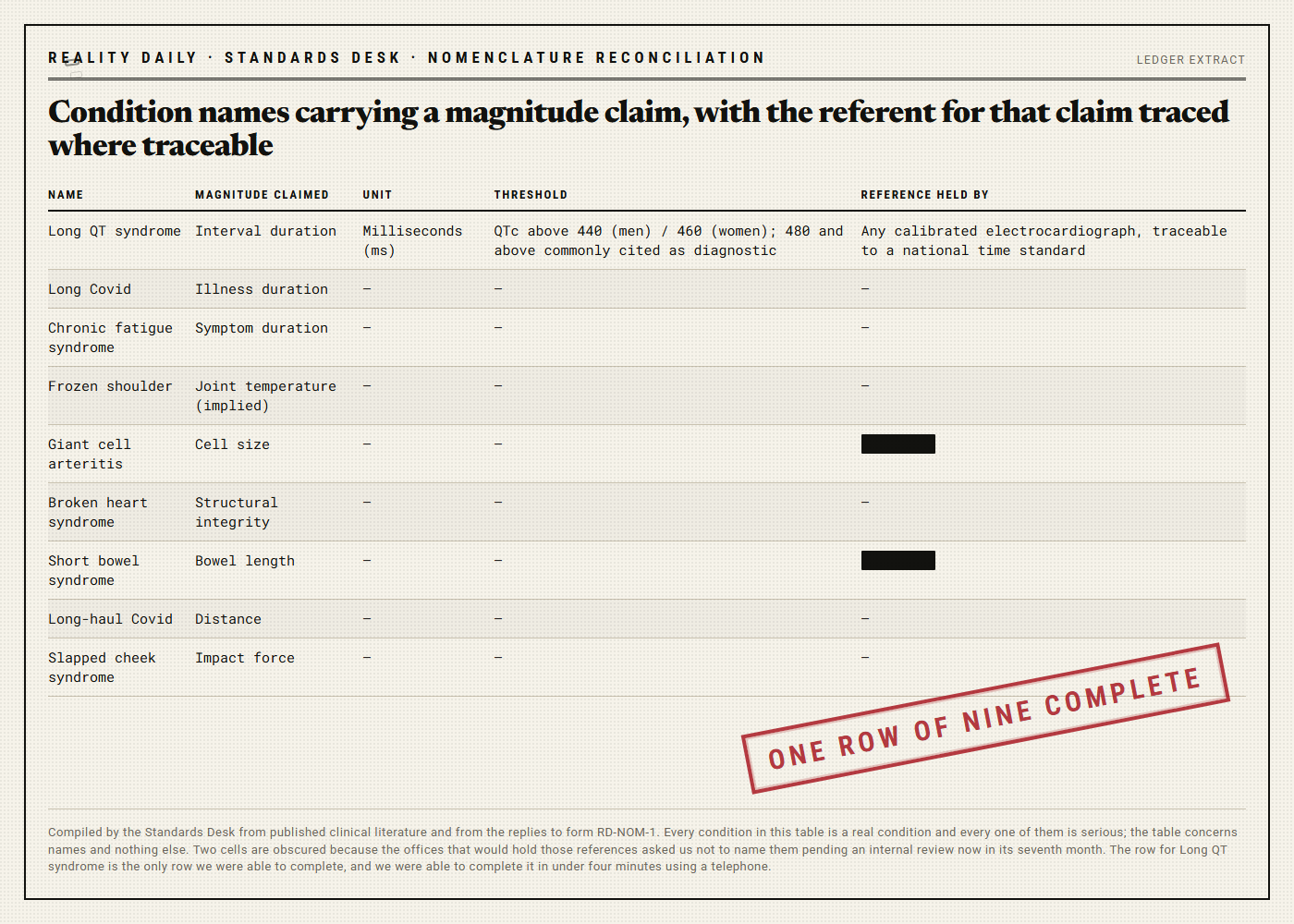
Before accepting that a condition name cannot carry a magnitude, this desk was obliged to establish whether medicine had ever managed it. Medicine has. Medicine managed it in 1957.
Long QT syndrome is a cardiac disorder whose name is a measurement. The QT interval is a segment of the electrocardiogram, measured in milliseconds, corrected for heart rate and written QTc. Thresholds are published and in daily use: above roughly 440 milliseconds in men and 460 in women is considered prolonged, and 480 and above is the value most commonly cited as diagnostic absent another explanation.
A number. A unit. A threshold. Held, and this is the part that undid us, by any calibrated electrocardiograph in any clinic on Earth, each tracing its timebase through a manufacturer's calibration chain to a national time standard, which traces to caesium, which is what the Bureau's letter had just spent a paragraph describing.
The chain closes. For one condition name, the chain closes.
We asked Dr. Ambrose Tandy-Hoerner, an electrophysiologist twenty-six years in practice in Davenport, Iowa, where the reference standard for the word "long" in "long QT syndrome" is kept. Our transcript logs a pause of seven seconds.
"It's four hundred and forty milliseconds. It's printed on the strip. The machine tells you. I'm not sure what you're asking me. We put the number in the name in 1957 and it wasn't hard."— Dr. Ambrose Tandy-Hoerner, electrophysiologist, Davenport, Iowa
We asked whether he considered this unusual. He said he had never once considered it at all, which is what a solved problem sounds like from the inside.
He asked us to print that he treats a cardiac electrical disorder, has no expertise in post COVID-19 condition, and would not want a reader drawing any inference about the second from anything he said about the first. He is right. The comparison here is between two names.
VI. An Adjective Is Not a Unit
In April we retained Dr. Ines Wolstenholme, a metrologist with thirty-one years in national laboratory work. We gave her form RD-NOM-1 and asked her to tell us where we were wrong. She told us, generously, and declined an honorarium twice.
Her central point, which we accept without reservation, is that this newspaper has confused two kinds of thing. A unit is a convention with a defined magnitude and a custody chain. An adjective is a comparison against an unstated expectation supplied fresh by every speaker every time, which is not a defect but the mechanism by which the word functions.
"When you say a movie is long," she said, "you are comparing it to other movies. Nobody holds the movie. There is no prototype movie in a vault outside Paris. If there were, you would not consult it, because you already know what you meant, and so does the person you said it to."
We asked whether the absence of a standard represented a failure by any institution. She said no, twice, and a third time in writing when we sent her the draft.
Wolstenholme, transcript, 22 April, 9:48 a.m.
"You have spent eleven months looking for a reference standard for a word. Metrology is the science of what can be measured. It is also, and people forget this half, the science of knowing what cannot be, and being unembarrassed about the difference."
"Your question isn't stupid. Your question is a custody question, and you keep asking it about a thing that was never in anybody's custody, because the people who made it never had a vault. They had a group chat."
That last sentence is why we ran this story, and it took us four more months to understand what she had told us.
VII. Who Actually Named It
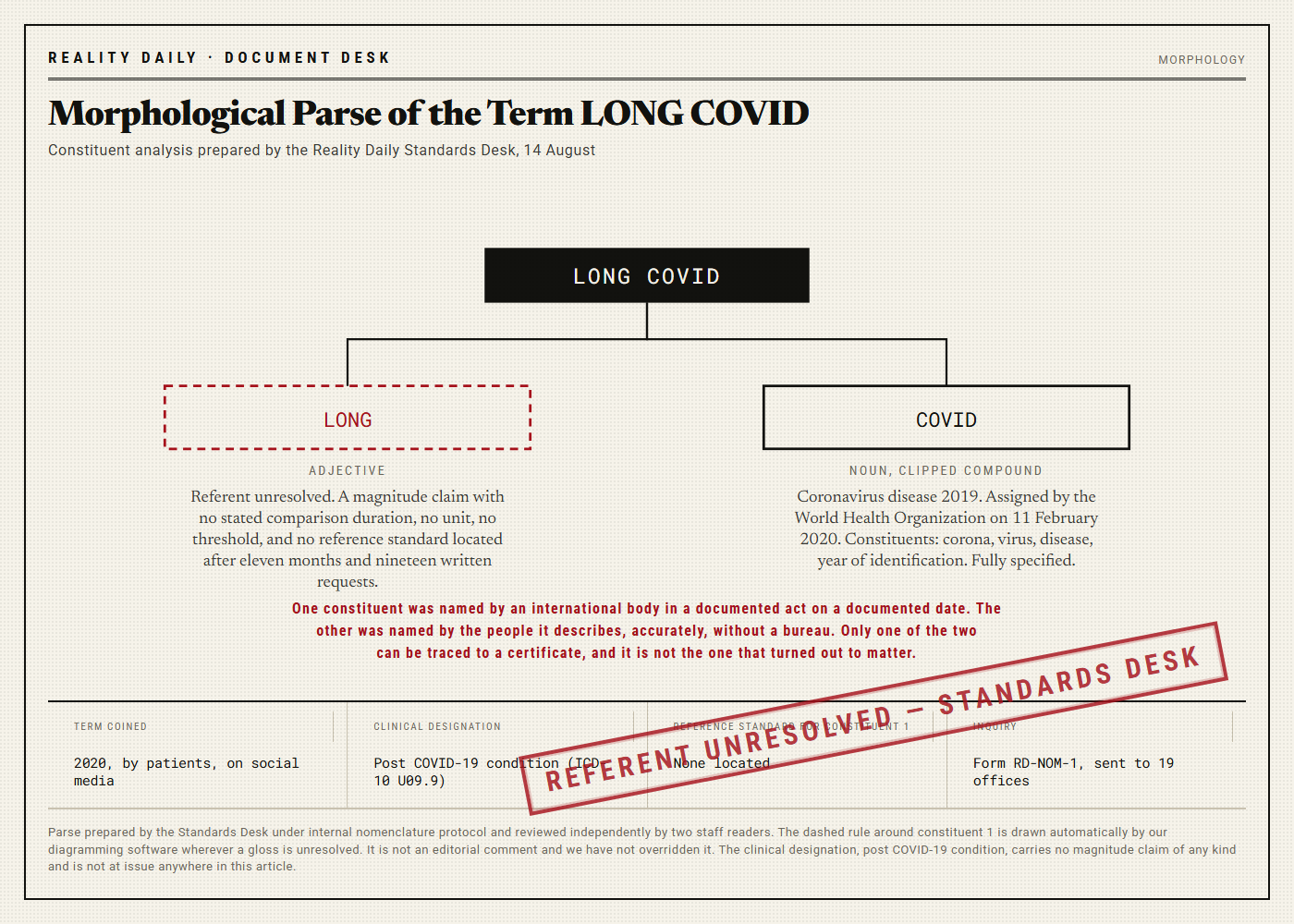
The term "long Covid" was not coined by the World Health Organization. Not by the Centers for Disease Control and Prevention, not by the National Institutes of Health, not by a nomenclature committee, a journal, a professional society, or any of the nineteen offices to which we sent form RD-NOM-1.
It was coined in 2020 by patients. People who were ill, describing their own illness in their own words, on social media, in the spring of that year. The name spread because it was accurate. Medicine adopted it afterward, which is the correct order of operations and almost never the order that happens.
This is the answer to question 4. There is no office holding the reference standard because the name was never institutionally minted. We spent eleven months asking nineteen offices which one held the certificate. The word was made outside all of them, by the only people with direct access to the quantity described.
We did not find a missing standard. We found a word that never needed one.
Marisol Tavenner-Ruiz is a school-district payroll clerk in Bakersfield, California. She has had post COVID-19 condition since October 2020 and coordinates a network of roughly 1,100 patients across four states, in the evenings, unpaid, on a spreadsheet. She returned our call on the first attempt and had already read the form.
She was not troubled by the form. She was not troubled by the Bureau's letter, which she read in about ninety seconds. She was not troubled by any of it, and we had prepared for a different conversation.
"We named it ourselves because nobody else was going to. It was accurate the day we said it and it is accurate now. You are looking for the office that approved the word. There isn't one. We were the office."— Marisol Tavenner-Ruiz, patient network coordinator, Bakersfield, California
We asked her the four questions anyway. She answered question 1 in eleven words: "Compared to how long we were told it would take."
We asked what unit that was in. She said months, and then years, and then named the number of each in her own case without hesitating, with dates, which we are not printing because they are hers.
The point is that patients had a unit the entire time. It was a calendar. Nobody had to certify it.
Reality Daily has no answer to this and will not pretend to one. We came looking for a prototype and were told, correctly, by a payroll clerk in Bakersfield, that the word was accurate without one, and that our eleven months had been spent auditing the only party to this argument who never once made a claim she could not support.
VIII. The Uncharacterized Category
This newspaper's Standards Desk does not rate things. Ratings are conclusions dressed as findings.
Accordingly, after a meeting on 14 August recorded in our minutes as running one hour and fifty minutes, the Standards Desk declines to characterize the size of Long Covid. Not as average, not as above average, not as below average. It declines to characterize the axis on which such a characterization would be made, no such axis having been established. And it declines to accept the characterization offered by Dr. Fauci, not because we hold contrary evidence but because we hold none at all, and neither, by his own account, does he, because he was talking about an adjective.
The matter is entered in the register as an uncharacterized category. It is the fifth this year. The register does not close entries. It marks them.
The medical question is not in the register at all. It was never opened. There was nothing to open. The condition is real and serious, and the register does not take entries on settled matters.
IX. Two Standards, One Year
In November this newspaper published Where the Kilogram Went, on the platinum-iridium cylinder that defined the unit of mass for 130 years and stopped defining it on 20 May 2019. Nineteen written requests produced no location, no custodial officer of record, no inspection date, and one bibliography. The object was retired and nobody would say where it went.
Eleven months later the same reporter has failed to locate a second reference standard, and this one appears never to have existed.
The author considers this a pattern and said so in a two-page memorandum to the Editor-in-Chief dated 19 August, which she annotated with a single word we have agreed not to print.
Two standards. One year. One retired to an undisclosed location, one never minted at all. In the first case an institution had the object and would not produce it. In the second no institution ever had it, and the people who did produced it in eleven words, over the telephone, on the first attempt.
The Data Desk has declined to say whether these are the same finding, on the grounds that a sample of two is not a series, which is correct, and which the author notes is precisely the kind of thing he says to other people.
X. What We Are Not Saying
This article will be summarized by people who have not read it, so we will be exact.
We are not saying Long Covid is mild. Nothing here bears on severity. Severity is a clinical question, the clinical answer is that this is a serious condition that disables people, and it is not in question.
We are not saying it is exaggerated, imagined, psychological, or anything other than a real disease of the body with a diagnostic code, a research program funded at over a billion dollars, and a case definition adopted by the World Health Organization. We said it in paragraph two. We say it again here, in the section where the summaries get made.
We are not saying patients named the condition badly. We are saying they named it correctly, without a bureau, in a year when no bureau had gotten around to it, and that this is the most impressive act of nomenclature this desk has examined in fourteen years.
We are not saying Dr. Fauci made a claim about the disease. Every word we quoted from him is about grammar, we asked his office four times to confirm that reading, and it confirmed it and restated his position that the condition is real and serious. Readers who came for a fight about medicine will have to find one elsewhere.
We are not saying the Bureau failed. It answered in nine working days, conceded our premise, identified our error, and was right. We would like every institution to fail us this way.
We are not saying medicine should rename anything. Long QT syndrome has a number in its name because a number was available in 1957. No number was available in 2020, because the thing had been going on four months and the people describing it were describing it from inside. A name that says this has not stopped is the most honest name available to somebody for whom it has not stopped.
We are not saying we found nothing. We found who did it. It was not who we wrote to.
XI. Conclusion
The failure in this story is ours, and we say so plainly, because we have spent fourteen years insisting that other people say it.
We received a magnitude claim and did what this desk does. We went looking for the referent, the unit, the threshold and the certificate. Four questions. Nineteen offices. Seventy-six data points requested, six received. Eleven months. One laminated letter from Sevres. One electrophysiologist who could not understand the question, because in his field it was answered in 1957 and has stayed answered.
And at the end of it a payroll clerk in Bakersfield who had the answer the whole time, who was not looking for a vault, and who never once needed a certificate to know how long she had been sick.
There is no prototype. There is no specimen. There is no office, no accession record and no certificate of calibration, and there is not going to be one, and this newspaper now understands that there was never supposed to be.
The word is accurate. It was made by the people it describes. That is the whole finding and it took us eleven months.
■ ■ ■
Reality Daily invites the nineteen offices named in our correspondence file, the office of Dr. Fauci, and any nomenclature body that wishes to be heard, to respond at any length. The response will be printed in full, unedited, at the foot of this page, with no commentary from us. The space has been held since October and remains held.
Ms. Tavenner-Ruiz asked, when we read her the draft, that if we printed anything of hers we print the short version, and this newspaper does what sources ask. The short version is that they named it themselves because nobody else was going to, that "long" was accurate then and is accurate now, and that she would rather we spent the next eleven months on the condition than on the adjective. We have no answer to that. We have filed it and left the entry open.
Corrections & Clarifications
06:41 — An earlier version of this article stated that form RD-NOM-1 was sent to nineteen offices. Following a full re-audit of the correspondence file by the Standards Desk, form RD-NOM-1 was sent to nineteen offices. The original wording stands.
10:57 — We initially described the diagnostic threshold for a prolonged corrected QT interval as approximately 440 milliseconds in men. Two cardiologists have written to note that 440 is the commonly cited upper limit of normal, that 460 is used in women, and that 480 and above is the figure more usually treated as diagnostic. We have added those figures, thank both readers, and note that the point of the passage was that figures exist at all, which now stands better supported than when we filed it.
15:12 — A reader writes to say that Long Covid is a real and serious condition. Reality Daily agrees, said so in the first line of the Editor's Note, in the second paragraph of the article, in Section VIII and four times in Section X, and thanks the reader for confirming that those passages are being read.
Sources & Documentation
- Reality Daily Standards Desk. Internal Form RD-NOM-1: Request for the Reference Duration, Unit, Threshold and Certifying Office Underlying the Term "Long Covid." One page, four questions, unaltered across all nineteen transmissions.
- World Health Organization. Clinical case definition of post COVID-19 condition, developed by Delphi consensus. Reviewed in full; three copies on file, one annotated by the Standards Desk.
- International Classification of Diseases, Tenth Revision, code U09.9, post COVID-19 condition, unspecified. Code descriptor reproduced verbatim in our correspondence file.
- National Institutes of Health. Published materials on the RECOVER initiative, including appropriation figures exceeding one billion dollars. Reviewed by the Data Desk.
- Centers for Disease Control and Prevention. Published guidance on post COVID conditions, reviewed for use of the word "long" in operative text. Occurrences in operative text: examined and logged.
- Correspondence, International Bureau of Weights and Measures, received 22 February, signed C. Ferrand-Oyelaran, Liaison, Time and Frequency. One page. Reproduced in full in Section III with nothing omitted.
- Wolstenholme, I., PhD. Recorded interviews, 22 April and 4 May. Transcript 58 pp., reviewed and approved by the subject with one correction, accepted. Honorarium declined twice.
- Tandy-Hoerner, A., MD. Recorded telephone interview, 9 June. Transcript 31 pp. Subject requested and received a written assurance regarding the scope of the comparison, which is honored in Section V.
- Tavenner-Ruiz, M. Recorded telephone interviews, 2 July and 18 July, and a third conversation in which the draft was read to her in full. Quoted material approved. Dates and personal figures withheld at her direction.
- Reality Daily Document Desk. Register of Transmissions, Form RD-NOM-1, 4 October to 3 August. 19 entries. Delivery confirmed: 17. Substantive replies: 2.
- Published literature on the QT interval, its rate correction, and the diagnostic thresholds in ordinary clinical use. 24 papers and two society statements reviewed; four cited internally.
- Bove, H. Memorandum to the Editor-in-Chief: On Having Failed to Locate Two Reference Standards in One Calendar Year. 19 August. 2 pp. Returned annotated.
- Reality Daily. Where the Kilogram Went, published November. Nineteen written requests; no location, no custodial officer, no inspection date, one bibliography.
- General Conference on Weights and Measures. Definition of the second by the caesium 133 hyperfine transition frequency, 9 192 631 770 Hz. Consulted to confirm the Bureau's second clause, which was correct in every particular.
- General Conference on Weights and Measures. Definition of the meter by the speed of light, adopted 1983. Consulted by the Standards Desk while establishing what a defined magnitude actually looks like.
- Automated acknowledgments received from five offices, 12 October to 3 January. Four are identical in wording. Two carry the same timestamp to the second.
- Reality Daily Standards Desk. Register of Uncharacterized Categories, current year. Entry five, opened 14 August, minuted at one hour fifty minutes. Open.
- Reality Daily Standards Desk. On the Difference Between "No" and Silence, internal memorandum, undated. Consulted. Not available to the public.
- Statement of a spokesperson for Dr. Fauci, received on our fourth written request, confirming that his position on the condition is that it is real, serious, and warranting sustained research funding. Reproduced in Section I without alteration.
- Transcription Desk log, entry 4471, timestamping the seven-second pause recorded in Section V. Audio retained.
- Reality Daily Reader Correspondence File RD-C-6120, 3,318 letters received since this inquiry was announced, of which 402 are from people who have the condition and 401 of those say the name is correct.
- Archival capture of publicly posted patient writing from spring 2020 in which the term appears, retained with timestamps by the Document Desk. Provenance chain intact and available to any credentialed party who asks in writing.
- Reality Daily Legal. Memorandum on Publication Absent Response After the Twelfth Request, 2 pp. Same memorandum as previously applied; no amendments required.
- Photograph of field 4 of form RD-NOM-1, blank, in nineteen returned copies. Document Desk, 4,096 × 3,072 px, EXIF intact.
- The people who named it. They were there. They did not need a certificate and they were right.
Reader Response — 5,079 comments
Cardiology fellow. One technical note: the QTc thresholds in the piece are stated correctly, including the point that 480 ms and above is the figure most often treated as diagnostic rather than 440. It is genuinely unusual for a condition name to carry its own measurement, and I had never once thought about that until this article made me.
I have had this since March 2021. I was braced for the usual thing and this was not the usual thing. You wrote down that we named it, that we named it right, and that nobody gave us permission to. That is the first time I have read that in a newspaper.
Respectfully, this is thirty minutes of reading to establish that a word is a word.
@d.mercier — Correct, and that is the story. We asked nineteen offices which one held the standard for a word, on the assumption that somebody must, and the answer is that a word is a word and the people who needed this one made it themselves in 2020 and got it right. We spent eleven months arriving where you arrived in a sentence. Your comment has been added to the correspondence file.
Weights and measures inspector, 22 years. Four questions, nineteen offices, six answers. If a gas station gave me that response rate I would padlock the pumps by lunch. I am not saying anyone here did anything wrong. I am saying I have never seen a number go unsourced that long.
Four years in with this condition. The bit that got me was that she answered question one in eleven words while nineteen institutions could not answer it in eleven months. We were never confused about what the word meant. We are the ones holding the calendar.
"They had a group chat" is going to live in my head next to the flag counter saying he does not count apparel. This paper keeps finding people who say one flat sentence that reorganizes the whole article.
Speech-language pathologist. The point about Long QT is sharper than it looks. Medicine names things after whatever was measurable at the time, and in 2020 what was measurable was how many months it had been, which is exactly what the patients said.