Forty-Year-Old Father of Two Says He Might Go Pro at StarCraft, Four Hours After Reinstalling It
He said it in the kitchen, at 11:40 on a Tuesday night, in the tone of a man raising a practical option. This newspaper measured his actions per minute at forty-one. The professionals he proposes to compete against sustain three hundred and forty, practise sixty hours a week in a house in Seoul, and are mostly finished by twenty-five because they started at thirteen.
Editor's Note
This story concerns two private individuals who are not public figures. Mr Ostergaard approached this newspaper and asked to be audited; he has been named at his own written request, made twice, the second time after he had been shown our figures. Mrs Ostergaard agreed to be interviewed on the condition that she would not be asked to be funny about it, and is named with her consent. The children are not named and do not appear. The passage Mrs Ostergaard twice asked us to remove appears in Section VII at her own instruction, given on 4 October; we would not have printed it otherwise and we would not have argued with her about it.
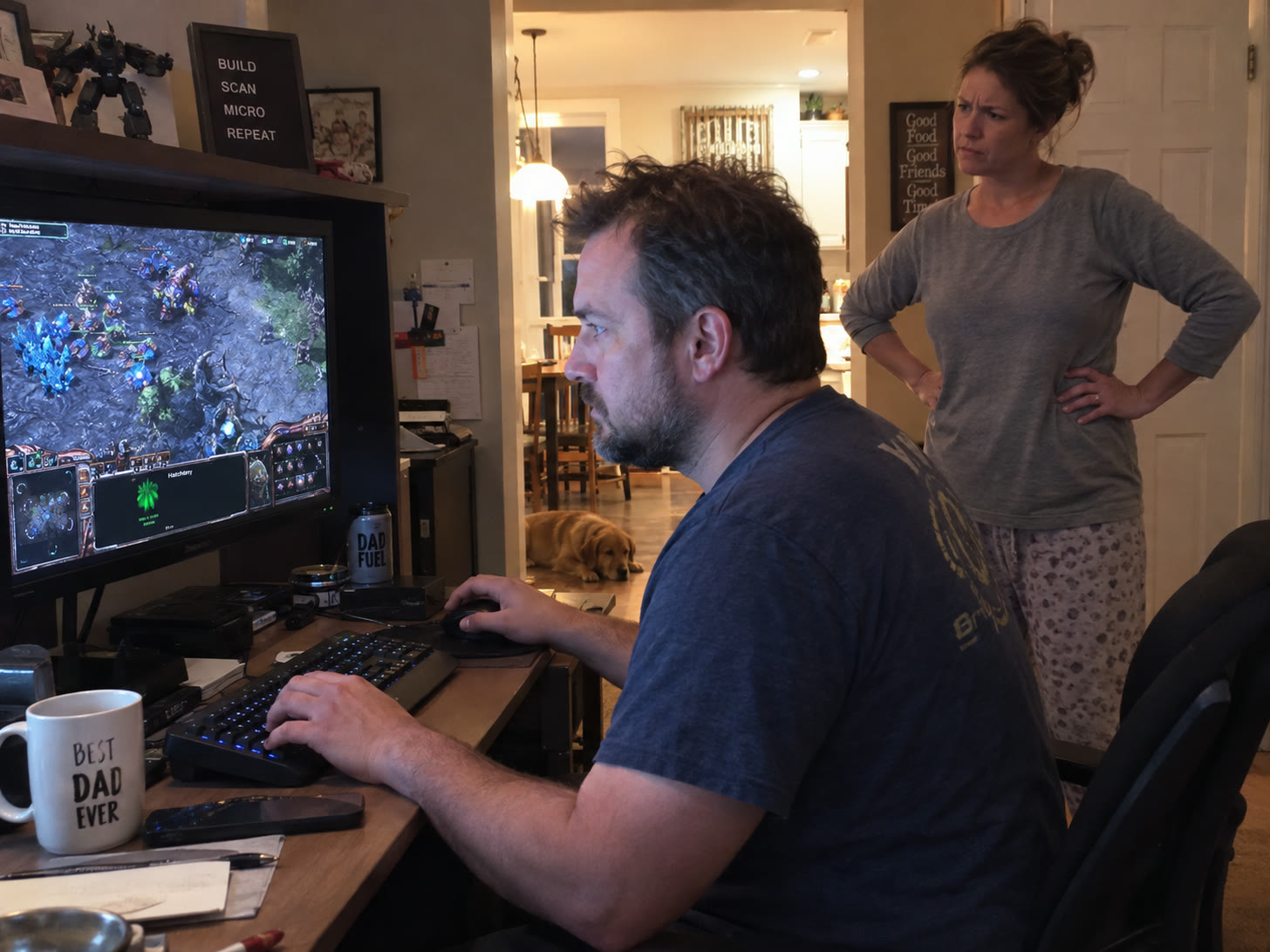
The sentence was spoken at 11:40 on the night of Tuesday, 9 September, in a kitchen in Winchester, Virginia, by a forty-year-old commercial-lines underwriter named Kevin Ostergaard, to his wife, who was loading a dishwasher.
The sentence was: I mean, honestly, maybe I should go pro.
He had reinstalled StarCraft at 7:20 that evening. He had been playing it, at the moment he said this, for four hours and eleven minutes. He had last played it in 2004.
This newspaper has spent five weeks on the sentence, at his invitation, and the Fact Audit desk is obliged to report that it does not survive contact with a single one of the fourteen measures we applied to it.
I. Why This Desk Is Involved At All
We want to deal with this immediately, because it is the only unusual thing about the story.
Mr Ostergaard wrote to us. He wrote on 16 September, unprompted, to the Fact Audit desk's public address, and he asked to be audited. His email is nine hundred words long, it is polite throughout, and its operative paragraph asks this newspaper to establish whether his stated intention is realistic, because — his words — “my wife and I have reached an impasse on the facts.”
He believed the audit would go the other way. He said so on the telephone on 18 September and again, in person, on 29 September, and he said it the second time after being told, plainly and by this reporter, what our figures were.
He has read this story. He has raised two objections, both of which are recorded in Section IX.
II. Actions Per Minute
The measure that matters in this sport is actions per minute: the count of discrete commands a player issues, keyboard and mouse together, sustained across a game. It is not a proxy for skill and every serious person in the sport will tell you so. It is, however, the floor. Below a certain rate a player cannot execute the decisions he is making, regardless of how good those decisions are.
We took Mr Ostergaard's own replay files — he supplied them, all sixty-one of them, sorted — and had them parsed by two people independently.
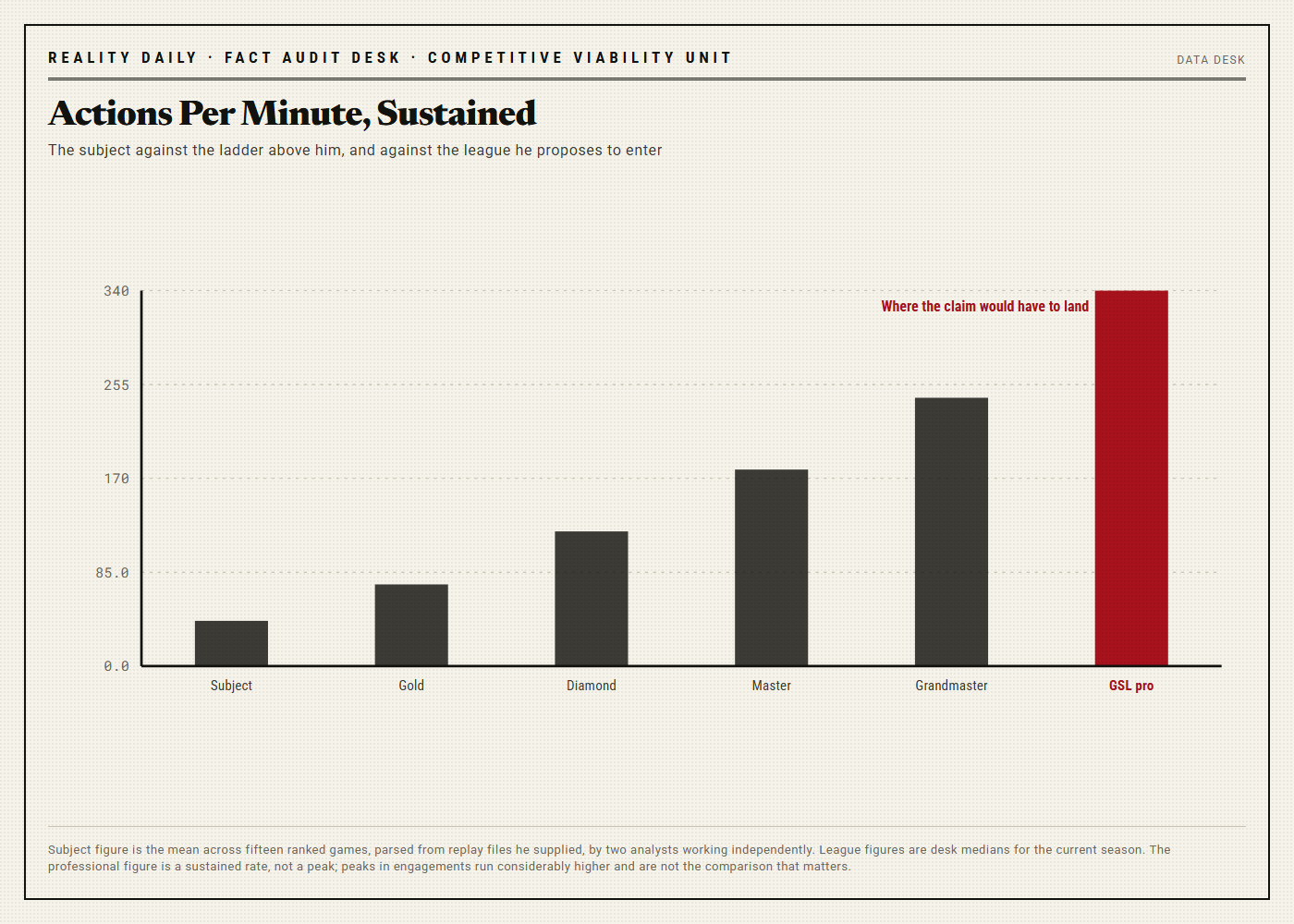
His mean actions per minute, across fifteen ranked games, is forty-one.
A professional in the Global StarCraft II League, the sport's premier competition, run out of Seoul, will sustain three hundred to four hundred. The players at the very top of that league go higher in engagements, and the peaks are not the interesting number; the sustained rate is.
We put the honest objection to ourselves before anybody else could. Raw actions per minute is inflated by redundant input — professionals spam commands to keep their hands warm and their rhythm intact, and a fair comparison uses effective actions per minute, which strips the redundancy out. On that measure the professional figure falls substantially. It does not fall to forty-one. It does not fall to a hundred and forty-one.
The parse also found that Mr Ostergaard's input contains almost no redundancy at all. Every action he issues is an action he meant. This is the single technically favourable finding in this audit and this desk wishes to be precise about its value: it is favourable in the way that a man who has never lifted a weight has no bad habits in the gym.
III. The Ladder
StarCraft II sorts its players into leagues by result. From the bottom: Bronze, Silver, Gold, Platinum, Diamond, Master, Grandmaster. Grandmaster is capped at a fixed number of players per region. Professionals sit at the top of Grandmaster and are not really described by it.
Mr Ostergaard's placement matches went four wins and eleven losses. He was placed in Gold 3.
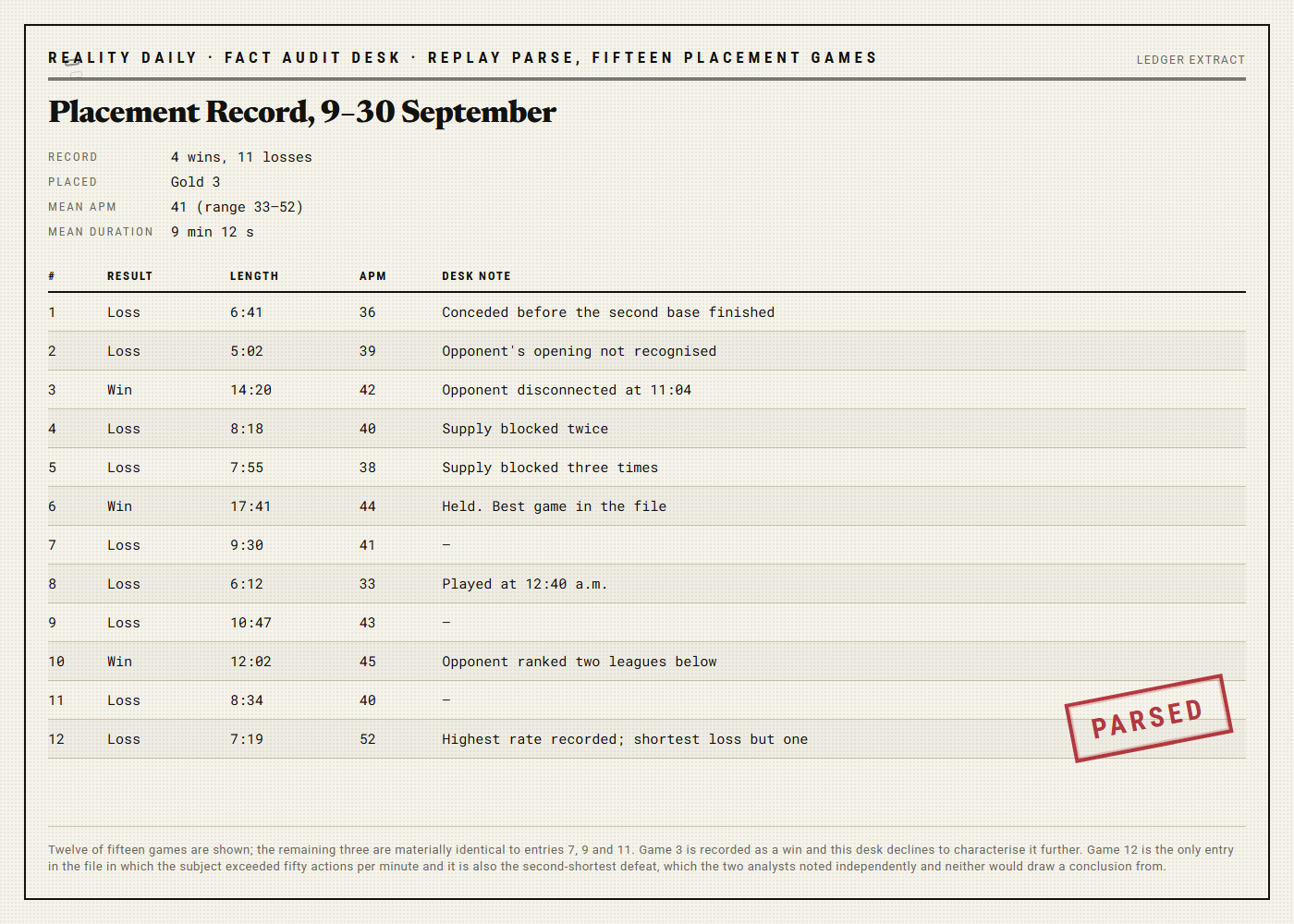
Gold is not an insult. Roughly half the ladder is below it. It is, for a man who reinstalled the game the previous Tuesday, a defensible result, and two of the four coaches we consulted said so unprompted.
The difficulty is what the claim requires. Going professional does not require being above average. It requires being inside a few hundred people worldwide. The distance between the fifty-fifth percentile and the ninety-nine-point-nine-ninth is not a gap this desk is able to express as a multiple, because the two numbers are not measuring the same activity.
IV. Seoul
The claim's real problem is not Mr Ostergaard. It is the twenty-year-old institution he would be entering.
South Korean players have won the overwhelming majority of premier StarCraft II titles since the game's release. This is not a stereotype this newspaper is repeating; it is the competition record, and it is the reason the premier league is held in Seoul rather than anywhere else.
The reason for the dominance is not mysterious and is not genetic. It is a training structure that has no equivalent in any other country: professional players have historically lived together in team houses, practising on a schedule of ten to twelve hours a day, six days a week, under a coaching staff, from adolescence.
From adolescence is the part this desk asks you to hold on to.
Cho Seong-ju, who competes as Maru and is among the most decorated players in the game's history, turned professional at thirteen. Lee Seung-hyun won the Global StarCraft II League at fifteen, the youngest champion the competition has had. The two most successful players from outside Korea in the modern era — Joona Sotala of Finland and Riccardo Romiti of Italy — were both competing internationally as teenagers, and Mr Romiti was winning premier events at an age at which he could not lawfully have signed his own contract in most of the countries he won them in.
Retirement runs the other way. Players in this sport are widely considered to be past their peak in their mid-twenties, and a great many of the finest careers ended at twenty-two, twenty-three, twenty-four. The median age of a premier-event champion sits around twenty.

Mr Ostergaard is forty. He would arrive at the sport twice the age of its median champion and approximately sixteen years after the point at which its practitioners are ordinarily finished.
The formulation his wife used, which she asked us not to soften, was: “They are children. He wants to go and lose to children in another country.” This desk has checked it and reports that it is closer to a description than to an insult.
V. The One Door We Found
We looked for a route, because an audit that only looks for the answer it expects is not an audit.
There is one. The original StarCraft — Brood War, released in 1998, the game Mr Ostergaard actually played as a teenager — sustains a live competitive scene in Korea to this day, and its premier competition fields players in their thirties. Men who are, by the standards of the newer game, elderly, are winning matches on television.
The door is closed, and it is closed for a single reason. Every one of those men has been playing that game continuously, at the highest level available to him, since he was a teenager. They are not thirty-somethings who came back. They are teenage prodigies who never stopped, and who have twenty-five uninterrupted years of practice underneath them.
Mr Ostergaard stopped in 2004. He was eighteen. He was, on his own account and on the account of the friend we located who played with him, good for a boy in Frederick County and nothing more than that.
VI. The Week
He told this newspaper on 18 September that he could find twenty hours a week to practise.
We asked him to walk us through the week. He works four days on site and one from home. There are two children, aged seven and four. The seven-year-old has swimming on Mondays and Thursdays. He is the parent who drives to swimming.
Reconstructed against his own calendar, and being generous at every point where a judgement was required, this desk puts the hours genuinely available to him at six, and notes that four of those six fall after ten at night.
Six hours against sixty. He did not dispute the number. He said, and we are printing it because he asked us to: “Okay, but that's this year.”
VII. The Other Party
Andrea Ostergaard is forty-one and works in hospital administration. She agreed to be interviewed on 26 September on the condition that she was not asked to be funny about it, a condition this newspaper accepted and has kept.
Her account of the kitchen matches his in every particular including the wording, which is rarer than readers of this newspaper might assume.
She has no objection to the game. She wants that stated first and stated plainly. She bought him the mouse. Her objection is to four syllables.
“Go pro,” she said. “I have heard go pro three times. I heard it about smoking meat. I heard it about a podcast. I heard it about the drone.”
We asked what happened to the drone.
“It's in the garage,” she said. “It's fine. Everything's fine. That's not the point and you know that's not the point.”
The point, when she reached it, is not the one her husband believes she is making, and it is the reason this story is longer than it needed to be.
“He thinks I'm worried about money,” she said. “There's no money. I've seen what they win. I'm worried that he turned forty in June and he has worked out that he is not going to be a famous anything, and the plan he has come up with is Korea.”
She asked us to take that out. We asked her twice more, on 30 September and on 3 October. She declined twice. On 4 October she telephoned this desk and told us to leave it in.
VIII. Finding
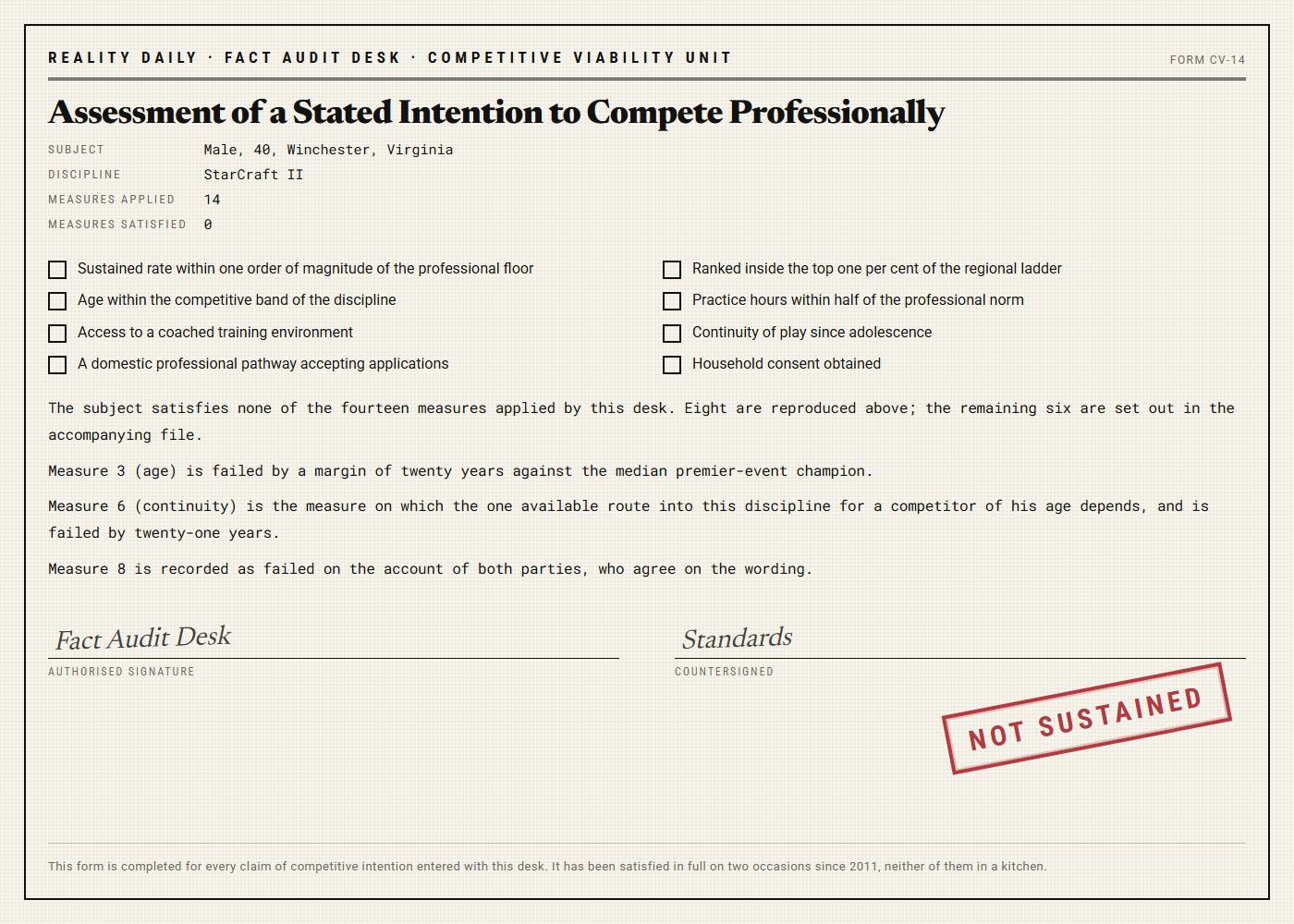
The claim is not sustained.
It fails on rate, on ranking, on age, on available practice hours, on the structure of the professional pathway, and on the absence of any professional pathway in his country that would accept an application from him. It fails on all fourteen measures this desk applied. The Fact Audit desk has sustained one claim of a domestic nature this year and this is not the second.
There is one number in his favour and we print it because we print the whole file. Over three weeks of measured play, Mr Ostergaard's mean actions per minute rose from thirty-nine to forty-one.
That is a five per cent improvement in twenty-one days. Extended in a straight line, which is not how any of this works and which this desk states in terms, it would place him at a professional rate in the year 2071, at the age of eighty-five.
IX. His Two Objections
Mr Ostergaard read this story on 6 October and raised two objections.
The first is that we have written 2004 as the year he stopped and he believes it was late 2005. We have checked what we can check and cannot resolve it. We have left 2004 in the text and recorded his position here, which is the whole of what he asked for.
The second is that the headline says four hours and he would like it noted that by the time he said it he had also watched, that same evening, approximately two hours of tournament footage, and that he considers this preparation and considers it relevant.
This desk records the objection. It declines to amend the headline. It observes that the two hours of footage he watched were of a tournament held in Seoul, that it has checked the ages of the eight players in that bracket, and that six of them were nineteen or under on the day it was played.
Corrections & Clarifications
Sources & Documentation
- Email from the subject to the Fact Audit desk, 16 September, 900 words, requesting an audit of his own stated intention.
- Sixty-one replay files supplied by the subject, 19 September, sorted by him; parsed independently by two analysts, 21–26 September, with a variance in mean APM of 0.7.
- Interviews with the subject, 18 September (telephone, 31 min), 29 September (in person, 74 min), 6 October (telephone, 19 min, after reading the story).
- Interview with Andrea Ostergaard, 26 September, 44 min, in person; and telephone calls of 30 September, 3 October and 4 October concerning one passage.
- Household calendar, September, supplied jointly, and the swimming schedule of the elder child.
- Global StarCraft II League, competition records and champion register, Seoul, 2010 to date.
- Premier-event results by player nationality, full record since release, compiled by this desk from the published brackets.
- Published ages at professional debut and at first premier title for eleven players, cross-checked against two independent competition databases.
- Published team-house practice schedules and coaching structures, Korean professional organisations, 2010–2016, and the accounts of three former players given in interviews to other outlets.
- AfreecaTV StarLeague, competitor register and ages, current season, examined for a viable route for a competitor in his fourth decade.
- Interviews with four coaches, three of them active, 22 September to 1 October, on ladder placement and rate of improvement in returning players.
- Interview with a man who played the original game alongside the subject in Frederick County, 1 October, 17 min.
- League and division thresholds and regional Grandmaster caps, current season, publisher documentation.
- Published prize distributions for the premier competition, three most recent seasons.
- Bracket and competitor ages for the tournament footage the subject watched on the evening of 9 September.
- Reality Daily Fact Audit desk, disposition summary of 1,104 claims of a domestic nature, 2011–2026.
- Reality Daily Standards Desk, memorandum on printing a passage a subject twice asked to withdraw and then instructed us to keep, 4 October, 3 pp.
Reader Response — 3,754 comments
"It would place him at a professional rate in the year 2071, at the age of eighty-five." They ran the regression. They ran the regression on the guy.
The man wrote in HIMSELF. He emailed a newspaper and asked to be audited because he was sure it would prove him right. Nine hundred words. Polite throughout. I have never felt so seen and so attacked.
Diamond 2, thirty-four years old, 118 APM, and I read this entire thing standing up in my kitchen. The line about having no bad habits because you have never lifted anything is going to be with me for a long time.
"Okay, but that's this year." Six hours against sixty and the man says okay but that's this year. Sir. SIR.
Everyone is quoting the funny bits and the actual story is in Section VII. She asked them to cut it twice and then rang up and told them to run it. She wanted him to read it in a newspaper because he would not hear it in the kitchen.
Was fully ready to be annoyed at a newspaper doing the lazy Koreans-are-robots thing and instead they explain the team house, name the actual structural reason, say out loud it is not genetic, and then close the Brood War loophole properly. That is more homework than most esports coverage does.
Objection two is that he ALSO watched two hours of tournament footage and considers this preparation, and the paper's response is to go and check the ages of everyone in that bracket. Six of eight were nineteen or under. Cold blooded.
She bought him the mouse. She wants it stated first and stated plainly that she bought him the mouse. This woman is not the villain and she knew exactly how this would read.
Reporter bio: has processed one thousand one hundred and four claims of a domestic nature and sustained one. We all know which one. That poor billing analyst is never getting away from this newspaper.
It's in the garage. It's fine. Everything's fine.