Interview With Corn Pop, 60 Years Later
He is seventy, unfailingly courteous, and the most articulate subject this newspaper has interviewed. He concedes the razor, disputes only that it was rusty, forgives Joe, worries about him — and then inventories what he still does, at a fraction of the former volume.
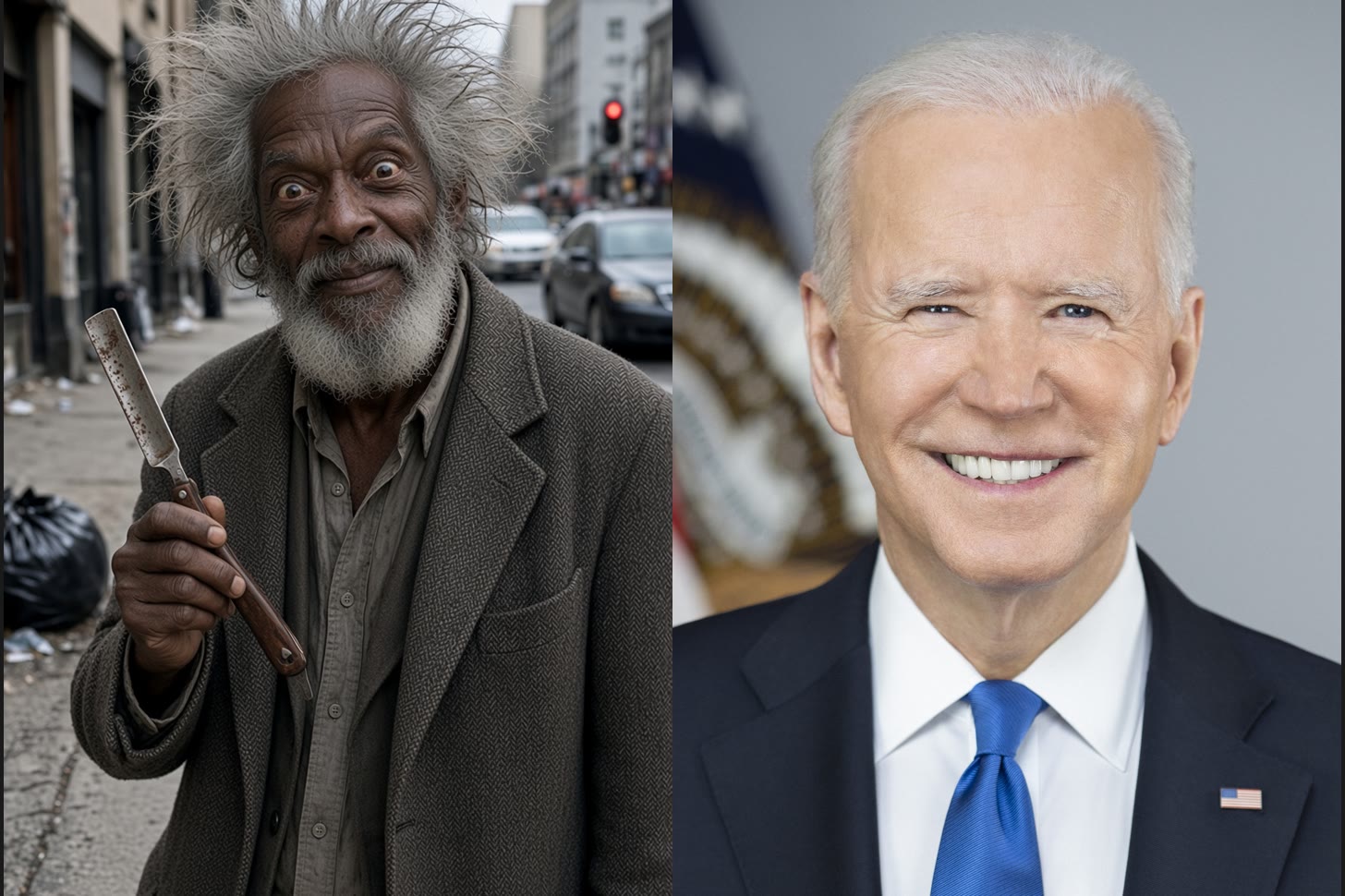
.jpg)
Editor's Note
This interview was conducted on the record, at the subject’s home, over two hours and eleven minutes. The subject was told at the outset that everything said would be reportable, and was reminded of it at minute 96, after a disclosure he made unprompted. He said he understood and continued. Quotations appear as spoken; the transcript required almost no cleaning, which is not usual. Counsel has read Sections IV and V. The Standards Desk has withheld the subject’s legal name, his street, and the name of one other person — the first two at his request, the third on its own judgment.
He agreed to the interview on the third request, on the condition that we come to him, that we not photograph the house, and that we hear him out on a business matter before we asked about 1962. We accepted the first two conditions. The third was not ours to accept or decline, because he raised it after we had sat down, and because he raised it again at minutes 14, 31, 52 and 66.
He is seventy. He was, by the account that made him famous, the presiding figure at a public swimming pool in Wilmington, Delaware, in the summer of 1962, which the Standards Desk notes would have made him approximately six years old at the time. We put this to him. He said that the discrepancy was “an artifact of oral history, which compresses and embellishes in roughly equal measure,” and that he had been, in any case, unusually tall.
The name he gave us is the one everybody uses. He answers to it without evident irritation and used it himself eleven times across two hours and eleven minutes.
This newspaper wishes to record one thing before proceeding, because it bears on everything below and because our reporter was not prepared for it. He is the most articulate subject this correspondent has interviewed in nine years. The transcript required almost no cleaning. He does not misspeak. He corrects himself mid-clause and the correction is invariably an improvement.
I. On Whether He Is Still a Bad Dude
He is not, and he wished that established before anything else.
“I was, by any honest accounting, a menace. I don’t quarrel with the characterization — I’d have chosen a harsher one, and I’d have been within my rights. But a man is not a photograph. He is a sequence. And the fellow you are describing to me is a still frame from very early in a rather long sequence.”— the subject, minute 4
Asked what changed, he cited, in order: “a conversion of the ordinary sort,” a coronary stent, a woman named Denise, and “the deteriorating margins in my former line.”
We asked him to expand on the last. He said the economics had become “frankly untenable — all of the exposure and none of the yield.” We asked untenable relative to what. He said relative to the business, and reached for a folder.
He also, at this point and unprompted, described his own diction, which he had noticed our reporter noticing.
“You’re wondering where the vocabulary comes from. Forty-one years of public libraries and a great deal of unstructured time. I read indiscriminately and I retained more than was strictly useful. People find it incongruous. I’ve stopped apologizing for it.”— the subject, minute 9
At minute 11 he proposed, without any prompting from us, that we continue the conversation at a swimming pool. He said he went most weeks, that the water was good for the knee, and that he had found it useful over the years to revisit the scene of a thing periodically “so that it stays a place and does not curdle into a symbol.” We drove. He brought the razor, because we had asked to photograph it, and because he wanted it understood that he carries it now the way a man carries a pocket watch.
He walked out onto the board without being asked. Our photographer had not raised the camera.
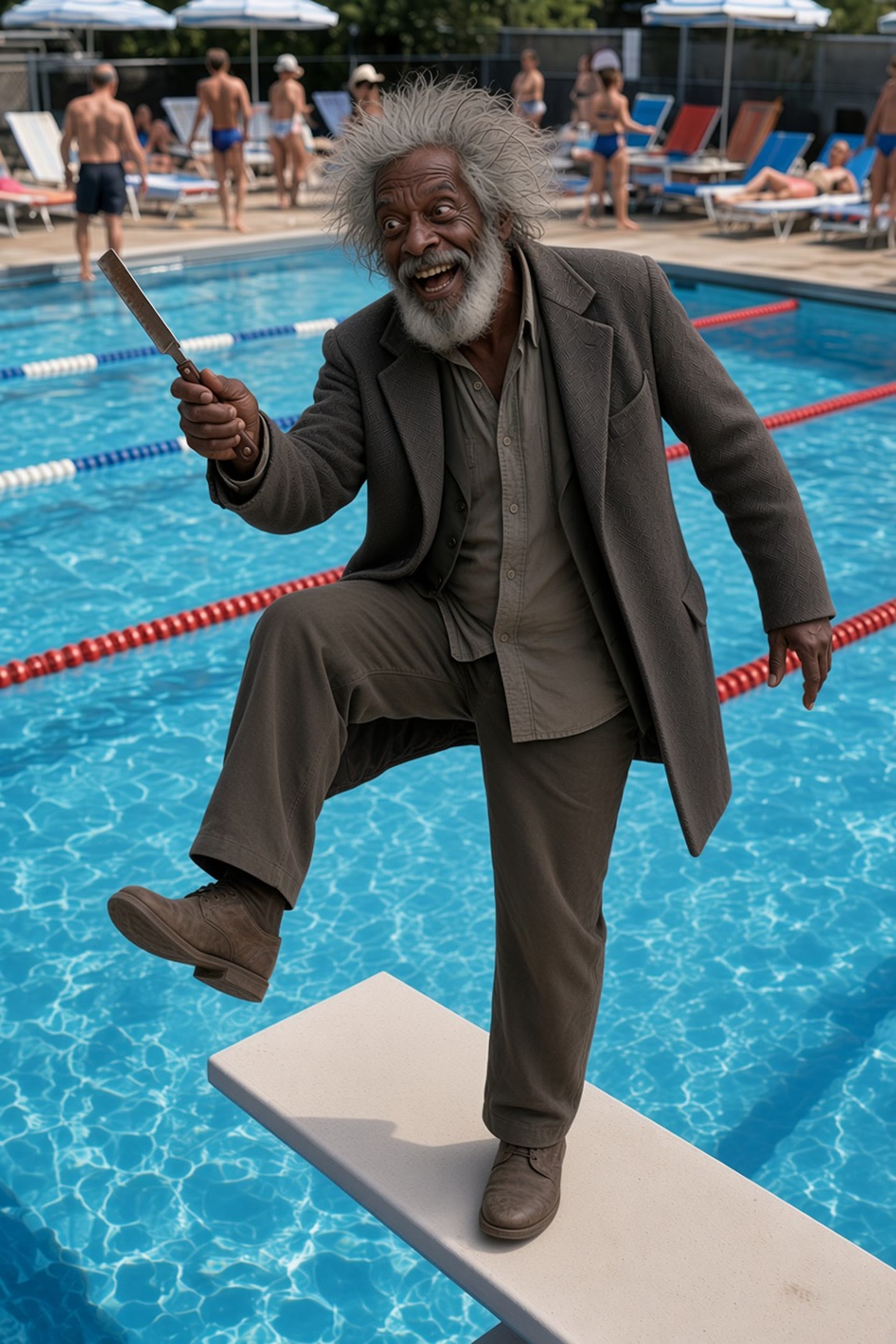
“I’m aware of how this looks. I’d ask you to consider that a man is permitted to be amused by his own mythology without endorsing it. I was never going to hurt anybody in this pool. I was sixteen and terrified and loud, and the loudness was the whole apparatus.”— the subject, minute 24, on the board
II. On the Razor
The account that made him a national figure includes a straight razor, and in most retellings a rusty one. We asked whether there had been a razor.
He was quiet for a moment. Our transcript logs six seconds.
“There was a razor. I won’t insult you with a denial. But it was not rusty, and I’d ask you to print that with some emphasis. Rust is not menace, it’s negligence. It advertises a man who does not maintain his instruments, and I was fastidious to the point of tedium. Corrosion implies I was careless. I was many things. I was never careless.”— the subject, minute 19
He returned to the word rusty five more times, twice unprompted, on one occasion calling it “a slander of a very particular kind, in that it impugns my housekeeping rather than my character, and I mind that more.”
He disputed no other element of the account. Asked about the chain, he said he had never personally seen a chain, and had been told of it “retrospectively, by parties equally reliant on hearsay.”
He produced, from the same folder that also produced the business, a photograph of himself taken at the Wilmington pool in 1968. He has carried it for fifty-eight years. He asked us to reproduce it at a size at which the razor is legible, and gave one reason.
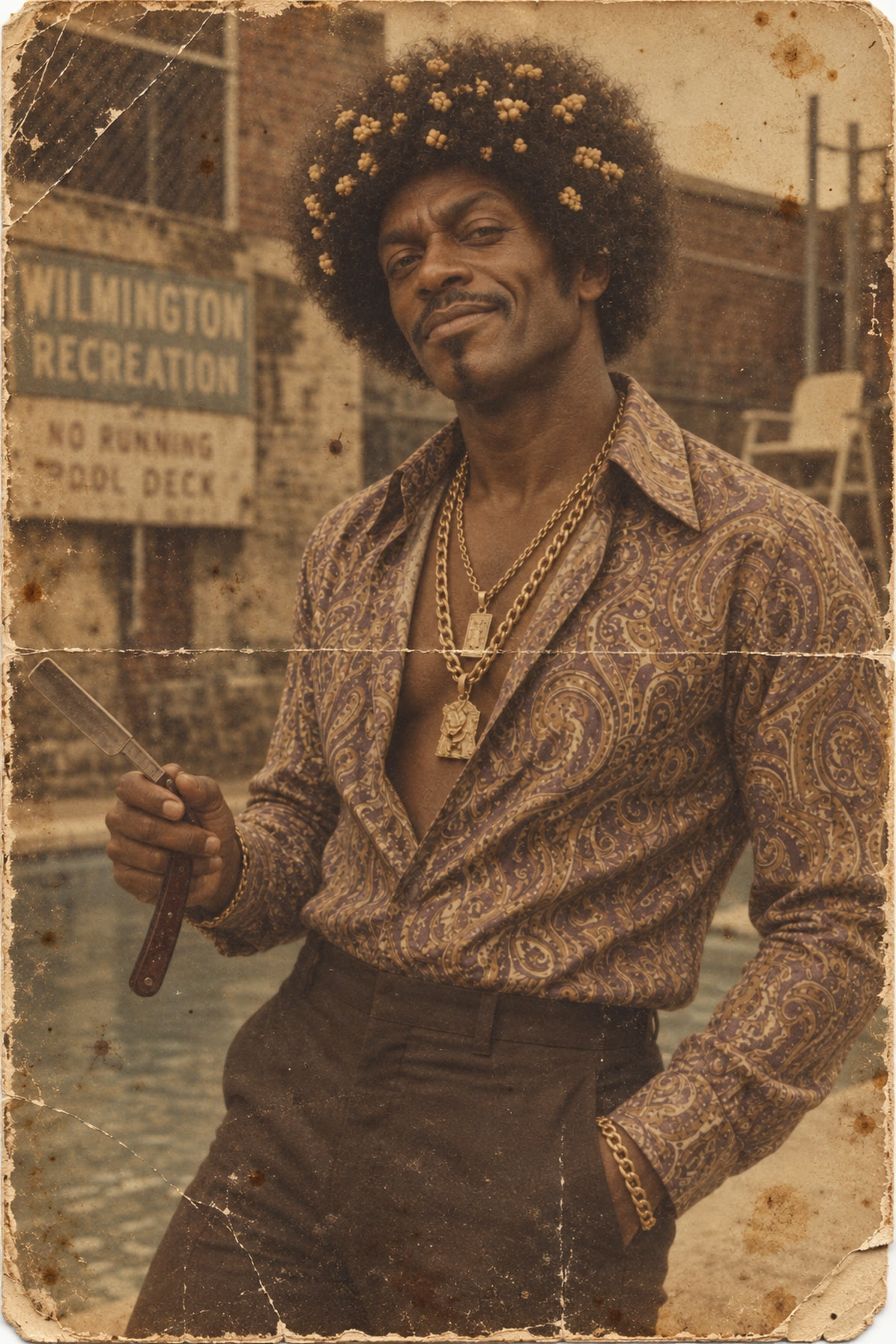
“Look at the edge of it. Look at the spine. That is a maintained instrument. I don’t ask anybody to admire the young man holding it — he was insufferable and I’ve spent sixty years making up for him — but the razor is immaculate and I’d like that conceded.”— the subject, minute 33
Asked about the corn, he said it had been his sister’s idea, that it had taken her forty minutes, and that he had worn it for one summer and answered to it for the rest of his life. He described this as “a reasonable exchange rate, all things considered.”
III. On Whether He Is Still Angry
He is not, and he was unhesitating about it, and he asked twice that we print it exactly.
“I harbour no animus toward Joseph. Let me be unambiguous, so nobody has to interpret me. I was aggrieved for the better part of a year in 1962, and then I had a life to get on with, and grievance is a poor tenant — it pays nothing and it never leaves. He told the story as it settled in him. Memory is not a transcript. I’m not angry at Joe.”— the subject, minute 26
What he wanted to discuss instead was how the man had seemed lately. He raised it himself, carefully, and twice checked that we understood the spirit of it.
“I’ll be candid, and I ask that it not be read unkindly, because I offer it as a man who is also seventy and who also has his diminished afternoons. I watch him and I’m concerned. There’s a hesitation that wasn’t there — a fractional lag between the thought and the retrieval of it. I know that lag intimately. It’s an unlovely thing to see in another man and worse to feel in yourself. I hope he’s attended to properly. I hope somebody who loves him is in the room.”— the subject, minute 28
He asked that we not make that into a headline. We have not made it into a headline. He then asked us to convey that he wishes the family well — “the entirety of them, the children, the grandchildren, all of it, without reservation” — and asked whether a card would be an imposition. We said we did not think a card would be an imposition. He wrote down an address. He did not show us what he wrote.
IV. The Business
The folder came out at minute 31 and did not go back in.
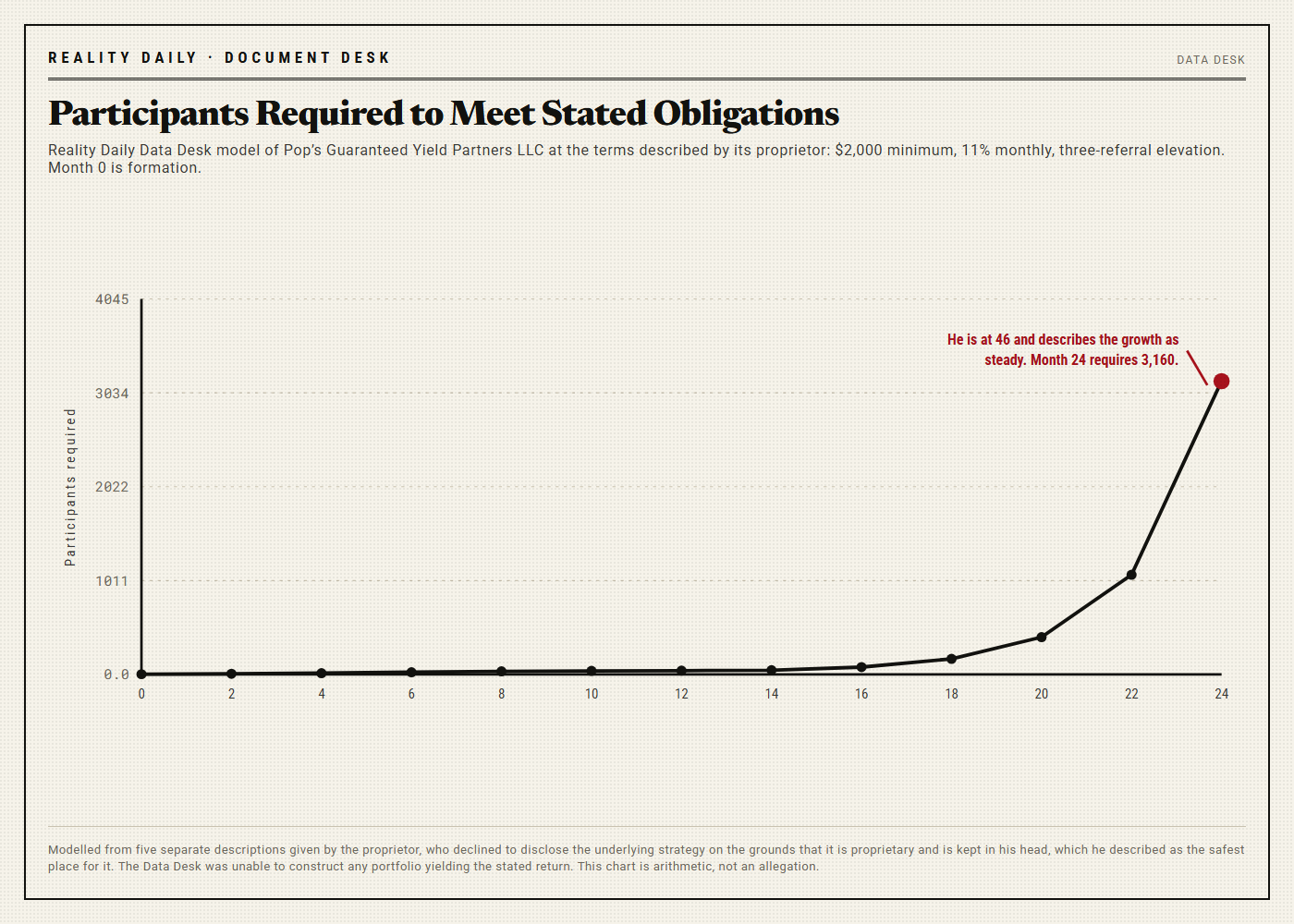
The business is Pop’s Guaranteed Yield Partners LLC, registered in Delaware fourteen months ago. He described it to this newspaper five separate times in slightly different terms, and the Data Desk has assembled the following from all five.
A participant contributes a minimum of two thousand dollars and is guaranteed a return of eleven percent — not annually, on which point he was insistent, but monthly. There is no fee to join. There is a pronounced preference for participants who introduce further participants, and a participant who introduces three is elevated to what he calls Pop’s Circle, which carries an enhanced monthly figure and a jacket.

We asked what generates the eleven percent.
“Instruments. A diversified basket, actively rebalanced, with a tilt toward the uncorrelated. I could walk you through the whole architecture but I’d be squandering your afternoon and mine.”— the subject, minute 38
We said we would like our afternoon squandered. He said the methodology was proprietary. We asked whether it was committed to paper anywhere. He said it was not, that it resided in his head, and that his head was “a jurisdiction with no subpoena power.”
We asked whether any participant had ever demanded to see it. He said one had, and had been redeemed in full within the hour, and had subsequently told everyone he knew, and that this had been, in his phrase, “the single most efficient marketing expenditure of my life.”
The Reality Daily Data Desk has modelled the arrangement as described. It notes the following and offers no characterisation:
- Eleven percent monthly compounds to roughly 249 percent annually. No disclosed instrument produces this. The Data Desk was unable to construct any portfolio that produces this.
- Every payout he described, when traced, was funded by a contribution received in the same or the preceding week.
- The referral structure requires the participant count to grow to meet obligations: a new participant roughly every nine days, then every four, then daily, then more than daily.
- He is at forty-one participants and characterises the growth as “orderly.”
We put the structure to him plainly, using the word, once. He did not take offence. He looked genuinely puzzled, and then explained, with great patience, that a Ponzi scheme is an arrangement in which there is no underlying enterprise, and that there is an underlying enterprise, because there is a limited liability company, and that he would be glad to show us the limited liability company.
He showed us the LLC. It is an LLC.
V. The Portfolio
At minute 96, unprompted, while looking at the ceiling, he volunteered an inventory of his remaining activities. We had not asked. Our reporter had put her pen down.
“I should be forthright with you, since you’ve been decent with me. I still move a modest quantity of pharmaceuticals. I facilitate the occasional transfer of a firearm. And I retain a small supervisory interest in the companionship trade. All three, and I want the proportion understood, at a fraction of the former volume — a rounding error against what I once did, and declining annually without any particular effort on my part.”— the subject, minute 96
He delivered this in precisely the register he had used for the stent and for Denise. He did not appear to regard it as a disclosure. When our reporter retrieved her pen he watched her do it, waited for her to find the page, and resumed.
“I’d be lying if I called it principle. It’s attrition. The clientele is elderly, the hours are unsociable, and I am seventy years of age with a knee that has opinions. What am I proposing to do — run? A man ought to know when he is being retired by circumstance rather than conviction, and have the grace not to dress it up as the latter.”— the subject, minute 98
He then observed that the business would render all of it unnecessary, that this was in fact the entire purpose of the business, and asked whether we had any questions about the eleven percent.
VI. What We Are Not Saying
We are not saying the subject is the man in the account. He says he is. The account is one man’s recollection of a summer sixty-four years ago, the arithmetic does not work, and he was asked about the arithmetic and declined — elegantly — to resolve it.
We are not characterising Pop’s Guaranteed Yield Partners LLC. We have set out its terms as he set them out, modelled them, and printed the model. Readers may draw a conclusion. This newspaper has drawn one and is not printing it, on the advice of counsel, who read this section twice.
We are not reporting Section V to law enforcement. We told him so at the time. He said he had assumed as much, that he had not been anxious about it, and that we struck him as “people of some scruple, which is rarer in your trade than you’d like.”
We are saying that a man told us he was not angry at a president, said it plainly and without being asked twice, described that man’s decline with what our reporter recorded as unperformed tenderness, wished his family well without reservation, asked whether a card would be an imposition — and then, in the same unhurried baritone and with the same immaculate grammar, inventoried three ongoing criminal enterprises and tried for ninety minutes to enroll her in a fourth.
VII. As of Press Time
He has telephoned this newspaper four times since. On each occasion he asked whether the story had run and whether it would mention the eleven percent. He was told it would. He said that was all he required, thanked our reporter by name, and asked after her mother, whom he had enquired about during the interview and had evidently remembered.
The card has not been sent as of Wednesday. He told us he was still deciding what to put in it, and that he did not want to be maudlin, and that the difficulty with a card is that there is no room to revise.
Corrections & Clarifications
Correction, 10:15 — An earlier version of this story reported the guaranteed return as eleven percent annually. The subject stated monthly, five times, and objected to the error within forty minutes of publication by telephone, describing it as “an order-of-magnitude injury to a sound instrument.” The error was ours. It is monthly.
Update, 15:30 — Since publication the subject reports the participant count has risen from forty-one to forty-six. He attributes this to the story. We have made no recommendation regarding participation and make none now.
Sources & Documentation
- Subject. Recorded interview, at his residence, 2 hrs 11 min. Transcript 74 pp. On the record in full. No corrections required to the transcript.
- Subject. Four subsequent telephone calls, 26 August–2 September, initiated by subject, 31 min total.
- Certificate of formation, Pop’s Guaranteed Yield Partners LLC, Delaware, filed fourteen months ago. Obtained from the state. It is an LLC.
- Promotional folder supplied by subject, 6 pp., including the participation certificate reproduced at Section IV.
- Reality Daily Data Desk, model of the arrangement as described across five accounts, 11 pp. No portfolio constructible at the stated yield.
- Reality Daily Data Desk, payout tracing: every payout described was funded by a contribution received in the same or preceding week.
- Reality Daily Standards Desk, memorandum on the minute-96 disclosure and whether to print it, 4 pp. Decision: print, subject having been reminded and having continued.
- Counsel to Reality Daily, written advice on Sections IV and V, 2 pp. Read twice at counsel’s request.
- Audio log: six-second pause preceding the answer on the razor, minute 19.
- Reality Daily transcript, occurrences of the word ‘rusty’ spoken by the subject: 6, of which 2 unprompted.
- Wilmington municipal pool employment records, summer 1962. Partial. Do not name the subject or resolve the age question.
- Wilmington Free Library, circulation policy and hours, 1984–2026. Consulted following the subject’s account of where the vocabulary came from.
- Office of the former president. Written request for comment on the subject’s remarks concerning his health, 1 September. No reply as of press time.
Reader Response — 6,768 comments
“Rust is not menace, it’s negligence.” Sixty-four years later and the part that still stings is the implication that he didn’t maintain his equipment. I would die for this man.
“He showed us the LLC. It is an LLC.” Six words. Devastating. Put it on a plaque.
“Grievance is a poor tenant — it pays nothing and it never leaves.” I am writing that down. A seventy year old man in Wilmington just out-wrote every columnist I subscribe to.
Financial adviser. 11% monthly is 249% a year. There is no instrument on this earth. He described “a tilt toward the uncorrelated” and I briefly believed him and that is the scariest part of my week.
“The single most efficient marketing expenditure of my life.” He explained the entire mechanism to a reporter, in perfect English, and did not notice he was doing it.
He listed drugs, guns and pimping in one sentence with a semicolon’s worth of dignity and called it “a rounding error against what I once did.” Sir. That is still three felonies.
“A jurisdiction with no subpoena power.” Describing his own head. While being interviewed. On the record. By a newspaper.
“A knee that has opinions.” There is a jacket, too. Nobody followed up on the jacket and I need to know about the jacket.
“A man ought to know when he is being retired by circumstance rather than conviction, and have the grace not to dress it up as the latter.” That is about crime. He is talking about CRIME.
He remembered to ask after the reporter’s mother. Unprompted. Four days later. This man is a career criminal and the single most gracious person to appear in this newspaper and both of those are just true.