The Kilogram Was Retired in 2019 and Fifty Micrograms of the Original Cylinder Are Still Missing
On 20 May 2019 a cylinder of platinum-iridium in a vault outside Paris stopped defining the unit of mass. Reality Daily supports that decision without reservation. We have spent nineteen months asking four questions about the cylinder itself, and we have received, in total, one bibliography.
Editor's Note
This story was held for seventeen weeks while our Standards Desk sought comment from the four bodies with a plausible claim to knowledge of the object's custody. Nineteen written requests were sent. Two produced automated acknowledgments, one produced a reading list, and none addressed the four questions put to them, which were the same four questions each time and fit on a postcard.
We are publishing without a substantive response, as our standards require after the twelfth request. Space is held at the foot of this page, at any length, unedited, for as long as it takes. We would genuinely rather print their answer than our reporting. — M. Vandersloot
On 20 May 2019, after four decades of preparation, the kilogram stopped being a thing and became a number. The unit of mass is now fixed to the Planck constant, a defined value of 6.626 070 15 × 10⁻³⁴ joule seconds, realized in practice on an instrument called a Kibble balance. This was the correct decision. Reality Daily supported it at the time and supports it now, and places that on the record in the first paragraph so that it cannot be edited out of a summary by somebody working quickly.
We are not disputing the physics. We have read Resolution 1 of the 26th General Conference on Weights and Measures eleven times, in two languages, and our Standards Desk has read it independently a further four. It is a good document. It is careful, it is short, and it does exactly what it says.
Our question is smaller than the physics and, we have come to believe, harder to answer. For 130 years the kilogram was an object: a cylinder of platinum alloyed with ten percent iridium, 39.17 millimetres tall and 39.17 across, kept in a vault at the Pavillon de Breteuil in Sèvres, France, beneath three nested bell jars, behind a door that opens only when three people bring three keys into the same room on the same day. It was called the International Prototype of the Kilogram. Everything you have ever weighed was, through an unbroken chain of comparison, weighed against it.
It defines nothing now. It is still 39.17 millimetres tall.
Reality Daily has spent nineteen months asking four questions about it. Where is it. Who holds the three keys. When was it last physically inspected. What happened to the fifty micrograms. We filed eleven records requests across five jurisdictions and one entity that is not, in the legal sense, inside a jurisdiction at all. We sent nineteen written requests for comment. Two produced automated acknowledgments. One produced a courteous, prompt and genuinely expert reply that answered a question we had not asked.
“In thirty-four years of weights and measures I never once found a missing weight that turned out to be fine. I'm not telling you it isn't fine. I'm telling you that's not how it's gone for me.”— Dellis Rauch, retired county weights and measures inspector, Sandusky County, Ohio
I. What the Record Shows
The cylinder was cast in 1879 by a metals firm in London, one of a small group of blanks drawn from a single melt, and was sanctioned in 1889 by the first General Conference on Weights and Measures under the Meter Convention of 1875. From that moment until a Monday in the spring of 2019 it was not a very accurate kilogram. It was the kilogram. Its mass was exactly one kilogram because a kilogram was exactly its mass, and the question of whether it was correct was not merely unanswered but structurally unaskable.
Stored in the vault alongside it are six official copies, known in the literature as témoins — the witnesses. The word is not ours. We would not have dared.
In 130 years the object was removed for official periodic verification three times, in campaigns generally dated to 1889, the late 1940s, and the years around 1988 to 1992, plus an extraordinary calibration in the run-up to the redefinition. We say “generally dated” because the literature dates them inconsistently, sometimes by a decade. We spent eleven days trying to reconcile the dates and failed. That was the first thing that happened when we sat down to build a timeline of the object the entire physical world was calibrated against, and it should not have been the first thing that happened.
We want to be exact here, because it will be mischaracterized. On 20 May 2019 the prototype was not destroyed. It was not decommissioned, deaccessioned, transferred, surplused or condemned. As far as we can establish, no document exists that uses any of those words about it. The definition simply moved out from under it, the way a tide goes out from under a boat, and the boat is still there.
The operative text of the new definition reads, in the English version:
THE KILOGRAM, SYMBOL kg, IS THE SI UNIT OF MASS. IT IS DEFINED BY TAKING THE FIXED NUMERICAL VALUE OF THE PLANCK CONSTANT h TO BE 6.626 070 15 × 10⁻³⁴ WHEN EXPRESSED IN THE UNIT J s.
That is the whole of it. The resolution around it runs to roughly 1,100 words. The word “prototype” appears, always in the past tense. The words “custody,” “vault,” “storage,” “location” and “inspection” do not appear at all. We counted. We had the Standards Desk count independently. Then we had Mr. Wrenn count, because he asked to.
II. The Object Itself
Reality Daily retained Roland Piske, who has appraised scientific and industrial instruments out of Sheboygan, Wisconsin, since 1991, principally for estate settlements and museum insurance schedules. We asked him a narrow question: what class of custody would an appraiser expect an object of this value to be held under.
Mr. Piske asked for the specifications in writing and called back the following afternoon. He gave us a metal figure first, a five-figure sum for the alloy alone, which he asked us not to print more precisely because quotes move and he did not want a number of his floating loose. We have honored that. He then declined, three times in forty minutes, to place a value on the provenance.
“I can price the metal,” he said. “I can price a nineteenth-century balance, I've priced a chronometer that went around the world. There is no comparable for this. You are asking me what it is worth that everything was measured against it, and the honest professional answer is that the market has never had to find out.”
He was careful, and asked us to print that he was careful, to say that he has no knowledge of the object's handling, has never been inside the building, and would not want a reader to think otherwise. We print that in his own framing.
Then he asked us a question, and it is the question this article is built around.
“Whose asset is it on? Somebody carries it. Nothing sits in a vault for a hundred and thirty years without being on somebody's schedule. Find the schedule.”— Roland Piske, appraiser of scientific instruments, Sheboygan, Wisconsin
III. Three Keys
The three-key arrangement is the most widely repeated fact about the prototype and the least documented. The customary account, printed in reference works for the better part of a century, is that the keys are held by the Director of the International Bureau of Weights and Measures, the President of the International Committee for Weights and Measures, and the French National Archives.
Reality Daily has no reason to doubt that account. Reality Daily has also been unable to get any of the three to confirm it in writing. Those are different sentences and we print both.
Piet Vanderkolk spent forty-one years as an institutional lock-and-safe consultant in Terre Haute, Indiana, specifying multi-custody hardware for hospital pharmacies, county election-equipment rooms, and two municipal bullion depositories. He answered on the second ring, talked for seventy minutes, and was the only source in this story who found our question ordinary.
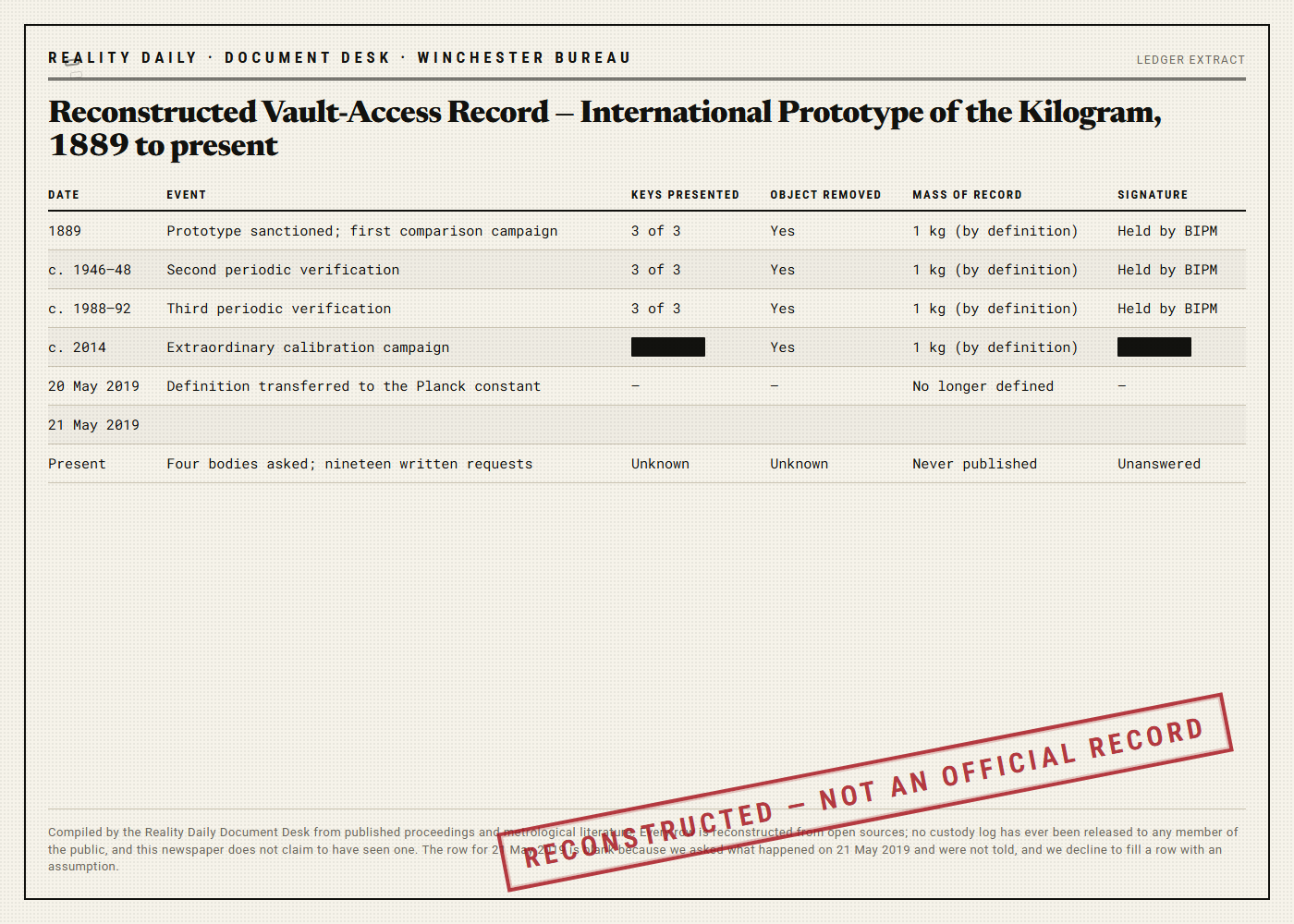
“People think three keys is about security,” he said. “It isn't. One good lock is about security. Three keys is about witnesses. You use three keys when the thing you're worried about isn't burglary, it's a story afterward that nobody can contradict. Three keys is not a lock. Three keys is a meeting.”
Vanderkolk, transcript, 12 February, 2:41 p.m.
“Here's the part your readers won't think about. A three-custodian protocol is a promise between offices, not between people. So the moment the reason for the promise goes away — the moment the thing in there stops being the thing — somebody has to actively decide that the protocol continues. That decision is a document. It has a date on it and somebody's name.”
“If nobody made that decision, the protocol doesn't get cancelled. It just quietly becomes nobody's job. That's worse and it's much more common.”
We asked what he would do if he were consulting on the file today. He said he would ask for the access log. We told him we had. He asked what they said. We told him nobody had said anything. He said, “Then ask for the log of who's allowed to ask for the access log,” which is either a joke or the most practical advice we received in nineteen months, and we have filed for it.
IV. The Fifty Micrograms
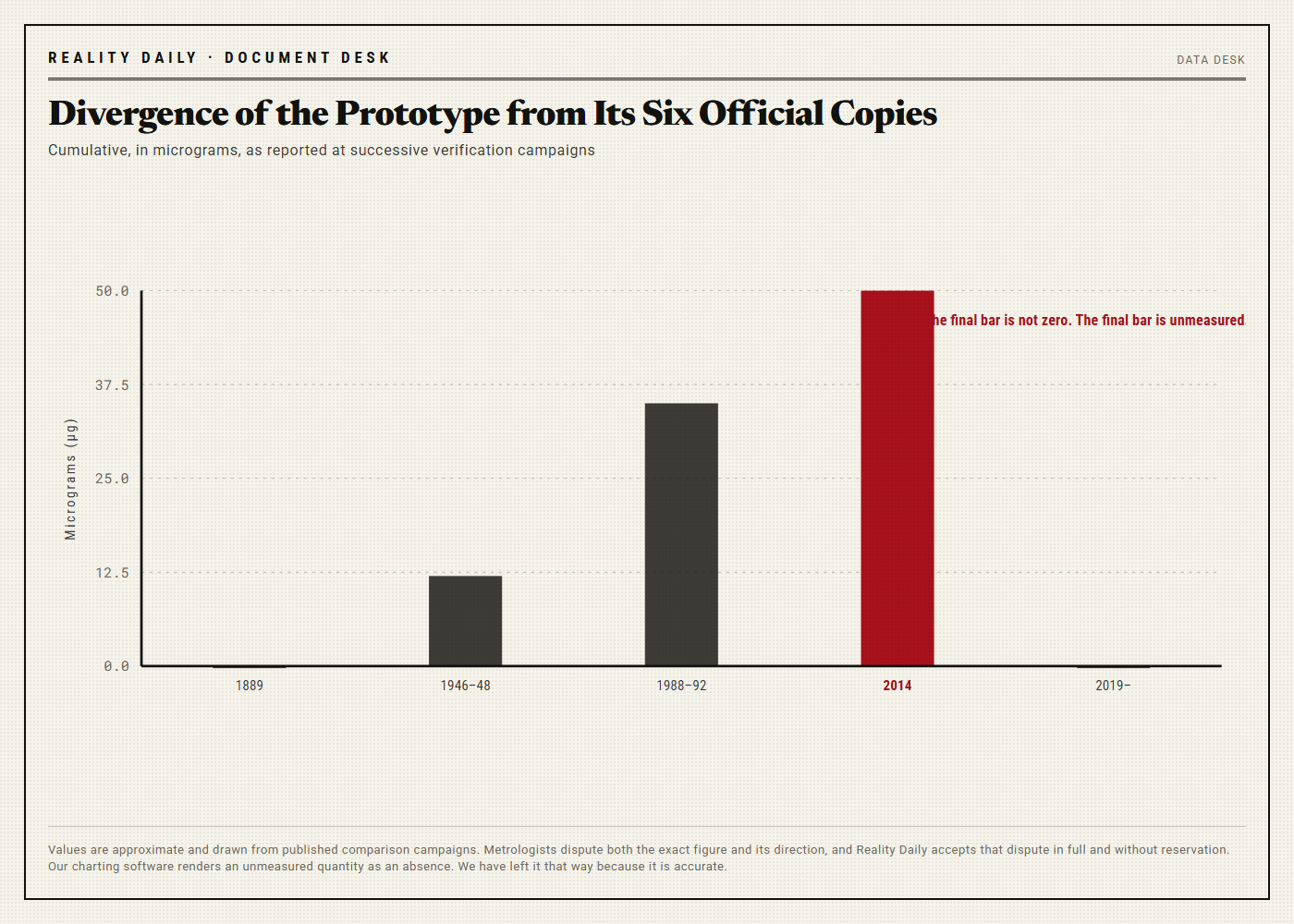
Over the twentieth century the prototype and its six witnesses stopped agreeing with each other, by an amount on the order of fifty micrograms. This is the most widely cited fact about the object after the bell jars, and it is usually reported in a tone of gentle whimsy, as though the cylinder had developed a personality.
Fifty micrograms is 0.000 000 05 kilograms. As a fraction of the object it is one part in twenty million. As an amount of matter it is roughly a grain of fine sand, or slightly more than the oil a fingertip leaves on glass.
As an entry in a ledger, it is a quantity of material that was in a room in France and then was not, and the ledger does not balance.
This is the part of the story where this newspaper's Economics and Data desk becomes difficult to be around, and we accept the characterization. A number without a denominator is a rumor. We asked nineteen times for the denominator: fifty micrograms of what, measured against what, moving in which direction, recorded on what form. We were not told we could not have it. We were not told it did not exist. We were told nothing, in four languages, by four institutions, over nineteen months.
V. “Drift”
In November we retained Dr. Solange Ferreira-Whitcomb, a mass metrologist with thirty-one years in national laboratory work and a specialization in comparing kilogram-class artifact standards. We gave her the four questions and asked her to tell us where we were wrong.
She told us, at length, patiently, and mostly correctly.
Her central point, which we accept without reservation and reproduce as fairly as we know how, is that the fifty micrograms is a relative figure whose direction is not established. The prototype may have lost mass. The witnesses may have gained it, most plausibly through the slow accumulation of hydrocarbons and adsorbed contaminants, a process well characterized in the literature. The cleaning applied before comparison — a chamois soaked in ethanol and ether, then a jet of steam — removes surface material, after which the object re-accumulates it along a measured curve. Nobody knows which cylinder moved, she said, because there was nothing to move against. Which is, she noted, exactly why the artifact definition had to go.
“You keep asking me which one moved. There was nothing to measure against. That is not a gap in the record. That is the entire reason we stopped doing it this way.”— Dr. Solange Ferreira-Whitcomb, mass metrologist
We thanked Dr. Ferreira-Whitcomb. We meant it. Then we asked our question again.
Ferreira-Whitcomb, transcript, 3 December, 10:19 a.m.
“I have now explained adsorption to you four times and I will explain it a fifth, because you are being polite about it and because most journalists stop at one. But I want it in your notes that you keep writing down the same question.”
“It's not that your question is stupid. It's that it's a custody question and you keep asking a physicist.”
That last line is why we ran this story.
Because grant the physics entirely — and we do, without caveat — and the ledger still does not close. If the prototype lost fifty micrograms, then fifty micrograms of platinum-iridium left a sealed vault in Sèvres and is somewhere. If the six witnesses gained fifty micrograms, then fifty micrograms of something entered six sealed bell jars, inside a locked vault, behind a door requiring three people, across a period in which the door was opened three times.
Nobody let it in. That is also a story. It is arguably the better story and no one has written it.
VI. The Jurisdiction Problem
Tobias Wrenn has run this newspaper's Document Desk since 2014 and has filed 2,209 records requests, 31 percent of them fulfilled, a rate he calls unacceptable and also the national average. He has never before met an object he could not address a request to.
The International Bureau of Weights and Measures is an intergovernmental organization established by treaty, and its site at Sèvres holds an international status agreed with the French Republic. As a matter of law this is proper, long-standing, and in no way irregular. As a matter of records access it means the French public-access regime does not reach it, and neither does anyone else's, because it is not an agency of anyone else.
Mr. Wrenn catalogued every national freedom-of-information regime he could identify. He counted 137. None reach the cylinder. He filed with member states instead, on the theory that a signatory's correspondence about the object is a record of that signatory. Four requests were closed. All four closures were correct. One read, in its entirety:
REQ-2026-1188 — CLOSED. NOT AN AGENCY RECORD. SUBJECT OF REQUEST IS NOT LOCATED WITHIN THE UNITED STATES AND IS NOT HELD BY OR ON BEHALF OF THIS AGENCY. NO FURTHER ACTION.
We have no quarrel with that denial. It is well drafted, it is fast, it is legally impeccable, and the officer who wrote it did the job properly. We note only that it was the fourth impeccable denial from the fourth agency, and that impeccability accumulated four times produces a result that is not impeccable at all: there is no public on Earth that can ask this question and get an answer. Nobody designed it that way. It is nonetheless the case.
The one substantive reply of nineteen months came from a national measurement institute, within six working days, from a named scientist. It contained a nine-item reading list on the realization of the kilogram, three items of which we had not seen. It did not mention the cylinder. We had not asked about the Planck constant. We wrote back to thank her and to ask the four questions again. That was in January.
VII. The Location Field
Bettina Oduya-Hall has been a collections registrar for twenty-two years, currently at a regional museum in Lawrence, Kansas, where she is responsible for roughly 61,000 accessioned objects. A registrar is the person who knows where things are. It is the least glamorous job in a museum and the only one that cannot be skipped.
We described the situation without naming the object, because we have learned to do that. Every object in a properly kept collection, she said, has at minimum four fields: an accession number, a current location, a custodial officer of record, and a date of last physical inspection. The fourth is the one that matters and the one everybody lets rot. Objects do not disappear during the years when everyone is watching them.
“Things don't go missing while they're important. They go missing the year after. Every single time, it's the year after.”— Bettina Oduya-Hall, collections registrar, Lawrence, Kansas
So we asked for four fields. Not the keys, not the vault schedule, not anything a security officer could reasonably refuse. Four fields, of the kind a registrar in Kansas produces in under a minute for any of 61,000 objects.
Finding 4, Bove memorandum to the Standards Desk, 9 February
Requested of four bodies, nineteen times, in writing: (1) the current physical location of the object; (2) the office of the custodial officer of record; (3) the date the object was last physically inspected; (4) the object's measured mass at that inspection, with stated uncertainty.
Fields received: none. Fields refused: none. Fields acknowledged as existing: none. Fields acknowledged as not existing: none.
The fourth field deserves a paragraph of its own, because it holds the strangest consequence of the redefinition. Before 20 May 2019 the prototype's mass was exactly one kilogram and could not be otherwise; it was incapable of error the way a meter stick cannot be the wrong length if it is the meter. After 20 May 2019 it is an artifact like any other, and its mass is a measured quantity with an uncertainty attached, on the order of ten micrograms.
For the first time in 130 years, the object is capable of being wrong.
Nobody has published what it weighs.
We want to be scrupulous: it is entirely possible the object has been weighed and the figure is unremarkable and sitting in a notebook nobody thought to make a fuss about. We would be delighted to print that. We have asked nineteen times to be allowed to.
VIII. What We Are Not Saying
This article will be summarized by people who have not read it, so we will be exact.
We are not saying the redefinition was wrong. It was right, it was overdue, and it removed a genuine vulnerability from the international measurement system. We said so in paragraph one and we say it again in the section where people stop reading.
We are not saying the object is missing. We have no evidence whatsoever that it is missing. We have no evidence that it is anywhere. Those are not the same statement, and the distance between them is this article.
We are not saying anyone took fifty micrograms. We are saying fifty micrograms is a quantity, that quantities are conserved, and that no institution has produced a line showing which way it went.
We are not saying the three keys are unaccounted for. We are saying we asked which three offices hold them, that the answer is already printed in reference books and would have cost nobody anything to confirm, and that “we do not discuss custody arrangements” is a reply we would have accepted and printed in full. We received nothing instead, which is not a refusal, and the difference between a refusal and nothing is the only thing this newspaper has ever been about.
We are not saying there is a conspiracy. We are saying that for 130 years every scale, every pharmaceutical dose, every shipping manifest and every child weighed at birth traced back through an unbroken chain of comparison to one cylinder in a basement outside Paris, and that as of a Monday in May 2019 that cylinder is, in the strictest institutional sense, nobody's assignment.
IX. Conclusion
The failure here is not concealment. We looked for concealment for nineteen months and did not find it, and we are obliged to say so plainly. Everyone we reached was decent. The physicists were generous. The denials were well drafted. The reading list was good.
The failure is that the machinery of caring about this object was switched off on a Monday, and no one wrote down who was supposed to switch on the machinery of caring about it on the Tuesday.
A cylinder. Platinum, ninety percent. Iridium, ten. Thirty-nine millimetres by thirty-nine. Three bell jars. Three keys. Three openings in 130 years. Fifty micrograms unaccounted for in a direction nobody has established. One location field, unpopulated. One inspection date, unpublished. One measured mass, never released, for an object that until recently could not be measured at all, because it was the measure.
We are not asking for the vault. We are asking for a sentence.
■ ■ ■
Reality Daily invites the International Bureau of Weights and Measures, the International Committee for Weights and Measures, the French National Archives, and any national measurement institute that wishes to be heard, to respond at any length they choose. The response will be printed in full, unedited, at the foot of this page, in the same typeface and at the same size as our own reporting, with no commentary from us.
We will print a correction, prominently and with an apology, if any of the four questions turns out to have been answered somewhere we failed to look.
The space has been held since November. It remains held. It is a large space and the answer would fit on a postcard.
Corrections & Clarifications
07:22 — An earlier version of this article described the prototype as approximately 39.17 millimetres in both height and diameter. Following review by two staff members and one outside reader, the prototype is approximately 39.17 millimetres in both height and diameter. The original wording stands.
12:05 — We initially reported that fourteen written requests for comment had been sent. The Standards Desk correspondence file records nineteen. We regret the undercount and note that it does not affect the finding, which was that none were answered, and which now applies to five additional requests.
16:48 — A reader with laboratory experience writes to point out that the fifty-microgram divergence may reflect mass gained by the copies rather than mass lost by the prototype. Reality Daily agrees, stated this at length in Section V, quoted a metrologist making the same point, and thanks the reader for confirming that Section V is being read.
Sources & Documentation
- General Conference on Weights and Measures. Resolution 1 of the 26th CGPM (2018): On the Revision of the International System of Units. English and French texts compared line by line.
- International Bureau of Weights and Measures. The International System of Units (SI Brochure), 9th ed. Sections on the realization of the kilogram; reviewed in full by the Standards Desk.
- Ferreira-Whitcomb, S., PhD. Recorded interviews, 3 December and 11 December. Transcript 63 pp., reviewed and approved by subject with two corrections, both accepted.
- Vanderkolk, P. Recorded telephone interview, 12 February, 2:41 p.m. EST. Transcript 29 pp. Subject declined an honorarium twice.
- Piske, R. Preliminary Valuation Note: Platinum-Iridium Artifact Standard, Class Unknown. Prepared for Reality Daily. 6 pp., with the provenance line left deliberately blank at the appraiser's insistence.
- Oduya-Hall, B. Recorded interview, 22 January. Institutional affiliation named with permission; her employer was not consulted and has no involvement in this reporting.
- Rauch, D. Recorded telephone interview, 4 February. Subject asked whether this was about the gas pumps. It was not.
- Reality Daily Document Desk. Register of Records Requests RD-K-0001 through RD-K-0011, covering five national jurisdictions. Fulfilled: 0.
- Records-access denial REQ-2026-1188, 4 pp. including cover sheet. Denial reviewed by Reality Daily Legal and assessed as correct in every particular.
- Reality Daily Standards Desk. Record of Comment Requests to Four Metrological Bodies, 14 November – 6 April. 19 entries; 2 automated acknowledgments; 1 bibliography; 0 substantive responses.
- Wrenn, T. Survey of National Public-Records Regimes and Their Applicability to Artifact Standards Held Under International Status. Reality Daily internal memorandum, 44 pp. Regimes surveyed: 137. Applicable: 0.
- Meter Convention, 20 May 1875, and subsequent instruments establishing the status of the Pavillon de Breteuil site. Reviewed for jurisdictional reach only.
- Bove, H. Memorandum to the Standards Desk: The Four Fields, 9 February. 3 pp.
- Published literature on surface contamination and cleaning of platinum-iridium mass standards, including the ethanol-ether chamois and steam-jet procedure. 31 papers reviewed; 9 cited internally.
- Reality Daily Data Desk. Attempted Reconciliation of Published Dates for the Three Periodic Verification Campaigns. 11 days of work. Result: not reconciled.
- Correspondence from a national measurement institute, 6 working days after request, containing a nine-item reading list. Reproduced in full in our correspondence file. Genuinely excellent. Non-responsive.
- Reality Daily Legal. Memorandum on Publication Absent Response After the Twelfth Request, 2 pp. Same memorandum as previously applied; no amendments required.
- International Committee for Weights and Measures, published session reports, 1889–2019, scanned and word-searched for the terms “custody,” “vault,” “inspection,” “location” and “disposition.”
- Reality Daily Reader Correspondence File RD-C-5119, 2,880 letters received since the announcement of this series, of which 71 contain the phrase “I have always wondered.”
- Sandusky County, Ohio, weights and measures inspection manual, ch. 4, “Traceability of Field Standards.” Provided by Mr. Rauch from his own shelf.
- Vanderkolk, P. Follow-up correspondence, 19 February, confirming approval of quoted material and enclosing a hand-drawn diagram of a three-custodian access sequence, retained on file.
- Reality Daily Standards Desk. On the Difference Between “No” and Silence, internal memorandum, undated. Consulted. Not available to the public.
- Photograph of a blank line on Reality Daily internal form RD-CUSTODY-4, field 3 (“Date last physically inspected”). Reality Daily Document Desk, 4,096 × 3,072 px, EXIF intact.
- The cylinder. It is thirty-nine millimetres tall. It is somewhere.
Reader Response — 4,988 comments
I have thought about this cylinder maybe four times in my entire life and now I am going to think about it every day. Four fields. They wouldn't give him four fields.
Scale calibration tech, 16 years in the field. The chain-of-comparison part is exactly right and most people have no idea. Every certificate I sign traces upward through class standards to a national lab and it used to keep going from there. It has to end somewhere physical or it isn't traceability, it's a vibe.
Respectfully this is 3,000 words to report that a museum piece is in a museum and a physicist got tired of you.
@P. Thorgrim — Accurate on both counts, and we would only add that we do not know it is in a museum, because that is field two of four and we did not receive field two of four. If you can obtain it, we will print it above our own reporting and credit you by name. Your comment has been added to the correspondence file.
The locksmith saying "three keys is a meeting" reorganized something in my head about my entire job and I work in accounts payable.
"It's a custody question and you keep asking a physicist." She got him and he printed it anyway. That is the whole paper right there.
Registrar here, 19 years. She is right and I want it louder. The year after is when the loss happens. Nobody is ever assigned to the year after.