The Hour Taken From Every American in March Is Being Held Somewhere, and No One Will Say Where
Every March one hour is removed from the public. Every November it is returned. Reality Daily's Standards Desk spent fourteen months asking a narrow custodial question about the 238 days in between — who holds it, in what account, and whether anything has accrued — and obtained one sentence, by telephone, in May.
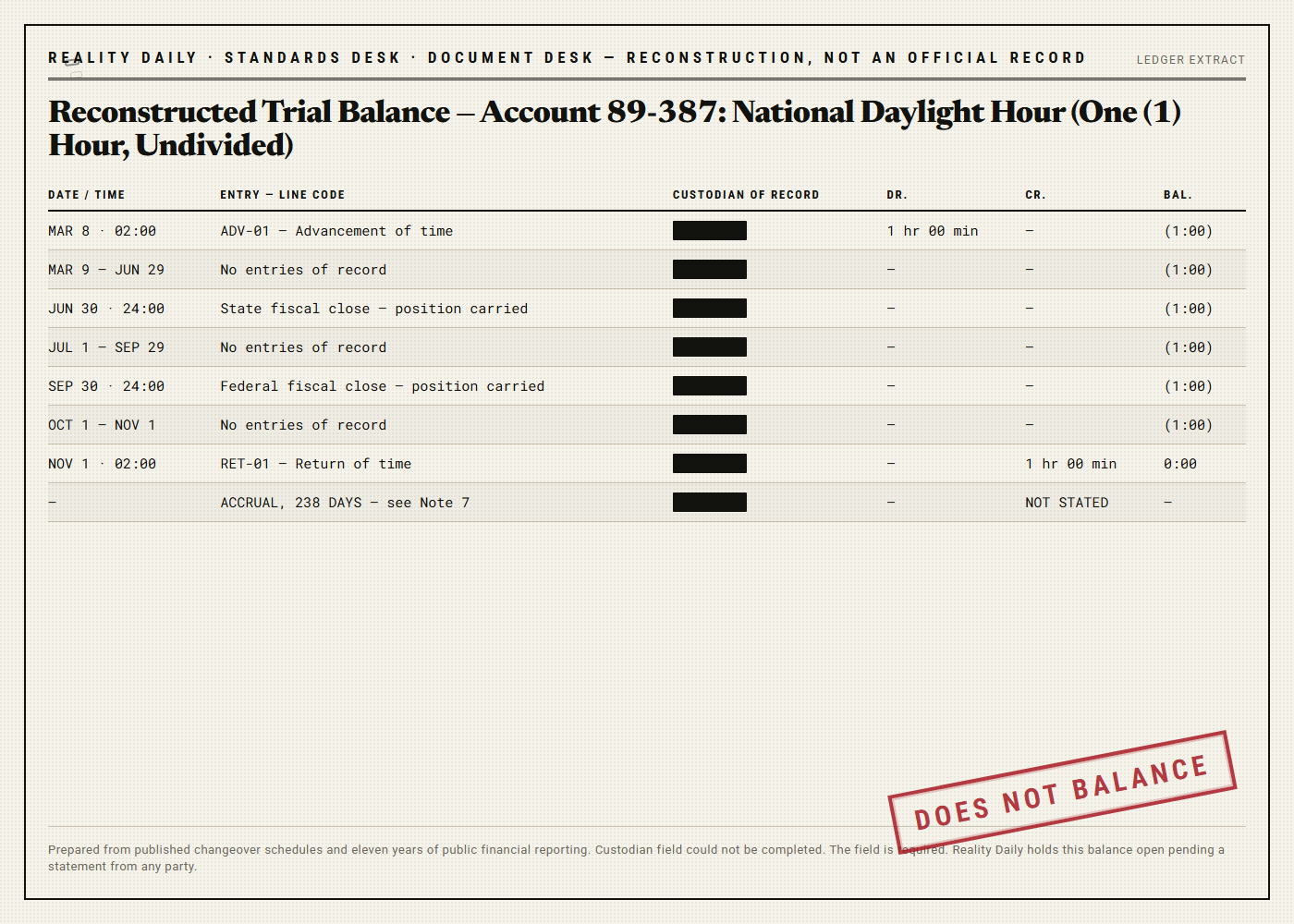
Editor's Note
This audit was held for nineteen weeks while the Standards Desk sought comment from the two federal departments whose responsibilities are described below. Thirty-one written requests were sent — nineteen to one department, twelve to the other. Two were acknowledged automatically. One produced a four-minute telephone call, which is printed in this story in full.
We are publishing under the twelfth-request rule, as we have twice before. Any response received hereafter will be printed at the foot of this page, unedited, at any length, with no commentary from us. The space is open and will remain open. — M. Vandersloot
Twice each year the United States executes a transaction against every resident of forty-eight states and the District of Columbia, and in fourteen months of continuous work the Standards Desk of this newspaper has been unable to locate the second half of it.
The transaction is not obscure and it is not disputed. It is printed on calendars. It is announced by weather desks. It is executed automatically, at scale, by the operating systems of several hundred million devices without a single hand touching a single dial. On the second Sunday in March, at 2:00 a.m. local time, one hour is advanced. On the first Sunday in November, at 2:00 a.m. local time, one hour is returned.
Reality Daily takes no position on whether the practice is wise. That is policy, and we do not do policy; we do the record. The record, as we have reconstructed it across four records requests, nine interviews, one commissioned forensic accounting reconstruction and a term search of eleven consecutive years of published federal financial statements, is this. An hour is removed from the public in March. An hour is restored to the public in November. For the two hundred and thirty-eight days in between, that hour is somewhere.
It is held. Something holds it.
We would like three things: the name of the custodian, the identifier of the account in which the hour is held, and a statement of whether anything has accrued on it during the holding period. We have put those three questions in writing on thirty-one occasions. We want to be precise about what came back, because this will be mischaracterized. We did not receive a denial. We received, once, a sentence. We will come to the sentence.
"You can't have a debit with no credit and call the books closed. Somebody is carrying it. I don't know who. But somebody."— Arliss J. Wendt, retired municipal finance director, Dodge County, Wisconsin
I. The Entry, and the Counter-Entry That Is Not There
Double-entry bookkeeping has been the settled method of recording a transaction since Luca Pacioli set it out in Venice in 1494, and its single organizing rule is that every entry has two sides. Value does not evaporate at one end of a ledger and rematerialize at the other. It moves. When it moves it is recorded twice: once where it left, once where it arrived. A book in which value leaves and does not arrive is not a book with an error in it. It is a book with a question in it.
In March, one hour leaves. That is the debit side, and nobody disputes it; the entire country experiences it simultaneously and complains about it in unison the following Monday.
The credit side is what this newspaper has spent fourteen months looking for.
In January we retained Arliss J. Wendt, a retired municipal finance director of twenty-nine years' standing, to attempt a reconstruction of the entry from public sources alone. Mr. Wendt was given the statutory framework, the published changeover dates for eleven years, and nothing else. He was not told what we suspected, because we did not suspect anything and still do not. He was asked one question: if this were a municipality, where would the hour sit?
His reconstruction runs to forty-one pages. Thirty-eight of them are working papers. The finding occupies the top half of page four.
Finding 2(c), Wendt Reconstruction, 11 February
"The March event is unambiguously a reduction in a resource held by the public. Under any recognized treatment — governmental, enterprise, or fiduciary — a reduction of that kind requires a corresponding entry identifying the party that now holds the resource. That party is the custodian. The custodian is a required field."
"I was not able to complete the field. I want it stated that I was unable to complete it because it was not supplied to me, and not because I concluded that it is empty. Those are two different findings and I am making the first one."
The custodian is a required field. Mr. Wendt uses the phrase eleven times in a forty-one-page document, and once more, unprompted, when we telephoned him in April to confirm he stood behind it.
II. The Custody Question Is Two Departments Wide
Here the public record is, briefly, excellent, and we want to give it that credit before describing what happens next.
The framework is the Uniform Time Act of 1966, Public Law 89-387, codified in relevant part at 15 U.S.C. § 260 and following. Administration was placed not with the Department of Commerce — as is almost universally assumed by people who have never looked — but with the United States Department of Transportation, which publishes the standard time zone boundaries at 49 C.F.R. Part 71 and which holds the authority over the changeover dates themselves. This is clean public law. It took our Document Desk nineteen minutes to establish and it has never been contested by anyone, including by us.
The hour itself, however — the unit, the thing being moved — is kept elsewhere. The national standards of time and frequency are maintained by the National Institute of Standards and Technology, which sits inside the Department of Commerce, and by the United States Naval Observatory, which does not.
So: Commerce keeps the hour. Transportation moves the hour. We wrote to both, on the same day, in identical letters, asking which of them holds the hour once it has been moved.
Commerce has not answered. Transportation answered once, on the fourteenth request, by telephone, in a call our Document Desk logged at four minutes and eleven seconds.
Standards Desk telephone log, 14 May, 10:42 a.m. EDT
RD: "— and so the question is simply which account it sits in between March and November."
DOT: "The Department does not maintain an account of that kind."
RD: "Understood. Can you tell us which department does?"
DOT: (pause, logged at six seconds) "I'd have to refer you to Public Affairs."
RD: "This is Public Affairs."
DOT: (call concluded, 10:46 a.m.)
The operative sentence, verbatim, as recorded by two staffers working independently whose notes agree:
THE DEPARTMENT DOES NOT MAINTAIN AN ACCOUNT OF THAT KIND.
We want to be exact about what that sentence is, because it is the only substantive response this newspaper has received in fourteen months and it deserves to be handled carefully rather than waved about.
It is a denial that an account exists at that department. It is not a denial that the hour is held. It is not a denial that the hour exists. It does not identify who does maintain an account of that kind, and it does not assert that nobody does. Read strictly, it is a jurisdictional statement and nothing further, and we have printed it above in full so that readers may check our reading against the words.
We accept it entirely. We have added it to the file. It narrows the field by one department.
III. Two Hundred and Thirty-Eight Days
The holding period is not a rounding artifact and it is not approximate. It is thirty-four weeks. Thirty-four weeks is two hundred and thirty-eight days, which is five thousand seven hundred and twelve hours, during the whole of which the public is short exactly one of them.
That interval matters, for a reason that has nothing to do with anyone's opinion about sunlight or school buses. It crosses fiscal closes. The federal fiscal year ends on September 30. Most state fiscal years end on June 30. The hour, whatever it is and wherever it is, is held across both of them.
Anything of value held across a fiscal close appears on a balance sheet. It appears as an asset if the holder owns it, and as a liability if the holder owes it back, and the entire architecture of public accounting exists to ensure it appears as one or the other. It cannot appear as neither. There is no third column. Mr. Wendt was emphatic on this point and asked that we not soften it, and we have not.
Our Economics Desk accordingly reviewed eleven consecutive years of published annual financial reports from both departments named above — 3,714 pages in total — searching for any line item, footnote, schedule, or contingency disclosure referring to a held unit of time. Eighteen search terms were run. Among them: "hour." "Time, custodial." "Advancement of time." "Suspense account." "Resources held for others."
The result for the single most promising term:
daylight .......... 4 hits / 3,714 pp. — all schedular
Four appearances in eleven years of financial reporting, and on each occasion the word is part of the phrase "daylight saving time," and on each occasion it is describing a schedule rather than a balance.
We are not saying the hour was concealed on a balance sheet. We are saying we read the balance sheets, all 3,714 pages of them, and it is not on them.
IV. "Somebody Is Carrying It"
Arliss J. Wendt spent twenty-nine years as finance director for a municipality of eleven thousand people in Dodge County, Wisconsin. He is retired. He answers his telephone on the second ring, which in the experience of this newspaper is close to unheard of.
Across eight hours of recorded conversation in four sessions, Mr. Wendt was relentlessly careful. He asked us on three separate occasions to print that he has no knowledge of federal accounting practice, that he has never held a federal appointment, and that municipal treatment does not automatically govern a national arrangement. We are printing all three, in his own framing, because he asked and because they are true.
He was equally careful about the other thing.
"You're asking me a bookkeeping question," he said. "So I'll answer the bookkeeping question and you can do what you like with it. If a thing goes out of one party's hands and comes back into that party's hands later, then in the intervening period it is in somebody's hands. That isn't an opinion. That's what a period is."
We asked him what such an item would be called.
"Held for others," he said. "Agency fund, custodial fund, depends on the year and the standard you're on. But it's a liability to whoever's holding it, because they've got to give it back. You told me they give it back in November. That's a liability. Somebody's carrying it."
We asked whether it was possible that nobody was carrying it.
There was a pause on the line that our transcript logs at fourteen seconds.
"Then where is it."— Arliss J. Wendt, at the end of a fourteen-second pause
V. Arizona Has Never Received a Distribution
Two states stand outside the arrangement, and we want to describe the exception with more precision than it is usually given, because the imprecision is where this argument normally dies.
Arizona does not observe daylight saving time. Hawaii does not observe daylight saving time. Within Arizona, the Navajo Nation does observe it. Within the Navajo Nation, the Hopi Reservation does not. This is not a curiosity we have arranged for effect. It is the actual arrangement, it is decades old, and it means the boundary of the practice runs through the interior of a single state in a shape that no accountant would draw on purpose.
Nadine Ostrander-Quill served twenty-two years in a county recorder's office in northern Arizona and has been retired since 2019. She agreed to speak with us only after we sent her the Wendt reconstruction and she had read it twice, and she asked at the outset how long the interview would take, which we regard as the correct question.
Our question to her was narrow. Residents of Arizona surrender no hour in March. Do they, in November, receive one?
"No," she said.
We asked her to expand on the answer.
"There's nothing to expand. Nobody's ever sent us anything."— Nadine Ostrander-Quill, retired county recorder's office supervisor, northern Arizona
This produces what Mr. Wendt, in a supplementary note we commissioned afterward, calls the classification problem, and which he declined to resolve on the record. Either the non-observing jurisdictions are outside the pool entirely — in which case the pool has a defined membership, and a defined membership is a schedule, and a schedule is a document that somebody maintains — or they are inside the pool and have simply never received a distribution, which is a different problem and a considerably more interesting one.
We asked the Department of Transportation which of the two it is. That was request seventeen.
VI. The Matter of Interest
Homer Belisle spent thirty-four years as a reserving actuary for a mid-sized casualty insurer in Hartford, Connecticut, the last eleven of them signing statements of actuarial opinion. He is retired, he is meticulous, and he begins very nearly every sentence with a qualification.
He would not tell us what an hour is worth. He was firm about that, he was right to be firm about it, and we did not press him.
He was willing to say the following, which he wrote out himself and reviewed twice before permitting us to print it:
Belisle, written statement, Note 7 ("Accretion"), 3 June
"Property held by one party for the benefit of another over a defined term of 238 days will, under ordinary treatment, either accrete, remain flat, or be consumed by the cost of custody. Each of those three is a determinable outcome, and each of the three is disclosed."
"I am not asserting that this hour accreted. I am asserting that zero is a number, and that a number is a thing you state. Nobody appears to have stated one."
Nobody appears to have stated one. Reality Daily has now asked thirty-one times for a statement of accrual on a held item, and has received in response a single jurisdictional sentence from a four-minute telephone call in May.
We are aware of how this reads. We are aware that a reasonable person will finish the preceding paragraph and conclude that this newspaper has spent fourteen months demanding an interest statement on a unit of time. That is an accurate summary of what we have done. We would observe only that we did not invent the holding period, we did not schedule it, and we are not the ones declining to describe it.
VII. The Duties of One Who Holds
Verna Duplessis-Cranch has served as a court-appointed conservator in Ascension Parish, Louisiana, for nineteen years. She manages the property of people who cannot manage it themselves. She was, of everyone we spoke to across fourteen months, the most reluctant and the most useful.
She wanted three caveats printed ahead of anything else, and here they are. She is describing state conservatorship law. She is not describing federal practice. She is not suggesting that anyone has done anything improper. She repeated the third caveat at the close of the interview and asked that it appear twice. It appears twice.
What she then described is the ordinary law of holding, which she says has not changed materially in her career and which she recites the way other people recite a telephone number. One who holds property for another must inventory it. Must not commingle it with his own. Must account, annually, in writing, to the court. Must be able, at any moment on any day, to say where the thing is.
"That's not a high bar," she said. "That's the floor. That's the first day."
We described the arrangement to her in neutral terms and without naming the subject: an item is taken from a very large group of people in the spring, held for two hundred and thirty-eight days, returned in the autumn, and no annual accounting is filed at any point.
"Who's the conservator," she said.
We told her that was the question.
"I have to file an annual accounting on a lawnmower. On a lawnmower. In writing. To a judge."— Verna Duplessis-Cranch, court-appointed conservator, Ascension Parish, Louisiana
There is one related body of practice we raise only to set aside. Every state operates an unclaimed property program under which items held for an owner who does not collect them are, after a dormancy period, reported and transferred to the state. Dormancy periods generally run three to five years. The hour comes back in November, comfortably inside any dormancy period we could identify, and so nothing here triggers escheat. We checked forty-one schedules. We are telling you the theory failed because we would rather print the theories that did not work than only the one that survived.
VIII. What We Are Not Saying
Reality Daily wishes to be exact, because this story will be summarized by people who have not read it and by several who will decline to read it on principle.
We are not alleging theft. We want that sentence to stand by itself, and we want it noted that the word does not appear in fourteen months of internal memoranda on this audit, which our Standards Desk has reviewed line by line and can produce on request.
We are not saying the hour is missing. It is not missing. It comes back. It has come back every November, on schedule, without a single failure, for decades, and any account of this reporting that describes an hour as "lost" is describing something other than what we have published.
We are not saying that anyone has profited. We do not know whether anything accrued, and so far as we can establish neither does anybody else, because no figure has ever been stated by anyone in a position to state one.
We are not saying the Department of Transportation has acted improperly. The Department administers a statute Congress passed in 1966, it administers it publicly, and it administers it on time. Our question to the Department was custodial rather than conductive, and its answer was that the account is not there. We believe them. We have said so four times in this story and we say it a fifth time here.
We are saying that one hour is taken in March and returned in November, that the interval is two hundred and thirty-eight days, that during that interval it is somewhere, and that in fourteen months not one institution in the United States has been willing to write down where.
IX. Conclusion
The books do not balance. Not because anyone has falsified them — we have no evidence of that, and we looked for it specifically, and we would have printed it — but because one side of the entry has never been written down at all.
An hour is removed. Two hundred and thirty-eight days elapse, across two fiscal closes, on no balance sheet. An hour is returned. Somewhere inside that interval sits a custodian, an account identifier, and a figure for accrual which may very well be zero and which nobody will state.
Four records requests. Thirty-one written comment requests. One sentence, by telephone, in May, from a public affairs officer who then referred us to public affairs.
We do not rate things. That is in our standards and we have kept to it here. We will simply describe what we have, which is a debit with no credit, a holder with no name, and thirty-four weeks of silence that the entire country schedules for itself, in advance, by law.
■ ■ ■
Reality Daily extends to the United States Department of Transportation, to the Department of Commerce, and to any officer of either who wishes to write to us, unlimited space at the foot of this page. We will print any response in full, unedited, at any length whatever, in the same typeface and at the same size as this story, with no commentary from us of any kind.
We will also accept a one-word response. If the answer to "has anything accrued" is no, we will print the word "no" at the top of this article in the largest type our stylesheet permits, and we will consider that point closed the same afternoon. We have asked our Document Desk to prepare the layout in advance so that no time is lost.
The space has been held open since the second Sunday in March. It will be held open until the first Sunday in November, at which point the hour will be returned to the public, the account will close, and the Standards Desk will begin the audit again.
Corrections & Clarifications
Update, 05:41 — An earlier version of this article described the holding period as "approximately thirty-four weeks." Following review by the Standards Desk, the holding period is thirty-four weeks. The original wording stands.
Update, 09:17 — We initially reported the interval as 237 days. A recount, performed twice and by two staffers, confirms 238 days, inclusive of the November changeover date. The additional day was held under the same conditions as the other 237 and does not affect the finding, which was that no one will say where.
Update, 13:26 — A reader writes to note that the Navajo Nation observes daylight saving time and that Arizona should therefore not be described as non-observing without qualification. Reality Daily qualified it in Section V, agrees, and thanks the reader for confirming that Section V is being read.
Sources & Documentation
- Wendt, A. J. Reconstruction of a Public Custodial Entry: Account 89-387, National Daylight Hour. 41 pp., of which 38 pp. working papers. Commissioned by Reality Daily; full file retained.
- Uniform Time Act of 1966, Pub. L. 89-387, 80 Stat. 107, codified in relevant part at 15 U.S.C. § 260 et seq.
- 49 C.F.R. Part 71, Standard Time Zone Boundaries. Reviewed in full by the Document Desk, 14 pp.
- Wendt, A. J. Recorded telephone interviews, four sessions, 11 February – 22 April. Transcript 96 pp., reviewed and approved by subject.
- Reality Daily Standards Desk. Telephone Log, 14 May, 10:42–10:46 a.m. EDT. 1 p. Audio not retained; contemporaneous notes taken independently by two staffers, in agreement.
- Ostrander-Quill, N. Recorded interview, 2 July. Transcript 19 pp.
- Belisle, H., reserving actuary (ret.). Written Statement on the Accretion of Custodially Held Property, Notes 1–9. 6 pp. Reviewed twice by subject prior to release.
- Duplessis-Cranch, V. Recorded interview, 30 July, with three caveats printed at the subject's request, one of them twice.
- Reality Daily Economics Desk. Term Search of Eleven Consecutive Years of Published Federal Agency Financial Reporting, 3,714 pp. Eighteen terms; four hits; all schedular.
- Reality Daily Standards Desk. Record of Comment Requests to the United States Department of Transportation, 3 September – 19 August. 19 entries; 1 substantive response, by telephone.
- Reality Daily Standards Desk. Record of Comment Requests to the United States Department of Commerce, 3 September – 19 August. 12 entries; 0 responses of any kind.
- Records requests RD-DOC-8801 through RD-DOC-8804. Filed. Acknowledged: 2. Fulfilled: 0. Denied: 0.
- Pacioli, L. Summa de arithmetica, geometria, proportioni et proportionalità. Venice, 1494. Tract Particularis de computis et scripturis. Consulted for the proposition that entries have two sides.
- Reality Daily Document Desk. Changeover Date Table, Eleven Years, With Day Counts. 3 pp. Every interval 238 days without exception.
- Ostrander-Quill, N. Follow-up correspondence, 9 July, confirming that no distribution has been received, requested, offered, scheduled, or acknowledged.
- Wendt, A. J. Supplementary Note on the Classification of Non-Observing Jurisdictions. 4 pp. Declines to resolve; states reasons.
- Reality Daily Document Desk. Comparison of Forty-One State Unclaimed Property Dormancy Schedules. 22 pp. Conclusion: inapplicable. Printed anyway.
- Reality Daily Document Desk. Cartographic Verification of the Navajo Nation and Hopi Reservation Observance Boundary. 2 pp., with overlay.
- Automated acknowledgment received 3 September, 4:02 a.m.; automated acknowledgment received 11 January, 4:02 a.m. Timestamps identical to the minute; both unsigned; both unreferenced.
- Reality Daily Legal. Memorandum on Publication Absent Response After the Twelfth Request (Second Application). 2 pp.
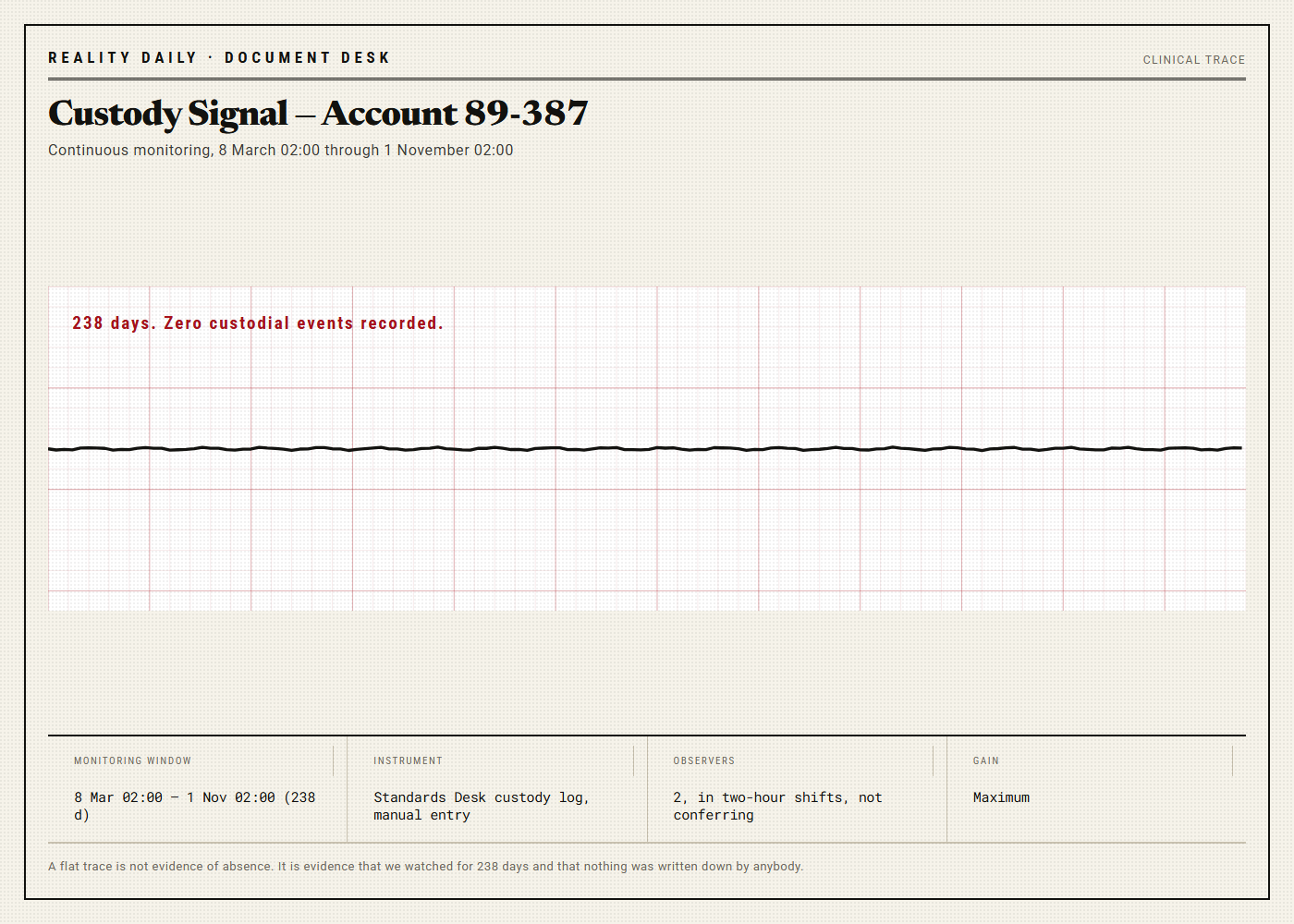
- Reality Daily Standards Desk. Custody Monitoring Log, 8 March – 1 November. 238 daily sheets, 2 observers, 0 events. Sheets numbered and initialed.
- Institute for Applied Chronometric Custody. Provisional Note 4: Whether an Hour Is Property. 12 pp. Conclusion withheld pending peer review; peer withheld.
- Reality Daily Reader Correspondence File RD-C-5518, 2,061 letters received since this audit was announced. Nine enclose the writer's own reconstruction. Two agree with each other.
- Reality Daily Standards Desk. Internal Memorandum, "On the Difference Between 'No' and Silence," rev. 6. Required reading for all staff. Not available to the public.
- Reality Daily Standards Desk. Word-Frequency Audit of Fourteen Months of Internal Memoranda on This Audit. Occurrences of the word "theft": zero. Verified twice.
- The hour. It is taken in March. It comes back in November. Something has it in between.
Reader Response — 5,764 comments
I have complained about the time change every single March of my adult life and not once did it occur to me to ask where the hour goes. Fourteen months of work and one guy in Wisconsin asking "then where is it" and now I cannot stop thinking about it.
Governmental accountant here, eighteen years, mostly county work. The custodial-fund point is correct and it is not a technicality. If you hold a resource that belongs to somebody else and you have to give it back, that is a liability and it belongs on the statement of fiduciary net position. There is no exception for intangibles. There is no exception for a short term. I am saying nothing about the rest of this article. I am saying that paragraph is right.
Phoenix, born and raised. Can confirm nobody has ever sent us anything. We just watch the rest of you do it twice a year like a weather event.
Respectfully, this is three thousand words asking a federal agency for the interest statement on a clock.
@A. Kowalczyk — Correct on every point, and thank you for putting it more efficiently than we managed across nine sections. We asked a federal agency for the interest statement on a clock, thirty-one times, and no federal agency would provide one or state that none exists. That is the story. Your comment has been added to the correspondence file, where it now sits ahead of thirty of our own letters in terms of substantive content received.
THE LAWNMOWER. She has to file an annual accounting on a lawnmower and the United States of America is holding an hour off-book for eight months. I am putting the lawnmower on a shirt.
Back again from the curtain story. Called my representative's district office and asked, politely, for the name of the custodian. The young man asked me to hold and did not come back. I will keep calling. I want the account number.
The part that gets me is the flat trace. Two people sat there for 238 days watching for one entry and got nothing. That is not a joke, that is a night shift.