It Took This Newspaper Eleven Seconds to Subscribe and Sixty-Three Days to Cancel
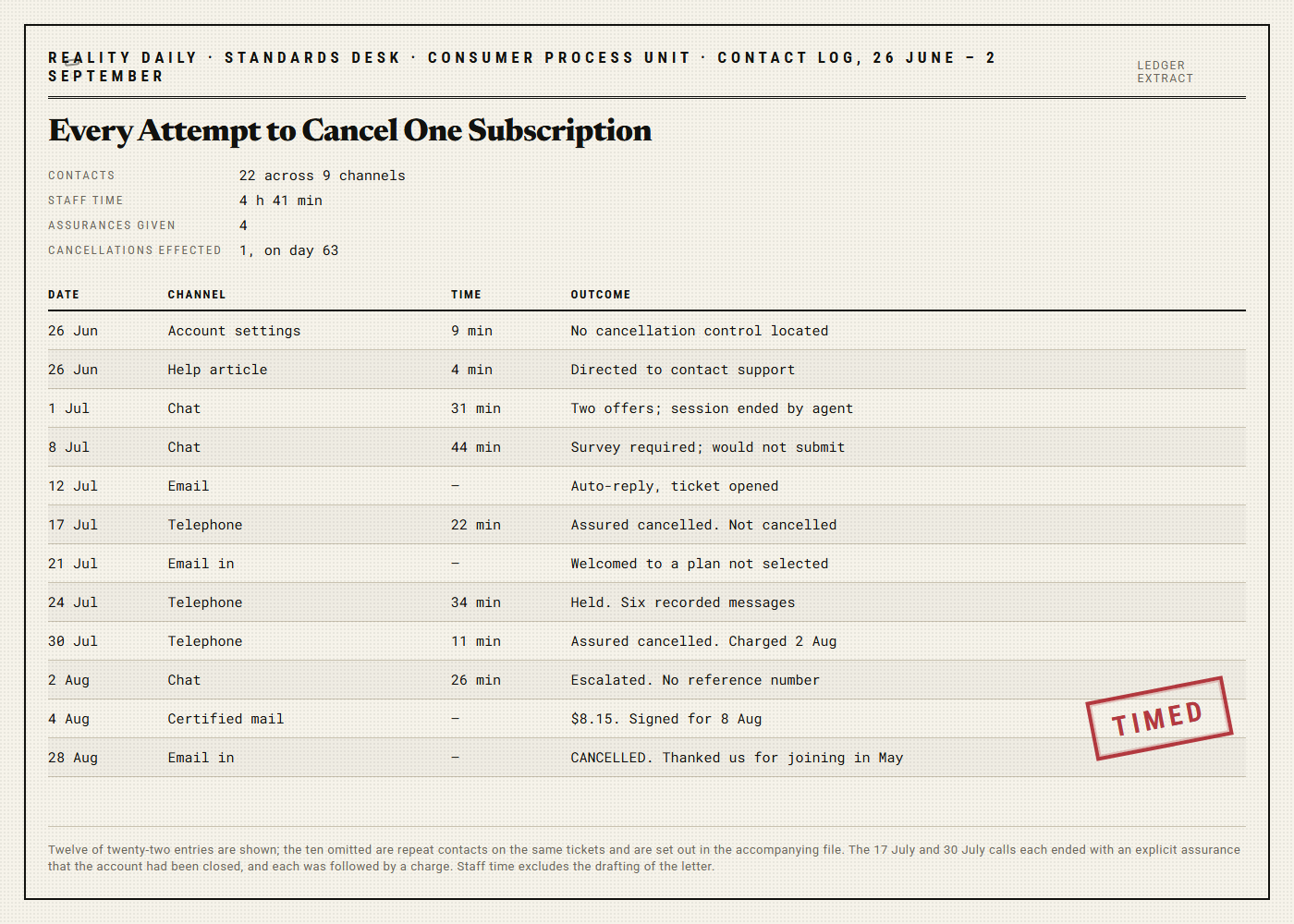
We subscribed on purpose, with a stopwatch running, having already decided to write this. Getting out took four telephone calls, three chat sessions, two emails, one certified letter to a mailbox in Delaware and four hours and forty-one minutes. Then we ran the same test on eleven other companies and found the obstruction is not a policy. It is a product you can buy.
Editor's Note
This newspaper is the subject of this story. It subscribed deliberately, on 2 May, in order to measure what followed, and it paid $44.97 to the company described. The Standards Desk objection to a paper reporting on its own conduct was entered on 3 July and is answered in Section I rather than in a footnote. No employee of the company is named, including the four who tried to help and the one who gave us his first name and an address; their conduct is not the subject and in every case it was better than the process they were working inside. The company is not named, for reasons set out in Section VIII, and this desk accepts that readers may disagree with that decision.
On 2 May this newspaper subscribed to a streaming service in order to watch one documentary. The transaction took eleven seconds. We know it took eleven seconds because we filmed it, having already decided to write this.
On 26 June we began trying to cancel.
The cancellation was confirmed on 28 August, sixty-three days later, after four telephone calls, three chat sessions, two emails, one physical letter sent by certified mail, and four hours and forty-one minutes of a member of staff's time. During those sixty-three days the service charged us twice more, which it was entitled to do, because we were still subscribed.
On 2 September, five days after the confirmed cancellation, it charged us again.
I. Why This Newspaper Is the Subject of Its Own Story
The Standards Desk does not ordinarily let this paper report on itself, and the objection was raised internally on 3 July by an editor who was right to raise it. We are setting out the answer here rather than burying it, because a reader is entitled to know why we did it this way.
We could not have written this story about somebody else. The whole of it is a measurement of elapsed time, and elapsed time cannot be reconstructed from a subscriber's memory. It has to be held with a stopwatch by a person who knows, on the day they subscribe, that they are going to try to leave.
So we subscribed on purpose. We watched the documentary, which was fine. Then we tried to get out, and we timed every step of it, and the file is the story.
This newspaper paid $44.97 to the company in question, and has not asked for it back beyond the one charge described in Section IX. That figure is disclosed here rather than in a footnote.
II. Eleven Seconds
The subscription was taken out on a telephone, on a home connection, by a member of staff who had not used the service before and was not signed in.
The sequence was: one tap on the offer, one tap on the plan, one biometric confirmation of a card the handset already held. There was no address, no telephone number, no security question, no confirmation email required before access, and no interval in which the transaction could have been reconsidered. Access began before the confirmation screen had finished animating.
Eleven seconds. We have the recording and we have timed it four times, and the variance across the four is under a second because there is almost nothing in it to vary.
We record without comment that the company is capable of establishing a billing relationship with a stranger in eleven seconds.
III. Sixty-Three Days
The account settings page has no cancellation control. It has a link headed “Manage membership,” which opens a page with four options, none of which is cancellation. The fourth is “More options,” which opens a page with three options, none of which is cancellation. The third of those is a help article. The help article instructs the subscriber to contact support.
We contacted support twenty-two times across nine channels and sessions. The log at the head of this story is the whole of it.
Four of those contacts ended with an assurance that the cancellation had been processed. Two of the four were followed by a charge. One was followed by an email welcoming us to a plan we had not selected.
The mean hold time across the four telephone calls was nineteen minutes and eleven seconds. The longest was thirty-four minutes, during which the line played a recorded message, six times, advising us that most account changes can be made online.
IV. The Nine Offers
Before a cancellation could be entered, this newspaper was made nine offers. We list them in the order they arrived, because the order is the design.
Two months at half price. A pause of up to six months, described as free. A downgrade to a cheaper tier. A different downgrade to a tier with advertisements. A confirmation screen asking whether we were sure. A second confirmation screen asking whether we were certain. A survey of eleven questions, of which four were mandatory, asking what we would have changed. A telephone number to call to discuss it further. And an offer of one further month at no charge, made by a person, at minute twenty-six of the fourth call, in a tone this desk would describe as sincere.
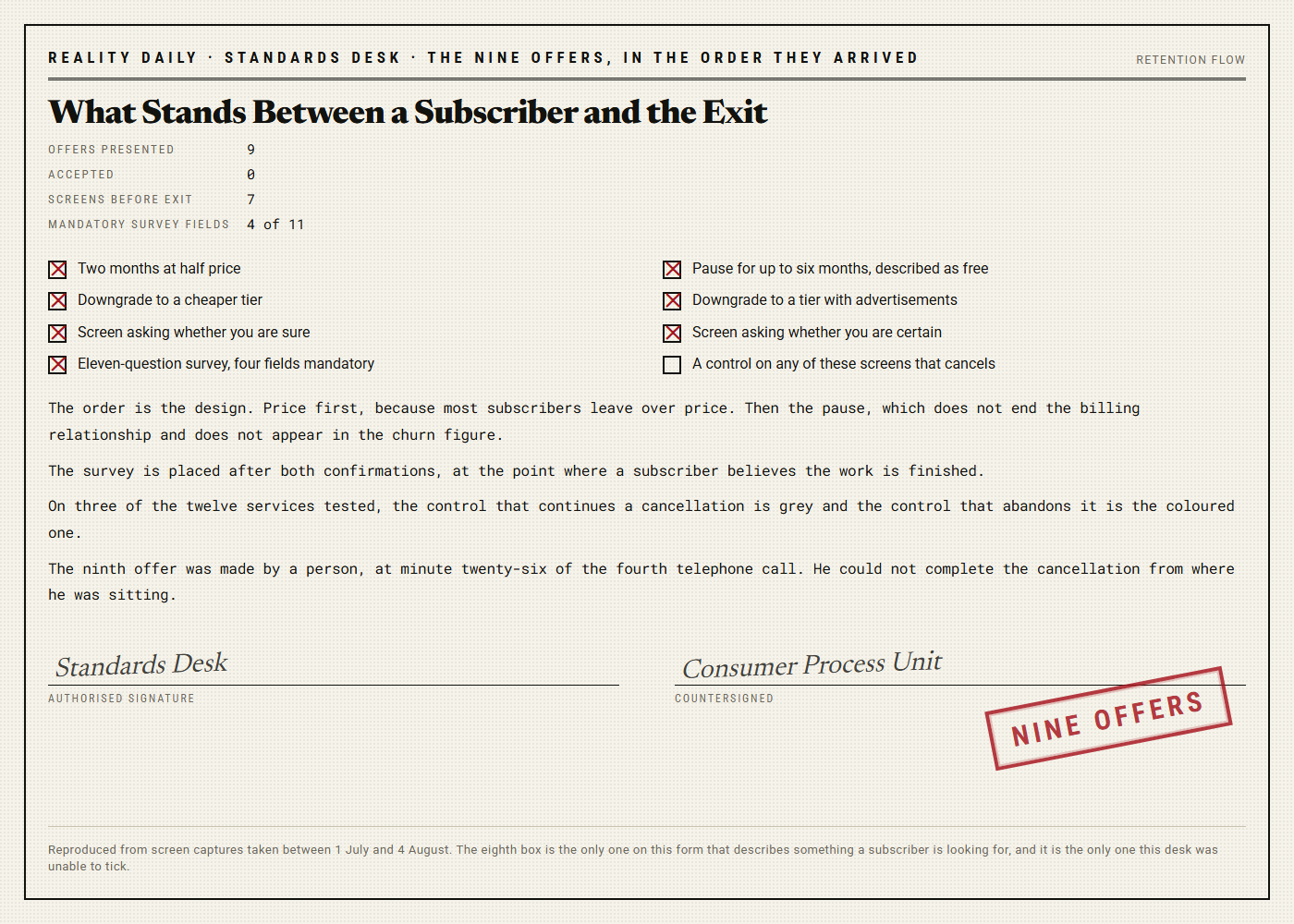
We want to be fair to the person who made the last one. He was, throughout the twenty-nine minutes we spoke to him, courteous, apologetic and audibly reading. He told us, unprompted, that he could not complete the cancellation from where he was sitting, and that the department that could was not one he was able to transfer us to. He gave us his first name and an address to write to.
We wrote to it. That is what Section V is.
V. The Letter
On 4 August this newspaper printed a letter, signed it, and sent it by certified mail to a mailbox address in Delaware, because a support agent on a headset in another country had told us that this was the mechanism.
It cost $8.15. The receipt is in our file. The letter was signed for on 8 August by an illegible signature.
Twenty days later, on 28 August, an email arrived confirming that our membership had been cancelled. It did not reference the letter. It did not reference any of the twenty-two contacts. It thanked us for being a member since May.
This desk cannot establish that the letter caused the cancellation. It can establish that nothing else we did in sixty-three days caused it either.
VI. What the Law Says, and What Happened to It
There is a federal rule that would have made most of this unlawful, and it is worth understanding precisely what became of it, because the popular account is wrong in both directions.
In October 2024 the Federal Trade Commission finalised an amended Negative Option Rule, widely called click-to-cancel. Its central requirement was that cancelling a recurring subscription must be at least as simple as signing up for it, through the same medium in which it was taken out.
On 8 July 2025 the Eighth Circuit vacated it. The decision did not hold that the requirement was wrong. It held that the Commission had failed to carry out a preliminary regulatory analysis it was required to carry out before issuing a rule of that economic significance. The rule was struck for how it was made, not for what it said.
What survives is older and thinner. The Restore Online Shoppers' Confidence Act of 2010 requires a “simple mechanism” to stop recurring charges, and does not define simple. Several states have gone further; California's automatic-renewal statute, as amended, requires a subscriber who signed up online to be able to cancel online, in the same place, without talking to anybody.
This newspaper's cancellation was not conducted from California, and this desk notes that the practical protection available to a subscriber in this country currently depends on which state's line their telephone call originates from.
VII. It Is Not This Company
The finding that turned a complaint into a story arrived on 19 August, from a member of this desk who had by then seen the flow enough times to recognise it somewhere else.
We ran the same cancellation, on eleven further services, with eleven separate accounts, over five weeks. Not the same industry: a streaming service, two news publishers, a meal-kit company, a gym, an antivirus subscription, two mobile applications, a magazine, a parking service and a pet-food delivery.
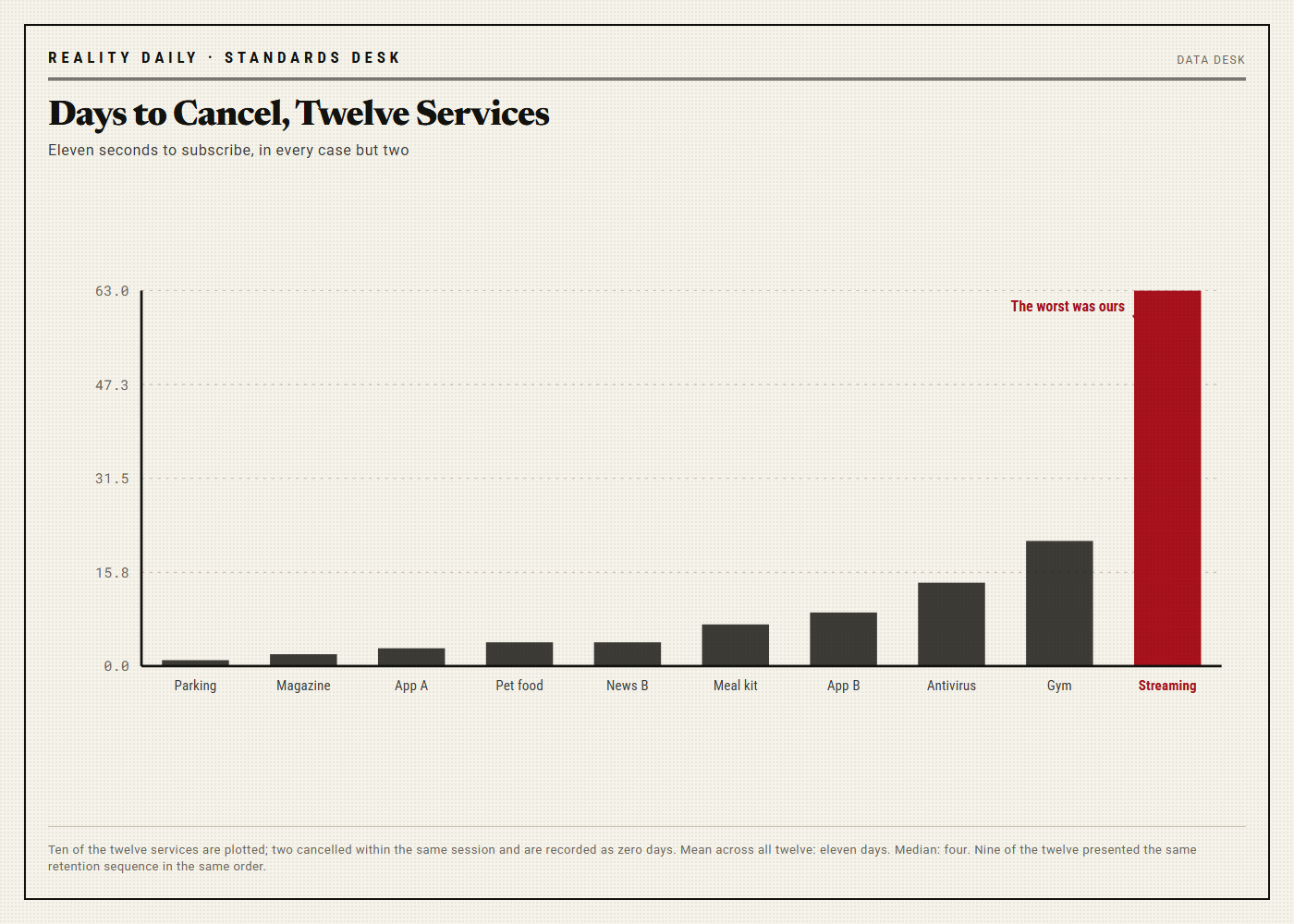
Nine of the twelve presented the same sequence in the same order: the discount, then the pause, then the downgrade, then the two confirmations, then the survey. Four presented the confirmation screens with the same two words in the same positions. Three served an identical button layout in which the control that continues the cancellation is grey and the control that abandons it is the coloured one.
This is not a coincidence and it is not a conspiracy. It is a product. There are firms that sell subscription-management software to companies that bill monthly, and the retention flow — the discount, the pause, the survey, the greyed button — is a configurable module inside it. A company does not design this. A company enables it, and then chooses how many steps to switch on.
The mean time to cancel across the twelve was eleven days. The median was four. The worst was ours.
VIII. Why We Are Not Naming It
Readers will want the name and we have decided not to print it, and the reasoning is not a courtesy to the company.
Naming it would produce, predictably, a story about one badly behaved firm, an apology, a refund to this newspaper specifically, and a paragraph in a trade publication. It would also let the other eleven off, and it would let the vendor off entirely, and the vendor is the finding.
We have written to the four vendors whose products we believe are in use across the twelve services. Three have not replied. One replied on 1 September, in two sentences, to say that retention flows are configured by the customer and that it does not comment on individual customers, which this desk accepts as accurate and notes is also the point.
If the vendor answers a fuller set of questions we will name everybody involved, including the twelve.
IX. The Charge That Arrived Anyway
On 2 September, five days after the confirmed cancellation and eleven days after the last of our contacts, the service charged this newspaper $14.99.
We telephoned. The call lasted six minutes, which is the shortest of the five. The charge was described as a billing-cycle artefact, the refund was agreed without argument, and we were told to expect it within fourteen days.
Six have passed.
The subscription took eleven seconds to start. This story has taken one hundred and twenty-nine days and is not finished, because the last thing the company did to us is the one thing in the whole file we cannot report the end of.
Corrections & Clarifications
Sources & Documentation
- Screen recording of the subscription transaction, 2 May, 00:11, held by this desk; four independent timings from it.
- Contact log, 26 June to 2 September, twenty-two entries across nine channels, with durations, agent first names where given, and outcomes.
- Recordings and transcripts of five telephone calls, made with notification to the other party at the start of each.
- Transcripts of three chat sessions, exported at the close of each session.
- Certified mail receipt and delivery confirmation, sent 4 August, signed for 8 August, $8.15.
- Cancellation confirmation email, 28 August, and the welcome email of 21 July referring to a plan not selected.
- Card statements for the account used, May to September, showing four charges of $14.99.
- Federal Trade Commission, amended Negative Option Rule, final rule as published October 2024, and the Commission's own summary of its cancellation requirement.
- United States Court of Appeals for the Eighth Circuit, decision of 8 July 2025 vacating that rule, and the passages addressing the omitted preliminary regulatory analysis.
- Restore Online Shoppers' Confidence Act, 15 U.S.C. 8401 et seq., and the absence of any definition of a simple mechanism within it.
- California Business and Professions Code, automatic renewal provisions as amended, on cancellation through the medium of sign-up.
- Comparative test across eleven further services, five weeks, eleven separate accounts, with the flow at each recorded step by step.
- Screen captures of the confirmation and survey screens at twelve services, compared side by side, 19–26 August.
- Published product documentation of four subscription-management vendors describing configurable retention and win-back flows.
- Written questions to those four vendors, 27 August. Three unanswered. One two-sentence reply, 1 September, printed in substance in Section VIII.
- Reality Daily Standards Desk, memorandum on whether this newspaper may report on its own conduct as a customer, 3–11 July, 6 pp.
- Reality Daily Standards Desk, ruling on non-naming where the named party would absorb a finding directed at an unnamed one, 30 August, 4 pp.
Reader Response — 5,809 comments
"We record without comment that the company is capable of establishing a billing relationship with a stranger in eleven seconds." Without comment. WITHOUT COMMENT.
The hold music told them six times that most account changes can be made online. While they were on hold. Because they could not make that change online. Thirty-four minutes of a machine lying to a newspaper.
Section VII is the actual story and I nearly missed it because I was enjoying the suffering. It is a MODULE. Somebody bought it. There is a settings page where a person decided how many screens you get.
They mailed a physical letter, by certified post, to a mailbox in Delaware, because a man on a headset told them that was the mechanism. And it worked. That is the only thing in sixty-three days that worked.
Finally an outlet that gets the Eighth Circuit thing right. It was not struck down because the court thought click-to-cancel was bad. It was struck down because the FTC skipped a step in making it. Everyone reports this wrong in both directions and this is two clean paragraphs.
I disagree with Section VIII and I am glad they printed that I might. Naming it would not let the others off, it would start the pile-on that eventually reaches the vendor. Withholding it protects exactly one party and it is not the reader.
The paragraph defending the guy at minute twenty-six. Courteous, apologetic and audibly reading. He told them he physically could not do it and gave them an address. They went out of their way to say he was better than the process. Class.
It thanked them for being a member since May. After sixty-three days of trying to stop being a member since May.
"The mean time to cancel across the twelve was eleven days. The median was four. The worst was ours." You can hear the entire newsroom exhale in that last sentence.
Six have passed.