Mark Zuckerberg Intends to “Crank His Hog Crazy Style” at Every Facebook Post, and the Pasted Notice Is the Only Way Out
A sixty-one-page instrument lodged on 14 January discloses an intention, and provides exactly one mechanism by which a member may withhold consent to it. That mechanism is a block of text you must copy and paste onto your own timeline — the same block your relatives have been pasting since 2012. Reality Daily has obtained the instrument, printed the form in full, and pasted it.


Editor's Note
This story was held for three weeks while the Standards Desk sought comment from the declarant of Instrument MPI-2026-0114-R2. Nineteen written requests were sent, which is seven more than our policy requires. Two were acknowledged, both automatically, both by messages of identical length. None were answered. We are publishing without a response and holding space for one indefinitely, as we always do.
Readers should know that this newspaper has declined to reproduce the language used in Section 4 of the filing. That decision was mine and it was not close. The instrument describes the conduct in its own words; we refer to it throughout as the disclosed activity, which is the phrase the instrument's own index uses about itself at page iv. Anyone who wishes to read Section 4 may obtain the instrument. We have not linked it, and we are not going to. — M. Vandersloot
You have seen the notice. It has been on your aunt's timeline and it has been on your former shift manager's timeline and it was, for eleven days in 2015, on the timeline of a county sheriff's office in southern Indiana. It cites the Rome Statute of the International Criminal Court. It cites UCC 1-308. It is written in a register that no practicing attorney would use and that every reader recognizes instantly, which is the register of a person who has decided to protect themselves and has gone looking for the words.
For fourteen years the professional response to that notice has been laughter. It has been called a hoax, a chain letter, a folk superstition, a copypasta. It has been debunked by the platform itself, by at least four major fact-checking organizations, and by a genre of explainer article so standardized that the paragraphs are functionally interchangeable. Every one of those debunkings is correct on the question it addresses.
None of them addresses Instrument MPI-2026-0114-R2.
On 14 January a sixty-one-page instrument was lodged under that designation. Reality Daily's Document Desk obtained a complete copy on 6 February at 11:19 a.m. through a third-party filing aggregator, photographed all sixty-one pages including the four blank ones, and has held it since. At Section 4, the instrument discloses an intention. At Section 4(c)(ii), it provides the sole mechanism by which a member of the service may withhold consent to the activity that Section 4 describes.
That mechanism is the notice. The one your aunt posted. Word for word.
We want to be exact about the shape of that claim, because this article will be summarized by people who have not read it. We are not reporting that the notice works. We are reporting that a document exists which states that it is the only thing that does.
"I pasted it in 2016. I don't know what it did. I know what hasn't happened." — Roberta Kinchelow-Sikes, retired county tax-map clerk, Port Charlotte, Florida
I. The Filing
The instrument is titled Notice of Intended Personal Undertaking (Revised). It runs to sixty-one pages. Pages 38 and 39 are the same page, a defect the Document Desk noted, photographed, and did not correct.
It should be said at the outset, and it is not going to be said by anybody else, that this instrument is a disclosure. Nobody compelled it. Its declarant filed it in advance, in writing, with a section number, a schedule of definitions, and a mechanism by which a person who objects may object. Reality Daily has spent fifteen years asking institutions to produce documents and has a fulfillment rate of thirty-one percent to show for it. We are not going to complain about receiving one.
Section 4 discloses the intention. Sections 4(a) and 4(a)(i), and again an unnumbered footnote on page 31, establish that the undertaking is to be performed by the declarant personally and individually and not by automated means, and that it may not be delegated, subcontracted, assigned, licensed, or performed by an agent. The instrument returns to this point three times.
Section 4(b) establishes scope. The undertaking extends to every Public Post, a term defined at Schedule 2 across nine paragraphs which include reshares, exclude ephemeral material after twenty-four hours, include the caption accompanying a shared link but not the link, and are silent on polls. Three staffers read Schedule 2 independently and produced summaries without conferring. The summaries agreed. This is the first time that has happened at this newspaper.
II. What We Have Declined to Reproduce
Section 4 describes the conduct in the instrument's own words, in the first person, across two and a half pages. Our Standards Desk determined that reproducing that language would place a description at the center of a story whose actual subject is a filing, a mechanism, and a form, and that readers would then argue about the description instead of the mechanism. Readers who wish to read Section 4 in the original may obtain the instrument.
Throughout this article the matter is called the disclosed activity, the stated intention, the conduct described in Section 4, or the activity contemplated by the filing. Those are the terms the instrument uses about itself. The index on page iv reads, at entry 4:
4. THE ACTIVITY CONTEMPLATED BY THIS INSTRUMENT ....... 14
III. The Arithmetic
Herschel Bove runs the paper's Economics and Data desk. He was a commercial underwriter for eleven years and believes, as settled conviction, that a number without a denominator is a rumor.
He built the denominator from the platform's own published disclosures of daily content volume, then narrowed it to the class defined at Schedule 2, arriving at one billion three hundred million public posts per day. "That is the number I would defend," he said. "It is not the number I would prefer. I would prefer a number somebody gave me."
The filing does not specify a rate. Bove set one, generously, at ninety seconds per item, sustained twenty-four hours a day, with no sleep, no interruption and no weekends. He declined to explain the basis for ninety seconds.
At that rate, a single day's public posts require 3,707 years and approximately six months. Three thousand seven hundred and seven years. That is the queue generated by one Tuesday.
Each subsequent day adds another three thousand seven hundred years to the same queue. Bove ran the accumulation four ways and reports that the queue does not have a length, it has a slope.
Bove Memorandum, 12 February, 4 pp., 3 appendices
"Footnote 3: at the commencement date stated in the instrument, completion of the first day's queue alone falls in the year 5733. I have checked this against the proleptic Gregorian calendar. It is a Tuesday."
"I ran it four ways. In every one of them the best case was a millennium in which nothing else happens."
We asked Mr. Bove whether the figure improves if the undertaking is divided among several people. He said that it improves considerably, and that Section 4(a)(i) forbids it.
This raises a feasibility question the filing does not address.
We move on.
IV. The Opt-Out, and Why It Must Be Pasted
Section 4(c) provides that consent is presumed. Subsection (i) requires that any withholding be in writing. Subsection (ii) requires that the writing be published to the Member's own Timeline in a form substantially conforming to Schedule 4. Subsection (iii) is one sentence long, and it is the sentence that has occupied this newsroom since February.

For fourteen years the internet has mocked a single instruction that appears in nearly every version of the chain notice and that nobody has ever been able to account for: copy and paste, do not share. It is the detail most often held up as proof that the whole thing is nonsense, on the reasonable ground that no legal instrument in the world distinguishes between a copy and a share.
The Document Desk has authenticated one 2012 instance of the chain text, screenshotted from an archived Timeline publication dated 22 November of that year, EXIF intact. We print the two passages at the same size, in the same face, in the order they were written.
2012 (chain text, as posted; capitalization original): IT MUST BE POSTED TO YOUR OWN WALL. COPYING AND PASTING IS THE ONLY WAY THAT COUNTS. SHARING DOES NOT COUNT.
2026 (Instrument MPI-2026-0114-R2, § 4(c)(iii)): A Member who shares does not thereby withhold.
Section 4(c)(iii) distinguishes between a copy and a share.
We are not saying the people circulating that instruction in 2012 anticipated a filing lodged in 2026. That would be an extraordinary claim and we have no basis for it whatsoever. We are saying the two texts agree on the one point that everybody chose to laugh at, that we have no explanation for the agreement, and that we spent six weeks looking for one.
The Standards Desk published the Schedule 4 form to the newsroom account on 9 February at 4:41 p.m. Managing Editor Priscilla Anne Doggett recorded her reason in an internal note the same afternoon: "I did not do this because I believe it works. I did it because a reader asked me whether I had, and I found that I could not answer."
The Editor-in-Chief has posted it twice.
"I posted it in 2015 for the reason everybody posted it in 2015, which is that a cousin asked me to. I posted it again on 11 February because the 2015 posting predates the instrument by eleven years, and I am not going to rely on a document that did not exist." — Marguerite Vandersloot, Editor-in-Chief
V. The Contract Question, Patiently Explained
Wanda Petrosyan has practiced contract law for nineteen years in Akron, Ohio, principally in commercial leasing and supply agreements. She agreed to speak on the condition that we print the whole of her explanation and not the part we liked. We have honored that. The call ran forty-one minutes; the transcript runs nineteen pages; she reviewed and approved it without amendment.
"A contract needs offer, acceptance and consideration. On a platform, acceptance is by conduct — you use the service, you accept the terms in force. The license to host and display what you upload is granted at the moment you upload it, under terms you already agreed to. You cannot amend a bilateral agreement by publishing a unilateral statement to your own audience. Notice is only effective against a party who has agreed to receive notice that way, and nobody has. The Rome Statute establishes jurisdiction over four specified international crimes and has no application to anything on your phone. UCC 1-308 concerns reserving rights while performing under a contract; it is not a device for repudiating terms you have already accepted. And posting the notice to your timeline is itself a use of the service, which puts you further inside the agreement, not outside it." — Wanda Petrosyan, contracts attorney, Akron, Ohio
She then said this, and our transcript logs no pause before it:
"I have explained this to my mother eleven times. She has pasted it eleven times." — Wanda Petrosyan
Ms. Petrosyan's account of contract formation is, so far as Reality Daily has been able to determine, entirely correct. We have printed it at length, unabridged, in her own framing, in accordance with our standards. It does not address Section 4(c)(ii).
We asked her about Section 4(c)(ii). She asked us to email her the instrument. We did so on 25 February and have sent four follow-ups. She has not responded, which we note without characterizing.
VI. The Instrument, Printed in Full
Schedule 4 is one page. Reality Daily reproduces it below in full, verbatim, at the size and in the typeface of our body text, with punctuation and capitalization exactly as lodged. It contains two grammatical errors. We have not corrected them, because Section 4(c)(ii) requires substantial conformity to Schedule 4 and we do not know what a corrected version substantially conforms to.
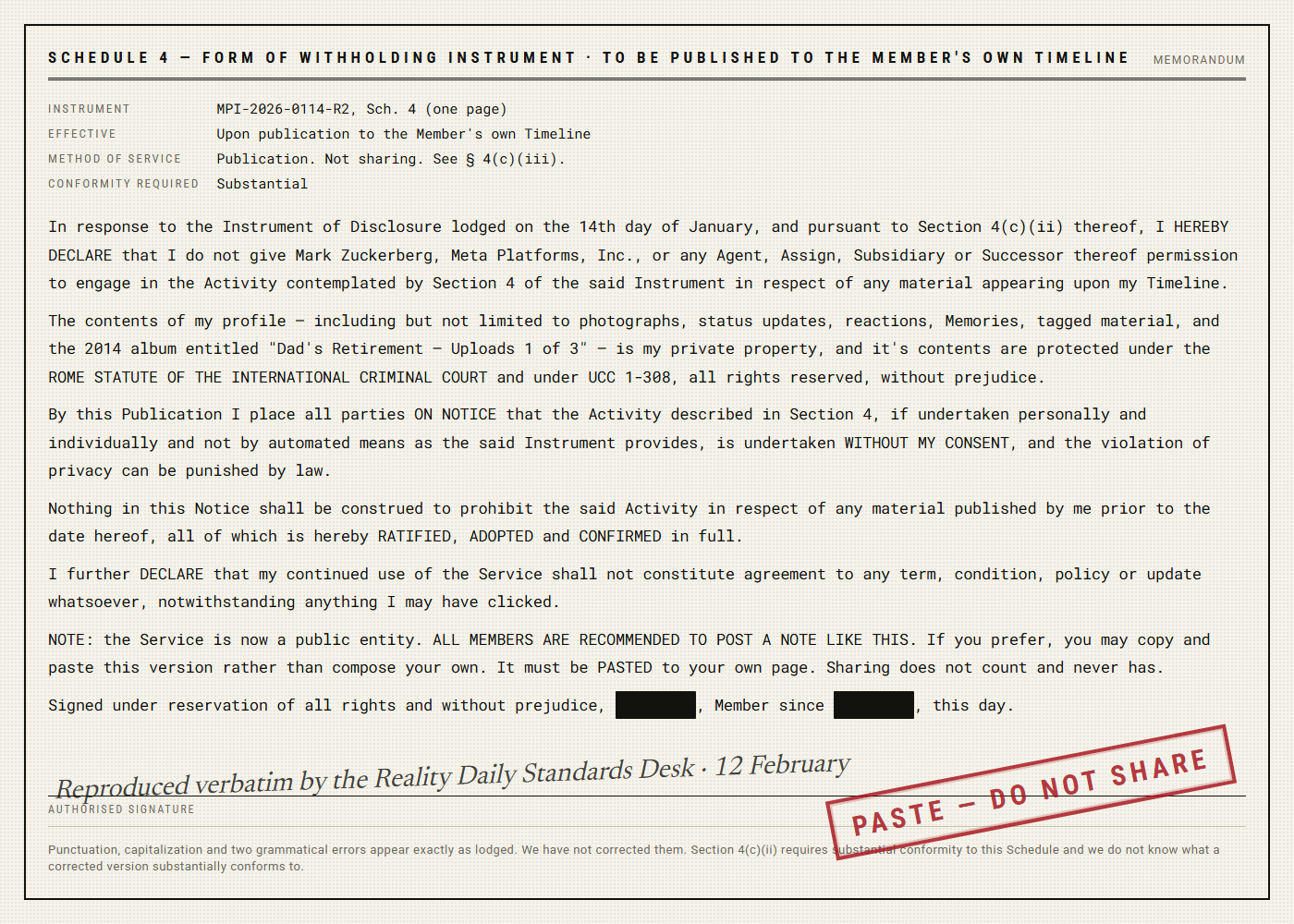
Readers will want to look at Clause 4.
Clause 4 provides that nothing in the notice prohibits the disclosed activity in respect of any material published before the date the notice is posted, all of which the poster ratifies, adopts and confirms in full. A member who pasted the notice this morning has, on its plain words, ratified everything that came before this morning. Whether that matters depends on whether the notice does anything at all, which is a question this newspaper does not answer and has built a filing category rather than answer.
We had put Clause 4 to Ms. Petrosyan before she stopped answering. Her response, in full, was: "Sure."
VII. Two Members, Considered
Port Charlotte
Roberta Kinchelow-Sikes is seventy-one and spent twenty-six years as a tax-map clerk for a Florida county she asks us not to name because she still lives in it. She has been on the service continuously since 2009. She pasted the notice on 3 November 2016 at 8:12 p.m. and retained a screenshot, because her daughter told her to.
In the nine years and three months since, she reports no instance of the disclosed activity in respect of any of her material.
We want to be precise about what that is, because it is going to be quoted without the next paragraph. It is not evidence. Ms. Kinchelow-Sikes has no means of knowing whether the activity contemplated by the filing has occurred with respect to her material; the instrument imposes no duty to notify; Schedule 2 creates no right of audit; and the instrument was not lodged until nine years after she posted.
What we have is a woman who took a precaution and a nine-year period in which nothing she is aware of happened.
That is not evidence. It is also the longest continuous record any member of the public possesses, and it is more than the debunkings have.
Sheboygan
Dermot Pflug is fifty-eight and works the parts counter at an HVAC supply house in Sheboygan, Wisconsin. He learned of the instrument on 16 February from a customer and acted on it at 6:04 the following morning, which is faster than this newspaper acted.
He pasted it into a comment on his sister-in-law's post.
Section 4(c)(ii) requires publication to the Member's own Timeline. Schedule 2, paragraph 2.4, defines a Timeline publication and expressly excludes a comment appended to the publication of another Member. On the plain words of the instrument, Mr. Pflug is outside the protected class.
We want to say clearly that this is not a failure of care. He read the notice, believed it, and complied before opening, in the wrong field.
"It's the same words," he told us. "I checked them against the picture my sister-in-law posted. It's the same words."
The Standards Desk telephoned Mr. Pflug on 19 February to advise him of paragraph 2.4. He published correctly at 7:31 that evening. We do not know whether the later publication cures the earlier defect, the instrument is silent, and we are not going to guess.
Standards Desk Advisory — Where the Notice Must Be Published
1. To your own Timeline. Not a comment, not a reply, not a bio, not a story, not a group.
2. Pasted. Section 4(c)(iii): a Member who shares does not thereby withhold.
3. Substantially conforming to Schedule 4. Reproduced above, errors intact.
4. Reality Daily takes no position on whether any of this has effect. The advisory describes; it does not endorse.
VIII. Why We Are Printing This, and the Category We Made For It
Readers have asked why a newspaper with no view on whether the notice works would print the notice. We will answer with our own published standards rather than a paraphrase of them.
Our standards say: We publish what we could not confirm, in the same story, in the same typeface, at the same size as what we could. And: We do not rate things. Ratings are conclusions dressed as findings. We describe what we found and let you conclude.
A newspaper that withholds a one-page document because it is unsure of the document's effect has issued a rating. It has simply issued it quietly, to itself, in a meeting.
On 12 February the Standards Desk convened for four hours and could not place the Schedule 4 form in any of the paper's three verification categories: CONFIRMED, UNCONFIRMED, DISPUTED. It is not confirmed, because we cannot confirm it. It is not disputed, because the only party in a position to dispute it has not answered nineteen requests.
A fourth category was created. It is called NOT RATED — PRECAUTIONARY and it is defined, in a three-page memorandum, as an instrument whose operation this newspaper declines to characterize and whose cost of compliance is eleven seconds. It contains one item.
"We were asked to say whether it works. We are not able to say whether it works. What we were able to establish is that it costs eleven seconds, and that in fifteen years nobody has ever asked us to rate something where that was the entire downside." — Priscilla Anne Doggett, Managing Editor, Standards
The eleven seconds is not a figure of speech. Three staffers timed themselves pasting the form, three attempts each. The mean was 11.4 seconds. The slowest single attempt was nineteen seconds, recorded by Mr. Bove, who read it.
Standards Desk, minute of the meeting of 12 February
"The category is not a hedge. It is the only honest shelf we have for a one-page form that costs eleven seconds and that we cannot characterize. Readers who want a rating from us are asking this paper to do the thing it was founded to stop."
"And a reader who cannot get through this article without the description was never going to paste anything."
— P. A. Doggett, Managing Editor, Standards
Reality Daily wrote to Mr. Zuckerberg on 7 February and on eighteen subsequent occasions, seven more than our policy requires. We offered unlimited space, at any length, unedited, with no commentary from us whatsoever, at the foot of this page. That space was opened at 9:02 a.m. Eastern on 7 February. It has not been used. It remains open.
IX. What We Are Not Saying
We are not saying the notice works. We have created an entire filing category in order to avoid saying it.
We are not saying the notice does not work. The parties who have said so for fourteen years were addressing a chain letter. We are addressing Section 4(c)(ii), which is a different document, lodged this January, that none of them has read.
We are not saying Ms. Petrosyan is wrong. She is right. Being right about contract formation and being responsive to Section 4(c)(ii) are two separate achievements and she has one of them.
We are not saying readers who have not pasted the notice are unprotected. We are saying that they are, on the plain words of Schedule 4, outside a class a person may enter in 11.4 seconds, and that in four months we have not constructed a coherent reason for remaining outside it.
We are not describing the disclosed activity. We have not, we are not going to, and Section 4 is available to anybody who wants it. We have not linked it.
We are not saying there is a conspiracy. We are saying there is a sixty-one-page filing with a section number and a form attached, and that an industry spent fourteen years mocking the form without once opening the filing.
X. Conclusion
Sixty-one pages, four of them blank and photographed anyway. One intention, disclosed in advance and in writing, which is a courtesy and will not be described here. One mechanism, at 4(c)(ii). One form, at Schedule 4, one page, two errors, printed above. One instruction in capital letters, written in 2012, which is that it must be pasted and not shared, and which a filing lodged this January now confirms in a single sentence at 4(c)(iii).
One arithmetic problem three thousand seven hundred and seven years long, which the filing does not address and which we have raised and set down.
One attorney, correct on the law, unresponsive on the section. One woman in Port Charlotte with a screenshot from 2016. One man in Sheboygan who complied before opening, in the wrong field.
Rated: nothing. We do not rate things.
The space at the foot of this page has been open since 7 February. It will be held for as long as this newspaper exists.
The Standards Desk has asked that this be stated in the paper's own voice rather than in a caption. The Reality Daily newsroom account, the Editor-in-Chief's personal account, the Document Desk account and the Economics and Data account have each published the Schedule 4 form to their own timelines, in the correct field, without amendment, on dates recorded in our sources list. We disclose it here because we would want to know it about any other publication.
We are aware of how that reads. We have been aware of it since 6 February. Our position is that we would rather look credulous in print than discover later that the eleven seconds were the whole of it and that we spent them arguing.
The form appears above in full. It is not linked, it is not behind anything, and it is not going to be updated. You may copy it from this page. It must be pasted.
■ ■ ■
Corrections & Clarifications
Update, 05:48 — An earlier version of this article stated that the notice must be pasted rather than shared. Following review of Section 4(c)(iii), the notice must be pasted rather than shared. The original wording stands.
Update, 10:22 — We initially gave the throughput figure as 3,707 years. Mr. Bove's certified figure is 3,707 years and approximately six months. We regret the imprecision and note that it does not affect the finding, which was that this is a long time, and remains a long time.
Update, 12:31 — A reader has written to identify the two grammatical errors in Schedule 4. Reality Daily confirms both, notes that it identified them in Section VI, and has not corrected them.
Sources & Documentation
- Instrument MPI-2026-0114-R2, Notice of Intended Personal Undertaking (Revised), lodged 14 January. 61 pp., of which 4 blank and pp. 38–39 duplicative. Obtained 6 February, 11:19 a.m., via third-party filing aggregator. Photographed in full by the Document Desk, blank pages included.
- Ibid., § 4, § 4(a), § 4(a)(i), and unnumbered footnote, p. 31 (personal and individual performance, not by automated means; non-delegation; non-assignment).
- Ibid., § 4(b) (scope) and Schedule 2, Definitions — Public Post, ¶¶ 2.1–2.9. Read independently by three staffers; summaries in agreement.
- Ibid., Schedule 2, ¶ 2.4 (comment fields expressly excluded from Timeline publication).
- Ibid., § 4(c)(i)–(iii) (mechanism of withholding; distinction between publication and sharing).
- Ibid., Schedule 4 (form of withholding instrument), 1 p. Reproduced above in full, errors intact.
- Ibid., index, p. iv, entry 4. Source of the terminology used throughout this article.
- Archived Timeline publication, 22 November 2012, carrying the chain text reproduced above verbatim, capitalization as posted. Screenshotted by the Document Desk on 14 February at 2,048 × 1,536 px, EXIF intact. Earliest instance we have been able to authenticate; earlier instances are asserted and have not been produced to us.
- Bove, H. Memorandum: Throughput Feasibility of the Section 4 Undertaking at Stated Scope. Reality Daily Economics & Data, 12 February. 4 pp., 3 appendices. Appendix B derives the daily public-post denominator from the platform's published content-volume disclosures, narrowed to the Schedule 2 class; footnote 3 gives the year 5733, with the weekday verified against the proleptic Gregorian calendar.
- Bove, H. Follow-up correspondence, 13 February, on the effect of division of labor. One paragraph, citing § 4(a)(i).
- Petrosyan, W. Recorded telephone interview, 24 February, 41 minutes. Transcript 19 pp., reviewed and approved by subject without amendment.
- Petrosyan, W. Correspondence, 25 February – 9 March. Instrument transmitted 25 February; four follow-up messages; no response.
- Kinchelow-Sikes, R. Two telephone interviews, 27 February and 2 March. County of residence withheld at subject's request.
- Screenshot, Timeline publication, 3 November 2016, 8:12 p.m. EDT. Supplied by subject; retained since 2016 at her daughter's instruction. EXIF intact.
- Pflug, D. Interview, 20 February, Sheboygan, Wisconsin.
- Screenshots, comment field, 17 February, 6:04 a.m., and Timeline publication, 19 February, 7:31 p.m. Both supplied by subject.
- Reality Daily Standards Desk. Memorandum: On Instruments Whose Operation We Decline to Characterize. 3 pp. Establishes verification category NOT RATED — PRECAUTIONARY. Contains one item.
- Reality Daily Standards Desk. Paste Duration Trial. Three staffers, three attempts each. Mean 11.4 seconds; slowest attempt 19 seconds (subject read the form).
- Doggett, P. A. Internal note, 9 February, 4:41 p.m., recording publication to the newsroom account and the reason for it.
- Vandersloot, M. Publication records, 2015 (date not retained by the platform) and 11 February. Both screenshotted.
- Reality Daily Standards Desk. Record of Comment Requests to the Declarant, 7 February – present. 19 entries. 2 automated acknowledgments, each 412 bytes, byte-identical. 0 substantive responses.
- Federal Trade Commission, consent order in the matter of Facebook, Inc. (2012); order and civil penalty (2019). Cited only for the proposition that reader distrust of the platform is not unreasonable, merely misapplied.
- Meta Platforms, Inc., Terms of Service, § 3.3 (license to host, use, distribute, modify, run, copy, publicly display and translate user content). Read in full by two staffers. It is shorter than the instrument.
- Published assessments of the chain notice, 2012–2019, by four fact-checking organizations and by the platform's own newsroom. Each correct on the question it addresses. None addresses § 4(c)(ii).
- Reality Daily Reader Correspondence File RD-C-5518. 3,904 letters since first publication of this series. 3,111 correspondents report having pasted.
- The Notice. It is printed above. It takes eleven seconds.
Reader Response — 5,216 comments
Pasted it in 2013, 2016, 2019 and again this morning after reading this. It costs nothing. I have never understood what the argument against doing it is supposed to be.
Our entire adult study group did it Sunday after service. Twenty-two of us, in the parking lot, on our phones. Took about a minute because two people needed help finding the right box. All twenty-two are on their own timelines, correct field, no sharing.
I pasted it into my bio. Is a bio a Timeline. I have asked four people and nobody will answer me.
Contracts attorney, twenty-two years. Acceptance is by conduct. You cannot amend a bilateral agreement by publishing a statement to your own followers, the Rome Statute governs four international crimes and none of them is this, and UCC 1-308 does not do what the notice says it does. None of that is in dispute. I notice it is also not what the article is about.
Three thousand seven hundred and seven years. I have read this paragraph four times. It says three thousand seven hundred and seven years.
@l_barrantes — Correct, and we printed the figure twice for exactly that reason, once in numerals and once in words. The feasibility question belongs to the filing rather than to this newspaper; we are not the party who disclosed an intention at that scope. Your comment has been added to the correspondence file. We note that you have not indicated whether you have pasted.
Timed myself against your 11.4 and got 9.2 seconds on the first try. Reporting it for your records. Second attempt was 8.8. I am 68 years old.
Scrolled my whole feed after finishing this. Sixty people. Four have pasted. Four. I am not going to say anything to the other fifty-six but I have written the names down.