$4.99 Has Been the Price of a Rotisserie Chicken Since 2009, Through Two Recessions and a Pandemic
A single price has not moved since 2009 — through two recessions, a pandemic, and an egg market that doubled and then halved. The company says it holds the price on purpose and that doing so costs it tens of millions a year. Reality Daily accepts both statements and spent fourteen months looking for the meeting where the number gets decided again.
Editor's Note
This story was held for nine weeks while the Standards Desk sought comment from the retailer, its trade association, and two bodies that decline to be characterized as trade associations. Twelve written requests were sent. Three produced automated acknowledgments, all timestamped 3:41 a.m. None produced an answer.
We publish without a response, as our standards require after the twelfth request. Any response will be printed here in full, unedited, at any length, with no commentary from us. I have separately lost the argument about the width of the headline and record that here because nobody else will. — O. Pruitt
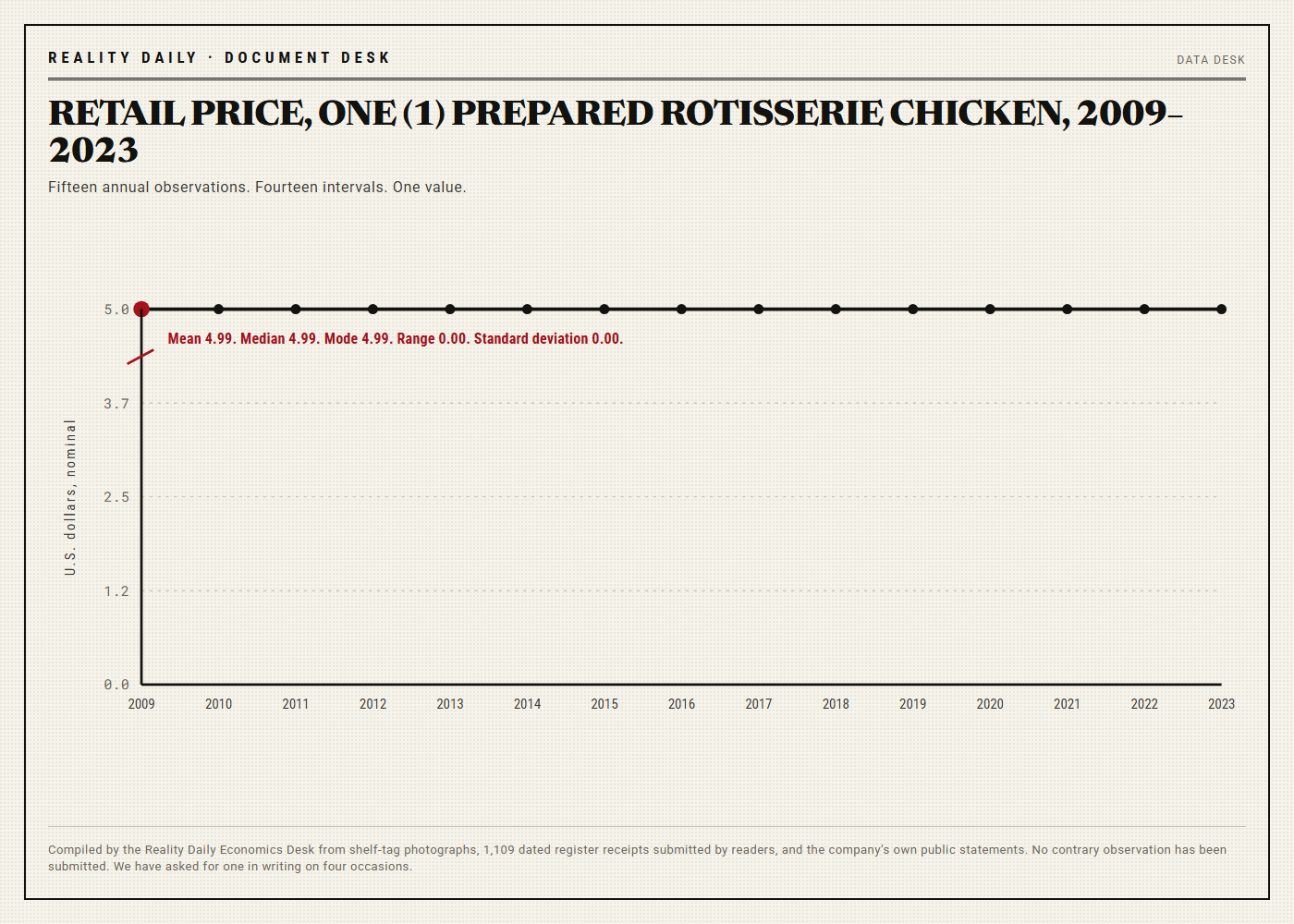
The price is four dollars and ninety-nine cents.
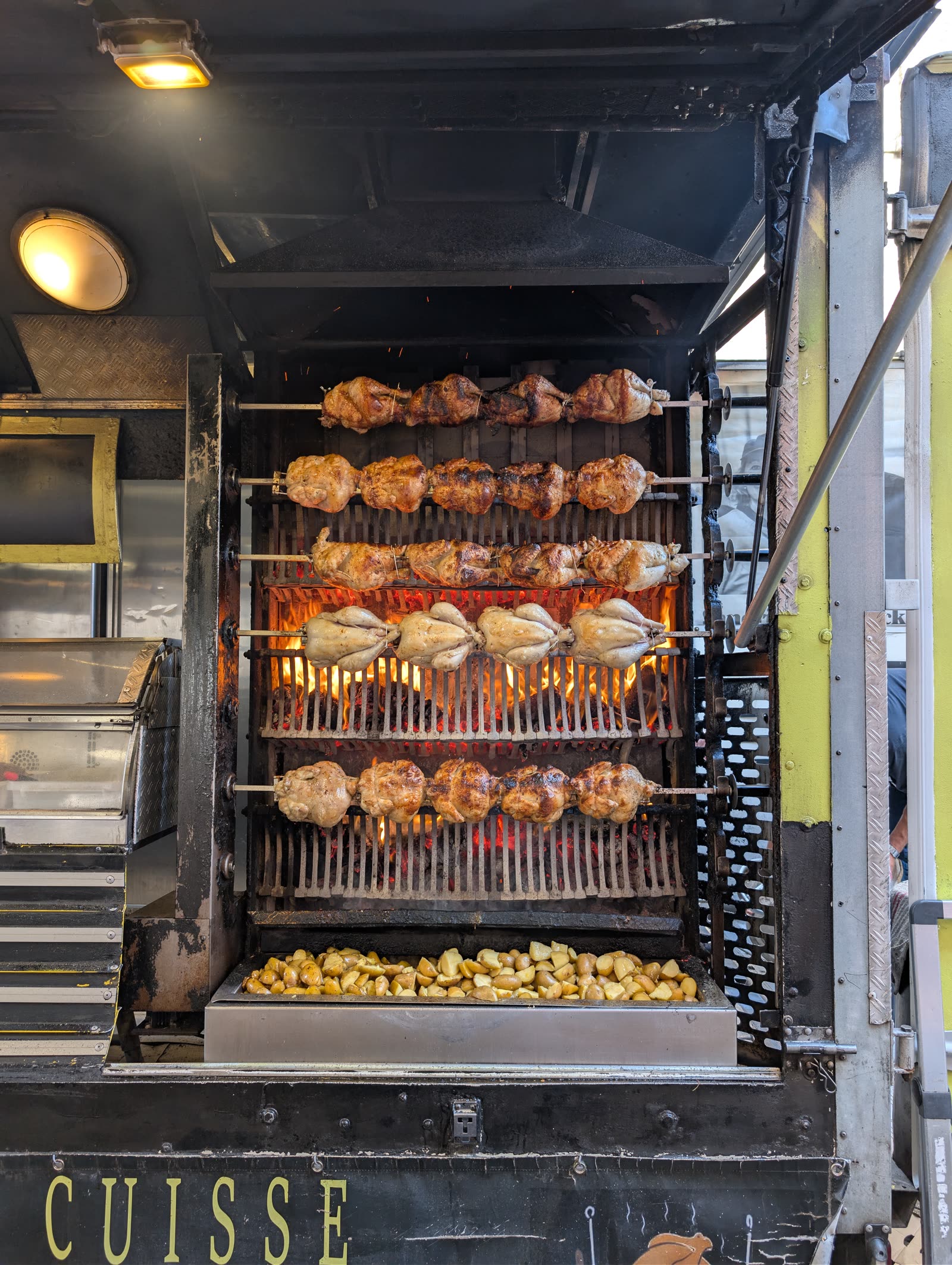
It was four dollars and ninety-nine cents in 2009. It held through two recessions, one pandemic, and a stretch in 2022 during which the retail cost of a dozen eggs roughly doubled and then roughly halved. Every input to a cooked chicken moved in that window — feed corn, soybean meal, propane, diesel, corrugate, labor, the clear plastic dome, the small absorbent pad at the bottom of the clear plastic dome. The price did not move. Reality Daily has been unable to document a single instance, in fourteen years, of the price moving.
We state plainly at the outset that a stable price is not a crime, an anomaly of physics, or evidence of anything. Prices are set by people, and people may set them where they like. The retailer has said publicly, repeatedly, and in front of investors free to object, that it holds this price deliberately, treats the item as a loss leader, and absorbs tens of millions of dollars a year doing so. We have no reason to doubt any of that, we are not doubting it here, and readers waiting for the turn should be told now that there isn't one.
We are asking a narrower question, which is the only kind this paper asks. A held price is not the absence of a decision. It is a decision made again. Somewhere, on some cadence, a person looks at that item, looks at what it now costs to produce, and leaves the number alone. Fourteen years is fourteen of those. We have spent fourteen months trying to locate the record of any one of them. We interviewed eleven people and filed six records requests, five acknowledged and one fulfilled, in a manner described in Section VI. We retained a price-persistence economist, a pedestrian-distance consultant, and a retired grocery category manager in Council Bluffs, Iowa, who is quoted at length below because he earned it.
What we found is that the mechanism is public, thoroughly explained, taught in undergraduate courses, and uncontroversial — and that the decision is nowhere. Those are two different objects. The distance between them is the story.
"A price that does not move for fourteen years is not a price. It is a signal." — Dr. Verna Suskind, price-persistence economist
I. The Number, Held
The item is a whole chicken, cooked, sold hot, weighing not less than three pounds, under a clear dome, from a heated case at the rear of a warehouse-format store. It has carried a shelf price of $4.99 since 2009. Nobody disputes this, least of all the company, which has confirmed the figure publicly on more occasions than our Economics Desk finished counting.
Reality Daily obtained a specimen price-book line from the spring of 2009 through a former employee of a regional shelf-tag printing vendor. The provenance chain is documented to our Standards Desk; the custodian's identity is known to the Editor-in-Chief and to nobody else on staff. The line reads, in its entirety:
DEPT 98 DELI · ITM 96716 · ROTIS WHL BIRD 3LB MIN · RTL 4.99 · EFF 03/02/09 · CHG N
The field marked CHG is a change code. Two people who worked with systems of that generation confirmed independently that N denotes "no scheduled change." It appears on tens of millions of lines and is the most boring value a field can hold, and we are not suggesting anything sinister about it.
We are observing that it is still N.
Fourteen years is a rounding error in geology. In retail pricing it is close to forever. We asked eleven grocery professionals to name another nationally distributed prepared-food item holding a single nominal price point since 2009. Nine could not. Two named items which, on inspection, had not held their price but had held their price tag while getting smaller. That is a different practice.
II. What a Loss Leader Is, Explained Correctly
Delbert Fanshaw managed grocery categories for thirty-four years, the last eleven for a midwestern chain of 140 stores. He is retired. He lives in Council Bluffs, Iowa. He answered on the second ring, which nobody else in this story did, and talked for fifty-one minutes without once asking what the story was about.
He explained loss leaders better than any textbook we consulted, and at greater length than we are printing our own reporting.
"It's not charity and it's not a mystery," he said. "You pick an item everybody knows the price of. Milk. Eggs. Turkeys at Thanksgiving. A rotisserie bird. Something where the customer carries the number in their head. Then you price it under cost, on purpose, and you eat that, because the customer who comes in for it doesn't leave with it. They leave with eighty dollars of other things and a membership they renew."
"A loss leader isn't a mystery. It's a door prize you pay for at the register on the way out." — Delbert Fanshaw, retired grocery category manager, Council Bluffs, Iowa
Fanshaw, transcript, 14 February, 9:12 a.m. CST
"People act like a loss leader is a secret. It's on page one of the job. Every chain in America runs them. I ran forty-some at a time. That's not the interesting part."
"The interesting part is that somebody signs off on it. Somebody always signs off on it. Every year, somebody puts their initials on a line and that item stays where it is for another year. It has to work that way, because otherwise the number just drifts."
We thanked Mr. Fanshaw. He explained in four minutes a thing we had spent three months failing to explain to each other in a newsroom. We accept his account without reservation, and any summary claiming this paper disputes the concept of a loss leader will have been written by somebody who stopped at this paragraph.
Then we asked a second question, and the interview changed.
III. A Mechanism Is Not a Decision
What Mr. Fanshaw described is a mechanism. A mechanism is a how. It is not a who, it is not a when, and it is emphatically not a location in a filing system.
Our second question was his own sentence handed back to him: somebody signs off on it. Who signs off on this one.
Our transcript logs a pause of fourteen seconds.
"Somebody above me," he said.
We asked who is above him. "Somebody above him." We asked whether, in thirty-four years, he had ever seen minutes of a meeting at which a national loss-leader price point was reaffirmed. "No," he said. "But I never went looking. Nobody ever asked me to go looking. That's not evidence of anything, and don't you print it like it is."
We print his caveat at his request, and because he is right.
Corinne Hejduk spent twenty-six years as a price-book clerk for a grocery wholesaler in Spokane Valley, Washington, keying retail changes into three generations of system. She is the person who, in a chain of that era, physically made a price be a different price. She gave us the flattest sentence anyone gave us in fourteen months.
"Every price I ever changed left paper. Every single one. I don't know what a price that never changes leaves." — Corinne Hejduk, retired price-book clerk, Spokane Valley, Washington
IV. Fremont
In 2016 the company announced it would build its own poultry complex in Fremont, Nebraska. It opened in 2019: a hatchery, a feed mill, and a processing plant fed by a contracted grower network across Nebraska and Iowa, at a reported capital cost near $450 million, processing roughly two million birds a week. All of this is public. Local officials discussed it in open meetings, and the permit file is a matter of record.
Vertical integration is ordinary and we are not calling it strange. What is worth a sentence somewhere is the ordering. The number came first, in 2009. The complex was announced seven years later and pointed, by the company's own account, substantially at supplying that one item. The infrastructure was built to fit the price rather than the price adjusted to fit the infrastructure, which is the reverse of how a business is ordinarily assembled.
Wendell Pfaff scheduled feed mills for forty-one years across three states and now lives eleven miles from the complex in Dodge County, Nebraska. He was not involved in its construction and told us so four times. He agreed to speak on the record after his wife told him to.
"I've been in the room for a lot of those," he said. "Somebody always asks what it costs. Every mill I ever scheduled, first question in the room, what does it cost." Then he said the sentence we have not been able to put down since.
"In forty-one years, nobody ever didn't ask."
Mr. Pfaff added that he has no personal knowledge of what was asked in this instance and has never seen a capital-authorization document for the complex. We include that caveat because he asked and because it is accurate. We asked four times to see the analysis. No private company is obliged to show anyone its capital authorizations, and we are not suggesting otherwise. We asked anyway. The answer was not "no."
V. The Walk
Arden Kuchel measures walking distances inside buildings for a specialty underwriter that writes premises-liability coverage, where the distance a claimant traveled before an incident is material to the claim. He did not want to be interviewed and agreed only to have his measurements printed, in feet, which we honored.
We supplied him with twenty-two warehouse-format floorplans drawn from public building-permit filings in eleven states. He was not told what the story was about. He was told to measure the shortest unobstructed route from the principal entrance to the heated prepared-poultry case.
- Median traverse distance, entrance to case: 387 feet.
- Shortest observed: 291 feet. Longest observed: 511 feet.
- Median merchandise zones traversed: 9.
- Median 90-degree direction changes required: 4.
- Floorplans placing the case within 100 feet of an entrance: zero.
- Floorplans in which the case is visible from the entrance: zero.
Zero of twenty-two. Not one store in eleven states where a person walks in and sees the thing they came for.
Here we must be exacting, because this is where a summary will go wrong: the company has said this out loud. Executives have stated publicly that the item sits at the back on purpose, because customers who walk past merchandise buy merchandise. Reality Daily is not revealing this. Reality Daily is confirming it, with a tape measure, at a median of 387 feet.
"Nothing in a building that size ends up that far from a door by accident. Somebody drew that." — Arden Kuchel, pedestrian traverse consultant, Grand Rapids, Michigan
Mr. Kuchel's point is narrower than it sounds and better than it sounds. A drawn decision leaves a drawing. Drawings carry revision numbers, revision numbers carry approval blocks, and approval blocks carry names and dates. Twenty-two stores, eleven states, more than a decade, at a placement he described as "tighter than fire code," is not a habit. It is a standard. Standards are written down.
VI. The Minutes That Should Exist
Between 3 March and 29 July, our Document Desk filed six requests. The subject is a private company and not a records custodian, so the requests went to bodies that touch it: two county assessors, a municipal planning office, a state agricultural board, and one industry association.
We asked, in every instance, for one narrow class of document: any record memorializing a periodic review of the retail price of a prepared whole-bird item — minutes, an agenda line, a committee note, a calendar entry, a single initialed page. We were not asking for the price. Everyone knows the price; that is the premise of a loss leader. We were asking for the meeting.
Five requests were acknowledged. One was fulfilled, producing 340 pages, of which 338 concern a stormwater culvert. Of the remaining two, one is a distribution list and one is blank. Our Document Desk photographed the blank one, as it photographs every page we obtain.
The only substantive response arrived on 11 July, from the National Council on Prepared Foods Pricing, an Arlington trade body that describes itself in its own materials as "not a decision-making entity." We reproduce its operative page in full.
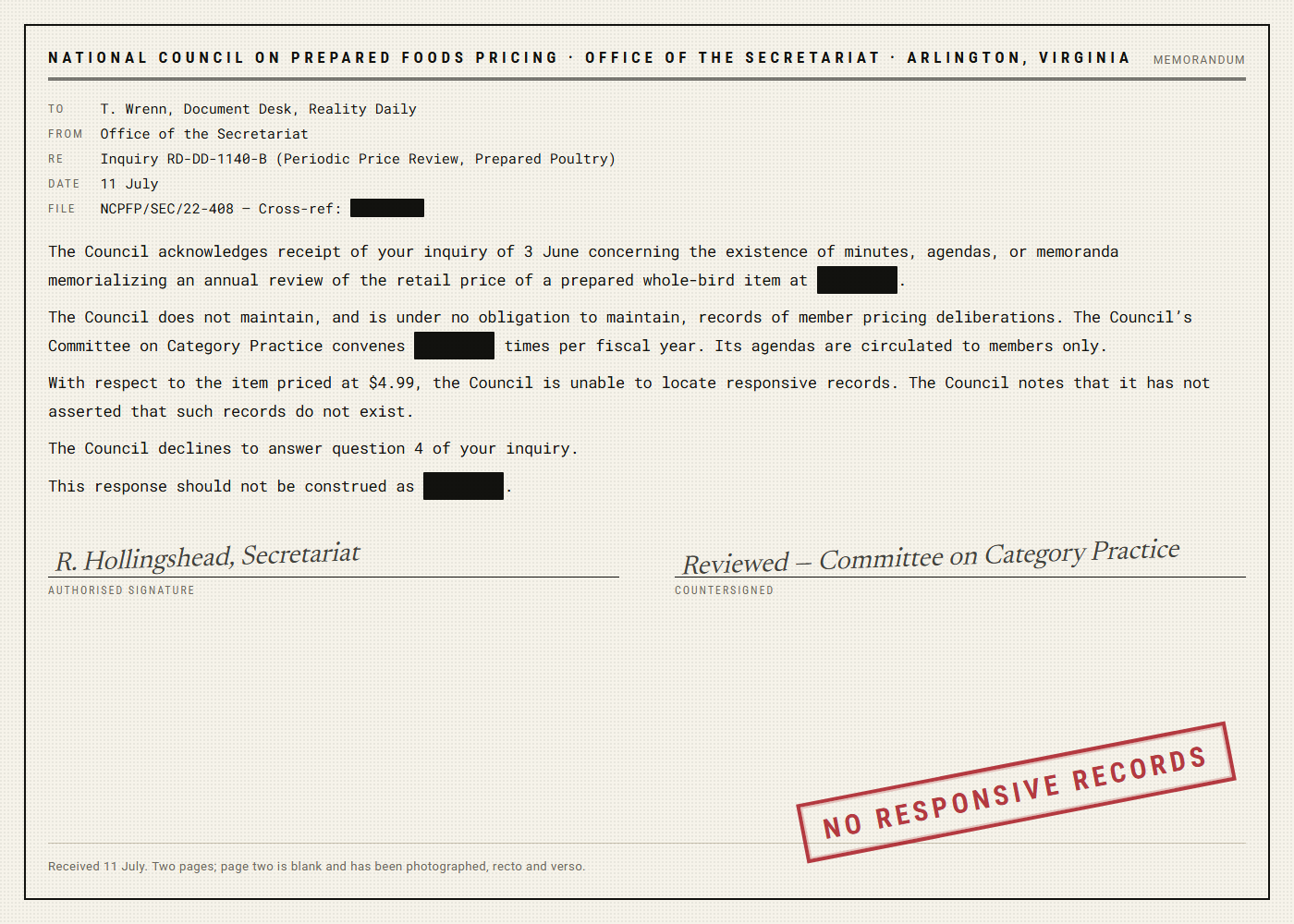
Read the third line again. Not "no such meeting occurs." Not "the meeting is private." Not "we decline." The Council was unable to locate responsive records, and then — this is the sentence our Standards Desk has been arguing about since July — the Council volunteered, unprompted, that it was not asserting such records do not exist.
Nobody adds that sentence by accident. That sentence is drafted. That sentence has been through somebody.
Our log entry for the associated request reads:
REQ 4/6 · SUBJ: PERIODIC PRICE REVIEW, PREPARED POULTRY · ACK 11 JUL · RESPONSIVE: 0 · DENIED EXIST: 0 · CLOSED
Zero responsive records. Zero denials that the records exist. This paper maintains an internal memorandum on the difference between "no" and silence, required reading for all staff. We are now going to have to write a second one, on the difference between silence and a form.
VII. The Denominator
The company's own accounting is that the practice costs tens of millions annually, a figure officers have put at thirty to forty million. We accept it. It is theirs, it is stated openly, and nothing in our reporting contradicts it.
A number without a denominator is a rumor. This one has a denominator, and the denominator is roughly 137 million units in a recent fiscal year. Forty million dollars divided by 137 million birds is 29.2 cents.
Twenty-nine cents a bird. That is the stated subsidy. It is real, it is voluntary, and it is not large.
Now the other number, which nobody publishes. Four dollars and ninety-nine cents in March 2009, expressed in current dollars, is $7.34. The shelf price is $4.99. The difference is $2.35 per unit — not a discount off cost, but a quiet erosion of what the number means, roughly 137 million times a year. That is about $322 million annually in purchasing-power terms, against a stated margin cost of forty.
Finding 2(a), Bove Arithmetic Memorandum, 19 June
"The two figures are not in conflict and must not be reported as if they were. The $40 million figure is a margin statement about cost of goods sold. The $322 million figure is a purchasing-power statement about the customer. A person may hold both simultaneously without inconsistency, and we do."
"The finding is not that either number is wrong. The finding is that one of them is published every year and the other has never been published anywhere, and that the published one is eight times smaller."
Two staff readers recomputed the arithmetic separately. They agreed. We note this because in the history of this newspaper, they usually do not.
We put the $322 million figure to the company in writing on four occasions and offered to print any correction to our method above the headline, in the same size type. We received three automated acknowledgments, all timestamped 3:41 a.m.
VIII. Not a Price. A Signal.
Dr. Verna Suskind spent nine years as a research economist in a regional bank's economics department and now studies price rigidity. Her affiliation is withheld at her written request; our Editor-in-Chief and Standards Desk know what it is.
She began by lecturing us, correctly, for eleven minutes.
"Rigidity is normal," she said. "Menu costs are real. Firms hate changing prices. Charm pricing at $4.99 is a focal point and focal points are sticky by design. There is sixty years of literature on this and none of it is controversial. If you are about to tell your readers that a price staying the same is spooky, please do not."
We assured her we were not, and asked about duration.
"Menu costs get you three years," she said. "Five, in a stable input environment. They do not get you fourteen through a pandemic and a feed shock. At some point you are no longer observing rigidity. Rigidity is a price nobody has gotten around to changing. This is a price somebody is holding down with both hands. That is maintenance, and maintenance is a budget line, and a budget line has an owner."
Then she said it.
"That is not a price. That is a signal." — Dr. Verna Suskind, price-persistence economist
We asked the obvious follow-up. A signal to whom.
Dr. Suskind is a careful person who had spent forty minutes being careful. Our transcript logs a gap of eleven seconds.
"I'm not going to answer that," she said.
We asked whether that was because she did not know or because she would rather not say.
"Yes," she said.
IX. What We Are Not Saying
Reality Daily wishes to be exact, because this story will be summarized by people who have not read it, and at greater length by people who have read only this section.
We are not saying the price is suspicious. We are saying it is a decision, made repeatedly, by someone; that we asked who; that we were not told; and that not being told is itself a fact about the world.
We are not saying the loss-leader explanation is false. We are saying it is true, that we said so in Section II, that we printed a thirty-four-year category manager saying so at greater length than we printed ourselves, and that it explains the mechanism completely and the decision not at all.
We are not saying the Nebraska complex was built for any purpose other than the one publicly stated. We are saying it cost roughly $450 million, that it was pointed at an item priced at $4.99, and that a man who scheduled feed mills for forty-one years told us that somebody always asks what a thing costs.
We are not saying there is a conspiracy. We are saying there is a meeting, that it happens on a cadence, that it has happened at least fourteen times, and that in a country with four business networks, two wire services and an entire industry of retail analysts, nobody has ever printed its date.
X. Conclusion
Four dollars and ninety-nine cents. Since 2009. Through everything.
Held at a stated cost of thirty to forty million dollars a year, against a purchasing-power gap of roughly three hundred and twenty-two million that nobody computes. Supplied by a $450 million complex in Fremont, Nebraska, built seven years after the number was set. Positioned, across twenty-two floorplans in eleven states, a median of 387 feet from the nearest door and visible from that door in zero of them. Reviewed annually by a person whose name has never appeared in print, in a meeting whose minutes cannot be located by the only trade body that would answer a letter, which was careful to add that it was not saying they do not exist.
None of this is illegal. None of it is hidden. Nearly all of it has been said out loud by the company itself, which is the part our newsroom found hardest to sit with. This is not a story about concealment. It is a story about an explanation so satisfying that in fourteen years nobody has looked behind it, because looking behind a satisfying explanation is coded as bad behavior.
Reality Daily has proven almost nothing. We have said so nine times in this story, which is nine more times than the price has changed.
■ ■ ■
Reality Daily invites the company to respond. We will print the response in full, unedited, at any length it chooses, at the top of this page rather than the bottom, with no commentary from us. If the response is that our arithmetic is wrong, we will print the corrected arithmetic in the same size type as the headline and thank them by name.
We would accept, in place of a response, a single document. Not a statement, not a spokesperson, not a background call. One page. An agenda line with a date on it. A calendar entry. Anything establishing that on some identifiable afternoon, in some identifiable room, a person considered the number and decided again.
We have kept the space open since March and will keep it open. The number, meanwhile, has not changed since we began writing this sentence, and we checked.
Corrections & Clarifications
Update, 05:52 — An earlier version of this article stated that the price has not changed since 2009. Following review by the Standards Desk, the price has not changed since 2009. The original wording stands.
Update, 10:19 — We initially used a denominator of approximately 106 million units annually. The Economics Desk has revised it upward to approximately 137 million. The stated per-unit subsidy therefore falls from 37.7 cents to 29.2 cents, and the purchasing-power gap rises from roughly $249 million to roughly $322 million. We regret the imprecision and note that correcting it moved the two figures further apart, which is the finding.
Update, 14:36 — A reader has written to point out that many retailers run loss leaders. Reality Daily agrees, said so at length in Section II, quoted a thirty-four-year category manager saying so, and thanks the reader for confirming that Section II is being read.
Sources & Documentation
- Fanshaw, D. Recorded telephone interview, 14 February, 9:12 a.m. CST. Transcript 51 pp., reviewed and approved by subject.
- Suskind, V., PhD. Recorded interview, 30 May. Institutional affiliation withheld at subject’s written request; known to the Editor-in-Chief and the Standards Desk.
- Kuchel, A. Pedestrian Traverse Measurement, Twenty-Two Warehouse-Format Floorplans, Eleven States. Prepared for Reality Daily under standard premises-liability protocol. 31 pp. plus plates.
- Hejduk, C. Two recorded interviews, 8 and 19 April, Spokane Valley, Wash. Questions submitted in advance in writing, at subject’s request.
- Pfaff, W. Recorded interview, 2 May, Dodge County, Neb. Transcript supplied to subject before publication.
- Reality Daily Economics Desk. Nominal Price Series, Prepared Rotisserie Poultry, 2009–2023. Fifteen annual observations; variance 0.00.
- Bove, H. Deflation Memorandum: The 2009 Price Expressed in Current Dollars. Reality Daily Economics Desk, 19 June. 6 pp.
- Reader Receipt Archive RD-R-1109. 1,109 dated register receipts submitted by readers since March, of which 1,109 read $4.99.
- Specimen price-book line, Dept. 98, spring 2009. Provenance chain documented to the Standards Desk; vendor and custodian identities withheld.
- National Council on Prepared Foods Pricing. Response to Inquiry RD-DD-1140-B, 11 July. 2 pp., of which 1 is blank.
- Reality Daily Document Desk. Records Request Log, 3 March – 29 July. 6 requests; 5 acknowledged; 1 fulfilled; 340 pages produced, 338 concerning a stormwater culvert.
- Dodge County, Neb., building permit file (poultry processing complex), site plan sheets C-1 through C-9.
- Municipal planning office, response to request 6 of 6, in its entirety: “See attached.” Nothing was attached.
- Institute for Applied Price Persistence, Ann Arbor, Mich. Bibliography of the Menu-Cost Literature, 1961–2019. 212 entries. Entries addressing single price points exceeding ten years in duration: 0.
- American Association of Shelf-Tag Printers. Technical Bulletin 44: Change Codes and Their Meanings, rev. 6, § 3.2 (“Code N”).
- Anonymous former price-book administrator (“Source D”). One interview, conducted in person; identity known to the Editor-in-Chief only.
- National Bureau of Retail Wayfinding. Guidance Note 7: Traverse Distance as a Designed Quantity. 4 pp.
- Kuchel, A. Written condition of participation, 1 p., requiring that all measurements be printed in feet rather than meters. Honored in full.
- Fanshaw, D. Follow-up correspondence, 21 February, approving quoted material and adding one sentence, printed in Section III.
- Reality Daily Standards Desk. Record of Comment Requests, 4 March – 30 July. 12 requests; 3 automated acknowledgments, all timestamped 3:41 a.m.; 0 substantive responses.
- Reality Daily Standards Desk. Independent Recomputation of the Bove Arithmetic by Two Staff Readers Working Separately. Both agreed. Noted here because it is unusual.
- Photograph, blank page two, National Council response, recto and verso. Reality Daily Document Desk, 4,096 × 3,072 px, EXIF intact.
- Reality Daily Legal. Memorandum on Publication Absent Response After the Twelfth Request. 2 pp. Identical to the memorandum filed in our East Room series; the Legal Desk has one memorandum.
- Reality Daily Reader Correspondence File RD-C-5108, 2,214 letters received since this series was announced, of which 41 contain the sentence “I have never once wondered about this.”
- The chicken. It is at the back of the store. It has been $4.99 since 2009.
Reader Response — 6,495 comments
In the fourteen years that price sat still my mortgage rate changed four times, my cable bill changed nine times, and my county reassessed my house twice. The chicken did not move. Somebody is doing that on purpose and this is the first time anybody has bothered to ask who.
Twenty-two years in retail price-book systems. Confirming the code N detail, that is exactly right. Also: a retail price change writes an authorization record with a user ID and a timestamp on it. There is no way to change a price and leave nothing behind. Whether anyone retains those records for fourteen years is a completely different question and the honest answer is usually no.
I live eleven miles from that complex. Nobody around here calls it a processing plant. Everybody calls it the chicken thing, and everybody knows exactly which chicken.
Let me summarize. A store sells a cheap chicken. It is cheap on purpose. They told you it was cheap on purpose, in public, repeatedly, to investors. You then spent fourteen months and roughly three thousand four hundred words being unsatisfied by the answer you were given.
@m_arbogast — Accurate, and we would change only one word. We were given an explanation, not an answer. We accepted the explanation in Section II without reservation and printed it at greater length than our own reporting. The unsatisfied part is the minutes. Your summary has been added to the correspondence file, where it is presently the second most useful item.
Ran the deflation myself in a spreadsheet before I got to Section VII, because I assumed they had fudged it. Got $7.34. Then read Section VII and they had $7.34. Checking their arithmetic and having it come out right was somehow worse than catching them.
"Yes," she said. I have now read that four times and I am going to be thinking about it at work tomorrow.