Denver International Still Maintains the Baggage System It Abandoned in 2005
A $560 million automated baggage system was abandoned in 2005. Its track is still on a quarterly maintenance schedule, its status field still reads ACTIVE, and forty-one work orders direct technicians to a level of the building that appears on no published plan. Reality Daily is not writing about the murals.
Editor's Note
This story was held for nine weeks while the Standards Desk sought comment on a single line item. Twelve written requests were sent, as our policy requires. Two produced replies of substantive length; neither addressed the line item. The twelfth was returned undeliverable, and whether an undeliverable request satisfies the twelfth-request rule occupied this desk for four days and a memorandum from Legal. We concluded that it does. We were not unanimous.
We publish without a response. Should one arrive it will be printed in full, unedited, at any length, at the head of this story rather than the foot. Readers should also know that we declined, on four separate occasions during the reporting of this piece, to pursue material concerning the airport's artwork, and that this decision was mine. — P. A. Doggett
There is a maintenance schedule. You have not seen it. Neither had we, for most of the nineteen months we spent asking for it, and that is the first thing worth saying about a document whose entire content is routine.
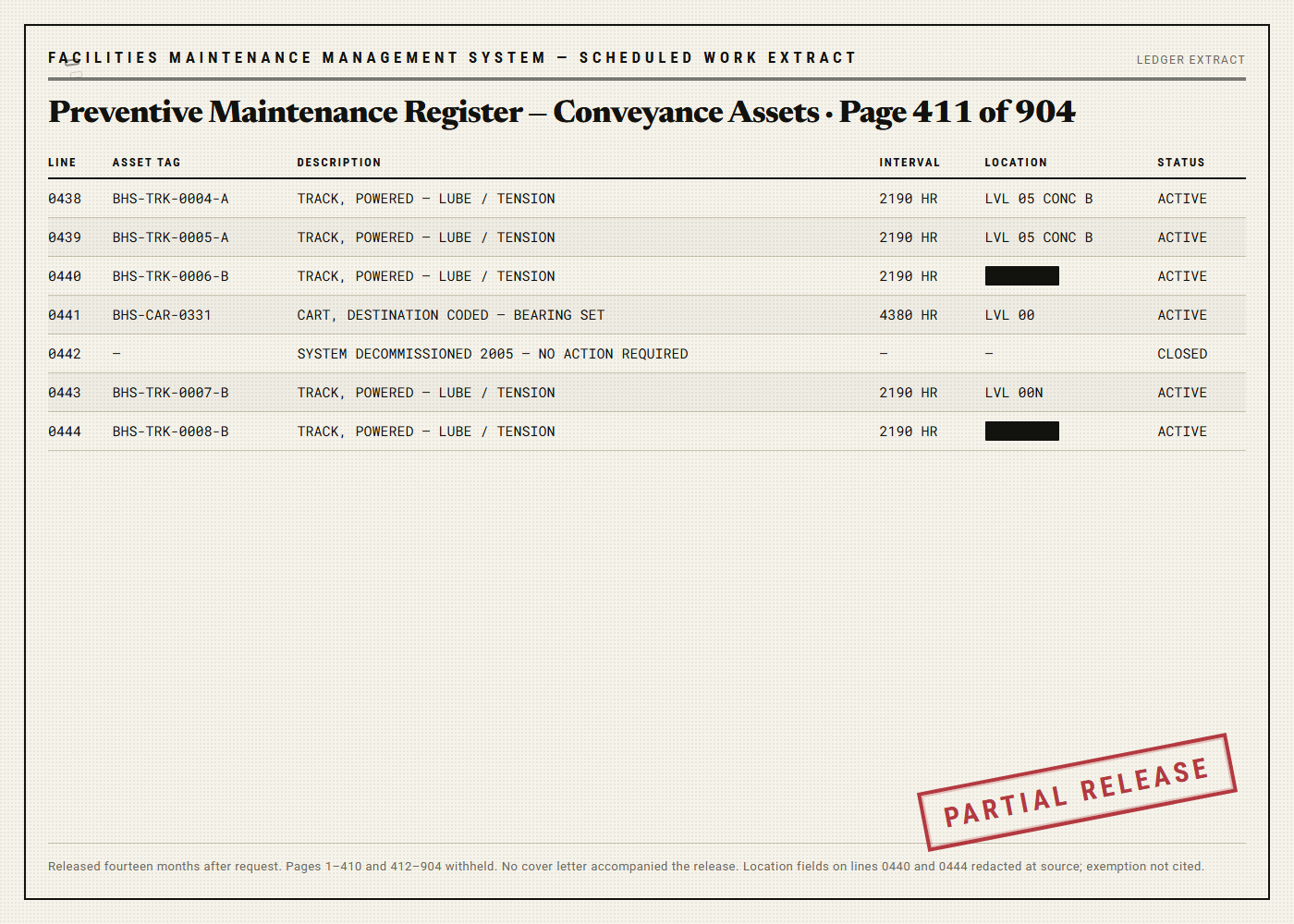
It is a quarterly preventive-maintenance register: the sort of printout that exists in every hospital, every stadium and every county courthouse in America, generated automatically by facilities software and read, in the ordinary course of things, by nobody. Six of the entries on the page we obtained concern powered conveyance track. Five are unremarkable. The sixth instructs a technician to lubricate and tension a section of powered baggage track beneath Concourse B at Denver International Airport, at an interval of 2,190 hours, and marks the asset's status as ACTIVE.
The automated baggage system beneath Denver International Airport was formally abandoned in 2005.
Reality Daily has spent nineteen months on this line item. We have conducted eleven interviews, seven of them on the record. We have filed seven records requests with four separate bodies. We have received, in total, one page. We also retained a retired conveyance systems engineer, at our own expense, to read that page and tell us whether we were wasting everyone's time. His answer occupies Section IV of this story and was not the answer we expected.
Before we go further we want to dispose of something, because if we do not dispose of it now it is the only thing anyone will take from this piece. We are aware of the murals. We are aware of the horse. We have read the same forums you have read. This newspaper is not writing about the murals, has never written about the murals, and will not be writing about the murals. We are writing about a line item on a maintenance schedule, and we ask the reader to hold that distinction as tightly as we have had to hold it.
"You don't schedule lubrication on a system you've stopped. You schedule lubrication on a system you intend to move." — Lyle Ostrander, retired conveyance systems engineer, Cheyenne, Wyoming
I. What the Schedule Shows
The page is numbered 411. Its header identifies it as page 411 of 904. It arrived fourteen months after our first request, on a Tuesday, with no cover letter, and with a stamp reading PARTIAL RELEASE applied at an angle across the lower third of the sheet.
Pages 1 through 410 were not released. Pages 412 through 904 were not released. We did not ask for page 411. We asked for the register. We were given the middle of it.
Line 0440 reads, in the software's own truncated capitals:
0440 BHS-TRK-0006-B TRACK, POWERED — LUBE / TENSION 2190 HR ACTIVE
Two lines below it, line 0442 carries no asset tag, no interval and no location. Its description field contains a sentence that a human being typed, at some point, into a field designed to hold equipment nomenclature:
SYSTEM DECOMMISSIONED 2005 — NO ACTION REQUIRED
Line 0443, immediately beneath that sentence, is another section of powered track. Its interval is 2,190 hours. Its status is ACTIVE.
We want to be exact here, because this will be mischaracterized inside a day of publication. We are not reporting that a baggage system is running. Nobody has told us a baggage system is running, we have no evidence that a baggage system is running, and we would be astonished if a baggage system were running. We are reporting that a document instructs somebody to grease it, on a schedule, four times a year, twenty-one years after it stopped.
II. What Was Abandoned, and What Was Left
The facts of the system are not in dispute and have never been secret. This is worth stating plainly, because the contested part of this story is very small and the uncontested part is enormous.
Denver International Airport was to open on 29 October 1993. It opened on 28 February 1995. The delay — roughly sixteen months — was caused principally by an automated baggage handling system that was, when commissioned, the most ambitious ever attempted: some twenty-six miles of track, roughly three thousand one hundred destination-coded carts, and a control architecture intended to carry a suitcase from curbside to aircraft without a human hand touching it.
It cost approximately $560 million. It never worked as designed. It was cut back to serve outbound flights for a single airline out of a single concourse, and in that reduced form it ran, badly and expensively, for a decade. In 2005 it was abandoned outright. Reporting at the time placed the ongoing cost of keeping it alive at roughly one million dollars a month, which is the figure the airline was described as saving by returning to conventional belts and human beings.
Those numbers are widely known and we have not improved on them. What is less discussed is what happened to the hardware.
Some of it was pulled. Some was sold as scrap. The tunnels were not filled, because filling a tunnel beneath an operating airport costs more than leaving it, and much of the track was never lifted, because lifting track out of a tunnel beneath an operating airport also costs more than leaving it. None of this is secret and none of it is sinister. It is arithmetic, and it is the same arithmetic that has left disused steam mains under half the courthouses in the Republic.
So there is track down there. There has always been track down there. The airport has said so. Every account of the system says so. We have said so, twice, in this section, on purpose. Our question is narrower and duller than the reader may be hoping: which six miles, maintained by whom, under what work order, charged to what line, and why does the field say ACTIVE.
III. A Note on the Murals, Which Are Not the Story
We said we would not write about the murals and we intend to keep that, but one adjacent fact cannot be avoided, because it bears directly on the reporting problem.
The airport is the subject of a large and energetic body of folklore concerning its artwork, its dedication capstone, and a thirty-two-foot fiberglass horse with illuminated eyes that stands beside the entrance road. The airport has for years made jokes about all of it. In 2018 it wrapped a construction project in signage teasing its own mythology. It has produced videos on the subject. By any measure it has been a good sport, and we would not want a word of this story read as a complaint about an institution having a sense of humor.
We will note once, and without editorializing, that the sculptor of the horse, the artist Luis Jiménez, was killed in his studio in 2006 when a section of the work fell on him. That is documented, it is a genuine tragedy, it is not folklore, and the amusement that has attached itself to it over the years is a failure of taste in which this newspaper declines to participate.
The reporting problem is this. When an institution adopts the conspiracy theories about itself as a marketing posture, it becomes structurally impossible to ask that institution a boring question. Every inquiry arrives pre-sorted. We wrote twelve times about a preventive-maintenance interval on a decommissioned asset. Two replies came back that we would characterize as playful. We are not owed seriousness and we did not ask for it. We would observe only that a joke is not a record, that a record is what we requested, and that a $560 million public asset is on a quarterly schedule nobody will explain.
Standards Desk Finding, 12 March
"Of twelve written requests for comment concerning line item PM-CVY-0440, two received replies of substantive length. Neither reply addressed the line item. Both replies referenced, unprompted, subterranean facilities of a kind not mentioned anywhere in our correspondence."
"The Desk notes for the record that the requester did not raise the subject of tunnels. The subject of tunnels was raised to the requester."
IV. Line Item PM-CVY-0440
Lyle Ostrander spent thirty-four years in materials handling. He commissioned automated conveyance systems for two airports, a regional mail sorting facility and two automotive plants, and he decommissioned four. He is retired, he lives outside Cheyenne, and he returned our call within the hour, which nobody else in this story did.
He would not say a word until we emailed him the page. He called back in twenty-six minutes.
Before anything else, and as a written condition of his participation, Mr. Ostrander required us to print his caveat in full and ahead of any conclusion of ours. It is the strongest argument against our own story and we have honored the condition without negotiation.
Ostrander, transcript, 3 February, 9:12 a.m. MST
"Half the plants I ever walked into had dead assets sitting in the system. Somebody retires a line, nobody closes the preventive, and it just sits in there generating paper for twenty years. It is the single most common thing in my field. It is so common it is boring. Print that before you print anything else, because if you don't, you're going to make people stupid."
"Now. Having said that. A dead preventive generates work orders that nobody closes. You're telling me these are closing. Closed by who?"
We read him the closure codes. He asked us to read them a second time, and then a third, and the transcript logs eleven seconds in which neither party said anything.
"That's not a leftover," he said. "A leftover doesn't get signed."
Mr. Ostrander was insistent, repeatedly and at his own initiative, that he has no knowledge of this facility, has never worked in it, has never been inside it, and is reading six inches of a document he did not obtain. We are including that in his framing because it is true and because he asked. He then said the thing that has occupied this desk since February: that in thirty-four years he had never once seen a lubrication interval survive a decommissioning, because lubrication is the one task nobody bothers to fake.
V. Level Zero
The terminal's published level designations run from Level 1, the train platform, up to Level 6, the ticketing hall. This is not obscure information. It is printed on the signage. It is in the wayfinding maps handed to passengers. It is on the walls.
Forty-one of the work orders we have reconstructed — from the single released page, from two vendor invoices obtained through a state procurement portal, and from a contractor's own retained copies — carry a location field reading LVL 00.
Level zero.
We want to be careful, because this is precisely the point at which a story like this one usually goes wrong. "Level 00" is an entirely plausible internal convention for anything below the lowest occupied floor: a tunnel, a utility chase, a pump room, a crawl space, a sump. Facilities software is full of conventions that mean nothing to anybody except the person who established them in 1994 and has since retired to Bullhead City. Eleven of the forty-one orders further specify LVL 00N, which may mean north, or nominal, or nothing at all.
What we cannot get past is the drawing reference. Thirty-one of the forty-one orders direct the technician to a drawing:
LOC: LVL 00N / SPUR 6-B / ACCESS VIA HATCH 3 — SEE DWG 00-11
The released drawing index — two pages, the only other document anyone has given us, and given by a regional history archive with no connection to the airport — lists drawings 00-08, 00-09, 00-10, 00-12 and 00-13.
There is no 00-11. There is no note recording that 00-11 was superseded. There is no note recording that it was withdrawn, reissued, voided or renumbered. The index simply steps over it, in numerical order, the way a person steps over a hole.
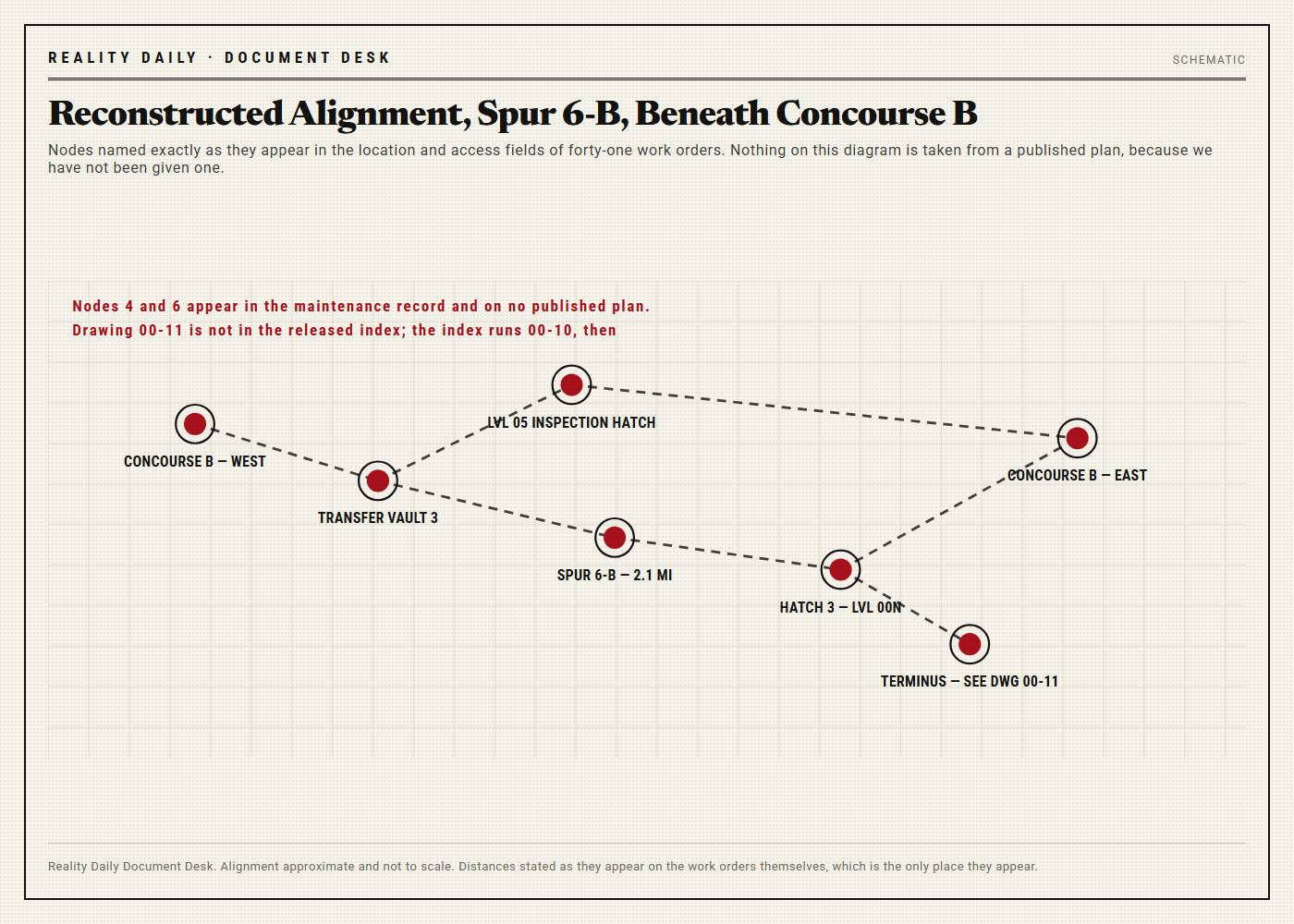
We are not going to tell you what is on drawing 00-11, because we do not know what is on drawing 00-11, and because every unfortunate thing ever written about this airport was written by somebody willing to guess.
But thirty-one work orders instruct a human being to consult it. Which means that at some point somebody expected a human being to be able to find it.
VI. One Page
Marva Enloe-Tackett has worked public-records desks for nineteen years across three governmental bodies in the Denver metropolitan area. She is the only person in this story who gave us anything, and what she gave us was one page.
She confirmed on the record that the page is authentic; that it came out of a scheduled software export rather than a manual query, which is why the header retains the pagination; and that she was handed the page rather than the file. She would not say by whom, and she told us plainly and immediately that she would not say by whom, which we respect, and which is more candor than anyone else in nineteen months has extended to us.
She asked twice whether we understood that a partial release is a lawful release. We said we did. We are saying so again here, in her words, because she was careful and because she was right.
"I have released ten thousand pages in my career. I have never in my life released one." — Marva Enloe-Tackett, public records officer, Denver metropolitan area
Ms. Enloe-Tackett declined to characterize the withholding of pages 412 through 904 and asked that we not describe her as uncomfortable. We have honored that. We would note only that she raised her own discomfort before we could ask about it, and then asked us not to print it, and that we are printing the fact of the request rather than the substance, which is the narrowest thing we could do and still be honest.
VII. The Scheduler
Danette Ruel builds and audits preventive-maintenance schedules for a living. She is a contractor, works out of Greeley, and her clients are school districts, water districts and one ski resort. She has never worked for an airport and has never been inside the facility discussed in this story. She asked us to print both of those sentences before anything else she said, and here they are.
Ms. Ruel walked us through the arithmetic of a 2,190-hour interval. It is ninety-one and a quarter days. It is a quarter of a year. Since 2005 that is eighty-four cycles: eighty-four occasions on which the software has generated a work order instructing somebody to lubricate and tension a section of track beneath Concourse B.
Of those eighty-four, according to the closure codes visible on the released page and in the contractor's retained file, sixty-one closed as COMPLETED. Nineteen closed as COMPLETED — NO ACCESS. Four remain open.
Ruel, Preliminary Schedule Audit, 8 April, p. 4
"A decommissioned asset should be flagged RETIRED, which suppresses generation entirely. This asset is flagged ACTIVE, which is a deliberate state rather than a residual one. Someone had to leave it that way, and someone had to keep leaving it that way through at least two software migrations, because a migration is where these things ordinarily die."
"I would want to see the migration mapping. In my experience the migration mapping is where the answer is, and in my experience nobody keeps it."
We asked Ms. Ruel the obvious question, which is whether sixty-one completions could themselves be automated — a technician's credential entered once into a template and repeated by the system without anyone leaving a desk. She said that this happens, that it is a known and disliked practice, and that she has caught it three times in her career.
"Schedules don't have ghosts. Somebody types the closure. Sixty-one times, somebody typed the closure. I'm not telling you what they saw when they got down there. I'm telling you the field doesn't fill itself." — Danette Ruel, facilities scheduling contractor, Greeley, Colorado
Nineteen of the eighty-four closed as NO ACCESS. We asked her what that code ordinarily means. She said it means a technician went, and could not get in, and said so.
VIII. What We Are Not Saying
Reality Daily wishes to be exact, because this story will be summarized by people who have not read it, and because the summary is already written in their heads.
We are not saying the baggage system is operating. We have no evidence of that whatsoever and we would regard the suggestion as ridiculous.
We are not saying there is a level of the airport the public has not been told about. We are saying that forty-one work orders use a location designation which does not appear on any published plan, that we asked seven times what that designation means, and that we were not told.
We are not saying drawing 00-11 was removed. We are saying the index runs 00-10, then 00-12.
We are not saying anyone has done anything wrong. Clerical residue is the likeliest explanation for the whole of it, and the retired engineer we paid to check our work said so on the record, at length, before we could ask him — which is why his caveat appears in Section IV, ahead of everything, exactly as he required.
We are not writing about the murals. We would like this sentence quoted whenever the previous five are.
IX. Conclusion
Six miles of track. Five hundred and sixty million dollars. Sixteen months of delay. A system abandoned in 2005 and confirmed abandoned, publicly, repeatedly, by everybody, including this newspaper, in Section II of this story.
And a standing quarterly instruction to grease it.
The likeliest explanation remains the dull one. We have said so four times and we will say it a fifth: a row in a database was never updated, and a schedule kept printing, and nobody ever looked. The difficulty is that the dull explanation is itself a document. It has a name. It is called a migration mapping, and it would fit on two pages, and in nineteen months nobody has produced one.
Not a denial. Not a correction. Not a one-line email reading the flag is a legacy artifact of the 2011 migration, here is the mapping, please stop writing to us. That email would have ended this story in an afternoon, and we would have printed it at the top with an apology for the trouble and our thanks.
Instead: twelve requests, two playful replies, one undeliverable address, one page out of nine hundred and four, sixty-one signed closures on a dead asset, and a drawing index that counts to ten and then to twelve.
■ ■ ■
Reality Daily invites the airport, its facilities management, its maintenance contractors, and any individual who has ever closed work order PM-CVY-0440 to respond. We will print any response in full, unedited, at any length, with no commentary from us whatsoever, at the head of this story rather than the foot.
We would settle for a great deal less. We would settle for the drawing index with 00-11 in it. We would settle for one sentence explaining what LVL 00N means. We would settle for somebody telling us that the line item was closed out on a Thursday in April, that we have spent nineteen months on a typing error, and that we should be embarrassed — and we would print that, with our thanks, in the same typeface and at the same size as everything above it.
We have kept the space open since February. It is a large space. We have six miles of it.
Corrections & Clarifications
Update, 05:52 — An earlier version of this article gave the preventive-maintenance interval as 2,190 hours. Following review of the source page, the interval is 2,190 hours. The original wording stands.
Update, 10:31 — We initially reported thirty-eight work orders bearing the designation LVL 00. Three further orders were located in the contractor's retained file after publication, bringing the total to forty-one. We regret the undercount and note that the correction moves the figure in the wrong direction for everybody.
Update, 16:07 — A reader has written to observe that decommissioned equipment is frequently left in maintenance software by mistake. Reality Daily agrees, reported exactly this in Section IV in the words of an expert we paid to disagree with us, and thanks the reader for confirming that Section IV is being read.
Sources & Documentation
- Ostrander, L. Recorded telephone interview, 3 February, 9:12 a.m. MST, and two follow-up calls. Transcript 63 pp., reviewed and approved by subject.
- Ostrander, L. Technical Reading of Line Item PM-CVY-0440 and Adjacent Register Entries. Commissioned by Reality Daily. 14 pp. Full report on file.
- Ostrander, L. Written condition of participation, 1 p., requiring that his caveat concerning clerical residue be printed in full and ahead of any conclusion. Honored without negotiation.
- Ruel, D. Preliminary Schedule Audit: Interval Generation and Closure Coding, Asset BHS-TRK-0006-B. Prepared for Reality Daily. 22 pp. plus appendices A–D.
- Ruel, D. Written statement declining to characterize the facility, 1 p. Printed as received in Section VII.
- Enloe-Tackett, M. Recorded interview, 19 May, and subsequent written correspondence, 4 items.
- Scheduled Work Extract, Preventive Maintenance Register — Conveyance Assets, p. 411 of 904. Released under partial-release stamp fourteen months after request. Pages 1–410 and 412–904 withheld; exemption not cited.
- Drawing index, subgrade series, 2 pp. Obtained from a regional transportation history archive holding an unrelated donated collection. Entry 00-11 absent; no supersession note.
- Correspondence, regional transportation history archive, accession 2021.0043, 6 pp., including the archivist's note that she had not previously opened the folder.
- Contractor's retained work-order copies, 41 items, provided on the written condition that the contracting entity not be named. Condition honored.
- Vendor invoices (2), lubricant and tensioning consumables, obtained via state procurement portal. Both reference asset BHS-TRK-0006-B by tag.
- Reality Daily Standards Desk. Record of Comment Requests, 4 October – 2 August. 12 entries; 2 substantive-length replies; 0 addressing the line item; 1 returned undeliverable.
- Reality Daily Legal. Memorandum: Whether an Undeliverable Twelfth Request Satisfies the Twelfth-Request Rule. 4 pp. Conclusion: yes, reluctantly.
- Reality Daily Data Desk. Cycle Reconstruction, 2,190-Hour Interval, 2005 to Present. 84 cycles; 61 closed COMPLETED; 19 closed COMPLETED — NO ACCESS; 4 open.
- Reality Daily internal memorandum, On Not Writing About the Murals, 1 p. Circulated to all staff 6 January and posted in the newsroom above the scanner.
- Public reporting on the automated baggage system, 1993–2005. 61 articles compiled and page-numbered. Reality Daily Document Desk clipping file DEN-BHS-01.
- Institute for Conveyance and Materials Handling Practice. Standard Practice for Retirement and Suppression of Preventive Maintenance Records (rev. 2), §§ 3.1–3.9.
- Bureau of Subgrade Facilities Nomenclature. Guidance Note 4: Level Designations Below Grade Are Not Standardized and Should Not Be Inferred. 5 pp.
- Photograph, PARTIAL RELEASE stamp, page 411 recto, 4,096 × 3,072 px, EXIF intact. Reality Daily Document Desk.
- Photograph, page 411 verso. Blank. Photographed in accordance with Document Desk policy, which does not distinguish between pages.
- Anonymous former scheduling administrator ("Source D"). One interview, conducted in person; identity known to the Managing Editor, Standards, only.
- Weld County, Colorado, municipal business registry, entry for D. Ruel, scheduling consultancy, established 2009.
- Reality Daily Reader Correspondence File RD-C-5518, 2,090 letters received since this line item was first mentioned in our morning newsletter.
- Automated acknowledgment received 4 October, 3:41 a.m.; automated acknowledgment received 11 December, 3:41 a.m. Timestamps identical; both unsigned; both from the same system that acknowledged our previous investigation.
- The track. It is still down there. Six miles of it. It has been down there the entire time.
Reader Response — 5,627 comments
Twenty-one years of quarterly work orders and not one reporter in Denver thought to ask who was signing them. It took a paper in Virginia. The drawing index is the part I keep going back to.
I administer a CMMS for a hospital system. RETIRED vs ACTIVE is not a nothing distinction — RETIRED suppresses generation, that's the whole point of the flag. ACTIVE surviving two migrations is somebody's choice, twice. That part of this is exactly right.
But what about the murals
Nineteen months, seven records requests, one page, two paid experts, and the finding is that a database row was never updated. I work in IT. I have four thousand of these before lunch.
@H. Okonkwo — Correct, and we said so in Section IV in the words of a man we paid specifically to disagree with us. The distinction we would draw is that your four thousand rows are not attached to sixty-one signed closures against a $560 million public asset. We would like very much to be wrong about this and have asked twelve times to be told so. Your comment has been added to the correspondence file.
My late husband drove a tug out there from 1996. He always said the tunnels ran further than the map did. I never once believed him and I told him so for thirty years. I would like that on the record.
"The index simply steps over it, in numerical order, the way a person steps over a hole." Somebody at this newspaper is being wasted on maintenance schedules.
Filed my own request this morning for pages 412 through 904 and for the migration mapping. Will report back. Somebody should also ask for the nineteen NO ACCESS orders by date.